



Community hub
Recent from talks
Contribute something
Nothing was collected or created yet.
Inversion temperature
View on WikipediaThe inversion temperature in thermodynamics and cryogenics is the critical temperature below which a non-ideal gas (all gases in reality) that is expanding at constant enthalpy will experience a temperature decrease, and above which will experience a temperature increase. This temperature change is known as the Joule–Thomson effect, and is exploited in the liquefaction of gases. Inversion temperature depends on the nature of the gas.
For a van der Waals gas we can calculate the enthalpy using statistical mechanics as


where is the number of molecules, is volume, is temperature (in the Kelvin scale), is the Boltzmann constant, and and are constants depending on intermolecular forces and molecular volume, respectively.


From this equation, if enthalpy is kept constant and there is an increase of volume, temperature must change depending on the sign of . Therefore, our inversion temperature is given where the sign flips at zero, or

- ,
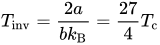
where is the critical temperature of the substance. So for , an expansion at constant enthalpy increases temperature as the work done by the repulsive interactions of the gas is dominant, and so the change in kinetic energy is positive. But for , expansion causes temperature to decrease because the work of attractive intermolecular forces dominates, giving a negative change in average molecular speed, and therefore kinetic energy.[1]


See also
[edit]References
[edit]- ^ Charles Kittel and Herbert Kroemer (1980). Thermal Physics (2nd ed.). W.H. Freeman. ISBN 0-7167-1088-9.
External links
[edit]- Thermodynamic Concepts and Processes (Chapter 2) (part of the Statistical and Thermal Physics (STP) Curriculum Development Project at Clark University)
Inversion temperature
View on GrokipediaFundamentals of the Joule-Thomson Effect
Overview of the Process
The Joule-Thomson expansion, commonly referred to as the throttling process, occurs when a gas is forced through a porous plug or narrow valve from a high-pressure side at pressure to a low-pressure side at , resulting in a pressure drop while the gas flow is maintained steady.[5] This setup ensures that the process is insulated to prevent heat exchange with the surroundings, allowing observation of the intrinsic temperature change due to the expansion.[5] A key characteristic of this process is its isenthalpic nature, where the enthalpy of the gas remains constant () across the plug, as the work done by the upstream gas balances the work received by the downstream gas.[5] This distinguishes it from adiabatic free expansion, in which no external work is performed and the internal energy remains constant for ideal gases, but real gases may show slight deviations.[5] The experiment was pioneered by James Prescott Joule and William Thomson (later Lord Kelvin) through a series of investigations conducted between 1852 and 1862, initially revealing minimal temperature changes for ideal gases but significant deviations for real gases due to intermolecular interactions.[6] Qualitatively, the throttling of most real gases at room temperature leads to cooling, as attractive forces between molecules cause the gas to do work on itself during expansion, reducing kinetic energy and thus temperature.[5] In contrast, certain gases like hydrogen exhibit heating under the same conditions at room temperature, where repulsive forces dominate.[5] The inversion temperature marks the threshold where this temperature change reverses from cooling to heating, a phenomenon arising directly from the isenthalpic nature of the process.[5]Thermodynamic Basis
The Joule-Thomson process is fundamentally an isenthalpic expansion, where the enthalpy remains constant throughout, with denoting internal energy, pressure, and volume.[1] In a steady-state flow through a throttling device, such as a porous plug or valve, no heat is exchanged with the surroundings (), and the work done balances such that the net change in enthalpy is zero, ensuring between the high-pressure inlet and low-pressure outlet.[2] This conservation arises from the first law of thermodynamics applied to the open system, where the enthalpy serves as the key state function governing the energy balance during the irreversible expansion.[7] The temperature change in this process stems from the interplay of intermolecular forces in real gases. Attractive forces between molecules, such as van der Waals interactions, dominate at moderate pressures and lead to cooling upon expansion: as molecules move farther apart under reduced pressure, the potential energy associated with these attractions increases, drawing from the kinetic energy and thereby lowering the temperature.[1] Conversely, at higher pressures where repulsive forces prevail due to finite molecular volumes, the expansion results in heating, as the molecules' kinetic energy increases to overcome these repulsions.[2] The Joule-Thomson coefficient quantifies this temperature-pressure sensitivity at constant enthalpy.[7] For an ideal gas, where intermolecular forces are negligible and molecules occupy zero volume, the internal energy depends solely on temperature, leading to no temperature change during the isenthalpic expansion, as .[1] Real gases deviate from this ideality due to non-zero molecular volumes and intermolecular attractions, introducing a temperature-dependent response that is captured by more advanced equations of state, such as the van der Waals equation.[2] These deviations explain the observed cooling or heating, with the balance between attractive and repulsive contributions determining the sign and magnitude of the effect.[7]Definition and Properties
Core Definition
The inversion temperature is defined as the temperature at which the Joule-Thomson coefficient, , equals zero, representing the point where the isenthalpic expansion of a real gas neither cools nor heats the gas.[8] Below this temperature, , resulting in cooling upon expansion due to intermolecular attractions dominating over repulsive forces; above it, , leading to heating as repulsive forces prevail.[2] This sign change in marks the boundary condition for the Joule-Thomson effect, an isenthalpic throttling process commonly used in gas liquefaction.[8] In the pressure-temperature (P-T) plane, the set of all points where forms the inversion curve, a locus that delineates regions of cooling and heating behavior for a given gas. This curve typically exhibits a parabolic shape, enclosing a region with a maximum pressure beyond which no inversion occurs, and it intersects the temperature axis at upper and lower inversion temperatures for pressures within the curve's span.[9] For most practical applications, the upper inversion temperature is the primary focus, as it determines the maximum starting temperature for achieving cooling via Joule-Thomson expansion; above this upper limit, the gas heats upon throttling, while below the lower inversion temperature (relevant for some gases at low pressures), the behavior may reverse to heating again.[8] The inversion temperature differs from the critical temperature, which marks the boundary for gas-liquid phase coexistence; while related through the gas's intermolecular potential, the upper inversion temperature is generally higher than the critical temperature for common gases, such as nitrogen (upper K versus K) or air (upper K versus effective K).[10] This distinction ensures that inversion effects can be exploited above the critical point without phase changes.[10]Physical Interpretation
The inversion temperature in the context of the Joule-Thomson effect represents the temperature at which the competing influences of attractive and repulsive intermolecular forces balance exactly, resulting in no net temperature change during isenthalpic expansion of a real gas.[11] In real gases, unlike ideal gases where intermolecular forces are negligible, molecules interact via long-range attractive forces (such as van der Waals attractions) and short-range repulsive forces (due to the finite volume of molecules). During the expansion process, the average intermolecular distance increases, altering the potential energy associated with these interactions.[12] Below the inversion temperature, attractive forces predominate because the molecules' kinetic energy is insufficient to fully overcome these cohesive interactions. As the gas expands, molecules are pulled apart against these attractions, requiring energy that is drawn from the gas's internal kinetic energy; this conversion decreases the average molecular speed, leading to cooling.[11] Conversely, above the inversion temperature, the higher kinetic energy makes repulsive forces dominant, as molecules frequently collide and experience the excluded volume effects more prominently. Expansion in this regime allows molecules to occupy previously inaccessible space, increasing the overall potential energy and thereby converting it into additional kinetic energy, which causes heating.[12] This temperature dependence arises because thermal energy modulates the relative strength of the forces: at elevated temperatures, the rapid molecular motion diminishes the impact of attractions relative to repulsions. From an enthalpy perspective, the Joule-Thomson process maintains constant enthalpy (H = U + PV), so any change in the intermolecular potential energy (reflected in the internal energy U's dependence on volume) directly influences the temperature to preserve this constancy. The inversion point thus signifies zero net contribution from these potential energy changes, a phenomenon unique to real gases where intermolecular forces are significant.[11][12]Mathematical Formulation
Joule-Thomson Coefficient
The Joule-Thomson coefficient, denoted as , is defined as the partial derivative of temperature with respect to pressure at constant enthalpy, . This quantity characterizes the temperature change experienced by a gas during an isenthalpic expansion process, such as throttling through a porous plug or valve.[13] To derive the explicit form of , begin with the differential of the enthalpy : where is temperature, is entropy, and is volume. For an isenthalpic process, , so Express in terms of temperature and pressure changes: The first partial derivative is , where is the heat capacity at constant pressure. The second follows from Maxwell's relations: . Substituting these yields Rearranging for the temperature-pressure derivative gives and thus This expression highlights the dependence of on the equation of state through the volume-temperature derivative.[13] The sign of determines the direction of temperature change during expansion: a positive indicates cooling (as for most gases near room temperature), a negative indicates heating (as for hydrogen and helium at ambient conditions), and occurs at the inversion temperature where no temperature change is observed.[13]Derivation of Inversion Temperature
The inversion temperature is the temperature at which the Joule-Thomson coefficient equals zero, marking the point where a gas neither cools nor heats upon isenthalpic expansion. The Joule-Thomson coefficient is given by , where is the heat capacity at constant pressure, is the temperature, is the volume, and the partial derivative is taken at constant pressure . Setting yields the condition which defines the inversion temperature for a given pressure.[8] This condition has a direct physical interpretation in terms of the thermal expansion coefficient . Substituting into the inversion equation gives , the same value as for an ideal gas. At , the volume's response to temperature changes at constant pressure mimics ideal gas behavior thermally, even though real gas deviations affect the overall equation of state.[9][7] For a general equation of state relating , , and , the inversion temperature is found by solving analytically if the equation permits, or numerically otherwise. The inversion curve, which traces the locus of inversion points in the - plane, is obtained by applying this condition across a range of pressures, separating regions where (cooling) from those where (heating). As an example, the van der Waals equation of state allows an explicit low-pressure approximation , where and are the van der Waals constants and is the gas constant.[3]Behavior in Real Gases
Van der Waals Model
The van der Waals equation of state provides a theoretical framework for modeling real gas behavior in the context of the Joule-Thomson effect by accounting for intermolecular attractions and finite molecular volume. For one mole of gas, it is expressed as where is the molar volume, represents the strength of attractive forces, is the excluded volume per mole, is the gas constant, and is the temperature.[3][14] To find the inversion temperature , the condition is applied to the Joule-Thomson coefficient derived from the van der Waals equation. This yields the explicit expression where the term accounts for the volume correction. At low densities (large ), this approximates to , providing a simple estimate of the maximum inversion temperature.[3][15] The inversion curve, which delineates regions of cooling and heating, emerges from substituting back into the van der Waals equation to relate pressure and volume along the locus where : In reduced variables, this curve exhibits a maximum pressure on the upper branch, separating the cooling region (positive ) from the heating region (negative ).[3] While the model predicts two branches—an upper inversion temperature for cooling-to-heating transition and a lower one for the reverse—real gases typically exhibit only the upper branch under practical conditions due to limitations in the equation's assumptions at high densities or near critical points.[14][3]Experimental Values for Common Gases
Experimental inversion temperatures, which mark the temperature below which a gas cools upon Joule-Thomson expansion at low pressures, have been measured for various common gases through 19th- and 20th-century experiments, including those by Heike Kamerlingh Onnes on hydrogen and helium.[16] These values provide critical empirical data for understanding real gas behavior, often deviating from classical predictions due to molecular interactions and quantum effects. Representative measured maximum inversion temperatures (at near-atmospheric pressure) for selected gases are summarized in the following table:| Gas | Maximum Inversion Temperature (K) |
|---|---|
| Helium (⁴He) | 45 |
| Hydrogen | 205 |
| Nitrogen | 621 |
| Oxygen | 761 |
| Carbon Dioxide | 1500 |