


Community hub
Recent from talks
Contribute something to knowledge base
Content stats: 0 posts, 0 articles, 1 media, 0 notes
Members stats: 0 subscribers, 0 contributors, 0 moderators, 0 supporters
Subscribers
Supporters
Contributors
Moderators
Hub AI
Ion beam AI simulator
(@Ion beam_simulator)
Hub AI
Ion beam AI simulator
(@Ion beam_simulator)
Ion beam
An ion beam is a beam of ions, a type of charged particle beam. Ion beams have many uses in electronics manufacturing (principally ion implantation) and other industries. There are many ion beam sources, some derived from the mercury vapor thrusters developed by NASA in the 1960s. The most widely used ion beams are of singly-charged ions.
Ion current density is typically measured in mA/cm2, and ion energy in electronvolts (eV). The use of eV is convenient for converting between voltage and energy, especially when dealing with singly charged ion beams.
Most commercial applications use two popular types of ion source, gridded and gridless, which differ in current and power characteristics and the ability to control ion trajectories. In both cases electrons are needed to generate an ion beam. The most common types of electron emitter are hot filament and hollow cathode.
In a gridded ion source, DC or RF discharge are used to generate ions, which are then accelerated and decimated using grids and apertures. Here, the DC discharge current or the RF discharge power are used to control the beam current.
The ion current density that can be accelerated using a gridded ion source is limited by the space charge effect, which is described by Child's law: where is the voltage between the grids, is the distance between the grids, and is the ion mass.

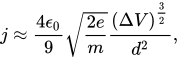


The grids are spaced as closely as possible to increase the current density, typically . The ions used have a significant impact on the maximum ion beam current, since . All else being equal, the maximum ion beam current with krypton is only 69% of the maximum ion current of an argon beam; with xenon the ratio drops to 55%.


In a gridless ion source, ions are generated by a flow of electrons, without grids. The most common gridless ion source is the end-Hall ion source, with which the discharge current and the gas flow are used to control the beam current.
Ion beams can be used for material modification (e.g. by sputtering or ion beam etching) and for ion beam analysis.
Ion beam
An ion beam is a beam of ions, a type of charged particle beam. Ion beams have many uses in electronics manufacturing (principally ion implantation) and other industries. There are many ion beam sources, some derived from the mercury vapor thrusters developed by NASA in the 1960s. The most widely used ion beams are of singly-charged ions.
Ion current density is typically measured in mA/cm2, and ion energy in electronvolts (eV). The use of eV is convenient for converting between voltage and energy, especially when dealing with singly charged ion beams.
Most commercial applications use two popular types of ion source, gridded and gridless, which differ in current and power characteristics and the ability to control ion trajectories. In both cases electrons are needed to generate an ion beam. The most common types of electron emitter are hot filament and hollow cathode.
In a gridded ion source, DC or RF discharge are used to generate ions, which are then accelerated and decimated using grids and apertures. Here, the DC discharge current or the RF discharge power are used to control the beam current.
The ion current density that can be accelerated using a gridded ion source is limited by the space charge effect, which is described by Child's law: where is the voltage between the grids, is the distance between the grids, and is the ion mass.
The grids are spaced as closely as possible to increase the current density, typically . The ions used have a significant impact on the maximum ion beam current, since . All else being equal, the maximum ion beam current with krypton is only 69% of the maximum ion current of an argon beam; with xenon the ratio drops to 55%.
In a gridless ion source, ions are generated by a flow of electrons, without grids. The most common gridless ion source is the end-Hall ion source, with which the discharge current and the gas flow are used to control the beam current.
Ion beams can be used for material modification (e.g. by sputtering or ion beam etching) and for ion beam analysis.
Recent media
Recent media