


Community hub
Recent from talks
Knowledge base stats:
Talk channels stats:
Members stats:
Space charge
Space charge is an interpretation of a collection of electric charges in which excess electric charge is treated as a continuum of charge distributed over a region of space (either a volume or an area) rather than distinct point-like charges. This model typically applies when charge carriers have been emitted from some region of a solid—the cloud of emitted carriers can form a space charge region if they are sufficiently spread out, or the charged atoms or molecules left behind in the solid can form a space charge region.
Space charge effects are most pronounced in dielectric media (including vacuum); in highly conductive media, the charge tends to be rapidly neutralized or screened. The sign of the space charge can be either negative or positive. This situation is perhaps most familiar in the area near a metal object when it is heated to incandescence in a vacuum. This effect was first observed by Thomas Edison in light bulb filaments, where it is sometimes called the Edison effect. Space charge is a significant phenomenon in many vacuum and solid-state electronic devices.
When a metal object is placed in a vacuum and is heated to incandescence, the energy is sufficient to cause electrons to "boil" away from the surface atoms and surround the metal object in a cloud of free electrons. This is called thermionic emission. The resulting cloud is negatively charged, and can be attracted to any nearby positively charged object, thus producing an electric current which passes through the vacuum.
Space charge can result from a range of phenomena, but the most important are:
It has been suggested that in alternating current (AC) most carriers injected at electrodes during a half cycle are ejected during the next half cycle, so the net balance of charge on a cycle is practically zero. However, a small fraction of the carriers can be trapped at levels[clarification needed] deep enough to retain them when the field is inverted. The amount of charge in AC should increase slower than in direct current (DC) and become observable after longer periods of time.
Hetero charge means that the polarity of the space charge is opposite to that of neighboring electrode, and homo charge is the reverse situation. Under high voltage application, a hetero charge near the electrode is expected to reduce the breakdown voltage, whereas a homo charge will increase it. After polarity reversal under ac conditions, the homo charge is converted to hetero space charge.
If the near "vacuum" has a pressure of 10−6 mmHg or less, the main vehicle of conduction is electrons. The emission current density (J) from the cathode, as a function of its thermodynamic temperature T, in the absence of space-charge, is given by Richardson's law: where
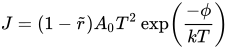
The reflection coefficient can be as low as 0.105 but is usually near 0.5. For tungsten, (1 − )A0 = (0.6 to 1.0)×106 A⋅m−2⋅K−2, and ϕ = 4.52 eV. At 2500 °C, the emission is 28207 A/m2.

Hub AI
Space charge AI simulator
(@Space charge_simulator)
Space charge
Space charge is an interpretation of a collection of electric charges in which excess electric charge is treated as a continuum of charge distributed over a region of space (either a volume or an area) rather than distinct point-like charges. This model typically applies when charge carriers have been emitted from some region of a solid—the cloud of emitted carriers can form a space charge region if they are sufficiently spread out, or the charged atoms or molecules left behind in the solid can form a space charge region.
Space charge effects are most pronounced in dielectric media (including vacuum); in highly conductive media, the charge tends to be rapidly neutralized or screened. The sign of the space charge can be either negative or positive. This situation is perhaps most familiar in the area near a metal object when it is heated to incandescence in a vacuum. This effect was first observed by Thomas Edison in light bulb filaments, where it is sometimes called the Edison effect. Space charge is a significant phenomenon in many vacuum and solid-state electronic devices.
When a metal object is placed in a vacuum and is heated to incandescence, the energy is sufficient to cause electrons to "boil" away from the surface atoms and surround the metal object in a cloud of free electrons. This is called thermionic emission. The resulting cloud is negatively charged, and can be attracted to any nearby positively charged object, thus producing an electric current which passes through the vacuum.
Space charge can result from a range of phenomena, but the most important are:
It has been suggested that in alternating current (AC) most carriers injected at electrodes during a half cycle are ejected during the next half cycle, so the net balance of charge on a cycle is practically zero. However, a small fraction of the carriers can be trapped at levels[clarification needed] deep enough to retain them when the field is inverted. The amount of charge in AC should increase slower than in direct current (DC) and become observable after longer periods of time.
Hetero charge means that the polarity of the space charge is opposite to that of neighboring electrode, and homo charge is the reverse situation. Under high voltage application, a hetero charge near the electrode is expected to reduce the breakdown voltage, whereas a homo charge will increase it. After polarity reversal under ac conditions, the homo charge is converted to hetero space charge.
If the near "vacuum" has a pressure of 10−6 mmHg or less, the main vehicle of conduction is electrons. The emission current density (J) from the cathode, as a function of its thermodynamic temperature T, in the absence of space-charge, is given by Richardson's law: where
The reflection coefficient can be as low as 0.105 but is usually near 0.5. For tungsten, (1 − )A0 = (0.6 to 1.0)×106 A⋅m−2⋅K−2, and ϕ = 4.52 eV. At 2500 °C, the emission is 28207 A/m2.