
Recent from talks
Ion-exchange resin
Knowledge base stats:
Talk channels stats:
Members stats:
Ion-exchange resin
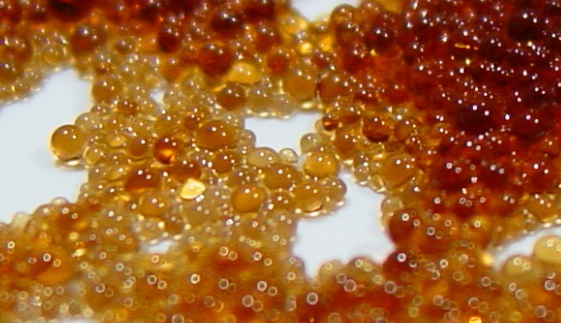
An ion-exchange resin or ion-exchange polymer is a resin or polymer that acts as a medium for ion exchange, that is also known as an ionex. It is an insoluble matrix (or support structure) normally in the form of small (0.25–1.43 mm radius) microbeads, usually white or yellowish, fabricated from an organic polymer substrate. The beads are typically porous (with a specific size distribution that will affect its properties), providing a large surface area on and inside them where the trapping of ions occurs along with the accompanying release of other ions, and thus the process is called ion exchange. There are multiple types of ion-exchange resin, that differ in composition if the target is an anion or a cation and are created based on the task they are required for. Most commercial resins are made of polystyrene sulfonate which is followed by polyacrylate.
Ion-exchange resins are widely used in different separation, purification, and decontamination processes. The most common examples are water softening and water purification. In many cases, ion-exchange resins were introduced in such processes as a more flexible alternative to the use of natural or artificial zeolites.
Most typical ion-exchange resins are based on crosslinked polystyrene. The actual ion-exchanging sites are introduced after polymerisation. Additionally, in the case of polystyrene, crosslinking is introduced by copolymerisation of styrene and a few percent of divinylbenzene. Crosslinking decreases ion-exchange capacity of the resin and prolongs the time needed to accomplish the ion-exchange processes but improves the robustness of the resin. Particle size also influences the resin parameters; smaller particles have larger outer surface, but cause larger head loss in the column processes.
Besides being made as bead-shaped materials, ion-exchange resins are also produced as membranes. These ion-exchange membranes, which are made of highly cross-linked ion-exchange resins that allow passage of ions, but not of water, are used for electrodialysis.
Four main types of ion-exchange resins differ in their functional groups:
Specialised ion-exchange resins are also known such as chelating resins (iminodiacetic acid, thiourea-based resins, and many others).
Anion resins and cation resins are the two most common resins used in the ion-exchange process. While anion resins attract negatively charged ions, cation resins attract positively charged ions.
Formula: R-OH basic
Hub AI
Ion-exchange resin AI simulator
(@Ion-exchange resin_simulator)
Ion-exchange resin
An ion-exchange resin or ion-exchange polymer is a resin or polymer that acts as a medium for ion exchange, that is also known as an ionex. It is an insoluble matrix (or support structure) normally in the form of small (0.25–1.43 mm radius) microbeads, usually white or yellowish, fabricated from an organic polymer substrate. The beads are typically porous (with a specific size distribution that will affect its properties), providing a large surface area on and inside them where the trapping of ions occurs along with the accompanying release of other ions, and thus the process is called ion exchange. There are multiple types of ion-exchange resin, that differ in composition if the target is an anion or a cation and are created based on the task they are required for. Most commercial resins are made of polystyrene sulfonate which is followed by polyacrylate.
Ion-exchange resins are widely used in different separation, purification, and decontamination processes. The most common examples are water softening and water purification. In many cases, ion-exchange resins were introduced in such processes as a more flexible alternative to the use of natural or artificial zeolites.
Most typical ion-exchange resins are based on crosslinked polystyrene. The actual ion-exchanging sites are introduced after polymerisation. Additionally, in the case of polystyrene, crosslinking is introduced by copolymerisation of styrene and a few percent of divinylbenzene. Crosslinking decreases ion-exchange capacity of the resin and prolongs the time needed to accomplish the ion-exchange processes but improves the robustness of the resin. Particle size also influences the resin parameters; smaller particles have larger outer surface, but cause larger head loss in the column processes.
Besides being made as bead-shaped materials, ion-exchange resins are also produced as membranes. These ion-exchange membranes, which are made of highly cross-linked ion-exchange resins that allow passage of ions, but not of water, are used for electrodialysis.
Four main types of ion-exchange resins differ in their functional groups:
Specialised ion-exchange resins are also known such as chelating resins (iminodiacetic acid, thiourea-based resins, and many others).
Anion resins and cation resins are the two most common resins used in the ion-exchange process. While anion resins attract negatively charged ions, cation resins attract positively charged ions.
Formula: R-OH basic
Recent media