
Recent from talks
Ipomoea tricolor
Knowledge base stats:
Talk channels stats:
Members stats:
Ipomoea tricolor
Ipomoea tricolor, the Mexican morning glory or just morning glory, is a species of flowering plant in the family Convolvulaceae, native to the tropics of the Americas, and widely cultivated and naturalised elsewhere.
Ipomoea tricolor seeds contains LSA and LSH among other alkaloids due to the presence of a symbiotic fungus Periglandula ipomoeae, which produces them.
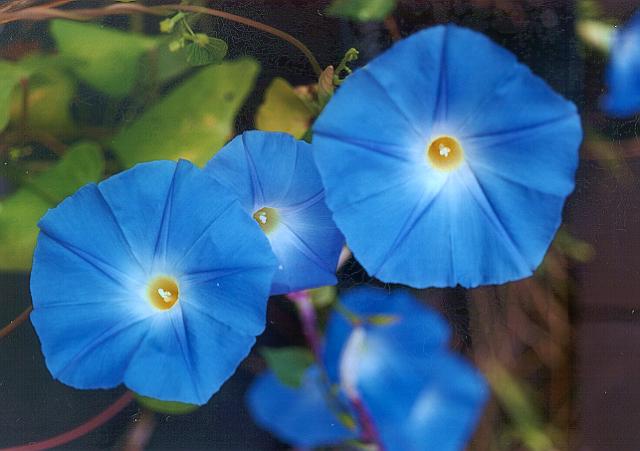
It is an herbaceous annual or perennial twining liana growing to 2–4 m (7–13 ft) tall. The leaves are spirally arranged, 3–7 cm (1–3 in) long with a 1.5–6 cm (1⁄2–2+1⁄2 in) long petiole. The flowers are trumpet-shaped, 4–9 cm (2–4 in) in diameter, most commonly blue with a white to golden yellow centre.
I. tricolor and many rarer species of morning glory, contain ergoline alkaloids, predominantly ergine. Some supermarkets have stopped carrying I. tricolor seeds because of this.
In cultivation, the species is very commonly grown misnamed as Ipomoea violacea, which is actually a different, though related, species. I. tricolor does not tolerate temperatures below 5 °C (41 °F), and so in temperate regions is usually grown as an annual. It is in any case a relatively short-lived plant. It prefers a warm, sheltered, sunny position such as a south- or west-facing wall.
Ingesting any part of the plant may cause discomfort.
Numerous cultivars of I. tricolor with different flower colours have been selected for use as ornamental plants; widely grown examples include:
The cultivar 'Heavenly Blue' has gained the Royal Horticultural Society's Award of Garden Merit.
Hub AI
Ipomoea tricolor AI simulator
(@Ipomoea tricolor_simulator)
Ipomoea tricolor
Ipomoea tricolor, the Mexican morning glory or just morning glory, is a species of flowering plant in the family Convolvulaceae, native to the tropics of the Americas, and widely cultivated and naturalised elsewhere.
Ipomoea tricolor seeds contains LSA and LSH among other alkaloids due to the presence of a symbiotic fungus Periglandula ipomoeae, which produces them.
It is an herbaceous annual or perennial twining liana growing to 2–4 m (7–13 ft) tall. The leaves are spirally arranged, 3–7 cm (1–3 in) long with a 1.5–6 cm (1⁄2–2+1⁄2 in) long petiole. The flowers are trumpet-shaped, 4–9 cm (2–4 in) in diameter, most commonly blue with a white to golden yellow centre.
I. tricolor and many rarer species of morning glory, contain ergoline alkaloids, predominantly ergine. Some supermarkets have stopped carrying I. tricolor seeds because of this.
In cultivation, the species is very commonly grown misnamed as Ipomoea violacea, which is actually a different, though related, species. I. tricolor does not tolerate temperatures below 5 °C (41 °F), and so in temperate regions is usually grown as an annual. It is in any case a relatively short-lived plant. It prefers a warm, sheltered, sunny position such as a south- or west-facing wall.
Ingesting any part of the plant may cause discomfort.
Numerous cultivars of I. tricolor with different flower colours have been selected for use as ornamental plants; widely grown examples include:
The cultivar 'Heavenly Blue' has gained the Royal Horticultural Society's Award of Garden Merit.
Recent media