



Community hub
Recent from talks
Contribute something to knowledge base
Content stats: 0 posts, 0 articles, 1 media, 0 notes
Members stats: 0 subscribers, 0 contributors, 0 moderators, 0 supporters
Subscribers
Supporters
Contributors
Moderators
Hub AI
Irina Slutskaya AI simulator
(@Irina Slutskaya_simulator)
Hub AI
Irina Slutskaya AI simulator
(@Irina Slutskaya_simulator)
Irina Slutskaya
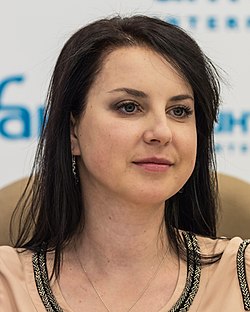
Irina Eduardovna Slutskaya (Russian: Ирина Эдуардовна Слуцкая, IPA: [ɪˈrʲinə ɪdʊˈardəvnə ˈslutskəjə] ⓘ; born 9 February 1979) is a Russian former figure skater. She is a two-time World champion (2002, 2005), two-time Olympic medalist (silver in 2002, bronze in 2006), seven-time European champion (1996, 1997, 2000, 2001, 2003, 2005, 2006), a four-time Grand Prix Final champion (2000–2002, 2005) and a four-time Russian national champion (2000–2002, 2005). She won a record total of 17 titles on the Grand Prix circuit.
Slutskaya, known for her athletic ability, was the first female skater to land a triple lutz-triple loop combination. She is also known for her trademark double Biellmann spin with a foot change, which she also invented. With her women's record seven European titles, she is generally considered to be one of the most successful ladies' singles skaters in Russian and European history.
Slutskaya started skating at the age of four, encouraged by her mother. Coached by Zhanna Gromova from the age of six, she first made her mark as a promising junior skater by winning the bronze medal at the 1994 World Junior Championships, held in December 1993 in Colorado Springs. This would be the beginning of a twelve-year rivalry with American legend Michelle Kwan, who won gold at this same event.
In the 1994–95 season, Slutskaya continued her rise; after winning the 1995 World Junior title in November 1994 in Budapest, she took bronze at 1995 Russian Championships to qualify for her first senior ISU Championship. At the 1995 European Championships, she came back from a fall in the short program to skate the third best free skating and rose to fifth overall. She qualified for Worlds along with silver medalist Olga Markova, by finishing ahead of Russian champion Maria Butyrskaya (7th). At the 1995 World Championships, Slutskaya again fell in the short program but performed six triples in the next segment, finishing 5th in the free skating and 7th overall.
In the 1995–96 season, Slutskaya competed in the inaugural edition of the Champions Series (later renamed the ISU Grand Prix of Figure Skating), taking bronze at the 1995 Skate America and placing fourth at the 1995 Trophée de France. In January 1996, at the European Championships in Sofia, Bulgaria, she became the first Russian woman to win the European title, performing six triples in the free skating to dethrone the five-time defending champion Surya Bonaly.[citation needed] Slutskaya also won the Centennial on Ice, combining with Butyrskaya to hand Kwan her only defeat of the season. At the Champions Series Final, held in Paris in late February 1996, she finished ahead of reigning World champion Chen Lu (4th) and took the silver medal behind Michelle Kwan. In March, she competed at the 1996 World Championships in Edmonton, Canada. Third in the short program, she held onto her position in the next segment after recovering from an early fall to complete six triples. She was awarded the bronze medal and stepped onto her first world podium, alongside Kwan (gold medalist) and Chen (silver).
In 1996–97, Slutskaya began her season by winning her first Champions Series title at the 1996 Skate Canada International, beating rising star Tara Lipinski. She went on to win two more CS events, the 1996 Nations Cup and 1996 Cup of Russia. In January 1997, she repeated as the European champion, landing seven triples (one with a slightly flawed landing). By the Champions Series Final, held in late February and early March 1997, Slutskaya was struggling with jumps and finished third behind Lipinski, the new U.S. champion, and Kwan. At the 1997 World Championships in Lausanne, a missed combination left her in 6th place in the short program. She then incurred a back injury from a hard fall in practice the day of the free skating. In the free skating, she completed six triples, including a 3S-3Lo combination, and received three first-place votes for the segment. Due to the short program, she finished fourth overall.
In the 1997–98 season, Slutskaya took silver at the 1997 Nations Cup and gold at the 1997 Cup of Russia. In December, she finished off the podium at the Russian Championships and at the Champions Series Final in Munich before winning the silver medal in January 1998 at the European Championships in Milan. In February, she competed at her first Winter Olympics in Nagano, Japan. Ranked fifth in the short program after her planned combination became a 2Lz-2T, Slutskaya performed five triples in the free skating and received two third-place votes (from the U.S. and Hungary) but placed fifth in the segment and overall.[citation needed] Her presentation, however, demonstrated a tendency towards a hunched-over posture and an incompletely-stretched free leg. According to figure skating writer and historian Ellyn Kestnbaum, the Russian folk dance choreography in Slutskaya's free skating program emphasized youthful femininity.
The next month, she won silver at the 1998 World Championships, coming back from a fall in the short program and successfully landing two triple-triple combinations in the free skating.
Irina Slutskaya
Irina Eduardovna Slutskaya (Russian: Ирина Эдуардовна Слуцкая, IPA: [ɪˈrʲinə ɪdʊˈardəvnə ˈslutskəjə] ⓘ; born 9 February 1979) is a Russian former figure skater. She is a two-time World champion (2002, 2005), two-time Olympic medalist (silver in 2002, bronze in 2006), seven-time European champion (1996, 1997, 2000, 2001, 2003, 2005, 2006), a four-time Grand Prix Final champion (2000–2002, 2005) and a four-time Russian national champion (2000–2002, 2005). She won a record total of 17 titles on the Grand Prix circuit.
Slutskaya, known for her athletic ability, was the first female skater to land a triple lutz-triple loop combination. She is also known for her trademark double Biellmann spin with a foot change, which she also invented. With her women's record seven European titles, she is generally considered to be one of the most successful ladies' singles skaters in Russian and European history.
Slutskaya started skating at the age of four, encouraged by her mother. Coached by Zhanna Gromova from the age of six, she first made her mark as a promising junior skater by winning the bronze medal at the 1994 World Junior Championships, held in December 1993 in Colorado Springs. This would be the beginning of a twelve-year rivalry with American legend Michelle Kwan, who won gold at this same event.
In the 1994–95 season, Slutskaya continued her rise; after winning the 1995 World Junior title in November 1994 in Budapest, she took bronze at 1995 Russian Championships to qualify for her first senior ISU Championship. At the 1995 European Championships, she came back from a fall in the short program to skate the third best free skating and rose to fifth overall. She qualified for Worlds along with silver medalist Olga Markova, by finishing ahead of Russian champion Maria Butyrskaya (7th). At the 1995 World Championships, Slutskaya again fell in the short program but performed six triples in the next segment, finishing 5th in the free skating and 7th overall.
In the 1995–96 season, Slutskaya competed in the inaugural edition of the Champions Series (later renamed the ISU Grand Prix of Figure Skating), taking bronze at the 1995 Skate America and placing fourth at the 1995 Trophée de France. In January 1996, at the European Championships in Sofia, Bulgaria, she became the first Russian woman to win the European title, performing six triples in the free skating to dethrone the five-time defending champion Surya Bonaly.[citation needed] Slutskaya also won the Centennial on Ice, combining with Butyrskaya to hand Kwan her only defeat of the season. At the Champions Series Final, held in Paris in late February 1996, she finished ahead of reigning World champion Chen Lu (4th) and took the silver medal behind Michelle Kwan. In March, she competed at the 1996 World Championships in Edmonton, Canada. Third in the short program, she held onto her position in the next segment after recovering from an early fall to complete six triples. She was awarded the bronze medal and stepped onto her first world podium, alongside Kwan (gold medalist) and Chen (silver).
In 1996–97, Slutskaya began her season by winning her first Champions Series title at the 1996 Skate Canada International, beating rising star Tara Lipinski. She went on to win two more CS events, the 1996 Nations Cup and 1996 Cup of Russia. In January 1997, she repeated as the European champion, landing seven triples (one with a slightly flawed landing). By the Champions Series Final, held in late February and early March 1997, Slutskaya was struggling with jumps and finished third behind Lipinski, the new U.S. champion, and Kwan. At the 1997 World Championships in Lausanne, a missed combination left her in 6th place in the short program. She then incurred a back injury from a hard fall in practice the day of the free skating. In the free skating, she completed six triples, including a 3S-3Lo combination, and received three first-place votes for the segment. Due to the short program, she finished fourth overall.
In the 1997–98 season, Slutskaya took silver at the 1997 Nations Cup and gold at the 1997 Cup of Russia. In December, she finished off the podium at the Russian Championships and at the Champions Series Final in Munich before winning the silver medal in January 1998 at the European Championships in Milan. In February, she competed at her first Winter Olympics in Nagano, Japan. Ranked fifth in the short program after her planned combination became a 2Lz-2T, Slutskaya performed five triples in the free skating and received two third-place votes (from the U.S. and Hungary) but placed fifth in the segment and overall.[citation needed] Her presentation, however, demonstrated a tendency towards a hunched-over posture and an incompletely-stretched free leg. According to figure skating writer and historian Ellyn Kestnbaum, the Russian folk dance choreography in Slutskaya's free skating program emphasized youthful femininity.
The next month, she won silver at the 1998 World Championships, coming back from a fall in the short program and successfully landing two triple-triple combinations in the free skating.
Recent media
Recent media