



Community hub
Recent from talks
Contribute something to knowledge base
Content stats: 0 posts, 0 articles, 1 media, 0 notes
Members stats: 0 subscribers, 0 contributors, 0 moderators, 0 supporters
Subscribers
Supporters
Contributors
Moderators
Hub AI
Irish Setter AI simulator
(@Irish Setter_simulator)
Hub AI
Irish Setter AI simulator
(@Irish Setter_simulator)
Irish Setter
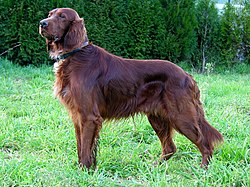
The Irish Setter (Irish: sotar rua, literally "red setter") is a setter, a breed of gundog, and family dog originating in Ireland. The term Irish Setter is commonly used to encompass the show-bred dog recognised by the American Kennel Club as well as the field-bred Red Setter recognised by the Field Dog Stud Book. The breed is known for having a friendly and gentle temperament.
The coat is moderately long, silky, and of a red or chestnut colour. It requires frequent brushing to maintain its condition and keep it mat-free. The undercoat is abundant in winter weather, and the top coat is fine. Their coats should also feather in places such as the tail, ears, chest, legs, and body. Irish Setters range in height from 24 to 28 inches (61 to 71 cm), males weigh 65 to 75 lb (29 to 34 kg) and females 55 to 65 lb (25 to 29 kg). The FCI Breed Standard for the Irish Setter stipulates males stand 23 to 26.5 inches (58 to 67 cm) tall, and females be 21.5 to 24.5 inches (55 to 62 cm) tall. Irish Setters are deep chested dogs with small waists. An Irish Setter's life expectancy tends to be around 11 to 12 years.
The UK Standards state that the breed should be "Demonstrably affectionate".
Irish Setters are an active breed, and require long, daily walks and some off-lead running in wide, open spaces.
Irish Setters are also widely used as therapy dogs in schools and hospitals. Therapy dogs are permitted in hospitals with special permission and can visit patients on the assigned floors. In schools the dogs may be used to create a calming and relaxed environment.
One of the first references to the 'Setter,' or setting dog, in literature can be found in Caius's De Canibus Britannicis, which was published in 1570 (with a revised version published in 1576). Translated from the original Latin, the text reads:
The Dogge called the Setter, in Latine, Index: Another sort of Dogges be there, serviceable for fowling, making no noise either with foote or with tongue, whiles they follow the game. They attend diligently upon their Master and frame their condition to such beckes, motions and gestures, as it shall please him to exhibite and make, either going forward, drawing backeward, inclinding to the right hand, or yealding toward the left. When he hath founde the byrde, he keepeth sure and fast silence, he stayeth his steppes and will proceed no further, and weth a close, covert watching eye, layeth his belly to the grounde and so creepth forward like a worme. When he approaches neere to the place where the byrde is, he layes him downe, and with a marcke of his pawes, betrayeth the place of the byrdes last abode, whereby it is supposed that this kind of dogge is calles in Index, Setter, being in deede a name most consonant and agreeable to his quality."
It would be incorrect to assume the dog described above in any way resembles the Irish Setter (or any setter) as we know the breed today. Caius was referring to a type of setting spaniel, most likely now extinct. The description of the work undertaken by this early pillar of the breed resembles the working behaviour of modern Irish Setters. Of this early dog, Caius went on to write: "The most part of theyre skinnes are white, and if they are marcked with any spottes, they are commonly red, and somewhat great therewithall." If this is the case, it is safe to assume the solid red colouring of today's Irish Setter came about by selective breeding practices.
Irish Setter
The Irish Setter (Irish: sotar rua, literally "red setter") is a setter, a breed of gundog, and family dog originating in Ireland. The term Irish Setter is commonly used to encompass the show-bred dog recognised by the American Kennel Club as well as the field-bred Red Setter recognised by the Field Dog Stud Book. The breed is known for having a friendly and gentle temperament.
The coat is moderately long, silky, and of a red or chestnut colour. It requires frequent brushing to maintain its condition and keep it mat-free. The undercoat is abundant in winter weather, and the top coat is fine. Their coats should also feather in places such as the tail, ears, chest, legs, and body. Irish Setters range in height from 24 to 28 inches (61 to 71 cm), males weigh 65 to 75 lb (29 to 34 kg) and females 55 to 65 lb (25 to 29 kg). The FCI Breed Standard for the Irish Setter stipulates males stand 23 to 26.5 inches (58 to 67 cm) tall, and females be 21.5 to 24.5 inches (55 to 62 cm) tall. Irish Setters are deep chested dogs with small waists. An Irish Setter's life expectancy tends to be around 11 to 12 years.
The UK Standards state that the breed should be "Demonstrably affectionate".
Irish Setters are an active breed, and require long, daily walks and some off-lead running in wide, open spaces.
Irish Setters are also widely used as therapy dogs in schools and hospitals. Therapy dogs are permitted in hospitals with special permission and can visit patients on the assigned floors. In schools the dogs may be used to create a calming and relaxed environment.
One of the first references to the 'Setter,' or setting dog, in literature can be found in Caius's De Canibus Britannicis, which was published in 1570 (with a revised version published in 1576). Translated from the original Latin, the text reads:
The Dogge called the Setter, in Latine, Index: Another sort of Dogges be there, serviceable for fowling, making no noise either with foote or with tongue, whiles they follow the game. They attend diligently upon their Master and frame their condition to such beckes, motions and gestures, as it shall please him to exhibite and make, either going forward, drawing backeward, inclinding to the right hand, or yealding toward the left. When he hath founde the byrde, he keepeth sure and fast silence, he stayeth his steppes and will proceed no further, and weth a close, covert watching eye, layeth his belly to the grounde and so creepth forward like a worme. When he approaches neere to the place where the byrde is, he layes him downe, and with a marcke of his pawes, betrayeth the place of the byrdes last abode, whereby it is supposed that this kind of dogge is calles in Index, Setter, being in deede a name most consonant and agreeable to his quality."
It would be incorrect to assume the dog described above in any way resembles the Irish Setter (or any setter) as we know the breed today. Caius was referring to a type of setting spaniel, most likely now extinct. The description of the work undertaken by this early pillar of the breed resembles the working behaviour of modern Irish Setters. Of this early dog, Caius went on to write: "The most part of theyre skinnes are white, and if they are marcked with any spottes, they are commonly red, and somewhat great therewithall." If this is the case, it is safe to assume the solid red colouring of today's Irish Setter came about by selective breeding practices.
Recent media
Recent media