Hubbry Logo
Irish SetterIrish SetterMain
Open search
Irish Setter
Community hub
Irish Setter
logo
8 pages, 0 posts
0 subscribers
Be the first to start a discussion here.
Irish Setter
Irish Setter
from Wikipedia
Not found
Revisions and contributorsEdit on WikipediaRead on Wikipedia
from Grokipedia
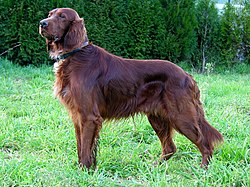
The Irish Setter is a medium-to-large breed originating from , renowned for its elegant, athletic build and striking or red coat that is straight, fine, and glossy, with feathering on the ears, chest, tail, and backs of the legs. Standing over 25 inches at the and weighing 60 to 70 pounds, it was developed in the 18th and 19th centuries primarily for bird hunting on the flat Irish countryside, where its speed, grace, and keen scenting ability allow it to locate and point game effectively. This high-spirited breed combines aristocratic poise with a playful, affectionate personality, making it a beloved family companion as well as a versatile sporting . Historically, the Irish Setter evolved from crosses of English Setters, pointers, and , with early specimens often featuring red-and-white markings that were selectively bred out in favor of the solid red coloration by the mid-19th century to enhance visibility in the field. The gained prominence in Ireland during the 1800s among huntsmen seeking a swift, stylish dog for upland game, and it was first recognized by the in 1878, with the Irish Setter Club of America founded in 1891 to preserve its standards. Originally known as the Irish Red Setter to distinguish it from the , it became a symbol of elegance in both and show rings, though its field prowess remains its defining trait. In temperament, the Irish Setter is outgoing, merry, and rollicking, often described as a "big kid at heart" with boundless energy that requires at least an hour of vigorous daily exercise, such as running or field work, to prevent boredom and destructive behavior. Eager to please and intelligent, it responds well to positive training but matures slowly, often retaining puppy-like exuberance until age three or four, which suits active but may overwhelm novice owners or sedentary households. As a family dog, it is gentle with children and other pets, though its enthusiastic greetings can be exuberant, and it thrives on human interaction, disliking prolonged . Care for the Irish Setter involves moderate grooming to maintain its silky coat, with weekly brushing to prevent matting and occasional baths, while its floppy ears require regular cleaning to avoid infections. Prone to health issues like , , and bloat, responsible breeders screen for these conditions, and the breed's lifespan averages 12 to 15 years with proper veterinary care and a balanced diet. Overall, the Irish Setter embodies a blend of sporting heritage and companion charm, appealing to those who appreciate its vibrant spirit and enduring loyalty.

Physical Description

Coat and Color

The coat of the Irish Setter is characterized by its silky texture and moderate length, designed for both functionality in the field and aesthetic appeal in the show ring. On the head and forelegs, the is short and fine, while on the body it is of moderate length and lies flat, free from curl or wave. Feathering is long and silky on the ears, extending to a fine fringe on the back of the forelegs, thighs, belly, , and chest; the tail features a moderately long, tapering fringe. This feathering is straight and as free from waviness as possible, contributing to the breed's elegant outline. The ideal color for the Irish Setter is a rich red or deep , with no trace of allowed in the . This vibrant red coat provides a striking contrast and is a hallmark of the breed's aristocratic appearance. Small amounts of white markings are permissible but not extensive; these may appear as a narrow streak or star on the , or limited white on the chest, throat, toes, or chin, without penalization in conformation judging. Any deviation to other colors, such as excessive white, roan, or , disqualifies the from meeting the standard. Grooming practices for the emphasize preserving its natural form, with trimming limited to the show ring to highlight the clean lines of the head, neck, and feet—such as removing excess feathering around the ears and throat—without altering the overall silky, flat appearance. This maintenance helps prevent matting in the feathered areas while supporting the coat's role in weather resistance during fieldwork.

Body Structure and Size

The Irish Setter possesses an elegant, symmetrical build that balances athleticism and grace, enabling swift movement and endurance in the field. Its emphasizes functionality as a gundog, with a substantial frame that is neither cumbersome nor fragile. According to the (AKC) standard, the breed stands over two feet at the , presenting a racy yet powerful outline suited for covering ground efficiently. Ideal height at the is 27 inches for males and 25 inches for females, as specified by both the AKC and (UKC) standards, though the (FCI) allows a broader range of 23 to 26.5 inches for males and 21.5 to 24.5 inches for females. Weight typically ranges from 60 to 70 pounds for females and 70 to 75 pounds for males, with proportion and balance deemed more critical than absolute size to maintain the breed's agile form. The body is slightly longer than tall when measured from the prosternum to the point of the rump versus the height at the , promoting a rectangular yet harmonious . The neck is long, muscular, and slightly arched, merging cleanly into sloping shoulders that are well-laid-back for . The chest is deep and capacious with well-sprung , extending to the elbows, while the back remains short, strong, and level, supported by muscular of moderate length. Forequarters feature straight, sinewy legs with substantial bone, set well under the body, and feet that are small, firm, and cat-like with arched toes. Hindquarters are broad and powerful, with well-angulated stifles and hocks for strong propulsion, ensuring a straight, free stride without interference. The tail, of moderate length, is thick at the base and tapers to a fine point, carried straight or with a slight upward curve but never over the back.

Temperament and Suitability

Personality and Behavior

The Irish Setter is renowned for its rollicking , characterized by high spirits, playfulness, and an outgoing demeanor that makes it a joyful companion. This breed exhibits a stable and affectionate , free from , , or timidity, which underscores its suitability as an engaging family member. Owners often describe Irish Setters as fun-loving and mischievous, with a natural eagerness to interact and a gentle, people-oriented nature that fosters strong bonds with humans. In terms of behavior, Irish Setters are highly energetic and require substantial daily exercise to channel their enthusiasm, thriving in environments that allow for running and exploration. Their innate instinct drives them to range widely and pursue scents with untiring vigor, which can lead to wandering if not contained in a secure area. Despite this independence, they are not aggressive and typically get along well with children, serving as playful and patient playmates, as well as with other pets when properly socialized. This sociable disposition extends to a demonstrably affectionate toward family members, often manifesting in enthusiastic greetings and a desire for constant companionship. Regarding trainability, Irish Setters are intelligent and responsive to positive reinforcement, learning commands quickly once grasped, though their stubborn streak and slow mental maturation—often extending into the second or third year—demand patient, consistent handling. They respond best to firm yet loving guidance, retaining lessons permanently due to their sharp memory, but may test boundaries with playful defiance if is inconsistent. Overall, their reflects a blend of spirited independence and devoted affection, making them ideal for active households that appreciate a lively, non-guarding companion.

Family and Training Compatibility

The Irish Setter is renowned for its affectionate and outgoing temperament, making it an excellent companion for families with active lifestyles. These dogs are sweet-natured, playful, and eager to please, often forming strong bonds with all household members. They thrive on human interaction and are generally good with children, providing gentle playfulness that suits older kids, though supervision is recommended around toddlers due to the breed's size and enthusiastic energy, which could inadvertently lead to accidental knocks. In terms of compatibility with other pets, Irish Setters typically get along well with dogs and can coexist with cats if introduced properly during puppyhood, thanks to their sociable and non-aggressive disposition. However, their high , rooted in their gundog heritage, may require early to manage interactions with smaller animals. As family pets, they adapt best to homes with ample space, such as suburban or rural settings, where they can expend their boundless energy through daily activities like walks, runs, or play sessions. Training Irish Setters is generally rewarding due to their intelligence and desire to connect with handlers, though their independent streak and distractibility—often drawn to scents or movement—can pose challenges. Positive reinforcement methods, incorporating praise, treats, and short, engaging sessions, yield the best results, fostering their natural eagerness while building focus and obedience. Early puppy classes and consistent routines are essential for socialization and to curb exuberant behaviors, enabling them to excel in obedience trials, agility, or as therapy dogs. Without structured training and sufficient exercise—at least 60-90 minutes daily—these dogs may develop boredom-related issues like chewing or excessive barking.

Historical Development

Origins and Early Breeding

The Irish Setter, a breed native to , traces its origins to the 17th and 18th centuries, when it was developed as a versatile gundog for locating and upland birds in the country's varied . Early forms of the breed likely emerged from crosses between setting spaniels, pointers, and possibly Scottish Setters or other land spaniels, selected for their ability to work swiftly across open fields and bogs. These foundational dogs were bred by Irish landowners and sportsmen to meet the demands of practices that required endurance, keen scenting, and a reliable point, with initial strains possibly dating back to pre-1798 developments by affluent breeders before political upheavals disrupted some lines. Throughout the , Irish Setters gained popularity among hunters, appearing in both red-and-white parti-colored varieties—reflecting spaniel influences—and early solid red specimens, though the latter were not yet standardized. Breeding efforts emphasized functional traits over aesthetics, with dogs trained to "set" or crouch upon finding , a behavior honed through generations of field work rather than formal pedigrees. Notable early contributors included Irish estates where setters were methodically paired to enhance speed and bird-finding prowess, adapting to Ireland's of heather, marshes, and cover crops. By the early , as evolved with improved firearms, breeders began favoring the solid mahogany-red coat for visibility in the field, marking a shift toward the modern through selective pairings that reduced white markings. The formalization of the breed accelerated in the mid-19th century, with the establishment of dedicated clubs and standards that codified early breeding practices. In 1882, the Red Setter Club formed in Ireland, followed by the approval of the first in 1886 by the Irish Red Setter Club, which specified the solid red coloration and outlined ideal physical and working qualities derived from those ancestral lines. This period saw increased exports to and America, where Irish breeders like those maintaining strains from and Tipperary influenced global development, preserving the breed's heritage amid growing interest in bench shows.

Modern Recognition and Variations

The Irish Setter, also known as the Red Setter, received formal recognition from the (AKC) in 1878, with the first dog registered being Admiral, marking its entry into organized pedigree breeding in the United States. The (UKC) followed suit in 1914, classifying it as a gundog breed emphasizing its working heritage. In the , the breed's standard was established by the Irish Red Setter Club in 1886 and adopted by , solidifying its status in conformation shows and field events across . Internationally, the (FCI) incorporated the breed into its standards in the early 20th century, with the current standard published in 2001, promoting its dual role as a and companion. In modern times, the Irish Setter's popularity has fluctuated but remains steady, ranking 85th among 201 breeds in AKC registrations as of 2024, reflecting its appeal as both a sporting and family . The Irish Setter Club of America, founded in 1891 and recognized by the AKC as the parent club, has played a key role in preserving breed standards through national specialties, field trials, and educational programs. Similarly, organizations like the Irish Setter Club of continue to host events that blend working trials with show competitions, ensuring the breed's versatility. A significant modern variation within the Irish Setter stems from the divergence between "bench" or show lines and "field" lines, which began in the late as breeders prioritized over prowess. Show Irish Setters are bred for conformation exhibitions, resulting in taller, more substantial builds—males typically 25-27 inches at the and weighing 70 pounds— with longer, silkier mahogany-red coats that enhance their elegant appearance in the ring. In contrast, field Irish Setters are selected for performance in and trials, featuring leaner, more athletic frames—often 23-25 inches tall and 60-65 pounds—with shorter, denser orange-red coats that shed water and brush more effectively, allowing greater and speed in the field. This split has led to dual registries in some organizations, where field dogs may compete separately, though both lines remain recognized as the same under AKC and FCI standards, with efforts ongoing to maintain cross-breeding for and functionality. Another recognized variation is the , a distinct but related breed that represents the earlier bicolor form of setters before favored the solid red coat in the mid-19th century. Officially separated and recognized by the AKC in 2009 in the Sporting Group, it differs in its parti-colored coat of white with red markings and slightly smaller stature, yet shares the Irish Setter's energetic temperament and gundog origins. While not a direct subtype of the modern Irish Setter, its preservation highlights the breed's historical diversity and influences contemporary breeding practices to avoid over-standardization.

Roles and Activities

As a Working Gundog

The Irish Setter originated as a versatile pointing gundog bred for upland game bird hunting in Ireland, where it uses its keen sense of smell to detect airborne scent and locate birds before freezing in a stylish point to indicate the find. This breed excels in open terrains such as moors and heaths, covering vast areas with a wide-ranging, galloping style that allows it to quarter efficiently at a distance from the handler. Working lines of Irish Setters tend to be more compact and athletic compared to show strains, emphasizing endurance and speed essential for full-day hunts. Key abilities include a strong pointing instinct, sharp vision for marking game, and the stamina to hunt independently over large beats, making them particularly effective on species like grouse, pheasant, and partridge. They also demonstrate proficiency in water retrieval, as good swimmers with a natural affinity for hunting waterfowl, though their primary strength lies in pointing rather than flushing or intensive retrieving. While capable of basic retrieving, Irish Setters may show less innate drive for it compared to spaniels or retrievers, requiring targeted training to enhance this skill without compromising their pointing focus. Training for gundog work begins early, leveraging the breed's and eagerness to learn through positive and varied, engaging sessions to build , steady , and quartering behaviors. Challenges arise from their high energy and occasional distractibility in youth, necessitating consistent handling to prevent ranging too far; field training often incorporates dummy work and exposure to refine instincts. Modern Irish Setters from working pedigrees require at least an hour of vigorous daily exercise, such as runs or hunts, to maintain focus and prevent boredom-induced mischief. In performance contexts, Irish Setters have demonstrated competitive success in field trials since the mid-20th century, with the breed producing 10 champions in the and 20 in the , reflecting a resurgence in field-bred lines. The Irish Setter Club of America hosted its inaugural field trial in 1979, won by NFC FC AFC Ramblin' Red Banshee, underscoring the breed's capability in structured pointing tests. Today, they remain valued in trials and practical for their graceful motion and reliable bird-finding, though they perform best in open country rather than dense woodland.

In Conformation Shows and Companionship

The Irish Setter participates in conformation shows within the Sporting Group of organizations like the (AKC) and (UK), where judges evaluate adherence to the emphasizing elegance, athleticism, and a distinctive or rich coat without black ticking. The standard describes an ideal specimen as 27 inches at the for males and 25 inches for females, with a racy build, long head, and free, springy movement that showcases the breed's gundog heritage while highlighting its graceful outline. Notable achievements include an Irish Setter earning Best of Breed at the 2024 , marking a strong entry of the breed. As a companion, the Irish Setter excels as a devoted , known for its affectionate, gentle and playful that make it an engaging household member, particularly in active homes with for exercise. The breed's sweet-natured disposition fosters strong bonds with owners and children, often displaying loyalty and enthusiasm in daily interactions, though its high requires consistent mental and physical stimulation to prevent boredom-related behaviors. Irish Setters adapt well to companionship roles, including therapy work, where their zestful yet sensitive provides comfort and joy, as evidenced by successful programs pairing the breed with emotional support needs. The Irish Setter Club of America supports these roles through events that blend showing with versatility demonstrations, promoting the breed's dual aptitude for exhibition and everyday partnership.

Health Considerations

Common Medical Conditions

Irish Setters, like many large breeds, are predisposed to , a developmental malformation of the hip joint that can lead to arthritis, pain, and lameness. Responsible breeders screen breeding stock through orthopedic evaluations to reduce incidence, with data from the Orthopedic Foundation for Animals indicating a moderate prevalence in the breed. Progressive retinal atrophy (PRA) is a hereditary eye disorder causing gradual degeneration of the , leading to night blindness and eventual total vision loss. for the rcd1 in the PDE6B is recommended, as it is autosomal recessive and causes early-onset PRA in Irish Setters. The Veterinary Genetics Laboratory at UC Davis offers screening to identify carriers and prevent affected litters. Hypothyroidism, an endocrine disorder resulting from insufficient production, is common in Irish Setters and manifests as , , dry skin, and . Diagnosis involves blood tests measuring levels, and treatment with lifelong replacement is effective in managing symptoms. , characterized by recurrent seizures, has been reported in Irish Setters, often with onset between six months and three years of age. While the exact cause is multifactorial, genetic factors may contribute, and medications control most cases successfully. Gastric dilatation-volvulus (GDV), or bloat, poses a life-threatening risk due to the breed's deep chest, where the stomach can twist and trap gas, leading to shock if untreated. Emergency surgery is required, and preventive measures include feeding smaller meals and avoiding exercise post-feeding. Osteochondritis dissecans (OCD) is a developmental joint disorder that can affect the shoulders, elbows, or hocks in Irish Setters, leading to lameness, pain, and joint inflammation. Responsible breeders perform radiographic screenings to evaluate for OCD and reduce its incidence in breeding stock. Canine leukocyte adhesion deficiency type I (CLAD-I) is a rare but severe inherited in Irish Setters, impairing function and causing recurrent infections, poor , and often early death without treatment. DNA testing for the ITGB2 allows breeders to eliminate the from lines. Von Willebrand's disease type I (vWD-I), a disorder due to deficient clotting protein, can result in excessive from injuries or surgeries in affected Irish Setters. Screening via DNA tests for the VWF variant is advised to avoid breeding carriers.

Lifespan and Preventive Measures

The Irish Setter typically enjoys a lifespan of 12 to 15 years when provided with appropriate care. This range can vary based on , diet, exercise, and early detection of issues, with the average around 14 years under optimal conditions. To promote a long and healthy life, owners should prioritize preventive measures targeting the breed's common vulnerabilities, such as , (PRA), , and gastric dilatation-volvulus (GDV or bloat). For and orthopedic concerns like , selecting puppies from breeders who perform recommended screenings—including hip evaluations and thyroid assessments—significantly reduces risk. Maintaining a healthy weight through balanced and regular, moderate exercise helps prevent joint strain, while genetic DNA testing for PRA (specifically the rcd1 variant) allows for early intervention or avoidance in breeding lines. Routine veterinary checkups, starting from puppyhood, enable monitoring for via annual blood tests and prompt thyroid hormone supplementation if needed. Preventing GDV, a life-threatening condition common in deep-chested breeds like the Irish Setter, involves feeding multiple small meals daily rather than one large one, using slow-feed bowls to reduce air ingestion, and avoiding vigorous activity for at least an hour before and after eating. Additional wellness practices include core vaccinations, parasite prevention (, , heartworm), and monitoring through neurological exams if seizures occur. Dental care via regular brushing with canine toothpaste and professional cleanings, along with ear inspections to catch infections early, further supports overall vitality. Owners are encouraged to consult breed-specific resources from organizations like the for tailored guidance.

Cultural Significance

Notable Irish Setters

The Irish Setter has been a favored companion to several U.S. presidents, enhancing the breed's prominence in American history. King Timahoe, an Irish Setter gifted to President by his White House staff on January 28, 1969, as a belated 56th birthday present, became one of the most photographed presidential pets of the era. Named after the Irish village of Timahoe, from which Nixon's ancestors emigrated, the dog resided in the alongside other Nixon family pets like the Vicky and Pasha, often joining the president on walks and vacations, including trips to . King Timahoe lived until 1979, outlasting Nixon's presidency, and symbolized the family's affection for the breed. Similarly, President Harry S. Truman's family briefly owned an Irish Setter named Mike in 1945, presented as a puppy to daughter Margaret by Robert Hannegan shortly after Truman's . Though the Trumans were generally not pet enthusiasts and relocated Mike to a farm for better care later that year, the dog's presence highlighted the breed's appeal even in reluctant households. President also kept an Irish Setter named Peggy at his ranch in during his tenure from 1981 to 1989, where she joined other pets like the Lucky and Rex; Peggy spent her life on the ranch and was buried there upon her death. Beyond the White House, Irish Setters have achieved fame through political figures and their devoted owners. Garry, an Irish Setter belonging to Maine Governor Percival P. Baxter, captured national attention in 1923 when the governor ordered state flags flown at half-staff following the dog's death on June 1 after being struck by a car near the State House in Augusta. Garry, who accompanied Baxter on daily walks and greeted schoolchildren outside the capitol, was one of several setters the governor cherished; Baxter even included Garry in official portraits and later bred more of the breed from lines like Glencora. The gesture sparked controversy from veterans' groups but underscored Baxter's bond with the dog, leading to widespread media coverage and cementing Garry's place as a symbol of loyalty in early 20th-century American public life. In the realm of field trials, the Irish Setter's working heritage produced legendary performers, most notably Joe Jr., an American-bred dog who won acclaim in 1879 by defeating the renowned Gladstone in a high-stakes two-day trial in . Owned by George W. Campbell, Joe Jr. excelled despite injuring a leg mid-competition, showcasing the breed's endurance and pointing ability; his victory helped establish the Irish Setter as a top contender in early U.S. field trials and earned him induction into the Field Trial Hall of Fame in 1982. Such feats contributed to the breed's reputation for versatility in hunting and competition during the late . The Irish Setter has also left a lasting mark in literature and media, often portrayed as a noble and adventurous companion. Big Red, the titular Irish Setter in Jim Kjelgaard's 1945 children's novel Big Red, embodies the breed's intelligence and spirit through the story of a young trapper named Danny Pickett and his bond with the champion dog as they confront wildlife threats in the Adirondack wilderness. The book, illustrated by Bob Kuhn and part of a including Irish Red (1951) and Outlaw Red (1953), sold widely and introduced generations to the Irish Setter's graceful form and hunting prowess, drawing from Kjelgaard's own experiences with the breed.

Representations in Media and Literature

The Irish Setter has been prominently featured in American children's literature through the works of author , particularly in his "Big Red" series, which portrays the breed as intelligent, loyal hunting companions in wilderness settings. The inaugural novel, Big Red (1945), centers on Danny Pickett, a young trapper's son in the of New York, who bonds with a champion Irish Setter named Red, emphasizing the dog's noble spirit and prowess despite conflicts with a menacing . This story highlights the breed's traditional role as a gundog while exploring themes of human-animal partnership and resilience. The series continues in Irish Red (1951), which shifts focus to Mike, one of Red's puppies—a headstrong who overcomes initial doubts to become a skilled hunter under Danny's —and Outlaw Red (1953), following Mike's descendant as an outlaw dog evading capture. These novels, drawing from Kjelgaard's own experiences with dogs, have enduringly shaped perceptions of Irish Setters as adventurous and affectionate family dogs in rural narratives. In film, the 1962 Walt Disney production Big Red, adapted from Kjelgaard's novel, brought the breed to wider audiences, starring as a wealthy owner who purchases the titular Irish Setter for show purposes, only for the dog to thrive under the care of an orphaned boy, . Filmed in Quebec's , the movie underscores the Irish Setter's elegance and free-spirited nature, contrasting show-ring expectations with natural instincts. Its release contributed to a surge in the breed's popularity during the early , often termed the "Irish Setter ," as families sought similar vibrant companions.

References

Add your contribution
Related Hubs
User Avatar
No comments yet.