Hubbry Logo
Isolator (microwave)Isolator (microwave)Main
Open search
Isolator (microwave)
Community hub
Isolator (microwave)
logo
8 pages, 0 posts
0 subscribers
Be the first to start a discussion here.
Isolator (microwave)
from Wikipedia
Resonance absorption isolator consisting of WG16 waveguide containing two strips of ferrite (black rectangle near right edge of each broad wall), which are biased by a horseshoe permanent magnet external to the guide. Transmission direction is indicated by an arrow on the label on the right

An isolator is a two-port device that transmits microwave or radio frequency power in one direction only. The non-reciprocity observed in these devices usually comes from the interaction between the propagating wave and the material, which can be different with respect to the direction of propagation.

It is used to shield equipment on its input side, from the effects of conditions on its output side; for example, to prevent a microwave source being detuned by a mismatched load.

Non-reciprocity

[edit]

An isolator is a non-reciprocal device, with a non-symmetric scattering matrix. An ideal isolator transmits all the power entering port 1 to port 2, while absorbing all the power entering port 2, so that to within a phase-factor its S-matrix is
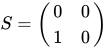
To achieve non-reciprocity, an isolator must necessarily incorporate a non-reciprocal material. At microwave frequencies, this material is usually a ferrite which is biased by a static magnetic field[1] but can be a self-biased material.[2] The ferrite is positioned within the isolator such that the microwave signal presents it with a rotating magnetic field, with the rotation axis aligned with the direction of the static bias field. The behaviour of the ferrite depends on the sense of rotation with respect to the bias field, and hence is different for microwave signals travelling in opposite directions. Depending on the exact operating conditions, the signal travelling in one direction may either be phase-shifted, displaced from the ferrite or absorbed.

Types

[edit]
Resonance isolator in rectangular waveguide topology.
Resonance isolator in rectangular waveguide topology. The forward magnetic field (solid line) is circularly polarized in the ferrite slab and FMR absorption is induced therein. The backward field (dashed) is not circularly polarized and flows normally along the guide.
Field-displacement isolator in rectangular waveguide topology
Field-displacement isolator in rectangular waveguide topology. The ferrite slab deforms the electric field so that the forward field is maximal at the border of the ferrite where a resistive sheet has been placed. This sheet decreases the intensity of the electric field. The backward field is minimal at this same place so that it experiences no loss because of the resistive sheet.
Circulator-based isolator.
Circulator-based isolator. The circulation mechanism induced by the ferrite in the cavity constrains the signal to flow from port 1 to port 2 and from port 2 to port 3. However, the port 3 is connected to a matched load. All the incoming signal is then absorbed and no signal can be emitted from port 3.

Most common types of ferrite-based isolators are classified into four categories: terminated circulators, Faraday rotation isolators, field-displacement isolators, and resonance isolators. In all these kinds of devices, the observed non-reciprocity arises from the wave-material interaction which depends on the direction of propagation.

Resonance absorption

[edit]

In this type the ferrite absorbs energy from the microwave signal travelling in one direction. A suitable rotating magnetic field is found in the dominant TE10 mode of rectangular waveguide. The rotating field exists away from the centre-line of the broad wall, over the full height of the guide. However, to allow heat from the absorbed power to be conducted away, the ferrite does not usually extend from one broad-wall to the other, but is limited to a shallow strip on each face. For a given bias field, resonance absorption occurs over a fairly narrow frequency band, but since in practice the bias field is not perfectly uniform throughout the ferrite, the isolator functions over a somewhat wider band.

Field displacement

[edit]

This type is superficially very similar to a resonance absorption isolator, but the magnetic biasing differs, and the energy from the backward travelling signal is absorbed in a resistive film or card on one face of the ferrite block rather than within the ferrite itself.

The bias field is weaker than that necessary to cause resonance at the operating frequency, but is instead designed to give the ferrite near-zero permeability for one sense of rotation of the microwave signal field. The bias polarity is such that this special condition arises for the forward signal; the backward signal sees the ferrite as an ordinary dielectric material (with little permeability, as the ferrite is already saturated by the bias field). Consequently, for the electromagnetic field of the forward signal, the ferrite has very low characteristic wave impedance, and the field tends to be excluded from the ferrite. This results in a null of the electric field of the forward signal on the surface of the ferrite where the resistive film is placed. Conversely for the backward signal, the electric field is strong over this surface and so its energy is dissipated in driving current through the film.

In rectangular waveguide the ferrite block will typically occupy the full height from one broad-wall to the other, with the resistive film on the side facing the centre-line of the guide.

Terminated circulator

[edit]

A circulator is a non-reciprocal three- or four-port device, in which power entering any port is transmitted to the next port in rotation (only). So to within a phase-factor, the scattering matrix for a three-port circulator is
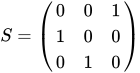
A two-port isolator is obtained simply by terminating one of the three ports with a matched load, which absorbs all the power entering it. The biased ferrite is part of the circulator and causes a differential phase-shift for signals travelling in different directions. The bias field is lower than that needed for resonance absorption, and so this type of isolator does not require such a heavy permanent magnet. Because the power is absorbed in an external load, cooling is less of a problem than with a resonance absorption isolator.

Faraday rotation isolator

[edit]

A last physical principle useful to design isolators is the Faraday rotation. When a linearly polarized wave propagates through ferrite having a magnetization aligned with the direction of propagation of the wave, the polarization plane will rotate along the propagation axis. This rotation may be used to create microwave devices as isolators, circulators, gyrators, etc. In rectangular waveguide topology, it also requires the implementation of circular waveguide sections which come out of the device plane.

An X band isolator consisting of a waveguide circulator with an external matched load on one port
Two isolators each consisting of a coax circulator and a matched load

See also

[edit]

References

[edit]
[edit]
Revisions and contributorsEdit on WikipediaRead on Wikipedia
from Grokipedia
A microwave isolator is a two-port passive device that transmits or power in one direction only, while attenuating or absorbing signals propagating in the reverse direction to prevent reflections from reaching the source. This non-reciprocal behavior is essential for protecting sensitive components, such as amplifiers and signal generators, in RF and systems by isolating them from load mismatches or unwanted feedback. Microwave isolators were developed in the mid-20th century, building on advances in ferrite materials during the and . They rely on the non-reciprocal properties of ferrite materials, often biased by a static ; one common mechanism is the Faraday rotation effect, where the ferrite rotates the polarization of electromagnetic waves propagating through it, allowing forward transmission but causing reverse signals to be absorbed or redirected. Ferrites, typically composed of combined with metals like or , exhibit these properties due to their interaction with the rotating of the signal, as described by and ferromagnetic resonance phenomena. Key components include a ferrite element housed in a , , or structure, often enclosed in a shielded metal can with connectors and a permanent for biasing; common types are connectorized isolators for easy integration and drop-in variants for embedded applications. Microwave isolators are widely used in , systems, communications, and test equipment to ensure unidirectional signal flow, minimize (typically less than 1 dB in the forward direction), and provide high isolation (10-25 dB or more in reverse). They handle power levels from tens to hundreds of watts and operate across frequency bands up to tens of GHz, with performance metrics analyzed using S-parameters to quantify behavior. In practical setups, isolators often complement circulators—three-port devices derived from similar principles—to enable duplexing and signal routing in complex circuits.

Introduction

Definition and Purpose

A microwave isolator is a two-port passive device that transmits (RF) or power in the forward direction from input to output with minimal , while providing high , typically greater than 20 dB, for signals traveling in the reverse direction. This non-reciprocal behavior enables unidirectional signal flow, distinguishing isolators from reciprocal components like attenuators. In a basic , the features an input port connected to a source and an output port linked to a load, where forward transmission (S_{21}) is near 0 dB loss, and reverse isolation (S_{12}) exceeds 20 dB, often absorbing reverse power internally to prevent reflection back to the source. The primary purpose of a microwave isolator is to protect sensitive signal sources, such as amplifiers, klystrons, magnetrons, and oscillators, from damaging reflections caused by mismatched loads or impedance discontinuities in the transmission line. By attenuating reverse signals, isolators prevent these reflections from returning to the source, which could otherwise detune the device, degrade frequency stability, or induce unwanted oscillations in the system. Additionally, they facilitate directional control of power flow in RF systems, ensuring signals propagate unidirectionally along waveguides, coaxial lines, or other microwave structures without interference from downstream reflections. Microwave isolators operate across a broad frequency spectrum, typically from 50 MHz to 50 GHz, depending on the specific design and application requirements, covering applications in , communications, and scientific . This range allows isolators to be integrated into diverse RF and setups, where their non-reciprocity—enabled by materials exhibiting directional-dependent transmission properties—forms the foundational principle for achieving isolation.

Historical Context

The development of microwave isolators emerged in the 1940s during radar efforts, driven by the need to protect sensitive transmitters from reflected signals in high-power systems. Pioneering research on ferrites suitable for microwave frequencies was led by J.L. Snoek at Laboratories, whose 1948 work revealed dispersion and absorption phenomena in magnetic ferrites at frequencies above 1 MHz, enabling their use in high-frequency non-reciprocal devices. The first experimental microwave ferrite device was demonstrated in 1949, marking the initial practical application of these materials toward isolator designs. At Bell Laboratories, A.G. Fox, S.E. Miller, and M.T. Weiss advanced ferrite-based isolators in the early 1950s, publishing seminal findings in 1955 on their behavior and circuit applications, which established non-reciprocal transmission via ferrite-loaded waveguides. A major milestone in the 1950s involved integrating isolators with magnetrons and klystrons in and communication systems, enhancing stability by absorbing reverse signals through ferromagnetic resonance. Isolators evolved from bulky configurations prevalent in the to compact stripline and forms by the 1980s, facilitating and broader integration in circuits. Post-2000 advancements have focused on mmWave isolators for and communications, incorporating improved ferrite compositions for operation up to 110 GHz and reduced . Key contributions to ferrite properties came from researchers like Kenneth J. Button at , whose studies on resonance and permeability informed device design, as summarized in his 1962 co-authored text Microwave Ferrites and Ferrimagnetics.

Operating Principles

Non-Reciprocity

In passive linear time-invariant electromagnetic media characterized by symmetric permittivity and permeability tensors, the Lorentz reciprocity asserts that the response at one point due to a source at another is identical when the sources are interchanged, implying equal power flow in both directions. This , derived from , holds under conditions of no external biases or time-varying properties, leading to symmetric scattering matrices where Sij=SjiS_{ij} = S_{ji} for all ports ii and jj. Mathematically, for a volume VV enclosed by surface SS, the takes the integral form: S(E1×H2E2×H1)dS=0,\oint_S (\mathbf{E}_1 \times \mathbf{H}_2 - \mathbf{E}_2 \times \mathbf{H}_1) \cdot d\mathbf{S} = 0, where E1,H1\mathbf{E}_1, \mathbf{H}_1 and E2,H2\mathbf{E}_2, \mathbf{H}_2 are fields excited by sources at two different locations, assuming no enclosed sources or losses that break the symmetry. Non-reciprocity arises when this symmetry is violated, typically through external biases such as static magnetic fields or time-periodic modulations, which render the material tensors asymmetric (e.g., gyrotropic). In such biased media, the Lorentz reciprocity theorem no longer applies, allowing directed wave propagation where forward and reverse transmissions differ, as quantified by non-symmetric scattering matrices with SSTS \neq S^T. For microwave isolators, this manifests as S21S12S_{21} \neq S_{12}, enabling high transmission in one direction (e.g., S211|S_{21}| \approx 1) while suppressing the reverse (e.g., S120|S_{12}| \approx 0), often represented by the ideal two-port S-matrix: S=(0010).S = \begin{pmatrix} 0 & 0 \\ 1 & 0 \end{pmatrix}. This non-symmetric behavior underpins the one-way functionality essential to isolators, distinguishing them from reciprocal devices. In contrast to reciprocal microwave components like hybrid couplers, which exhibit symmetric S-matrices (e.g., S12=S21=j/2S_{12} = S_{21} = j/\sqrt{2}
Add your contribution
Related Hubs
User Avatar
No comments yet.