Recent from talks
Nothing was collected or created yet.
Isotopes of boron
View on Wikipedia
This article needs additional citations for verification. (May 2018) |
| ||||||||||||||||||||||||||
| Standard atomic weight Ar°(B) | ||||||||||||||||||||||||||
|---|---|---|---|---|---|---|---|---|---|---|---|---|---|---|---|---|---|---|---|---|---|---|---|---|---|---|
Boron (5B) naturally occurs as isotopes 10
B and 11
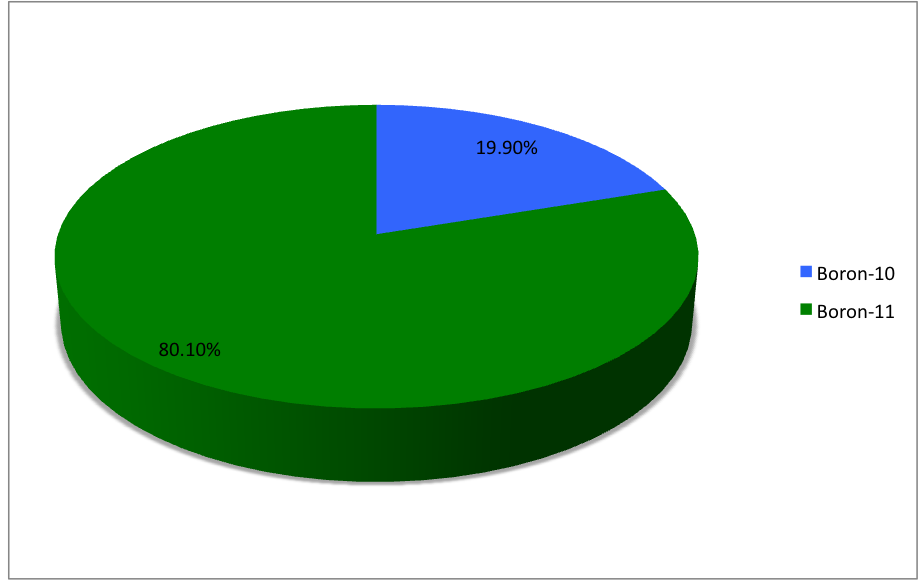
B, the latter of which makes up about 80% of natural boron. There are 13 radioisotopes that have been discovered, with mass numbers from 7 to 21, all with short half-lives, the longest being that of 8
B, with a half-life of only 771.9(9) ms and 12
B with a half-life of 20.20(2) ms. All other isotopes have half-lives shorter than 17.35 ms. Those isotopes with mass below 10 decay into helium (via short-lived isotopes of beryllium for 7
B and 9
B) while those with mass above 11 mostly become carbon.

List of isotopes
[edit]| Nuclide [n 1] |
Z | N | Isotopic mass (Da)[4] [n 2][n 3] |
Half-life[1] [resonance width] |
Decay mode[1] [n 4] |
Daughter isotope [n 5] |
Spin and parity[1] [n 6][n 7] |
Natural abundance (mole fraction) | |||||||||||
|---|---|---|---|---|---|---|---|---|---|---|---|---|---|---|---|---|---|---|---|
| Excitation energy | Normal proportion[1] | Range of variation | |||||||||||||||||
| 7 B |
5 | 2 | 7.029712(27) | 570(14) ys [801(20) keV] |
p | 6 Be[n 8] |
(3/2−) | ||||||||||||
| 8 B[n 9][n 10] |
5 | 3 | 8.0246073(11) | 771.9(9) ms | β+α | 4 He |
2+ | ||||||||||||
| 8m B |
10624(8) keV | 0+ | |||||||||||||||||
| 9 B |
5 | 4 | 9.0133296(10) | 800(300) zs | p | 8 Be[n 11] |
3/2− | ||||||||||||
| 10 B[n 12] |
5 | 5 | 10.012936862(16) | Stable | 3+ | [0.189, 0.204][5] | |||||||||||||
| 11 B |
5 | 6 | 11.009305167(13) | Stable | 3/2− | [0.796, 0.811][5] | |||||||||||||
| 11m B |
12560(9) keV | 1/2+, (3/2+) | |||||||||||||||||
| 12 B |
5 | 7 | 12.0143526(14) | 20.20(2) ms | β− (99.40(2)%) | 12 C |
1+ | ||||||||||||
| β−α (0.60(2)%) | 8 Be[n 13] | ||||||||||||||||||
| 13 B |
5 | 8 | 13.0177800(11) | 17.16(18) ms | β− (99.734(36)%) | 13 C |
3/2− | ||||||||||||
| β−n (0.266(36)%) | 12 C | ||||||||||||||||||
| 14 B |
5 | 9 | 14.025404(23) | 12.36(29) ms | β− (93.96(23)%) | 14 C |
2− | ||||||||||||
| β−n (6.04(23)%) | 13 C | ||||||||||||||||||
| β−2n ?[n 14] | 12 C ? | ||||||||||||||||||
| 14m B |
17065(29) keV | 4.15(1.90) zs | IT ?[n 14] | 0+ | |||||||||||||||
| 15 B |
5 | 10 | 15.031087(23) | 10.18(35) ms | β−n (98.7(1.0)%) | 14 C |
3/2− | ||||||||||||
| β− (< 1.3%) | 15 C | ||||||||||||||||||
| β−2n (< 1.5%) | 13 C | ||||||||||||||||||
| 16 B |
5 | 11 | 16.039841(26) | > 4.6 zs | n ?[n 14] | 15 B ? |
0− | ||||||||||||
| 17 B[n 15] |
5 | 12 | 17.04693(22) | 5.08(5) ms | β−n (63(1)%) | 16 C |
(3/2−) | ||||||||||||
| β− (21.1(2.4)%) | 17 C | ||||||||||||||||||
| β−2n (12(2)%) | 15 C | ||||||||||||||||||
| β−3n (3.5(7)%) | 14 C | ||||||||||||||||||
| β−4n (0.4(3)%) | 13 C | ||||||||||||||||||
| 18 B |
5 | 13 | 18.05560(22) | < 26 ns | n | 17 B |
(2−) | ||||||||||||
| 19 B[n 16] |
5 | 14 | 19.06417(56) | 2.92(13) ms | β−n (71(9)%) | 18 C |
(3/2−) | ||||||||||||
| β−2n (17(5)%) | 17 C | ||||||||||||||||||
| β−3n (< 9.1%) | 16 C | ||||||||||||||||||
| β− (> 2.9%) | 19 C | ||||||||||||||||||
| 20 B[6] |
5 | 15 | 20.07451(59) | > 912.4 ys | n | 19 B |
(1−, 2−) | ||||||||||||
| 21 B[6] |
5 | 16 | 21.08415(60) | > 760 ys | 2n | 19 B |
(3/2−) | ||||||||||||
| This table header & footer: | |||||||||||||||||||
- ^ mB – Excited nuclear isomer.
- ^ ( ) – Uncertainty (1σ) is given in concise form in parentheses after the corresponding last digits.
- ^ # – Atomic mass marked #: value and uncertainty derived not from purely experimental data, but at least partly from trends from the Mass Surface (TMS).
- ^
Modes of decay:
n: Neutron emission p: Proton emission - ^ Bold symbol as daughter – Daughter product is stable.
- ^ ( ) spin value – Indicates spin with weak assignment arguments.
- ^ # – Values marked # are not purely derived from experimental data, but at least partly from trends of neighboring nuclides (TNN).
- ^ Subsequently decays by double proton emission to 4
He for a net reaction of 7
B → 4
He + 3 1
H - ^ Has 1 halo proton
- ^ Intermediate product of a branch of proton–proton chain in stellar nucleosynthesis as part of the process converting hydrogen to helium
- ^ Immediately decays into two α particles, for a net reaction of 9
B → 2 4
He + 1
H - ^ One of the few stable odd-odd nuclei
- ^ Immediately decays into two α particles, for a net reaction of 12
B → 3 4
He + e− - ^ a b c Decay mode shown is energetically allowed, but has not been experimentally observed to occur in this nuclide.
- ^ Has 2 halo neutrons
- ^ Has 4 halo neutrons
Boron-8
[edit]Boron-8 is an isotope of boron that undergoes β+ decay to beryllium-8 with a half-life of 771.9(9) ms. It is the strongest candidate for a halo nucleus with a loosely-bound proton, in contrast to neutron halo nuclei such as lithium-11.[7]
Although boron-8 beta decay neutrinos from the Sun make up only about 80 ppm of the total solar neutrino flux, they have a higher energy centered around 10 MeV,[8] and are an important background to dark matter direct detection experiments.[9] They are the first component of the neutrino floor that dark matter direct detection experiments are expected to eventually encounter.
Applications
[edit]Boron-10
[edit]Boron-10 is used in boron neutron capture therapy as an experimental treatment of some brain cancers.
See also
[edit]Daughter products other than boron
References
[edit]- ^ a b c d e Kondev, F. G.; Wang, M.; Huang, W. J.; Naimi, S.; Audi, G. (2021). "The NUBASE2020 evaluation of nuclear properties" (PDF). Chinese Physics C. 45 (3) 030001. doi:10.1088/1674-1137/abddae.
- ^ "Standard Atomic Weights: Boron". CIAAW. 2009.
- ^ Prohaska, Thomas; Irrgeher, Johanna; Benefield, Jacqueline; Böhlke, John K.; Chesson, Lesley A.; Coplen, Tyler B.; Ding, Tiping; Dunn, Philip J. H.; Gröning, Manfred; Holden, Norman E.; Meijer, Harro A. J. (2022-05-04). "Standard atomic weights of the elements 2021 (IUPAC Technical Report)". Pure and Applied Chemistry. doi:10.1515/pac-2019-0603. ISSN 1365-3075.
- ^ Wang, Meng; Huang, W.J.; Kondev, F.G.; Audi, G.; Naimi, S. (2021). "The AME 2020 atomic mass evaluation (II). Tables, graphs and references*". Chinese Physics C. 45 (3) 030003. doi:10.1088/1674-1137/abddaf.
- ^ a b "Atomic Weight of Boron". CIAAW.
- ^ a b Leblond, S.; et al. (2018). "First observation of 20B and 21B". Physical Review Letters. 121 (26): 262502–1–262502–6. arXiv:1901.00455. doi:10.1103/PhysRevLett.121.262502. PMID 30636115. S2CID 58602601.
- ^ Maaß, Bernhard; Müller, Peter; Nörtershäuser, Wilfried; Clark, Jason; Gorges, Christian; Kaufmann, Simon; König, Kristian; Krämer, Jörg; Levand, Anthony; Orford, Rodney; Sánchez, Rodolfo; Savard, Guy; Sommer, Felix (November 2017). "Towards laser spectroscopy of the proton-halo candidate boron-8". Hyperfine Interactions. 238 (1): 25. Bibcode:2017HyInt.238...25M. doi:10.1007/s10751-017-1399-5. S2CID 254551036.
- ^ Bellerive, A. (2004). "Review of solar neutrino experiments". International Journal of Modern Physics A. 19 (8): 1167–1179. arXiv:hep-ex/0312045. Bibcode:2004IJMPA..19.1167B. doi:10.1142/S0217751X04019093. S2CID 16980300.
- ^ Cerdeno, David G.; Fairbairn, Malcolm; Jubb, Thomas; Machado, Pedro; Vincent, Aaron C.; Boehm, Celine (2016). "Physics from solar neutrinos in dark matter direct detection experiments". JHEP. 2016 (5): 118. arXiv:1604.01025. Bibcode:2016JHEP...05..118C. doi:10.1007/JHEP05(2016)118. S2CID 55112052.
Isotopes of boron
View on GrokipediaOverview
Natural occurrence and abundance
Boron occurs naturally on Earth primarily in the form of two stable isotopes, ^{10}B and ^{11}B, which constitute the entirety of primordial boron in terrestrial materials. The average concentration of boron in the Earth's crust is approximately 10 ppm, though values range from 5 ppm in basaltic rocks to higher levels in shales and sediments.[7] This element is dispersed in various minerals and fluids, with no significant presence of radioactive isotopes in natural samples due to their short half-lives, typically on the order of milliseconds to days.[2] The natural isotopic abundance of boron shows ^{10}B comprising 18.9–20.4% and ^{11}B 79.6–81.1%, reflecting variations in geological reservoirs that influence the standard atomic weight of [10.806, 10.821]. For instance, continental crust exhibits a slightly higher proportion of ^{10}B (around 20%) compared to seawater (approximately 19.2%), driven by differences in isotopic compositions across environments. These abundances are determined relative to the certified reference material NBS SRM 951, with the isotopic ratio ^{11}B/^{10}B standardized at 4.04558.[2][8] Isotopic fractionation of boron occurs during geological processes such as evaporation, adsorption onto clays, and incorporation into minerals, leading to significant variations in the δ^{11}B notation, which measures deviations in the ^{11}B/^{10}B ratio from the standard in per mil (‰). Natural δ^{11}B values span a wide range from -70‰ to +60‰, with continental crust averaging -9.4‰ and seawater at +39.5‰, highlighting the role of low-temperature surface processes in enriching heavier ^{11}B in oceanic settings.[9][8][10] Primary natural sources of boron include evaporite deposits (e.g., borates like kernite and ulexite), volcanic emanations and hot springs, and minor contributions from cosmic dust influx, which together maintain the element's cycle in the lithosphere, hydrosphere, and atmosphere without substantial radioactive contributions.[9][7]Isotopic characteristics
Boron has 15 known isotopes, spanning mass numbers from ^7B to ^21B, with only ^10B and ^11B being stable. The lighter isotopes (A < 10) are proton-rich and unstable, decaying primarily through positron emission (β⁺) or proton (p) emission to corresponding beryllium isotopes, while the heavier isotopes (A > 11) are neutron-rich and decay via electron emission (β⁻) or neutron (n) emission to carbon isotopes. The valley of stability lies at A = 10 and 11, where the binding energy per nucleon reaches its maximum for boron, approximately 6.5 MeV, reflecting greater nuclear stability compared to the more loosely bound lighter and heavier isotopes. No isotopes beyond ^21B have been observed, as they lie beyond the neutron drip line, where neutrons become unbound.[11] The following table summarizes the key nuclear properties of these isotopes, based on evaluated data. Half-lives are given for ground states, decay modes indicate primary channels, and spin/parity refers to the ground-state values. Binding energy trends show a rise to a peak at the stable isotopes followed by a decline, with per-nucleon values dropping to below 5 MeV for the extremes near the drip lines.[11]| Mass number | Half-life | Decay modes | Spin/parity |
|---|---|---|---|
| 7 | 570(14) × 10^{-24} s | p | (3/2⁻) |
| 8 | 771.9(9) ms | β⁺, EC | 2⁺ |
| 9 | 8(3) × 10^{-19} s | p | 3/2⁻ |
| 10 | Stable | - | 3⁺ |
| 11 | Stable | - | 3/2⁻ |
| 12 | 20.20(2) ms | β⁻ | 1⁺ |
| 13 | 17.16(18) ms | β⁻ | 3/2⁻ |
| 14 | 12.36(29) ms | β⁻, n | 2⁻ |
| 15 | 10.18(35) ms | β⁻, n | 3/2⁻ |
| 16 | < 0.19 ns | n | 0⁻ |
| 17 | 5.08(5) ms | β⁻, n | (3/2⁻) |
| 18 | <26 ns | n | (2⁻) |
| 19 | 2.92(13) ms | β⁻, n | 3/2⁻ |
| 20 | <260 ns | n | (1⁻, 2⁻) |
| 21 | <260 ns | 2n | (3/2⁻) |
