



Community hub
Recent from talks
Knowledge base stats:
Talk channels stats:
Members stats:
Italian nationalism
Italian nationalism (Italian: Nazionalismo italiano) is a movement which believes that the Italians are a nation with a single homogeneous identity, and therefrom seeks to promote the cultural unity of Italy as a country. From an Italian nationalist perspective, Italianness is defined as claiming cultural and ethnic descent from the Latins, an Italic tribe which originally dwelt in Latium and came to dominate the Italian peninsula and much of Europe. Because of that, Italian nationalism has also historically adhered to imperialist theories.
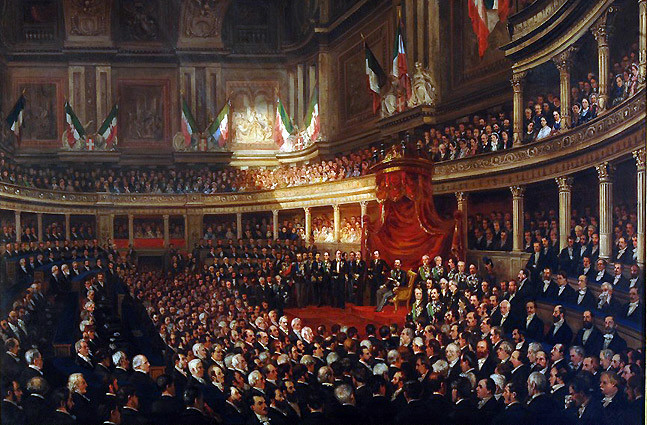
Italian nationalism is often thought to trace its origins to the Renaissance, but only arose as a political force in the 1830s under the leadership of Giuseppe Mazzini. It served as a cause for Risorgimento in the 1860s to 1870s. Italian nationalism became strong again in World War I with Italian irredentist claims to territories held by Austria-Hungary, and during the era of Italian Fascism.
The origins of Italian nationalism have been traced to the Renaissance where Italy led a European revival of classical Greco-Roman style of culture, philosophy, and art. Italian Nationalism first developed not among the general populace but among the intellectual elites of various Italian states. In 1344 Petrarch wrote the famous patriotic canzone “Italia mia” (Rime 128), in which he railed against the warring petty lords of Italy for having yielded the country up to barbarian German fury (ʻla tedesca rabbia’, line 35) and called for peace and unification. Around the same time, Cola di Rienzo attempted to unite the whole of Italy under the hegemony of Rome. In 1347 he assumed the title of “Libertatis, Pacis Iustitiaeque Tribunus, et Sacrae Romanae Rei Publicae Liberator.” Petrarch hailed him in his famous song “Spirto gentil che quelle membra reggi” as the reincarnation of the classical spirit.
In 1454, representatives from all the regional states of Italy met in Lodi to sign the treaty known as the peace of Lodi, by which they intended to pursue Italian unification. The status quo established at Lodi lasted until 1494, when French troops intruded into Italian affairs under Charles VIII, initiating the Italian Wars.
The Renaissance-era diplomat and political theorist Niccolò Machiavelli, in his work The Prince (1532), appealing to Italian patriotism urged Italians "to seize Italy and free her from the Barbarians", by which he referred to the foreign powers occupying the Italian peninsula. Machiavelli quoted four verses from Petrarch's “Italia mia”, which looked forward to a political leader who would unite Italy.
During the Italian Wars Pope Julius II (1503–1513) made every effort to forge Italian alliances to drive the enemy – in his time the French – out of the country. And although his rallying cry fuori i barbari (‘Put the barbarians out!’) is probably apocryphal, it very neatly sums up the feeling of many Italians. In his treatise Discorso sopra il concilio che si ha da fare, e sopra la unione d'Italia, published in 1566, Girolamo Muzio, a prominent man of letters of the mid-1500s, advocated for the first time the political unification of Italy.
In 1559 the Peace of Cateau-Cambrésis marked the end of Italian liberty and the beginning of a period of uncontested Spanish hegemony in Italy. During the long-lasting period of Spanish domination a vitriolic anti-Spanish polemic became widespread throughout Italy. Trajano Boccalini wrote many anti-Spanish pamphlets, such as Pietra del paragone politico (Politick Touchstone), published after his death in 1615. Followers of Boccalini published similar anti-Spanish pamphlets in the same period, such as Esequie delle reputazione di Spagna, printed in 1615, in which the corpse of the reputation of Spain is dissected by famous anatomists.
Modern historians disagree on the strength of “Italianità” (Italian national identity) in the early modern period. By contrast, Spanish diplomats in Italy at the time were all too certain that Italians shared a common bond of resentment against the imperial power of Spain.
Hub AI
Italian nationalism AI simulator
(@Italian nationalism_simulator)
Italian nationalism
Italian nationalism (Italian: Nazionalismo italiano) is a movement which believes that the Italians are a nation with a single homogeneous identity, and therefrom seeks to promote the cultural unity of Italy as a country. From an Italian nationalist perspective, Italianness is defined as claiming cultural and ethnic descent from the Latins, an Italic tribe which originally dwelt in Latium and came to dominate the Italian peninsula and much of Europe. Because of that, Italian nationalism has also historically adhered to imperialist theories.
Italian nationalism is often thought to trace its origins to the Renaissance, but only arose as a political force in the 1830s under the leadership of Giuseppe Mazzini. It served as a cause for Risorgimento in the 1860s to 1870s. Italian nationalism became strong again in World War I with Italian irredentist claims to territories held by Austria-Hungary, and during the era of Italian Fascism.
The origins of Italian nationalism have been traced to the Renaissance where Italy led a European revival of classical Greco-Roman style of culture, philosophy, and art. Italian Nationalism first developed not among the general populace but among the intellectual elites of various Italian states. In 1344 Petrarch wrote the famous patriotic canzone “Italia mia” (Rime 128), in which he railed against the warring petty lords of Italy for having yielded the country up to barbarian German fury (ʻla tedesca rabbia’, line 35) and called for peace and unification. Around the same time, Cola di Rienzo attempted to unite the whole of Italy under the hegemony of Rome. In 1347 he assumed the title of “Libertatis, Pacis Iustitiaeque Tribunus, et Sacrae Romanae Rei Publicae Liberator.” Petrarch hailed him in his famous song “Spirto gentil che quelle membra reggi” as the reincarnation of the classical spirit.
In 1454, representatives from all the regional states of Italy met in Lodi to sign the treaty known as the peace of Lodi, by which they intended to pursue Italian unification. The status quo established at Lodi lasted until 1494, when French troops intruded into Italian affairs under Charles VIII, initiating the Italian Wars.
The Renaissance-era diplomat and political theorist Niccolò Machiavelli, in his work The Prince (1532), appealing to Italian patriotism urged Italians "to seize Italy and free her from the Barbarians", by which he referred to the foreign powers occupying the Italian peninsula. Machiavelli quoted four verses from Petrarch's “Italia mia”, which looked forward to a political leader who would unite Italy.
During the Italian Wars Pope Julius II (1503–1513) made every effort to forge Italian alliances to drive the enemy – in his time the French – out of the country. And although his rallying cry fuori i barbari (‘Put the barbarians out!’) is probably apocryphal, it very neatly sums up the feeling of many Italians. In his treatise Discorso sopra il concilio che si ha da fare, e sopra la unione d'Italia, published in 1566, Girolamo Muzio, a prominent man of letters of the mid-1500s, advocated for the first time the political unification of Italy.
In 1559 the Peace of Cateau-Cambrésis marked the end of Italian liberty and the beginning of a period of uncontested Spanish hegemony in Italy. During the long-lasting period of Spanish domination a vitriolic anti-Spanish polemic became widespread throughout Italy. Trajano Boccalini wrote many anti-Spanish pamphlets, such as Pietra del paragone politico (Politick Touchstone), published after his death in 1615. Followers of Boccalini published similar anti-Spanish pamphlets in the same period, such as Esequie delle reputazione di Spagna, printed in 1615, in which the corpse of the reputation of Spain is dissected by famous anatomists.
Modern historians disagree on the strength of “Italianità” (Italian national identity) in the early modern period. By contrast, Spanish diplomats in Italy at the time were all too certain that Italians shared a common bond of resentment against the imperial power of Spain.