


Community hub
Recent from talks
Contribute something
Nothing was collected or created yet.
Iyotetsu
View on Wikipedia | This article needs additional citations for verification. (October 2018) |
The Iyo Railway Co., Ltd. (伊予鉄道株式会社, Iyotetsudo kabushiki gaisha), commonly known as Iyotetsu, is the main transport provider in Matsuyama, Ehime, Shikoku, Japan. The company operates railway, tram, and bus lines, and also has many subsidiaries, which include a bank, department stores, travel agencies, and various other businesses.
Key Information


History
[edit]The company was founded on September 14, 1887, and its Takahama railway line, the first in Shikoku, was opened on October 28, 1888. In addition to being the first railway in Shikoku, it was also the third private railway in Japan.[1] It is named for the former Iyo Province. The first tramway was electrified in 1911, whilst the entire tram network was changed from 1,435 mm (4 ft 8+1⁄2 in) gauge to 1,067 mm (3 ft 6 in) gauge in 1923.[2]
Services
[edit]Railway
[edit]
Iyotetsu operates the following railway lines.
- ■ Takahama Line: Takahama — Matsuyama City
- ■ Yokogawara Line: Matsuyama City — Yokogawara
- ■ Gunchū Line: Matsuyama City — Gunchū Port
Takahama Line
[edit]This 9.4 km line opened as 762 mm (2 ft 6 in) gauge in 1888, and was regauged to 1,067 mm (3 ft 6 in), double-tracked to Baishinji (8.2 km) and electrified at 600 V DC in 1931. This line is still electrified at 600 V DC, not increased to 750 V DC as Yokogawara or Gunchū Lines.[3] The Takahama Line and the Ōtemachi Tramline have one of the few remaining rail/tram level crossings in Japan.[4]
Yokogawara Line
[edit]This 13.2 km line opened as 762 mm (2 ft 6 in) gauge in 1893, and was regauged to 1,067 mm (3 ft 6 in) in 1931. Steam locomotives were replaced by diesel traction in 1954, and the line was electrified at 750 V DC in 1967. Through services to and from the Takahama line commenced in 1981.[3]
Gunchū Line
[edit]The initial 10.7 km line was opened as a 762 mm (2 ft 6 in) gauge line in 1896 by the South Iyo Railway. Iyotetsu acquired it through merger in 1900. It was regauged to 1,067 mm (3 ft 6 in) in 1937.[3] In 1939, a 600 m extension opened to Gunchuko, enabling a transfer to JR Iyo station (today Iyoshi on the Yosan Line.[5] The line was electrified in 1950 at 600 V DC, increased to 750 V DC in 1976.[3]
CTC signalling was introduced on the rail system in 1993.[3]
Former connecting lines
[edit]A 4.4 km 762 mm gauge line opened from Iyo Tachibana (on the Yokogawara Line) to Morimatsu in 1896, the line being regauged to 1,067 mm in 1931. The line closed in 1965.[6]
Tram
[edit]Iyotetsu operates the Matsuyama City Lines (松山市内線, Matsuyama Shinai-sen), a system of five interconnected tram (路面電車, romen-densha) lines.

Lines
[edit]There are officially five lines, as follows.
- Jōhoku Line: Komachi — Heiwadōri 1
- Jōnan Line: Dōgo Onsen — Nishi-Horibata
- Honmachi Line: Minami-Horibata — Hommachi 6
- Ōtemachi Line: Komachi — Nishi-Horibata
- Hanazono Line: Matsuyama City Station — Minami-Horibata
- Renraku Line: Heiwadōri 1 — Kami-Ichiman
Routes
[edit]There are five routes regularly in service by using one or more lines above.
- ■ Route 1 - Loop Line (clockwise): Matsuyama City Station → JR Matsuyama Station → Kiyachō → Kami-Ichiman → Ōkaidō → Matsuyama City Station
- ■ Route 2 - Loop Line (counter-clockwise): Matsuyama City Station → Ōkaidō → Kami-Ichiman → Kiyachō → JR Matsuyama Station → Matsuyama City Station
- ■ Route 3: Dōgo Onsen — Ōkaidō — Matsuyama City Station
- ■ Route 5: Dōgo Onsen — Ōkaidō — JR Matsuyama Station
- ■ Route 6: Dōgo Onsen — Hommachi 6
Bus
[edit]
The company operates highway buses linking Matsuyama and the major cities of Japan, including Tokyo, Ōsaka, Fukuyama, Takamatsu, Tokushima, and Kōchi. It also operates a local network in and around the city, including services that operate to and from Matsuyama Airport.
Rolling stock
[edit]Heavy rail
[edit]- Iyotetsu 700 series two/three-car EMU sets (since 1987, converted from former Keio 5000 series trains)
- Iyotetsu 610 series two-car EMU sets (since 1995)
- Iyotetsu 3000 series three-car EMU sets (since 2009, converted from former Keio 3000 series trains)
- Iyotetsu 7000 series three-car EMU sets (since 2025)[7]
-
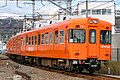 700 series set 728 in December 2021
 -
 610 series EMU set 612 in April 2023
 -
 3000 series set 3010 in December 2021


Trams
[edit]- MoHa 50 series (since 1951)
- MoHa 2000 series (since 1964)
- MoHa 2100 series (since 2002)
- MoHa 5000 series (from September 2017)
Two 5000 series low-floor tramcars (numbers 5001 and 5002) were delivered in September 2017, scheduled to enter revenue service on 21 September 2017.[8][9]
-
 A MoHa 50 series tramcar
 -
 A MoHa 2000 series tramcar
 -
 A MoHa 2100 series tramcar
 -
 A MoHa 5000 series tramcar


Former rolling stock
[edit]- Iyotetsu 100 series
- Iyotetsu 300 series (until 2008)
- Iyotetsu 600 series (until 2008)
- Iyotetsu 800 series (until 2010, converted from former Keio 2010 series trains)
-
 An Iyotetsu 100 series train in 1984
 -
 An Iyotetsu 300 series train in October 2008
 -
 An Iyotetsu 600 series train in March 2008
 -
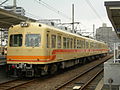 An Iyotetsu 800 series train in March 2008


Botchan Ressha
[edit].jpg)
Iyo Railway also operates the Botchan Ressha, diesel-powered replicas of the original Iyotetsu steam locomotives, well-known from Natsume Sōseki's famous 1906 novel, Botchan. The current Botchan Ressha, operating on two of the city lines since 2001, reproduces the atmosphere of early Meiji era train travel in Matsuyama.
See also
[edit]References
[edit]This article incorporates material from the corresponding article in the Japanese Wikipedia.
- ^ "Yuichiro Kishi, "Railway Operators in Japan 13: Shikoku Region", Japan Railway & Transport Review 39 (2004): 44". Archived from the original on 2011-09-22. Retrieved 2011-05-19.
- ^ Brown, Colin (2007). "Tramway Opening and Closure Dates". Bullet-In Issue 61, p.25
- ^ a b c d e Terada, Hirokazu (19 January 2013). データブック日本の私鉄 [Databook: Japan's Private Railways] (in Japanese). Japan: Neko Publishing. pp. 170, 301. ISBN 978-4-7770-1336-4.
- ^ Kawashima, Ryōzō (2013). 図説: 日本の鉄道 四国・九州ライン 全線・全駅・全配線・第2巻 四国西部エリア [Japan Railways Illustrated. Shikoku and Kyushu. All lines, all stations, all track layouts. Volume 2 Western Shikoku] (in Japanese). Kodansha. p. 18. ISBN 9784062951616.
- ^ Kawashima, Ryōzō (2013). 図説: 日本の鉄道 四国・九州ライン 全線・全駅・全配線・第2巻 四国西部エリア [Japan Railways Illustrated. Shikoku and Kyushu. All lines, all stations, all track layouts. Volume 2 Western Shikoku] (in Japanese). Kodansha. p. 86. ISBN 9784062951616.
- ^ Imao, Keisuke (2009). 日本鉄道旅行地図帳 11号 中国四国―全線・全駅・全廃線 (11) [Japan Rail Travel Atlas No. 11 Chugoku Shikoku - all lines, all stations and disused lines] (in Japanese). Mook. p. 55. ISBN 9784107900296.
- ^ 伊予鉄道、67年ぶり新型車両「7000系」の運行開始 [Iyotetsu's first new train in 67 years, the 7000 series, enters revenue service]. The Nikkei (in Japanese). 2025-02-21. Retrieved 2025-02-21.
- ^ 伊予鉄道5000形が古町車両工場に搬入される [Iyo Railway 5000 series delivered to Komachi Depot]. Japan Railfan Magazine Online (in Japanese). Japan: Koyusha Co., Ltd. 1 September 2017. Archived from the original on 4 September 2017. Retrieved 4 September 2017.
- ^ INC, SANKEI DIGITAL (2017-09-25). "ゆったり乗車できます 松山・伊予鉄路面電車に新型LRT5000系車両導入". 産経ニュース (in Japanese). Retrieved 2024-02-21.
External links
[edit]
- Official website (in English)
- Official website (in Japanese)
Transit in Shikoku | |
|---|---|
 JR Shikoku JR Shikoku | |
| Heavy rail lines | |
| Tram and light rails | |
| Cable car and aerial tramways | |
 Airports Airports | |
 Ferries Ferries |
|
 Card Card | |


| International | |
|---|---|
| National | |
| Academics | |
