Hubbry Logo
JS IseJS IseMain
Open search
JS Ise
Community hub
JS Ise
logo
8 pages, 0 posts
0 subscribers
Be the first to start a discussion here.
JS Ise
JS Ise
from Wikipedia

JS Ise
History
Japan
Name
  • Ise
  • (いせ)
NamesakeIse Province
Ordered2006
BuilderIHI, Yokohama
Laid down30 May 2008
Launched21 August 2009
Commissioned16 March 2011
HomeportSasebo
Identification
MottoReadiness, Expertness, Integrity[1]
StatusActive
General characteristics
Class & typeHyūga-class helicopter destroyer
Displacement
  • 13,950 long tons (14,170 t) standard;
  • 19,000 long tons (19,000 t) full load
Length197 m (646 ft 4 in)
Beam33 m (108 ft 3 in)
PropulsionCOGAG, two shafts, 100,000 hp (75,000 kW)
Speedmore than 30 knots (56 km/h; 35 mph)
Sensors &
processing systems
  • ATECS (advanced technology command system)
    • OYQ-10 advanced combat direction system
    • FCS-3 AAW system
    • OQQ-21 ASW system
    • NOLQ-3C EW system
    • OPS-20C surface search radar
Armament
Aircraft carried
Aviation facilitiesFlight deck and enclosed hangar

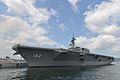
JS Ise (DDH-182) is a Hyūga-class helicopter destroyer of the Japan Maritime Self-Defense Force (JMSDF). She is the second ship to be named Ise, the first being the Imperial Japanese Navy World War II-era battleship Ise.

Development and design

[edit]

They are sometimes referred to as an aircraft carrier (helicopter carrier) from the ship's type of flight deck,[2] but officially follows the predecessor Haruna-class destroyer, and as they are also a helicopter destroyer. In addition to advanced command and control capabilities, the ship itself has powerful anti-submarine and anti-aircraft combat capabilities due to the vertical launch system that can launch anti-submarine and anti-aircraft missiles and the newly developed C4ISTAR system. Instead, the function as an escort ship that can perform anti-submarine warfare with its own equipment is also emphasized. This point is one of the features that is significantly different from the Izumo-class helicopter destroyer, which specializes in on-board helicopter operation, with only the minimum weapons for self-defense (two each for close-range air defense missiles and high-performance 20 mm machine guns).[3]

They have the ability to operate a large number of helicopters at the same time due to its vast full deck and large hull volume. As a result, it has superior zone anti-submarine warfare capability than conventional helicopter-equipped destroyers, and can also handle transport helicopters and rescue helicopters. Respond to various missions such as support.

Since the hull size is larger than some conventional light aircraft carriers and amphibious assault ships, it may be compared with light aircraft carriers that operate STOVL aircraft such as the F-35 and Harrier. However, the Japanese Ministry of Defense has not announced the operation of fixed-wing aircraft in the model, and Yoji Koda, a former fleet commander of the JMSDF, states that the ship is completely different in nature from an aircraft carrier.

Construction and career

[edit]

The vessel was laid down on 30 May 2008 and launched on 21 August 2009 by IHI Marine United at Yokohama and her first sea trial started on July 20, 2010. She was commissioned into service on 16 March 2011.[4] She was transferred to the 4th Escort Group 4th Escort Corps. Her home port is Kure. Her name plate was made by Naotake Takatsuka, Ise Jingu Omiyaji, and her wood was the zelkova used for Uji Bridge.[5]

She assisted in post-Typhoon Haiyan disaster relief efforts in the Philippines as part of the JSDF's in November 2013.[6] Ise participated in RIMPAC alongside the JS Kirishima from June 26 to August 1, 2014.[7] Ise docked in the Philippines on April 26, 2016 for a four-day goodwill visit.[8]

On March 22, 2017, due to the reorganization of the second Izumo-class helicopter destroyer JS Kaga, she was transferred to the 2nd Escort Group, and the fixed port was transferred to Sasebo. From September 11 to 28 of the same year, she participated in joint training, along with JS Akebono and JS Sazanami, with the USS Ronald Reagan and the Aegis ships of the US Navy in the waters south of the Japanese archipelago.[9] On November 12, the same year, she conducted joint US-Japan training with several ships including USS Ronald Reagan, USS Nimitz, and USS Theodore Roosevelt, along with JS Inazuma and JS Makinami in the Sea of Japan.[10]

From March 11 to 23, 2018, Japan-US joint cruising training was conducted with several ships including the USS Carl Vinson in the sea and airspace from the northern part of the South China Sea to the area around Okinawa.[11] From June 8 to June 16 of the same year, she participated in the Japan-US-India Joint Training (MALABAR 2018) conducted on Guam Island and the sea and airspace around the island.[12] In addition to Ise, the participating units include JS Fuyuzuki and JS Suzunami, five onboard aircraft, JS Soryu, and two P-1 patrol aircraft.[13] Ise continued to participate in the RIMPAC 2018, which were held from June 27 to August 2.[14] On September 22, she arrived at Karatsu Port for the first time in five years. The welcome ceremony was attended by officials such as the local mayor.[15] On December 1, Ise sailed south of Yakushima, Kagoshima Prefecture, in search of a man in his forties who fell into the sea from the JS Kongō the day before. Around 4 am on the 1st, the crew of Ise discovered him drifting about 50 km south of Yakushima, clinging to a drifting object such as a cooler box, and were able to rescue him.[16]

She was placed under the command of the Mine Warfare Force commander during training with the U.S. military (Talisman Saber 19), which was conducted from June 3 to August 21, 2019 at the Shoalwater Bay Exercise Area in Queensland, Australia and the surrounding waters. In addition, JS Kunisaki and the Amphibious Rapid Deployment Brigade and the 1st Helicopter Corps from the Ground Self-Defense Force participated in joint landing and land combat between Japan and the United States, joint cruise training, etc.[17]

Ise alongside JS Ashigara took part in RIMPAC exercise in the waters near Hawaii from August 17 to 30 of 2020. Both ships arrived two weeks before the start of the exercise.[18][19] In September 2023, the first landings by Ground Self Defence Force (JGSDF) V-22 aircraft were conducted on the helicopter carrier. The landings were part of efforts to strengthen inter-operability and create the JGSDF's Amphibious Rapid Deployment Brigade for the purpose of better defending Japan's southern Nansei Islands.[20]

[edit]

Notes

[edit]
[edit]
Revisions and contributorsEdit on WikipediaRead on Wikipedia
from Grokipedia
JS Ise (DDH-182) is a Hyūga-class helicopter destroyer operated by the (JMSDF). She is the second warship to bear the name Ise, following an battleship from the Second World War era. Commissioned on 16 March 2011 after being laid down on 30 May 2008 and launched on 21 August 2009, the vessel was constructed by IHI Marine United at its shipyard. With a full-load displacement of approximately 19,000 tonnes and a length of 197 meters, JS Ise ranks among the largest surface combatants in the JMSDF inventory. Her design emphasizes , featuring a spacious through-deck and capable of accommodating up to 11 rotary-wing , such as SH-60K anti-submarine helicopters, alongside advanced systems and vertical launch systems for missiles. Based at , she supports fleet command functions and has engaged in multinational exercises, including RIMPAC 2020 and joint maneuvers with U.S. and other allied forces to bolster regional maritime defense. As of 2025, JS Ise remains in active service, contributing to Japan's strategic deterrence in the amid evolving security challenges.

Overview and Specifications

Class Affiliation and Naming

JS Ise (DDH-182) belongs to the Hyūga-class of helicopter destroyers (DDH) in service with the Japan Maritime Self-Defense Force (JMSDF), serving as the second vessel in the class following the lead ship JS Hyūga (DDH-181). The Hyūga-class represents an evolution in JMSDF surface combatants, classified under the DDH designation to emphasize their helicopter-carrying and anti-submarine warfare roles within Japan's post-war constitutional constraints on offensive capabilities. This affiliation underscores the JMSDF's focus on defensive maritime operations, including enhanced command-and-control for fleet coordination. The ship's , DDH-182, formally identifies it within JMSDF , where "DDH" denotes a optimized for operations, distinguishing it from earlier classes like the Haruna-class. Operated by the JMSDF as part of Japan's Ministry of Defense, Ise exemplifies the service's integration into broader security frameworks while adhering to exclusively defensive postures. The name Ise honors the lead ship of the Imperial Japanese Navy's Ise-class battleships, a pair of dreadnoughts laid down in 1912 and commissioned during World War I, which later underwent aviation conversions in the 1930s. This naming practice revives pre-war naval heritage in the JMSDF, a tradition begun in the 1950s to foster institutional continuity amid Japan's pacifist reorientation under Article 9 of its constitution, without implying offensive intent. As the second JMSDF vessel to bear the name, it symbolizes a measured reclamation of historical identity in modern defensive naval architecture.

Physical Characteristics and Armament


JS Ise has a length of 197 meters, a beam of 33 meters, and a draft of 7 meters. Her displacement measures 13,950 tons at standard load and 19,000 tons at full load. The design incorporates a flush upper deck suitable for operations, with the positioned on the starboard side to maximize clear space for activities.
The ship's sensor suite emphasizes anti-submarine and air defense roles, featuring the active electronically scanned array radar for multi-function air and surface tracking, the OPS-20C surface search radar, and the OQQ-21 integrated system for underwater detection. These systems integrate with the OYQ-10 advanced combat direction subsystem to process data for coordinated engagements. Armament focuses on defensive and anti-submarine capabilities, including a single 16-cell Mk 41 (VLS) configured for RIM-162 Evolved SeaSparrow Missiles (ESSM) against aerial threats and RUM-139 Vertical Launch Anti-Submarine Rockets (VLA) for subsurface targets. Two Mk 15 Phalanx close-in weapon systems (CIWS) provide terminal defense with 20 mm gatling guns firing at high rates against incoming missiles and low-flying aircraft. Additionally, two triple-tube launchers accommodate Type 68 heavyweight torpedoes for , while .50 caliber machine guns offer supplementary close-range protection. No dedicated anti-ship missiles or long-range strike weapons are installed, aligning with the Japan Maritime Self-Defense Force's emphasis on area denial and defensive operations.

Propulsion and Performance

The propulsion system of JS Ise utilizes a (COGAG) configuration featuring four LM2500-30 gas turbines manufactured under license by Ishikawajima-Harima Heavy Industries, delivering a total of 100,000 shaft horsepower to two shafts fitted with five-bladed controllable-pitch propellers. This setup prioritizes reliability and rapid acceleration, drawing from proven maritime gas turbine technology adapted for the demands of helicopter destroyer operations. The system enables a maximum speed exceeding 30 knots, facilitating high-mobility escort duties and quick repositioning in dynamic maritime environments. Operational range is approximately 6,000 nautical miles at cruising speeds, supporting extended patrols with minimal reliance on immediate resupply, though exact endurance varies with load and . Fuel efficiency benefits from the turbines' , allowing selective engagement of engines to optimize consumption during lower-speed transits typical of anti-submarine .

Development and Design

Strategic Background

The in 1991 marked the end of the primary maritime threat that had shaped the (JMSDF) during the , shifting focus from open-ocean against Soviet naval forces to addressing proximate regional challenges. North Korea's test-launch of the ballistic missile on August 31, 1998, which flew over Japanese airspace, demonstrated the immediacy of missile threats capable of striking the home islands, compelling Japan to prioritize enhanced surveillance, interception, and area denial capabilities in its defense planning. Concurrently, China's naval modernization and territorial assertiveness in the , including repeated submarine incursions into Japanese territorial waters—such as a Han-class nuclear-powered detected near Okinawa in December 2001 and a Song-class diesel-electric tracked for over seven hours in 2004—exposed gaps in JMSDF's ability to monitor and counter stealthy underwater threats amid expanding Chinese submarine fleets estimated at over 60 vessels by the mid-2000s. These empirical threats drove doctrinal adaptations within the JMSDF, evolving from a post-World War II emphasis on escort and hunting in northern lanes to a multi-domain posture emphasizing control and in Japan's immediate littorals. This shift aligned with updates to Japan's National Defense Program Guidelines, such as the revision, which stressed responses to "gray zone" incursions and attacks without exceeding the "minimum necessary level" of self-defense forces permitted under Article 9 of the Constitution. Helicopter-equipped surface combatants emerged as a key enabler for this evolution, providing persistent aerial ASW patrols, over-the-horizon targeting, and rapid response to subsurface intrusions, thereby addressing the limitations of reliant on distant bases vulnerable to preemptive strikes. The U.S.-Japan Treaty of Mutual Cooperation and Security, revised in , underpinned these developments by framing JMSDF enhancements as complementary to U.S. forward presence, fostering interoperability in joint exercises while adhering to 's exclusively defense-oriented policy that precludes offensive strike capabilities. This alliance dynamic allowed to invest in platforms optimized for defensive maritime operations, such as bolstering anti-submarine detachments, without duplicating U.S. carrier-based power projection, thereby deterring aggression through credible denial rather than escalation dominance.

Key Design Features and Innovations

The Hyūga-class helicopter destroyers introduced a full through-deck configuration, marking a significant evolution from preceding JMSDF classes like the Haruna and Shirane, which featured limited aft flight decks. This design maximizes operational space for simultaneous helicopter launches and recoveries, supporting up to 11 SH-60K anti-submarine helicopters distributed across the enclosed hangar and flight deck. The arrangement enables swift deployment of aviation assets for anti-submarine warfare, enhancing the vessels' role in area denial and maritime deterrence without relying on fixed-wing capabilities. Positioning the island superstructure offset to starboard optimizes the central flight deck for unimpeded maneuvers, while the overall silhouette retains proportions to conform to Japan's post-war naval policy restrictions. This layout includes two aircraft elevators for efficient hangar-to-deck transfers, allowing sustained multi-role operations such as search-and-rescue or border surveillance alongside primary ASW missions. The class's architectural innovations prioritize versatility, with the expansive 197-meter length and integrated facilities supporting prolonged at-sea endurance and command functions, thereby extending JMSDF reach in contested waters. These features collectively shift the fleet toward hybrid surface-aviation platforms, bolstering defensive postures amid regional threats.

Modifications for Enhanced Capabilities

In response to evolving regional threats, particularly submarine proliferation and the need for enhanced , the JS Ise underwent refits in the focused on electronic and communication system upgrades rather than structural alterations. These enhancements included improvements to radar processing and capabilities, allowing for more effective coordination with escort destroyers and allied units. A key aspect of these modifications was the integration of advanced data links compatible with U.S. Navy systems, such as upgraded terminals, enabling real-time sharing of tactical data for networked warfare. This allowed the ship to contribute to distributed sensor networks during joint operations, extending its operational flexibility beyond standalone helicopter deployments. Unlike the Izumo-class vessels, which received deck reinforcements, heat-resistant coatings, and provisions for arrestor wires to support F-35B STOVL operations between 2018 and 2020, the Hyūga-class, including JS Ise, did not undergo comparable structural changes due to size limitations and hangar constraints unsuitable for fixed-wing jets. The JMSDF's retention of the DDH classification for JS Ise complies with Article 9 of Japan's constitution, which constrains offensive capabilities like dedicated aircraft carriers, while permitting light carrier roles through helicopter-centric aviation support and amphibious facilitation. This approach balances legal restrictions with strategic needs for in defensive scenarios.

Construction and Commissioning

Building Timeline

The keel of JS Ise (DDH-182) was laid down on 30 May 2008 at the Ishikawajima-Harima Heavy Industries (IHI) Marine United shipyard in , , initiating the hull fabrication and structural assembly processes. This step demonstrated 's self-reliant industry, with IHI handling integrated construction of the vessel's advanced hull form designed for operations. The ship was launched on 21 2009, transitioning from assembly to float-out for subsequent superstructure installation and systems integration. Post-launch activities included equipping the deck for facilities and installing components, underscoring the of Yokohama's facilities in producing large-displacement warships within a 15-month build-to-launch timeframe. Builder's sea trials followed, testing propulsion reliability, stability under load, and basic seaworthiness in controlled maritime conditions off the Japanese coast, as per standard protocols for JMSDF vessels to validate parameters before final fitting. These trials confirmed the integration of the ship's gas turbine engines and configurations without reported major deviations from specifications.

Launch and Fitting Out

JS Ise was launched on 21 August 2009 at the IHI Marine United shipyard in Yokohama, Japan. The launch marked the completion of the hull construction phase, transitioning the vessel into outfitting, where internal and external systems were installed and integrated. The fitting-out period, extending from late 2009 to early 2011, involved the installation of advanced radar systems, vertical launch systems for anti-air missiles, close-in weapon systems, and specialized aviation facilities including hangars and a reinforced for multiple operations. was paramount, with rigorous inspections ensuring structural integrity and system compatibility under JMSDF standards to maintain seaworthiness without compromise. Pre-commissioning trials focused on validating performance, electrical integration, and the suite's effectiveness, including simulated deployments. These tests confirmed the vessel's readiness for service, culminating in its formal commissioning on 16 March 2011.

Entry into Service

JS Ise (DDH-182) was formally commissioned into the on 16 March 2011 following completion of fitting out and sea trials that began in July 2010. Upon entry into service, the vessel was assigned to the 4th Escort Flotilla's 4th Escort Corps, with Naval Base designated as its homeport. Initial crew training emphasized integration of the ship's operations, systems, and command-and-control functions, drawing on the Hyūga-class design's focus on multi-role capabilities. Post-commissioning work-up periods included operational evaluations to certify full-spectrum readiness, including deck operations for SH-60K and MH-60J helicopters. By mid-2011, Ise had integrated into the JMSDF's escort flotilla rotations for routine maritime patrols in Japanese waters, marking its operational debut within the fleet structure. This phase solidified its role in enhancing the JMSDF's anti-submarine and area defense postures without immediate involvement in extended deployments.

Operational History

Initial Deployments and Exercises

Following its commissioning on 16 March 2011, JS Ise joined the Maritime Self-Defense Force's (JMSDF) 4th Escort Flotilla, with as its initial homeport, where it conducted shakedown cruises and basic training to integrate its systems, including up to 11 SH-60K Seahawk helicopters for and torpedo operations. These early activities emphasized fleet proficiency in escorting merchant and supply vessels along Japan's vital sea lanes, a core JMSDF mandate amid documented foreign transits in the by Russian and North Korean vessels during the period. JS Ise's initial major deployment came during the Keen Sword 2013 bilateral exercise with the U.S. Navy in November 2012, where it steamed in formation with the USS George Washington (CVN-73), JMSDF destroyers JS Haruyuki (DD-128) and JS Abukuma (DE-229), and other allied units in the to practice coordinated anti-submarine and surface maneuvers. This exercise, involving over 47,000 personnel from both forces, focused on in defending Japanese territory against amphibious and undersea threats, leveraging Ise's for simulated ASW strikes. Building on this, JS Ise participated in Keen Sword 2015 in November 2014, operating in the Pacific to refine joint tactics against incursions, including cross-deck helicopter operations and formation steaming that enhanced real-time data sharing with U.S. assets for threat detection in contested waters.in_de_Stille_Oceaan_tijdens_de_oefening_Keen_Sword_2015,-12_november_2014_a.jpg) These routines underscored the ship's role in countering empirically tracked activities near , prioritizing causal deterrence through allied ASW proficiency over standalone patrols.

Disaster Response and Humanitarian Missions

In November 2013, JS Ise contributed to (JSDF) humanitarian assistance and disaster relief (HADR) efforts in the following , which made landfall on November 8 and caused over 6,000 deaths, widespread destruction, and displaced millions across the islands. The ship, operating as part of a multinational response, utilized its embarked SH-60J/K Seahawk helicopters to transport and airdrop emergency supplies such as food, water, and medical kits to hard-hit coastal and inland areas where road access was severed by storm surges and flooding. This deployment underscored the destroyer's design advantages for HADR, including its large accommodating up to 11 helicopters and hangars enabling sustained rotary-wing operations independent of shore-based infrastructure. The Ise's role in the Haiyan response involved coordination with Philippine authorities and international partners, including U.S. forces, to prioritize aid delivery to remote communities, thereby facilitating the distribution of relief goods to populations cut off from conventional supply lines. While specific metrics attributable solely to Ise are not publicly detailed, the JMSDF's overall HADR contribution via assets from vessels like Ise supported the rapid movement of approximately 20 tons of initial emergency supplies in the operation's early phases, complementing ground-based efforts. Such missions demonstrated the ship's versatility in leveraging anti-submarine warfare-configured platforms for civilian aid, with helicopters conducting multiple sorties daily to mitigate immediate post-disaster risks like disease outbreaks and . Beyond Haiyan, JS Ise has maintained readiness for regional HADR, aligning with JMSDF priorities in typhoon-prone , though subsequent deployments have emphasized preventive exercises over acute responses. The vessel's capacity to embark up to 550 personnel and sustain helicopter operations for extended periods positions it effectively for future soft-power projections through aid, as evidenced by its integration into multinational frameworks that enhance for non-combat contingencies.

Recent Activities and International Engagements

In August 2021, JS Ise participated in integrated training exercises led alongside the U.S. Navy's , involving Sasebo-based (JMSDF) ships in the waters off Japan, emphasizing interoperability in and operations. This engagement included coordination with the Royal Navy's , underscoring multilateral efforts to maintain amid regional challenges. As part of the JMSDF's Deployment (IPD25) in 2025, JS Ise conducted a port visit to , , on June 21, accompanied by the JS Suzunami, to foster bilateral cooperation and joint training opportunities with Philippine forces. This visit highlighted Japan's commitment to regional stability through goodwill exchanges and enhanced . In August 2025, JS Ise and JS Suzunami made a ceremonial port call to , , from August 8, marking the first such visit by Japanese warships in nearly 90 years and promoting interoperability in the South Pacific. On September 5, 2025, JS Ise joined U.S. Navy forces in the for bilateral operations with JS Suzunami, focusing on tactical maneuvers and communication exercises to strengthen alliance deterrence without provocative actions. These activities reflect JS Ise's role in routine patrols and engagements that respond to persistent territorial tensions, such as activities in the , while adhering to Japan's exclusively defense-oriented policy.

Role and Capabilities in JMSDF

Anti-Submarine and Helicopter Operations

JS Ise fulfills a core JMSDF mission in (ASW) through its capacity to embark and operate SH-60K helicopters configured for submarine detection and engagement. These helicopters are equipped with AN/AQS-13 dipping for active sonar searches and deploy sonobuoys for passive detection, complemented by Mk-46 or Mk-54 lightweight torpedoes for neutralization. The ship typically carries 3 SH-60K ASW helicopters in standard operations, expandable to 7 in intensified ASW configurations, alongside potential MCH-101 for multi-role support, enabling sustained area coverage. This setup supports coordinated hunts using the ship's advanced suite and command facilities to direct deployments. The platform's ASW primacy targets quiet diesel-electric submarines prevalent in regional fleets, such as China's Type 039A Yuan-class vessels featuring (AIP) for extended submerged endurance. JS Ise's operations provide persistent airborne surveillance and rapid response, critical for denying sea control to adversaries in contested waters like the . Doctrinal emphasis on layered ASW integrates surface, airborne, and subsurface assets, with Ise serving as a mobile command node for fleet-wide tracking. Performance data from joint exercises underscore effectiveness, including successful submarine tracking in bilateral Japan-U.S. drills where enhanced tactical proficiency. In Pacific Vanguard 2025, JS Ise contributed to multinational ASW scenarios simulating real-world threats, demonstrating reliable detection and engagement sequences against diesel-electric targets. Simulations and live tracking incidents, such as those in the , validate the Hyūga-class's zone ASW superiority over legacy destroyers, with helicopter sonars proving adept at localizing low-signature submarines. These outcomes reflect rigorous training against evolving threats, prioritizing empirical validation over theoretical projections.

Surface Warfare and Defensive Posture

The JS Ise employs a 16-cell Mk 41 (VLS) loaded with RIM-162 Evolved SeaSparrow Missiles (ESSM), which provide medium-range air defense against , helicopters, and anti-ship missiles at standoff distances of up to 50 kilometers, with quad-packing enabling up to 64 missiles per cell configuration. Supported by the active electronically scanned array (AESA) radar, these systems enable rapid target acquisition and fire control for engaging multiple threats simultaneously, forming the outer layer of the vessel's defensive envelope. Complementing missile-based air defense, two Mk 15 Close-In Weapon Systems (CIWS) deliver point defense against sea-skimming missiles or aircraft that breach longer-range engagements, utilizing 20mm Gatling guns with radar-guided fire for high-volume suppression within 2 kilometers. For surface threats, the ship relies on two triple Type 68 torpedo tubes launching Mk 46 or Type 73/97 lightweight , effective against approaching submarines or small surface vessels at short ranges up to 10 kilometers, emphasizing close-quarters denial over extended anti-surface strikes. These capabilities integrate via the Advanced Technology Command System (ATECS) and OYQ-10 combat direction system, allowing with JMSDF Aegis-equipped for networked air and surface threat tracking, thereby extending layered protection across fleet formations without independent defense roles. In alignment with Japan's dynamic defense strategy, which prioritizes rapid response and area denial to counter regional incursions, the Ise's posture focuses on safeguarding sea lanes and fleet assets defensively, coordinating with JGSDF ground-based Patriot and Type 03 systems for multi-echelon deterrence rather than offensive reach.

Potential for STOVL Aircraft Integration

The Hyūga-class helicopter destroyers, including JS Ise (DDH-182), possess a full-length flight deck measuring approximately 190 meters in length and capable of supporting up to 11 helicopters, which has prompted assessments of their theoretical compatibility with short take-off and vertical landing (STOVL) fixed-wing aircraft like the Lockheed Martin F-35B Lightning II. This design similarity to the larger Izumo-class vessels—whose decks have been modified with heat-resistant coatings, redesigned bows for ski-jump ramps, and enhanced lighting to enable F-35B operations—suggests that comparable upgrades could technically allow limited STOVL integration on Hyūga-class ships without requiring a complete redesign. However, the shorter deck length and smaller overall displacement of 18,000 tons (compared to Izumo-class's 27,000 tons) impose practical constraints, such as reduced takeoff roll distances and limited hangar space for more than 4-6 F-35Bs, potentially necessitating ski-jump additions or thrust vectoring optimizations for safe operations. No official modifications or trials for F-35B operations have been conducted or planned for the Hyūga-class as of 2025, with Japan's STOVL efforts concentrated on the Izumo-class ships JS Izumo and JS Kaga, where sea trials confirmed deck compatibility following upgrades completed in phases through 2024. Japanese defense officials have emphasized helicopter-only roles for Hyūga-class vessels during their construction in the late , reflecting initial design priorities for over fixed-wing capabilities. Despite this, the class's potential for retrofits remains a topic of strategic analysis, as minimal deck hardening and aviation fuel storage expansions—estimated at under 10% of Izumo-class modification costs—could enable STOVL trials, drawing on proven U.S. technical support for allied integrations. Such integration would primarily serve defensive objectives, extending intelligence, surveillance, and reconnaissance (ISR) ranges and precision strike options for protecting Japan's southwestern island chains against anti-access/area-denial (A2/AD) threats, as evidenced by Chinese missile deployments and maneuvers that have compressed operational envelopes in regional simulations. Alignment with U.S. F-35B , demonstrated in joint exercises like those involving and U.S. Marine Corps assets in 2024, would facilitate cross-domain operations without committing to offensive carrier , preserving JMSDF's emphasis on in contested littorals. Limitations include vulnerability to saturation attacks due to the class's lighter armor and lack of angled decks for simultaneous launches and recoveries, restricting utility to augmentation roles rather than standalone air wings.

Controversies and Strategic Debates

Debates on Classification and Article 9 Compliance

The Hyūga-class helicopter destroyers, including JS Ise (DDH-182), are officially classified as "helicopter destroyers" (DDH) rather than aircraft carriers to conform to interpretations of Article 9 of Japan's 1947 Constitution, which renounces war and prohibits maintaining "land, sea, and air forces, as well as other war potential." This nomenclature emphasizes their primary roles in (ASW) and defensive operations, despite features such as a 248-meter through-deck , hangar space for up to 11 helicopters, and VLS missile systems for area defense, which enable sustained operations akin to light carriers. The Japanese government maintains that such vessels lack fixed-wing offensive strike capabilities and are sized for escort duties within Japan's , distinguishing them from offensive platforms prohibited under prevailing constitutional readings. Article 9's constraints have prompted ongoing scrutiny of JMSDF surface combatants, with proponents of strict arguing that DDHs like Ise represent an evasion of the clause's intent by prioritizing symbolic labeling over capability assessments. Critics, including some domestic scholars and international observers such as Chinese , contend that the vessels' design—evident in Ise's 13,950-ton displacement and helicopter-centric air wing—functions as a carrier for , potentially undermining the Constitution's defensive ethos regardless of designation. Government defenders counter that empirical distinctions matter: DDHs integrate with destroyer flotillas for ASW against submarine threats, a core function, rather than independent offensive strikes, aligning with Article 9's allowance for minimal force to repel invasions. A pivotal development occurred on July 1, 2014, when Shinzō Abe's cabinet issued a reinterpretation of Article 9, permitting limited collective actions to aid allies under attack if Japan's survival is threatened, thereby expanding operational flexibility for assets like Ise without formal amendment. This decision, while not directly altering DDH classifications, addressed broader debates on JMSDF capabilities by affirming that defensive enhancements do not inherently violate the . Japanese Supreme Court precedents, such as the 1959 Sunakawa ruling, have upheld the inherent under Article 9 and validated the existence of Self-Defense Forces (SDF) as constitutional for repelling aggression, provided they lack aggressive war potential; subsequent cases, including the 1973 Naganuma Nike decision, deferred merits review to political branches, reinforcing governmental discretion in security classifications. Compliance is further evidenced by Ise's operational record, which shows no participation in offensive deployments or strikes, in stark contrast to Imperial Japanese Navy carriers during World War II that enabled aggressive expansion. Through 2025, JMSDF doctrine limits DDHs to , , and alliance exercises focused on deterrence, with helicopter operations confined to rotary-wing assets for surveillance and ASW, underscoring a causal emphasis on reactive defense over proactive offense. This factual usage pattern supports the classification's alignment with Article 9, prioritizing verifiable restraint amid regional submarine proliferation threats from actors like and .

Criticisms of Militarization vs. Defensive Necessity

Opposition parties such as the have criticized expansions in JMSDF capabilities, including helicopter destroyers like JS Ise, as steps toward remilitarization that undermine Article 9's pacifist principles. These critiques portray such vessels as enabling offensive projections rather than strictly defensive postures, echoing broader concerns from pacifist groups about Japan's shift from post-World War II restraint. Defensive necessity is underscored by empirical disparities in regional naval power, with the operating over 370 warships as of 2025, compared to the JMSDF's approximately 150 vessels. This imbalance, coupled with persistent Chinese maritime assertiveness—such as vessels entering Senkaku 22 times in 2025 alone and maintaining near-daily presence with record streaks exceeding 300 consecutive days—necessitates enhanced anti-submarine and surveillance capacities provided by ships like JS Ise. The U.S.-Japan alliance has demonstrably stabilized the through joint deterrence, reducing escalation risks via integrated operations and forward presence, as evidenced by coordinated responses to intrusions that have prevented direct kinetic conflicts despite heightened tensions. While increased defense budgets—rising to 2% of GDP by 2027—impose fiscal strains, they yield economic multipliers through domestic industry growth, including job creation in and technology sectors that offset costs via export potential and technological spillovers.

Regional Security Implications

The JS Ise (DDH-182), as a key asset in the (JMSDF), contributes to regional security by augmenting (ASW) capabilities essential for deterring submarine incursions from and in contested waters such as the . Equipped to operate up to 11 helicopters, including SH-60K models optimized for ASW with , torpedoes, and dipping capabilities, the vessel enables persistent surveillance and engagement against stealthy underwater threats that could disrupt maritime supply lines or enable blockades. This operational posture directly supports causal deterrence mechanisms, where the credible threat of detection and neutralization raises operational risks for adversarial navies expanding their submarine fleets, as evidenced by 's deployment of over 60 submarines by 2023. Integration of JS Ise into frameworks enhances forward-deployed presence, particularly in scenarios involving the , by providing layered ASW protection for U.S. carrier strike groups and amphibious forces. Joint operations demonstrate , with JS Ise's participation in bilateral exercises simulating convoy defense and hunts, thereby complicating potential Chinese amphibious or campaigns across the strait. Such capabilities signal Japan's commitment to collective defense under the U.S. umbrella, empirically aligning with reduced escalation risks through extended deterrence, as regional analyses note that enhanced JMSDF ASW assets correlate with more cautious adversary behavior in gray-zone activities post-2010s modernization. JS Ise's involvement in multinational exercises like Rim of the Pacific (RIMPAC) in 2018 and 2020 fosters coalition-building beyond bilateral ties, promoting trust and standardized procedures among partners including the U.S., , and others. These engagements, involving group sails and live-fire drills, build capacity for coordinated responses to shared threats, prioritizing networked operations over isolated national restraint. By embedding in these frameworks, JS Ise helps construct resilient deterrence architectures that distribute burden-sharing and amplify collective resolve against unilateral aggression, as seen in trilateral U.S.--South Korea missile warning systems activated in 2023.

References

Add your contribution
Related Hubs
User Avatar
No comments yet.