Hubbry Logo
Jack HendricksJack HendricksMain
Open search
Jack Hendricks
Community hub
Jack Hendricks
logo
8 pages, 0 posts
0 subscribers
Be the first to start a discussion here.
Jack Hendricks
Jack Hendricks
from Wikipedia

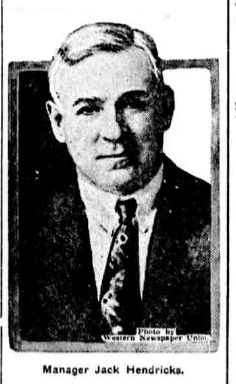
John Charles Hendricks (April 9, 1875 – May 13, 1943) was an American professional baseball player and manager. He played parts of two seasons in Major League Baseball as an outfielder, but is best known as the manager of the Cincinnati Reds from 1924 to 1929.

Key Information

Playing career

[edit]

Hendricks' brief playing career consisted of half a game with the New York Giants and two with the Chicago Orphans in 1902, and 32 games with the Washington Senators in 1903 following the death of Ed Delahanty.

Managerial career

[edit]

After retiring as a player, he started managing in the minor leagues, eventually getting his major league opportunity when Miller Huggins was fired by the St. Louis Cardinals after the 1917 season. After a 51–78 record and a last-place finish, Hendricks quit. In the 1924 season, the Reds had reported to spring training in Orlando, Florida when their manager Pat Moran died of Bright's disease. Hendricks, who had resigned his post as athletic director of the Knights of Columbus to become a Reds coach that year, took over the club. His best finish as manager was second place in the 1926 season, behind his former team, the Cardinals. He was fired in 1929 after a seventh-place finish. His overall managerial record was 520–528 (.496).

Hendricks held a law degree from Northwestern University Law School and was admitted to the bar in the state of Illinois.[1] Hendricks was one of a select group of major league managers to hold a law degree or pass a state bar. Other include James Henry O'Rourke, Miller Huggins, Branch Rickey (his successor in St. Louis), John Montgomery Ward, Hughie Jennings, Muddy Ruel, and Tony La Russa.[2]

Death

[edit]

Hendricks died in Chicago at age 68.[3]

References

[edit]
[edit]
Revisions and contributorsEdit on WikipediaRead on Wikipedia
from Grokipedia
Jack Hendricks is an American actor and stunt performer known for his prolific career in supporting and uncredited roles in B-Western films and Hollywood productions spanning several decades. Born in 1903 in Pickens County, South Carolina, he began appearing in films in the early 1930s and amassed over 260 acting credits, most often portraying henchmen, townsmen, ranch hands, or similar background characters in low-budget Westerns. He frequently worked alongside prominent B-Western stars such as Tim McCoy, Gene Autry, Bob Steele, and Buster Crabbe, contributing to the genre's signature ensemble style through his reliable presence in posse scenes, saloon sequences, and action set pieces. Hendricks occasionally received credited roles, including in Caryl of the Mountains (1936), Gun Grit (1936), Frontier Revenge (1948), and Mark of the Lash (1948), and he performed stunts in select projects such as The Pecos Kid (1935). His work extended into the 1950s and 1960s with uncredited appearances in feature films like Tarantula (1955) and The Bounty Killer (1965), as well as television series including The Adventures of Rin Tin Tin and Bonanza. Hendricks served as a Corporal in the United States Army during World War II. He died on May 29, 1990, in Los Angeles, California.

Early life

Birth and family background

John Talley Hendricks, professionally known as Jack Hendricks, was born on June 9, 1903, in Pickens County, South Carolina, to William Earl Hendricks, a farmer, and Minerva Aikens (also recorded as Aiken in some documents). His birth date appears as July 9, 1903, in some secondary sources including IMDb, but primary records such as his Social Security application, WWII draft registration, California Death Index, and headstone consistently list June 9. The family resided in rural Pickens County, where his father worked as a farmer. The 1920 United States Census recorded the household in Pickens County with William E. Hendricks (age 48, born in South Carolina, occupation farmer), wife Alice (age 39, born in South Carolina), son J. Talley Hendricks (age 15, born in South Carolina), and two stepsons and one stepdaughter. This indicates Alice as a stepmother to Hendricks, with the census listing additional step-siblings in the home. His early family life was thus rooted in the agricultural setting of South Carolina before any later moves.

Early years and relocation

Jack Hendricks had relocated to the Los Angeles area by 1935, as reported in the 1940 United States Census. On December 24, 1936, he applied for a Social Security number, listing his occupation as "various motion picture studios" and his residence as 5518 Franklin Avenue in Hollywood, California. The 1940 census further documents him as a single lodger at 5518 Franklin Avenue, Los Angeles, with his occupation recorded as "Actor – Movie Studio." He had made his first film appearance in 1931, prior to the period when these records confirm his established presence in Hollywood. No precise date for his relocation from South Carolina is documented in available records.

Military service

World War II enlistment and service

Jack Hendricks enlisted in the United States Army on August 25, 1942, in Los Angeles, California. At the time of enlistment, his World War II Army enlistment record listed him as married, with a civil occupation of "actors and actresses" and an education level of grammar school. He entered service as a private, under the Branch Immaterial - Warrant Officers, USA, as a selectee from civil life for the duration of the war plus six months. During his World War II service, Hendricks attained the rank of corporal in the U.S. Army. Photographs from approximately 1943 show him in uniform wearing corporal stripes on his sleeve and what appears to be a U.S. Army Air Corps patch on his left sleeve. His service is reflected in his identification as CPL John T. Hendricks, U.S. Army, World War II.

Career

Entry into Hollywood and early roles

Jack Hendricks began his film career in the early 1930s, with his earliest known appearances occurring in 1931 in low-budget B-Westerns. Most of his work during this period consisted of uncredited bit parts or background roles, often as rough-looking supporting types such as henchmen, gang members, vigilantes, posse riders, or barflies, typically with minimal dialogue and limited screen time. Examples include his uncredited role as a man at a dance in Quick Trigger Lee (1931), as a henchman in Headin' for Trouble (1931), and as a henchman in The Montana Kid (1931). These early assignments reflected the standard opportunities for background players in independent Western productions of the era. Credited roles remained rare in Hendricks' initial years in Hollywood. He received one of his first on-screen credits in the mid-1930s with a supporting part as Al Romero in Gun Grit (1936). The same year, he earned another credited role as Constable Gary in Caryl of the Mountains (1936), a Rin-Tin-Tin Jr. adventure film. Such named appearances stood out amid his predominantly unbilled contributions during this formative phase of his career. These early experiences in B-Westerns established the foundation for his subsequent prolific output in the genre.

Peak years in B-Western films

Jack Hendricks experienced the height of his screen presence in B-Western films during the 1930s through the late 1940s, a period when low-budget Western productions offered prolific opportunities for character actors in supporting and background roles. He appeared in a large volume of these films, most often without on-screen credit, contributing to the genre's characteristic stock ensembles. Secondary sources estimate his total film appearances at about 200 during his career, with the vast majority uncredited or in brief bits. His IMDb listing records 262 acting credits overall, underscoring the scale of his output, though the preponderance remained uncredited background work. In B-Westerns, Hendricks routinely filled archetypal parts such as henchmen, townsmen, barflies, posse riders, ranch hands, and similar minor figures who populated saloons, trails, and frontier towns with little or no dialogue. Among his relatively few credited performances were the role of Red, a henchman, in Frontier Revenge (1948) and Bill Gunnison in Mark of the Lash (1948). He also appeared uncredited as a gambler in Rancho Notorious (1952) and as a townsman in The Bounty Killer (1965). Hendricks frequently collaborated with leading Western performers of the era, including Tim McCoy, Gene Autry, Buster Crabbe, and Tex Ritter, with many of these associations occurring in mid-1940s releases from Producers Releasing Corporation (PRC).

Television appearances

Jack Hendricks appeared in a number of Western television series during the 1950s and 1960s, typically in minor or uncredited roles as background figures such as troopers, townsmen, barflies, gang members, or similar characters typical of the genre. His most frequent television work came in The Adventures of Rin Tin Tin, where he played a Trooper or Townsman in 29 episodes from 1954 to 1956. He also made appearances in The Cisco Kid in five episodes between 1950 and 1951, taking on roles including henchman and townsman (uncredited). In 1963, Hendricks appeared in two episodes of Bonanza as a townsman or barfly (uncredited). He had additional uncredited guest roles in other Western programs, including as a gang member in The Lone Ranger in 1956, as a townsman in The Virginian in 1964, and as a wagon train applicant in Wagon Train in 1964.

Stunt and additional crew work

Jack Hendricks' non-acting contributions to film were minimal compared to his extensive on-screen career, which encompassed 262 acting credits. In his limited stunt work, he served as the uncredited stunt double for Fred Kohler Jr. in the 1935 Western The Pecos Kid. He also performed additional crew duties as the uncredited stand-in for Dana Andrews in the 1940 Western Kit Carson, a credit confirmed by both production records and industry archives. These isolated roles underscore the rarity of his behind-the-camera involvement amid a career otherwise dominated by acting.

Personal life

Residences, physical description, and personal details

Jack Hendricks had curly or wavy hair, a cleft in his longish protruding chin, a mole or bump on his left cheek, three moles or bumps on his right cheek, and a scar on his upper right lip, as observed in photographs and film stills from his career. His height was recorded as 5 feet 11 inches and his weight as 178 pounds on his World War II draft registration card dated February 14, 1942. Later sources, including his IMDb profile, list his height as 5 feet 9 inches (1.75 m). Hendricks resided at 5518 Franklin Avenue in Hollywood, California during the 1930s and 1940s. His 1942 draft registration gave his address as 1830 North Kingsley Drive in Los Angeles. His last known residence was in Sun Valley, Los Angeles, with ZIP code 91352. He was married according to his U.S. Army enlistment record from August 25, 1942. Some credits and databases list him under the alternative name Ray Henderson, though detailed research indicates this may have been an error carried forward in records rather than a confirmed alias.

Death

Later years and passing

Jack Hendricks' last on-screen appearance was an uncredited role as a townsman in the 1965 western film The Bounty Killer. He died on May 29, 1990, in Los Angeles, California, at the age of 86.

Burial and veteran recognition

Jack Hendricks was interred at Riverside National Cemetery in Riverside, California, in Section 28, Site 1341. His grave is marked by a standard military headstone that reads "HENDRICKS JOHN T CPL US ARMY WORLD WAR II" followed by his birth date of June 9, 1903, and death date of May 29, 1990. The marker, provided through the U.S. Department of Veterans Affairs, recognizes his service as a corporal in the United States Army during World War II.
Add your contribution
Related Hubs
User Avatar
No comments yet.