


Community hub
Recent from talks
Contribute something
Nothing was collected or created yet.
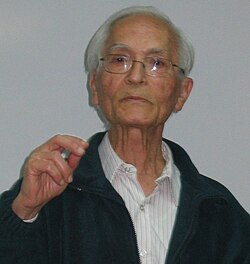
Jacob Ziv
View on WikipediaJacob Ziv (Hebrew: יעקב זיו; 27 November 1931 – 25 March 2023) was an Israeli electrical engineer and information theorist who developed the LZ family of lossless data compression algorithms alongside Abraham Lempel. He is also a namesake of the Ziv–Zakai bound in estimation theory, with Moshe Zakai.
Key Information


Biography
[edit]Born in Tiberias, British mandate of Palestine, on 27 November 1931, Ziv received his B.Sc., Dip. Eng. (1954) and M.Sc. degrees (1957) in electrical engineering from the Technion – Israel Institute of Technology, and his D.Sc. degree, receiving the degree from the Massachusetts Institute of Technology in 1962.[1] In 1970, Ziv joined the Technion – Israel Institute of Technology and was the Herman Gross Professor of Electrical Engineering and a Technion Distinguished Professor.[2]
Ziv was dean of the Faculty of Electrical Engineering from 1974 to 1976 and vice president for Academic Affairs from 1978 to 1982.[2] From 1987, Ziv had spent three sabbatical leaves at the Information Research Department of Bell Laboratories in Murray Hill, New Jersey.[3]
From 1955 to 1959, he served as a senior research engineer for the Scientific Department of the Israel Ministry of Defense, focused on research and development of communication systems.[2] While studying for his doctorate at M.I.T. from 1961 to 1962, he joined the Applied Science Division of Melpar, Inc. in Watertown, Massachusetts, where he was a senior research engineer performing research in communication theory.[2] In 1962 he returned to the Israel Ministry of Defense's scientific department, as head of the Communications Division and was also a contributor to the Faculty of Electrical Engineering, Technion – Israel Institute of Technology.[2] From 1968 to 1970 he was one of the technical staff members of Bell Laboratories, Inc., and, from 1985 to 1991, was the chairman of the Israeli Universities Planning and Grants Committee.[3] He was also a member of the Israel Academy of Sciences and Humanities from 1981 to his death, and he served as its president between 1995 and 2004.[3]
Awards
[edit]In 1993, Ziv was awarded the Israel Prize, for exact sciences.[6] Ziv received in 1995 the IEEE Richard W. Hamming Medal, for "contributions to information theory, and the theory and practice of data compression",[7] and in 1998 a Golden Jubilee Award for Technological Innovation from the IEEE Information Theory Society.[8]
Ziv is the recipient of the 1997 Claude E. Shannon Award from the IEEE Information Theory Society[9] and the 2008 BBVA Foundation Frontiers of Knowledge Award in the category of Information and Communication Technologies.[10] In 2021, Ziv has been awarded the IEEE Medal of Honor, the highest recognition from IEEE, "for fundamental contributions to information theory and data compression technology, and for distinguished research leadership".[11]
Ziv was elected to the American Philosophical Society in 2003[12] and the National Academy of Sciences in 2004.[13]
See also
[edit]Lectures
[edit]- 1992 - Information measures of individual sequences with application to universal data compression and hypothesis testing Lecture sponsored by the Dept. of Electrical and Computer engineering, University of California, San Diego. Electrical and Computer Engineering Distinguished Lecture Series. Digital object made available by UC San Diego Library.
References
[edit]- ^ "Dist. Prof. Jacob Ziv 1931-2023". Technion - Israel Institute of Technology -. 27 March 2023. Archived from the original on 13 April 2023. Retrieved 3 April 2023.
- ^ a b c d e "Jacob Ziv". USC Viterbi | Ming Hsieh Department of Electrical and Computer Engineering. Retrieved 3 April 2023.
- ^ a b c "Ziv Receives Frontiers of Knowledge Award | IEEE Information Theory Society". www.itsoc.org. Retrieved 3 April 2023.
- ^ "The Israel Academy mourns the passing of its past President Prof. Jacob Ziv". www.academy.ac.il. Retrieved 26 March 2023.
- ^ Technology, TechnionIsrael Institute of. "The Technion Mourns the Passing of Distinguished Professor Jacob Ziv". cacm.acm.org. Archived from the original on 3 April 2023. Retrieved 3 April 2023.
- ^ "Israel Prize Official Site - Recipients in 1993" (in Hebrew). 15 August 2012. Archived from the original on 12 October 2014. Retrieved 30 October 2014.
- ^ "IEEE Richard W. Hamming Medal Recipients" (PDF). IEEE. Archived from the original (PDF) on 20 June 2010. Retrieved 30 October 2014.
- ^ "Golden Jubilee Awards for Technological Innovation". IEEE Information Theory Society. 1998. Retrieved 30 October 2014.
- ^ "Claude E. Shannon Award". IEEE Information Theory Society. 1997. Retrieved 30 October 2014.
- ^ "Information and communication technologies 2008: Jacob Ziv". BBVA Foundation Frontiers of Knowledge Award. Retrieved 30 October 2014.
- ^ "IEEE Medal of Honor Goes to Data Compression Pioneer Jacob Ziv". IEEE Spectrum. Retrieved 15 January 2021.
- ^ "APS Member History". search.amphilsoc.org. Retrieved 14 September 2021.
- ^ "Jacob Ziv". www.nasonline.org. Retrieved 14 September 2021.
External links
[edit]- A Conversation with Jacob Ziv (on his 65th birthday) Archived 1 June 2015 at the Wayback Machine
- ACM Paris Kanellakis Theory and Practice Award 1977: Jacob Ziv
- Jacob Ziv at DBLP Bibliography Server

| International | |
|---|---|
| National | |
| Academics | |
| Other | |
Jacob Ziv
View on GrokipediaEarly Life and Education
Upbringing in Palestine
Jacob Ziv was born on November 27, 1931, in Tiberias, in the British Mandate of Palestine (now Israel), to Jewish immigrant parents from Russia.[6][1] He was the younger of two sons of Ben Tzion Ziv, an educator who served as principal of an elementary school in Tiberias, and Hannah Ziv.[1] At the age of three, Ziv's family relocated from Tiberias to the Tel Aviv suburb of Ra'anana, where his father became the principal of the town's first school, named after him.[7][8] This move within Mandatory Palestine exposed the young Ziv to the region's growing Jewish communities and the tensions preceding statehood.[7] Ziv's formative years coincided with the escalating conflicts in the region, culminating in the 1948 Arab-Israeli War, known in Israel as the War of Independence. At age 16, following the war's outbreak, he was conscripted into the Israel Defense Forces (IDF).[7][8] This period of mandatory service amid the war's challenges shaped his early experiences in the newly forming state. Ziv completed his high school education at Herzliya Gymnasium in Tel Aviv.[7] Following this, he transitioned to higher education at the Technion – Israel Institute of Technology in Haifa.[7]Academic Training
Jacob Ziv began his formal academic training at the Technion – Israel Institute of Technology in Haifa, where he pursued studies in electrical engineering. He earned his B.Sc. degree in 1954, followed by an M.Sc. degree in 1957.[9][1] In 1960, Ziv traveled to the United States to advance his education at the Massachusetts Institute of Technology (MIT) in Cambridge. There, he completed a D.Sc. degree—equivalent to a Ph.D.—in electrical engineering in 1962. Influenced by prominent figures in information theory such as Robert Fano and Jack Wozencraft, Ziv's doctoral dissertation centered on coding theory, exploring fundamental problems in error-correcting codes and communication systems.[10][9] During his time at MIT, Ziv was profoundly influenced by the pioneering work in information theory, particularly that of Claude Shannon, whose foundational ideas on entropy and channel capacity shaped the department's curriculum and research environment. This exposure, combined with coursework under influential faculty like Robert Fano and Jack Wozencraft, equipped Ziv with the theoretical tools essential for his subsequent contributions to data compression and universal coding.[10]Professional Career
Early Positions
Following his bachelor's degree from the Technion in 1954, Jacob Ziv began his professional career as a research engineer in the Scientific Department of the Israel Ministry of Defense, where he served from 1955 to 1959. In this role, he focused on the research and development of communication and radar systems, applying his electrical engineering expertise to defense-related technologies during a period of national security challenges in the newly established state of Israel.[11][9][3] While pursuing his PhD at MIT from 1959 to 1962, Ziv worked part-time as a senior research engineer at Melpar, Inc., in Watertown, Massachusetts, from 1961 to 1962.[9] After completing his PhD at MIT in 1962, Ziv returned to the Ministry of Defense, taking on the position of head of the Communications Division in the Scientific Department from 1962 to 1968. Here, he led efforts in advancing secure communication protocols essential for military operations, balancing intensive practical engineering demands with his growing interest in theoretical aspects of information processing. This period solidified his foundation in applied systems engineering while highlighting the limitations of defense work for deeper academic pursuits.[2][12][1] In 1968, Ziv joined Bell Laboratories in Murray Hill, New Jersey, as a member of the technical staff until 1970. During this time, he collaborated with leading figures in information theory on foundational projects that bridged practical communications engineering with emerging theoretical frameworks, marking a pivotal shift toward research-oriented endeavors.[9][13][2]Technion Roles
In 1970, Jacob Ziv joined the Technion – Israel Institute of Technology as the Herman Gross Professor of Electrical Engineering in the Department of Electrical Engineering, and was later appointed a Distinguished Professor.[9][13] His academic career at the Technion spanned over five decades, marked by a commitment to both research and institutional leadership within the Andrew and Erna Viterbi Faculty of Electrical and Computer Engineering.[14] Ziv assumed significant administrative roles early in his tenure, serving as Dean of the Faculty of Electrical Engineering from 1974 to 1976 and as Vice President for Academic Affairs from 1978 to 1982.[2][9] These positions allowed him to shape the department's curriculum and research priorities, fostering advancements in electrical engineering and information sciences at the institution.[1] Throughout his career, Ziv maintained close ties to industry through sabbatical leaves at Bell Laboratories, including periods from 1977–1978, 1983–1984, and 1991–1992, where he pursued collaborative research on information theory and data processing.[13][3] As an educator, Ziv contributed extensively to teaching courses on information theory and signal processing, emphasizing practical applications and theoretical foundations that influenced generations of engineers.[2] He was renowned for his mentorship of Ph.D. students, providing guidance that propelled many into prominent careers in academia and industry; notable among his collaborators was Abraham Lempel, with whom he developed key advancements during their time at the Technion.[14][1] Ziv's dedication to student development extended beyond formal advising, as he served as a role model and advisor, contributing to the Technion's reputation as a hub for innovation in electrical engineering.[14]Research Contributions
Lempel–Ziv Algorithms
Jacob Ziv collaborated with Abraham Lempel, a fellow professor at the Technion – Israel Institute of Technology, to develop a family of lossless data compression algorithms that revolutionized digital storage and transmission.[14] Their partnership began in the mid-1970s at the Technion's Department of Electrical Engineering, where theoretical insights into information theory evolved into practical tools for encoding redundant data efficiently.[10] These algorithms, known as Lempel–Ziv (LZ) methods, form the foundation of many modern compression standards by exploiting patterns in sequential data without probabilistic assumptions.[6] The LZ77 algorithm, introduced in 1977, employs a sliding window approach for lossless compression by referencing substrings from previously encoded text.[15] It maintains a search buffer of recently processed data (typically 4–32 KB) and a lookahead buffer for upcoming symbols, treating the search buffer as an implicit dictionary of prior substrings. The core mechanism scans the lookahead for the longest matching substring starting from the current position in the search buffer, encoding matches as a pair (distance, length) where distance indicates the backward offset from the current position and length specifies the match size; any non-matching next symbol is output literally. This dictionary-based encoding reduces output size by avoiding repetition, with the window sliding forward after each match. To illustrate LZ77's process, consider compressing the string "ABABABA" with a small window size for clarity (in practice, windows are larger):- Start at position 1 ('A'): No prior data, output literal 'A'. Window advances.
- Position 2 ('B'): No match, output literal 'B'. Window: "AB".
- Position 3 ('A'): Matches 'A' at distance 2, length 1; output (2,1). Next 'B' is literal. Window advances to "ABA B".
- Position 5 ('A'): Matches "ABA" at distance 4, length 3; output (4,3). End of string.
- Position 1 'A': Longest prefix empty (0), output (0, 'A'); add "A" as 1. Advance to 'B'.
- Position 2 'B': Empty (0), output (0, 'B'); add "B" as 2. Advance to 'A'.
- Position 3 'A': "A..." matches 1, output 1; next 'B', add "AB" as 3. Advance to 'B' (position 5).
- Position 5 'B': "BA..." matches "B"=2, output 2; next 'A', add "BA" as 4. Advance to 'B' (position 7).
- Position 7 'B': "BA" matches 4, output 4; next 'A', add "BAA"? Wait, next is end? String "A B A B B A B A", positions 1A 2B 3A 4B 5B 6A 7B 8A After position 5 'B' (5th char 'B'), prefix "B"=2, next pos6 'A', add "BA"=4, advance to pos7 'B'. Pos7 'B': "BA" (7B 8A), matches "BA"=4, output 4; next symbol after would be end, but since length 2 reaches end, output 4, no add. For end, if no next symbol, just output the prefix index.