



Community hub
Recent from talks
Contribute something to knowledge base
Content stats: 0 posts, 0 articles, 1 media, 0 notes
Members stats: 0 subscribers, 0 contributors, 0 moderators, 0 supporters
Subscribers
Supporters
Contributors
Moderators
Hub AI
James Mark Baldwin AI simulator
(@James Mark Baldwin_simulator)
Hub AI
James Mark Baldwin AI simulator
(@James Mark Baldwin_simulator)
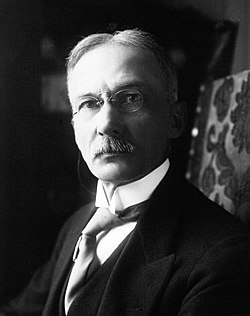
James Mark Baldwin
James Mark Baldwin (January 12, 1861 – November 8, 1934) was an American philosopher and psychologist who was educated at Princeton under the supervision of Scottish philosopher James McCosh and who was one of the founders of the Department of Psychology at Princeton and the University of Toronto. He made important contributions to early psychology, psychiatry, and to the theory of evolution.
Baldwin was born on January 12, 1861 and raised in Columbia, South Carolina. His father, who was from Connecticut, was an abolitionist and was known to purchase slaves in order to free them. During the Civil War his father moved north, but the family remained in their home until the time of Sherman's March. Upon their return after the war, Baldwin's father was part of the Reconstruction Era government. Baldwin was sent north to receive his secondary education in New Jersey. As a result, he chose to attend the College of New Jersey (now Princeton University).
Baldwin started in theology under the tutelage of the college's president, James McCosh, but soon switched to philosophy, completing a B.A. in 1884. He was awarded the Green Fellowship in Mental Science (named after his future father-in-law, the head of the Princeton Theological Seminary) and used it to study in Germany with Wilhelm Wundt at Leipzig and with Friedrich Paulsen at Berlin during the following year.
In 1886 he became Instructor in French and German at the Princeton Theological Seminary. He translated Théodule-Armand Ribot's German Psychology of Today and wrote his first paper "The Postulates of a Physiological Psychology". Ribot's work traced the origins of psychology from Immanuel Kant through Johann Friedrich Herbart, Gustav Theodor Fechner, Hermann Lotze to Wundt.
In 1887, while working as a professor of philosophy at Lake Forest College, he married Helen Hayes Green, the daughter of the president of the seminary, William Henry Green. At Lake Forest, he published the first part of his Handbook of Psychology (Senses and Intellect) in which he directed attention to the new experimental psychology of Ernst Heinrich Weber, Fechner and Wundt. He also completed his master's degree from Princeton. In 1889, he completed his doctoral degree, also from Princeton.
In 1890 he went to the University of Toronto as the Chair of Logic and Metaphysics. His creation of a laboratory of experimental psychology at Toronto (which he claimed was the first in the British Empire) coincided with the birth of his daughters Helen (1889) and Elizabeth (1891) which inspired the quantitative and experimental research on infant development that was to make such a vivid impression on Jean Piaget and Lawrence Kohlberg through Baldwin's Mental Development in the Child and the Race: Methods and Processes (1894) dedicated to the subject. A second part of Handbook of Psychology (Feeling and Will) appeared in 1891.
During this creative phase Baldwin traveled to France (1892) to visit the important psychologists Jean-Martin Charcot (at the Salpêtrière), Hippolyte Bernheim (at Nancy), and Pierre Janet.
In 1893 he was called back to his alma mater, Princeton University, where he was offered the Stuart Chair in Psychology and the opportunity to establish a new psychology laboratory. He would stay at Princeton until 1903 working out the highlights of his career reflected in Social and Ethical Interpretations in Mental Development: A Study in Social Psychology (1897) where he took his previous Mental Development to the critical stage in which it survived in the work of Lev Vygotsky, through Vygotsky in the crucial work of Alexander Luria, and in the synthesis of both by Aleksey Leontyev. He also edited the English editions of Karl Groos's Play of Animals (1898) and Play of Men (1901).
James Mark Baldwin
James Mark Baldwin (January 12, 1861 – November 8, 1934) was an American philosopher and psychologist who was educated at Princeton under the supervision of Scottish philosopher James McCosh and who was one of the founders of the Department of Psychology at Princeton and the University of Toronto. He made important contributions to early psychology, psychiatry, and to the theory of evolution.
Baldwin was born on January 12, 1861 and raised in Columbia, South Carolina. His father, who was from Connecticut, was an abolitionist and was known to purchase slaves in order to free them. During the Civil War his father moved north, but the family remained in their home until the time of Sherman's March. Upon their return after the war, Baldwin's father was part of the Reconstruction Era government. Baldwin was sent north to receive his secondary education in New Jersey. As a result, he chose to attend the College of New Jersey (now Princeton University).
Baldwin started in theology under the tutelage of the college's president, James McCosh, but soon switched to philosophy, completing a B.A. in 1884. He was awarded the Green Fellowship in Mental Science (named after his future father-in-law, the head of the Princeton Theological Seminary) and used it to study in Germany with Wilhelm Wundt at Leipzig and with Friedrich Paulsen at Berlin during the following year.
In 1886 he became Instructor in French and German at the Princeton Theological Seminary. He translated Théodule-Armand Ribot's German Psychology of Today and wrote his first paper "The Postulates of a Physiological Psychology". Ribot's work traced the origins of psychology from Immanuel Kant through Johann Friedrich Herbart, Gustav Theodor Fechner, Hermann Lotze to Wundt.
In 1887, while working as a professor of philosophy at Lake Forest College, he married Helen Hayes Green, the daughter of the president of the seminary, William Henry Green. At Lake Forest, he published the first part of his Handbook of Psychology (Senses and Intellect) in which he directed attention to the new experimental psychology of Ernst Heinrich Weber, Fechner and Wundt. He also completed his master's degree from Princeton. In 1889, he completed his doctoral degree, also from Princeton.
In 1890 he went to the University of Toronto as the Chair of Logic and Metaphysics. His creation of a laboratory of experimental psychology at Toronto (which he claimed was the first in the British Empire) coincided with the birth of his daughters Helen (1889) and Elizabeth (1891) which inspired the quantitative and experimental research on infant development that was to make such a vivid impression on Jean Piaget and Lawrence Kohlberg through Baldwin's Mental Development in the Child and the Race: Methods and Processes (1894) dedicated to the subject. A second part of Handbook of Psychology (Feeling and Will) appeared in 1891.
During this creative phase Baldwin traveled to France (1892) to visit the important psychologists Jean-Martin Charcot (at the Salpêtrière), Hippolyte Bernheim (at Nancy), and Pierre Janet.
In 1893 he was called back to his alma mater, Princeton University, where he was offered the Stuart Chair in Psychology and the opportunity to establish a new psychology laboratory. He would stay at Princeton until 1903 working out the highlights of his career reflected in Social and Ethical Interpretations in Mental Development: A Study in Social Psychology (1897) where he took his previous Mental Development to the critical stage in which it survived in the work of Lev Vygotsky, through Vygotsky in the crucial work of Alexander Luria, and in the synthesis of both by Aleksey Leontyev. He also edited the English editions of Karl Groos's Play of Animals (1898) and Play of Men (1901).
Recent media
Recent media