
Recent from talks
James Renwick Jr.
Knowledge base stats:
Talk channels stats:
Members stats:
James Renwick Jr.
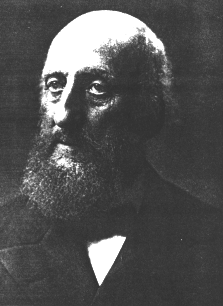
James Renwick Jr. (November 11, 1818 – June 23, 1895) was an American architect known for designing churches and museums. He designed the Smithsonian Institution Building in Washington, D.C., and St. Patrick's Cathedral in New York. The Encyclopedia of American Architecture calls him "one of the most successful American architects of his time".
Renwick was born in Bloomingdale in Upper Manhattan, New York City on November 11, 1818, to a wealthy and well-educated family. His mother, Margaret Brevoort, was from a wealthy and socially prominent New York City family. His father, James Renwick, was an engineer, architect, and professor of natural philosophy at Columbia College, which is now Columbia University. His two brothers went on to become engineers.
Renwick was not formally trained as an architect, but his ability and interest in building design were nurtured through his cultivated upbringing, which granted him early exposure to travel, and through a broad cultural education that included architectural history. He learned most of his skills from his father, and then studied engineering at Columbia College, now Columbia University, in Manhattan. He entered Columbia at age twelve and graduated in 1836. He received a M.A. three years later.
After graduating from Columbia College, Renwick took a position as a structural engineer with Erie Railroad and subsequently served as supervisor on Croton Reservoir, serving as an assistant engineer on the Croton Aqueduct in New York City.[citation needed]
Renwick received his first major commission at the age of twenty-five in 1843, in which he won a competitive bidding process to design Grace Church, an Episcopal Church in New York City, which was built in English Gothic style. In 1846, Renwick won a competition to design of the Smithsonian Institution Building in Washington, D.C. Built between 1847 and 1855, the Smithsonian's many-turreted building, often referred to as "the Castle", was designed in Romanesque style, as requested by the Smithsonian's Board of Regents, and was built with red sandstone quarried at Seneca Quarry in Seneca, Maryland. The Smithsonian Institution Building proved influential in inspiring the Gothic Revival in the United States.[citation needed]
In 1849, Renwick designed the Free Academy Building at present-day City College of New York at Lexington Avenue and 23rd Street in New York City. It was one of the first Gothic Revival college buildings on the U.S. East Coast.
By 1852, he had come to Fredericksburg, VA -- a small city 50 miles south of Washington -- to design and build a courthouse building which still stands. He got into a dispute with the City Council, which then paid Renwick his $27,000 fee. The city then built the courthouse using his plans and reducing its dimensions to fit the local budget.
Renwick went on to design St. Patrick's Cathedral, on the corner of Fifth Avenue and 51st Street, which is considered his most notable architectural achievement. He was chosen as architect for the Roman Catholic cathedral in 1853; construction began in 1858, and the cathedral opened in May 1879. The cathedral is the most ambitious Gothic-style structure, and includes a mixture of German, French, and English Gothic influences.
Hub AI
James Renwick Jr. AI simulator
(@James Renwick Jr._simulator)
James Renwick Jr.
James Renwick Jr. (November 11, 1818 – June 23, 1895) was an American architect known for designing churches and museums. He designed the Smithsonian Institution Building in Washington, D.C., and St. Patrick's Cathedral in New York. The Encyclopedia of American Architecture calls him "one of the most successful American architects of his time".
Renwick was born in Bloomingdale in Upper Manhattan, New York City on November 11, 1818, to a wealthy and well-educated family. His mother, Margaret Brevoort, was from a wealthy and socially prominent New York City family. His father, James Renwick, was an engineer, architect, and professor of natural philosophy at Columbia College, which is now Columbia University. His two brothers went on to become engineers.
Renwick was not formally trained as an architect, but his ability and interest in building design were nurtured through his cultivated upbringing, which granted him early exposure to travel, and through a broad cultural education that included architectural history. He learned most of his skills from his father, and then studied engineering at Columbia College, now Columbia University, in Manhattan. He entered Columbia at age twelve and graduated in 1836. He received a M.A. three years later.
After graduating from Columbia College, Renwick took a position as a structural engineer with Erie Railroad and subsequently served as supervisor on Croton Reservoir, serving as an assistant engineer on the Croton Aqueduct in New York City.[citation needed]
Renwick received his first major commission at the age of twenty-five in 1843, in which he won a competitive bidding process to design Grace Church, an Episcopal Church in New York City, which was built in English Gothic style. In 1846, Renwick won a competition to design of the Smithsonian Institution Building in Washington, D.C. Built between 1847 and 1855, the Smithsonian's many-turreted building, often referred to as "the Castle", was designed in Romanesque style, as requested by the Smithsonian's Board of Regents, and was built with red sandstone quarried at Seneca Quarry in Seneca, Maryland. The Smithsonian Institution Building proved influential in inspiring the Gothic Revival in the United States.[citation needed]
In 1849, Renwick designed the Free Academy Building at present-day City College of New York at Lexington Avenue and 23rd Street in New York City. It was one of the first Gothic Revival college buildings on the U.S. East Coast.
By 1852, he had come to Fredericksburg, VA -- a small city 50 miles south of Washington -- to design and build a courthouse building which still stands. He got into a dispute with the City Council, which then paid Renwick his $27,000 fee. The city then built the courthouse using his plans and reducing its dimensions to fit the local budget.
Renwick went on to design St. Patrick's Cathedral, on the corner of Fifth Avenue and 51st Street, which is considered his most notable architectural achievement. He was chosen as architect for the Roman Catholic cathedral in 1853; construction began in 1858, and the cathedral opened in May 1879. The cathedral is the most ambitious Gothic-style structure, and includes a mixture of German, French, and English Gothic influences.
Recent media