


Community hub
Recent from talks
Contribute something
Nothing was collected or created yet.
James Starks
View on Wikipedia
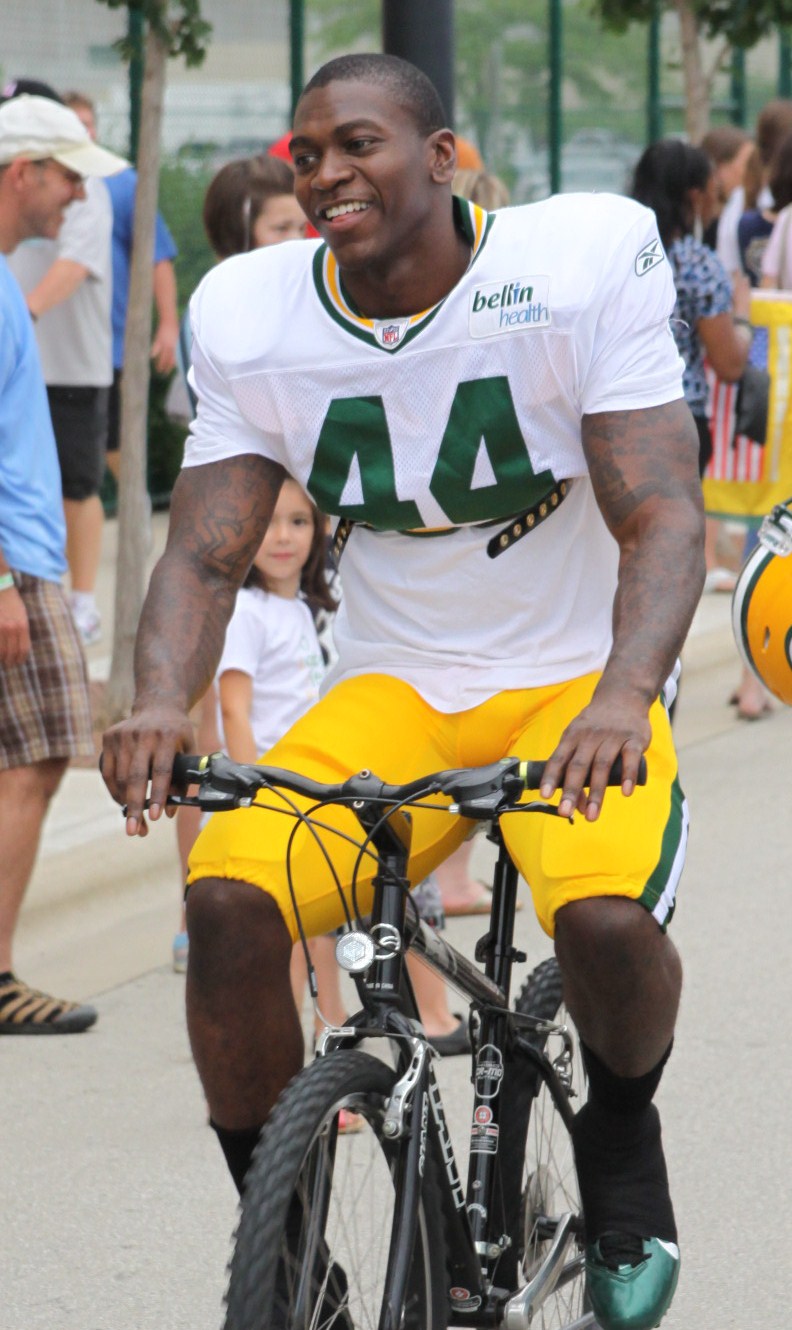
James Darell Starks (born February 25, 1986) is an American former professional football player who was a running back for the Green Bay Packers of the National Football League (NFL). He played college football for the Buffalo Bulls and was selected by the Packers in the sixth round of the 2010 NFL draft. He was a member of their Super Bowl XLV championship team that beat the Pittsburgh Steelers.
Key Information


Early life
[edit]James attended high school in Niagara Falls, New York, where he played football and ran track. In football, he ran for 1,048 yards and threw for over 600 yards for the Wolverines of Niagara Falls High School while earning All-Western New York honors in his senior season and nomination for The Connolly Cup. He served as a captain for three years. In track & field, Starks was one of the states top performers in the long jump (PR of 7.00 meters), and also recorded an 11.14 100-meter dash time.[citation needed]
Considered only a two-star recruit by Rivals.com, Starks's only scholarship offer came from Buffalo, which he accepted.
College career
[edit]Starks attended the University at Buffalo, where he played on the Buffalo Bulls football team from 2006 to 2009. He set a career rushing record with 3,140 yards, and scored 40 total touchdowns. He registered back-to-back 1,000 yard seasons as a sophomore and junior. He was one of the elite backs in the MAC and became the first 1,000-yard rusher in the Bulls’ Division I-A era. He also became the first UB freshman to earn All-MAC recognition in 2006. He earned second-team All-MAC honors as a freshman and sophomore, and was named to the All-MAC first-team as a junior. Starks did not play in his senior season due to a shoulder injury.[1] He is also a member of Phi Beta Sigma fraternity.[2]
College statistics
[edit]| Buffalo Bulls | ||||||||||||
|---|---|---|---|---|---|---|---|---|---|---|---|---|
| Year | GP | Rushing | Receiving | |||||||||
| Att | Yds | Avg | Lng | TD | Rec | Yds | Avg | Lng | TD | |||
| 2006 | 12 | 175 | 704 | 4.0 | 54 | 6 | 34 | 226 | 6.6 | 30 | 0 | |
| 2007 | 12 | 251 | 1,103 | 4.4 | 92 | 12 | 41 | 311 | 7.6 | 74 | 2 | |
| 2008 | 12 | 272 | 1,333 | 4.9 | 66 | 16 | 52 | 361 | 6.9 | 65 | 1 | |
| Total | 36 | 698 | 3,140 | 4.5 | 92 | 34 | 127 | 898 | 7.1 | 74 | 3 | |
| Source: FoxSports.com | ||||||||||||
Professional career
[edit]| External videos | |
|---|---|
 Starks's NFL Combine workout Starks's NFL Combine workout |
| Height | Weight | Arm length | Hand span | 40-yard dash | 10-yard split | 20-yard split | 20-yard shuttle | Three-cone drill | Vertical jump | Broad jump | Bench press | |
|---|---|---|---|---|---|---|---|---|---|---|---|---|
| 6 ft 2+1⁄8 in (1.88 m) |
218 lb (99 kg) |
33+3⁄4 in (0.86 m) |
9+1⁄2 in (0.24 m) |
4.50 s | 1.61 s | 2.69 s | 4.23 s | 6.89 s | 36.0 in (0.91 m) |
9 ft 11 in (3.02 m) |
15 reps | |
| All values are from NFL Combine[3][4] | ||||||||||||
Starks was selected in the sixth round (193rd overall) by the Green Bay Packers in the 2010 NFL draft.[5] On June 23, 2010, he signed a contract with the Packers.[6] Starks was placed on reserve/physically unable to perform on August 31, 2010.[7] On November 9, 2010, he was activated from the physically unable to perform list.[8] He made his NFL debut on December 5 against the San Francisco 49ers, with 18 carries for 73 yards. On January 9 in the 2011 Wild Card Playoff game against the Philadelphia Eagles, Starks broke the Packers' rookie post-season record for rushing yards in a single game. His first touchdown came against the Chicago Bears in the NFC championship game. On the weekend before the Super Bowl, the Niagara Falls—in his hometown of Niagara Falls, New York—were lit green and gold in his honor. The following Monday, Starks met with Niagara Falls mayor Paul Dyster.[citation needed]
Starks's rookie season finished with a win against the Pittsburgh Steelers in Super Bowl XLV in which he rushed for 52 yards on 11 carries.[9] He ended the postseason with the third-most rushing yards for a rookie running back in a single playoffs behind Timmy Smith in 1987 and Jamal Lewis in 2000. Starks' 315 playoff yards in four games was more than triple his total of 101 yards from three games as an active player in the regular season.[10][11]
In the 2011 season, Starks led the Packers in rushing yards with 578. However, Starks utilized a physical style of play which exposed him to injuries. Starks missed three games with an ankle injury that year.[12]
In the 2012 season, Starks was plagued by turf toe in September and a bone bruise in December.[12] By the end of the season, he managed only 71 carries in six games.[13]

Starks performed adequately in limited action during the 2013 season. On September 15, 2013, against the Washington Redskins, Starks rushed for over 100 yards in a game for the first time in his career. His 132 yards on 20 carries marked the first time a Packers player had topped 100 yards since Brandon Jackson in 2010, also against the Redskins.[14] In the following game, Starks exited with a knee injury and would miss the following three games.[15] Capitalizing on Starks's injuries, Packers rookie running back Eddie Lacy became the team's star running back.[16]
Between various lower body injuries, Starks missed 29 games and played in only 35 in his first four seasons in the NFL.[12]
Prior to the 2014 season, Starks and the Packers agreed on a two-year contract worth $3.165 million with the expectation that he would be the backup to Eddie Lacy.[17] After missing so much time due to injury, Starks adjusted his style of play to be more conservative, evading tackles instead of absorbing or breaking them. As a result, he played the first two full seasons of his career, managing to appear in all 32 games of his two-year contract.[12]
During the 2015 season, starter Eddie Lacy's playing time decreased due to issues with conditioning and his violations of the team's curfew. Lacy's diminished workload and Starks's continued health contributed to Starks receiving four starts during the season and registering career high totals in rushing yards, receiving yards and touchdowns.[12][18]
In March 2016, after visiting with the New England Patriots, Starks, an unrestricted free agent, agreed to a two-year contract to return to the Packers.[18] On October 16, 2016, Starks, who had been second on Green Bay's depth chart behind Eddie Lacy, underwent surgery to repair a torn meniscus in his knee.[19] Starks also dealt with a family death about the same time as the surgery. To compound his 2016 troubles, he was involved in a car crash on December 12, and went into concussion protocol, missing the next game.[20]
On February 7, 2017, Starks was released by the Packers after seven seasons with a non-football injury designation.[21][22]
In 2025, it was announced that Starks would be inducted into the Greater Buffalo Sports Hall of Fame.[23]
NFL career statistics
[edit]Regular season
[edit]| Year | Team | GP | GS | Rushing | Receiving | Fumbles | |||||||||
|---|---|---|---|---|---|---|---|---|---|---|---|---|---|---|---|
| Att | Yds | Avg | Lng | TD | Rec | Yds | Avg | Lng | TD | Fum | Lost | ||||
| 2010 | GB | 3 | 0 | 29 | 101 | 3.5 | 16 | 0 | 2 | 15 | 7.5 | 12 | 0 | 0 | 0 |
| 2011 | GB | 13 | 2 | 133 | 578 | 4.3 | 40 | 1 | 29 | 216 | 7.4 | 17 | 0 | 2 | 1 |
| 2012 | GB | 6 | 2 | 71 | 255 | 3.6 | 22 | 1 | 4 | 31 | 7.8 | 9 | 0 | 1 | 0 |
| 2013 | GB | 13 | 1 | 89 | 493 | 5.5 | 41 | 3 | 10 | 89 | 8.9 | 23 | 1 | 1 | 0 |
| 2014 | GB | 16 | 0 | 85 | 333 | 3.9 | 41 | 2 | 18 | 140 | 7.8 | 28 | 0 | 1 | 0 |
| 2015 | GB | 16 | 4 | 148 | 601 | 4.1 | 65 | 2 | 43 | 392 | 9.1 | 30 | 3 | 5 | 3 |
| 2016 | GB | 9 | 4 | 63 | 145 | 2.3 | 11 | 0 | 19 | 134 | 7.1 | 31 | 2 | 1 | 0 |
| Total | 76 | 13 | 618 | 2,506 | 4.1 | 65 | 9 | 125 | 1,017 | 8.1 | 31 | 6 | 11 | 4 | |
| Source: NFL.com | |||||||||||||||
Postseason
[edit]| Year | Team | GP | GS | Rushing | Receiving | Fumbles | |||||||||
|---|---|---|---|---|---|---|---|---|---|---|---|---|---|---|---|
| Att | Yds | Avg | Lng | TD | Rec | Yds | Avg | Lng | TD | Fum | Lost | ||||
| 2010 | GB | 4 | 4 | 81 | 315 | 3.9 | 27 | 1 | 3 | 15 | 5.0 | 8 | 0 | 0 | 0 |
| 2011 | GB | 1 | 0 | 6 | 43 | 7.2 | 29 | 0 | 4 | 24 | 6.0 | 12 | 0 | 0 | 0 |
| 2013 | GB | 1 | 0 | 5 | 29 | 5.8 | 10 | 0 | 1 | 13 | 13.0 | 13 | 0 | 0 | 0 |
| 2014 | GB | 2 | 0 | 10 | 60 | 6.0 | 32 | 0 | 1 | 0 | 0.0 | 0 | 0 | 0 | 0 |
| 2015 | GB | 2 | 0 | 19 | 76 | 4.0 | 22 | 1 | 6 | 16 | 2.7 | 6 | 0 | 0 | 0 |
| Total | 10 | 4 | 121 | 523 | 4.3 | 32 | 2 | 15 | 68 | 4.5 | 13 | 0 | 0 | 0 | |
| Source: pro-football-reference.com | |||||||||||||||
References
[edit]- ^ "Bulls lose Starks to shoulder injury". ESPN.com. Associated Press. August 25, 2009. Retrieved October 26, 2016.
- ^ Brand, J. David (March 17, 2015). "Catching up with Buffalo Bulls football great Justin Winters at St. Vincent Pallotti". UBBullRun.com. Retrieved October 26, 2016.
- ^ "NFL Events: Combine Player Profiles - James Starks". NFL.com. Retrieved October 26, 2016.
- ^ "James Starks - Buffalo, RB : 2010 NFL Draft Scout Player Profile". NFLDraftScout.com. Retrieved October 26, 2016.
- ^ "2010 NFL Draft Listing". Pro-Football-Reference.com. Retrieved May 13, 2023.
- ^ "Packers sign three draft picks". Packers.com. June 23, 2010. Archived from the original on July 9, 2016. Retrieved October 26, 2016.
- ^ "Packers place three players on reserve/PUP, Porter on injured reserve". Packers.com. August 31, 2010. Archived from the original on October 26, 2016. Retrieved October 26, 2016.
- ^ "Packers activate RB Starks, release LB Francois". Packers.com. November 9, 2010. Archived from the original on November 26, 2010. Retrieved October 26, 2016.
- ^ "Super Bowl XLV - Pittsburgh Steelers vs. Green Bay Packers - February 6th, 2011". Pro-Football-Reference.com. Retrieved December 15, 2017.
- ^ ""Super Season" kicks off" (PDF). NFLCommunications.com. January 7, 2016. Retrieved October 26, 2016.
- ^ "James Starks 2010 Game Log". Pro-Football-Reference.com.
- ^ a b c d e Wood, Ryan (January 29, 2016). "James Starks 'being smarter,' staying healthy". PackersNews.com. Retrieved October 26, 2016.
- ^ Silverstein, Tom (July 27, 2013). "James Starks resolves to stay healthy". JSOnline.com. Retrieved October 26, 2016.
- ^ Katzowitz, Josh (September 15, 2013). "James Starks has first 100-yard rushing day for Packers since 2010". CBSSports.com. Retrieved October 26, 2016.
- ^ Dunne, Tyler (June 20, 2014). "James Starks' No. 1 goal: Stay healthy this year". JSOnline.com. Retrieved October 26, 2016.
- ^ Morgan, Chris (January 7, 2014). "2013 Packers: surmounting injuries, Eddie Lacy's bright future". NewYork.CBSLocal.com. Retrieved October 26, 2016.
- ^ McGinn, Bob (March 20, 2014). "James Starks' deal is worth $3.165 million". JSOnline.com. Retrieved October 26, 2016.
- ^ a b Alper, Josh (March 18, 2016). "James Starks returns to Packers". ProFootballTalk.NBCSports.com. Retrieved October 26, 2016.
- ^ "Packers' James Starks: Has surgery on torn meniscus". CBSSports.com. October 16, 2016. Retrieved October 26, 2016.
- ^ Young, Shalise Manza (December 15, 2016). "Packers' James Starks in concussion protocol after car accident". Yahoo! Sports. Retrieved November 23, 2024.
- ^ "Packers release RB James Starks". Packers.com. February 7, 2017.
- ^ Bergman, Jeremy (February 7, 2017). "Packers release running back James Starks". NFL.com. Archived from the original on February 8, 2017.
- ^ Ludwiczak, Mark (May 19, 2025). "Broadcaster John Murphy, RB James Starks to join Greater Buffalo Sports HOF". News 4 Buffalo. Retrieved October 16, 2025.
External links
[edit]
James Starks
View on GrokipediaEarly life and education
Family and childhood
James Starks was born on February 25, 1986, in Niagara Falls, New York, where he faced immediate health challenges, including a collapsed lung and heart issues that required medical interventions and machines during his early years.[5] His mother, Lillie Hall, who raised him, often described him as a "blessing" due to his resilience in overcoming these complications, including freak accidents where he stopped breathing as an infant; she noted that he was a "chunky baby" whose chest struggled to support his size.[5] These early health struggles persisted into childhood, ultimately necessitating lung surgery before he could participate in high school football.[5] Starks grew up in a large family with six siblings, including brothers Sanquin and Dale Stewart, and sisters Ebony Starks and Ahmadja Greene, in an environment shaped by his mother Lillie Hall's guidance and involvement from his father, James Starks Sr.[3][6] His father recalled taking the energetic seven-year-old to Unity Park, a local community spot in Niagara Falls, where Starks fearlessly performed back-flips off high structures, demonstrating early physical prowess and a daring spirit that his parents both nurtured and monitored.[7] Family dynamics emphasized support amid challenges, with Starks later crediting his mother and brother Sanquin for providing stability during tough times.[3] The socioeconomic conditions of Niagara Falls, marked by poverty and limited resources, made childhood difficult for Starks and his siblings, exposing them to urban hazards in a declining industrial city.[3] These circumstances fostered a strong sense of community reliance, as the family navigated economic hardships that influenced Starks' early development and later commitment to local youth programs.[3] At age 12, he discovered his passion for football through local opportunities, marking the beginning of his organized athletic involvement that carried into high school.[4]High school athletics
James Starks attended Niagara Falls High School in Niagara Falls, New York, graduating in 2005, where he emerged as a three-sport standout in football, basketball, and track and field.[8] His versatility across these disciplines highlighted his athletic talent from an early age, supported by his family's encouragement in pursuing competitive sports.[4] In football, Starks primarily played quarterback and running back, serving as team captain for three years and earning All-Western New York honors as a senior.[8] During his senior year in 2004, he rushed for 1,048 yards and threw for over 600 yards, contributing significantly to the team's offensive output.[8] Over his high school career, he registered back-to-back 1,000-yard rushing seasons as a sophomore and junior.[8] Starks also excelled in track and field, establishing himself as one of New York State's top performers in the long jump and 100-meter dash events.[8] In the 2005 Carl J. Roesch Track Classic, he posted a qualifying time of 10.9 seconds in the 100-meter dash, showcasing his speed that complemented his football prowess.[9] Additionally, he served as a key sixth man for the basketball team, which captured the New York State championship in 2005.[8][10] His multifaceted high school achievements, particularly his dual-sport excellence in football and track, drew recruitment interest from colleges, culminating in his commitment to the University at Buffalo to continue his football career.[11][8]College career
University of Buffalo
James Starks committed to the University at Buffalo in 2005 after a notable high school career at Niagara Falls High School. He joined the Buffalo Bulls football team, initially recruited as a quarterback but transitioning to running back during his tenure from 2006 to 2009.[12] As a true freshman in 2006, Starks saw significant playing time and contributed to the team's offensive efforts, helping establish a foundation for the Bulls' ground game.[13] Starks emerged as the starting running back in 2007, his sophomore year, where he became the first player in the program's Division I-A era (dating back to 1999) to rush for over 1,000 yards in a season, totaling 1,103 yards and marking a breakout performance that earned him second-team All-MAC honors.[14][13] This achievement highlighted his speed and vision, solidifying his role as a key offensive weapon and contributing to the Bulls' improved record of 5-7 that year.[8] In 2008, as a junior, Starks maintained consistency with another strong season, rushing for 1,333 yards and 16 touchdowns, which propelled the team to a 7-6 record and a berth in the International Bowl, while earning first-team All-MAC recognition.[13][8] His senior year in 2009 was cut short before it began due to a labral tear in his right shoulder, requiring surgery and sidelining him for the entire season, which effectively ended his collegiate playing career.[15] Despite the injury, Starks' overall contributions extended beyond the field; he was known for his leadership in the running back room and helped mentor younger players, fostering team cohesion during the Bulls' transition to more competitive play in the Mid-American Conference.[8] Academically, Starks made steady progress toward his degree while balancing the demands of Division I athletics, though specific details on his coursework remain private.[16]College statistics
During his three active seasons at the University of Buffalo from 2006 to 2008, James Starks amassed 3,140 rushing yards on 698 carries, averaging 4.5 yards per attempt, and scored 34 rushing touchdowns.[13] He also contributed 898 receiving yards on 127 receptions with 3 receiving touchdowns, bringing his total scrimmage yards to 4,038 and total touchdowns to 37.[13] These figures established him as one of the most productive backs in Bulls history, with his career rushing total ranking third in program history behind Branden Oliver (4,049 yards) and Jaret Patterson (3,884 yards), as of 2025.[17] Starks' performance evolved markedly across his seasons, transitioning from quarterback to full-time running back and achieving back-to-back 1,000-yard rushing campaigns in 2007 and 2008. The following table summarizes his year-by-year rushing and receiving statistics:| Year | Games | Rush Att | Rush Yds | Yds/Att | Rush TD | Rec | Rec Yds | Rec TD |
|---|---|---|---|---|---|---|---|---|
| 2006 | 12 | 175 | 704 | 4.0 | 6 | 34 | 226 | 0 |
| 2007 | 12 | 251 | 1,103 | 4.4 | 12 | 41 | 311 | 2 |
| 2008 | 12 | 272 | 1,333 | 4.9 | 16 | 52 | 361 | 1 |
| Career | 36 | 698 | 3,140 | 4.5 | 34 | 127 | 898 | 3 |
Professional career
Green Bay Packers
James Starks was selected by the Green Bay Packers in the sixth round, 193rd overall, of the 2010 NFL Draft out of the University at Buffalo.[1][22] As a late-round pick, he entered the league with low expectations but quickly found a niche in a backfield led by Ryan Grant and Brandon Jackson.[2] In his rookie season of 2010, Starks served primarily as a backup running back, appearing in just three regular-season games after missing the first 13 due to a hamstring injury sustained in training camp.[23] However, injuries to other backs elevated his role during the Packers' playoff run, where he contributed significantly, including starting in Super Bowl XLV against the Pittsburgh Steelers.[24] In that championship game, which the Packers won 31-25, Starks recorded 11 carries for 52 yards, providing key runs that helped maintain offensive balance. His emergence as a reliable option was instrumental in Green Bay's postseason success, culminating in their first Super Bowl victory since 1996.[22] Starks' tenure peaked in subsequent years, particularly as a spot starter amid ongoing backfield rotations. In 2012, he appeared in six games with two starts, rushing for 255 yards on 71 carries at an average of 3.6 yards per attempt, offering burst and vision when called upon.[25] His most productive season came in 2015, when he achieved career highs of 601 rushing yards on 148 carries (4.1 yards per carry) and three receiving touchdowns on 43 catches for 392 yards, serving as a complementary piece to Eddie Lacy in Green Bay's zone-running scheme.[26][27] These performances underscored his versatility as a runner and pass-catcher, contributing to the Packers' NFC North division title and another playoff appearance that year.[28] Throughout his seven seasons with the Packers from 2010 to 2016, Starks amassed 2,506 rushing yards and supported five playoff berths, including the 2010 Super Bowl triumph and NFC Championship appearances in 2014 and 2016.[1] His role as a depth player who stepped up in critical moments exemplified the Packers' emphasis on roster flexibility, helping sustain a potent offense under quarterback Aaron Rodgers.[23]Injuries and release
Starks' NFL career was significantly hampered by recurring injuries, particularly to his lower body, which limited his availability and effectiveness during his tenure with the Green Bay Packers. In his rookie 2010 season, a hamstring injury sidelined him for the first 13 games, preventing him from contributing until late in the year.[29] The following year, 2011, brought a knee sprain and ankle injury that caused him to miss three games, further disrupting his development as a backup running back. These challenges persisted into 2012 and 2013, with turf toe in September 2012 forcing him to miss five games and a subsequent knee bone bruise limiting his play in December of that year.[30] A knee injury in 2013 resulted in four more missed games, contributing to Starks absent from 29 of his first 64 regular-season contests over his initial four seasons.[31] Despite these setbacks, Starks had shown flashes of his potential in high-stakes playoff games, such as his 2010 postseason debut where he rushed for 123 yards against Atlanta.[29] The 2016 season proved particularly devastating, as Starks underwent surgery for a torn meniscus in his knee in mid-October, causing him to miss four games and restricting him to just 63 carries for 145 yards upon his return.[32] Later that year, on December 12, a car accident left him with a concussion, placing him in the NFL's concussion protocol and preventing any further participation in games.[33] These injuries culminated in limited production, as Starks averaged a career-low 2.3 yards per carry that season.[34] On February 7, 2017, the Packers released Starks with a non-football injury designation tied to the unresolved concussion effects, ending his seven-year stint with the team after signing a two-year, $6 million extension the prior offseason.[22] In the immediate aftermath, Starks expressed gratitude to the organization via social media, thanking teammates and coaches while affirming his intent to continue his playing career elsewhere, stating, "It's not over."[35] He later echoed this determination in interviews, noting his desire to sign with another NFL team despite the physical toll of his injury history.[36]NFL career statistics
Regular season
James Starks played in 76 regular season games over his NFL career from 2010 to 2016, all with the Green Bay Packers, accumulating 2,506 rushing yards on 618 carries with 9 rushing touchdowns, as well as 1,017 receiving yards on 125 receptions with 6 receiving touchdowns.[1] His career averaged 4.1 yards per carry, reflecting efficient but limited usage as a backup running back, and he lost possession on 11 fumbles during regular season play.[1] Starks' role primarily involved spelling primary rushers such as Ryan Grant early in his career and Eddie Lacy later on, often contributing as a change-of-pace back with receiving skills from the backfield.[1] Injuries occasionally impacted his availability, reducing his snap counts in certain seasons.[1] He reached his performance peak in 2015, rushing for 601 yards and catching passes for 392 yards, showcasing his versatility in a contract year.[1] The following table summarizes Starks' year-by-year regular season rushing and receiving statistics:| Year | Team | Games | Rush Att | Rush Yds | Rush TD | Rec | Rec Yds | Rec TD |
|---|---|---|---|---|---|---|---|---|
| 2010 | GNB | 3 | 29 | 101 | 0 | 2 | 15 | 0 |
| 2011 | GNB | 13 | 133 | 578 | 1 | 29 | 216 | 0 |
| 2012 | GNB | 6 | 71 | 255 | 1 | 4 | 31 | 0 |
| 2013 | GNB | 13 | 89 | 493 | 3 | 10 | 89 | 1 |
| 2014 | GNB | 16 | 85 | 333 | 2 | 18 | 140 | 0 |
| 2015 | GNB | 16 | 148 | 601 | 2 | 43 | 392 | 3 |
| 2016 | GNB | 9 | 63 | 145 | 0 | 19 | 134 | 2 |
| Career | - | 76 | 618 | 2,506 | 9 | 125 | 1,017 | 6 |