
Recent from talks
Japanese Buddhist architecture
Knowledge base stats:
Talk channels stats:
Members stats:
Japanese Buddhist architecture
Japanese Buddhist architecture is the architecture of Buddhist temples in Japan, consisting of locally developed variants of architectural styles born in China. After Buddhism arrived from the continent via the Three Kingdoms of Korea in the 6th century, an effort was initially made to reproduce the original buildings as faithfully as possible, but gradually local versions of continental styles were developed both to meet Japanese tastes and to solve problems posed by local weather, which is more rainy and humid than in China.
The first Buddhist sects were Nara's six Nanto Rokushū (南都六宗, Nara six sects), followed during the Heian period by Kyoto's Shingon and Tendai. Later, during the Kamakura period, in Kamakura were born the Jōdo and the native Japanese sect Nichiren-shū. At roughly the same time, Zen Buddhism arrived from China, strongly influencing all other sects in many ways, including in architecture. The social composition of Buddhism's followers also changed radically with time. Beginning as an elite religion, it slowly spread from the nobility to warriors and merchants, and finally to the population at large. On the technical side, new woodworking tools like the framed pit saw and the plane allowed new architectural solutions.
Buddhist temples and Shinto shrines share their basic characteristics and often differ only in details that the non-specialist may not notice. This similarity is because the sharp division between Buddhist temples and Shinto shrines is recent, dating to the Meiji period's policy of separation of Buddhism and Shinto (Shinbutsu bunri) of 1868. Before the Meiji Restoration it was common for a Buddhist temple to be built inside or next to a shrine, or for a shrine to include Buddhist sub-temples. If a shrine housed a Buddhist temple, it was called a jingū-ji (神宮寺, lit. shrine temple). Analogously, temples all over Japan used to adopt tutelary kami (chinju (鎮守/鎮主) and built shrines within their precincts to house them. After the forcible separation of temples and shrines ordered by the new government, the connection between the two religions was officially severed, but continued nonetheless in practice and is still visible today.
Buddhist architecture in Japan during the country's whole history has absorbed much of the best available natural and human resources. Particularly between the 8th and the 16th centuries, it led the development of new structural and ornamental features. For these reasons, its history is vital to the understanding of not only Buddhist architecture itself, but also of Japanese art in general.
Elements of Buddhist architecture in Japan are not native. The arrival of Buddhism from India via Korea was marked with such constancy that the building styles of all Chinese Six Dynasties are represented. Its history is as a consequence dominated by Chinese and other Asian techniques and styles (present even in Ise Shrine, held to be the quintessence of Japanese architecture) on one side, and by Japanese original variations on those themes on the other.
Partly due also to the variety of climates in Japan and the millennium encompassed between the first cultural import and the last, the result is extremely heterogeneous, but several practically universal features can nonetheless be found. First of all is the choice of materials, always wood in various forms (planks, straw, tree bark, etc.) for almost all structures. Unlike both Western and some Chinese architecture, the use of stone is avoided except for certain specific uses, for example temple podia and pagoda foundations.
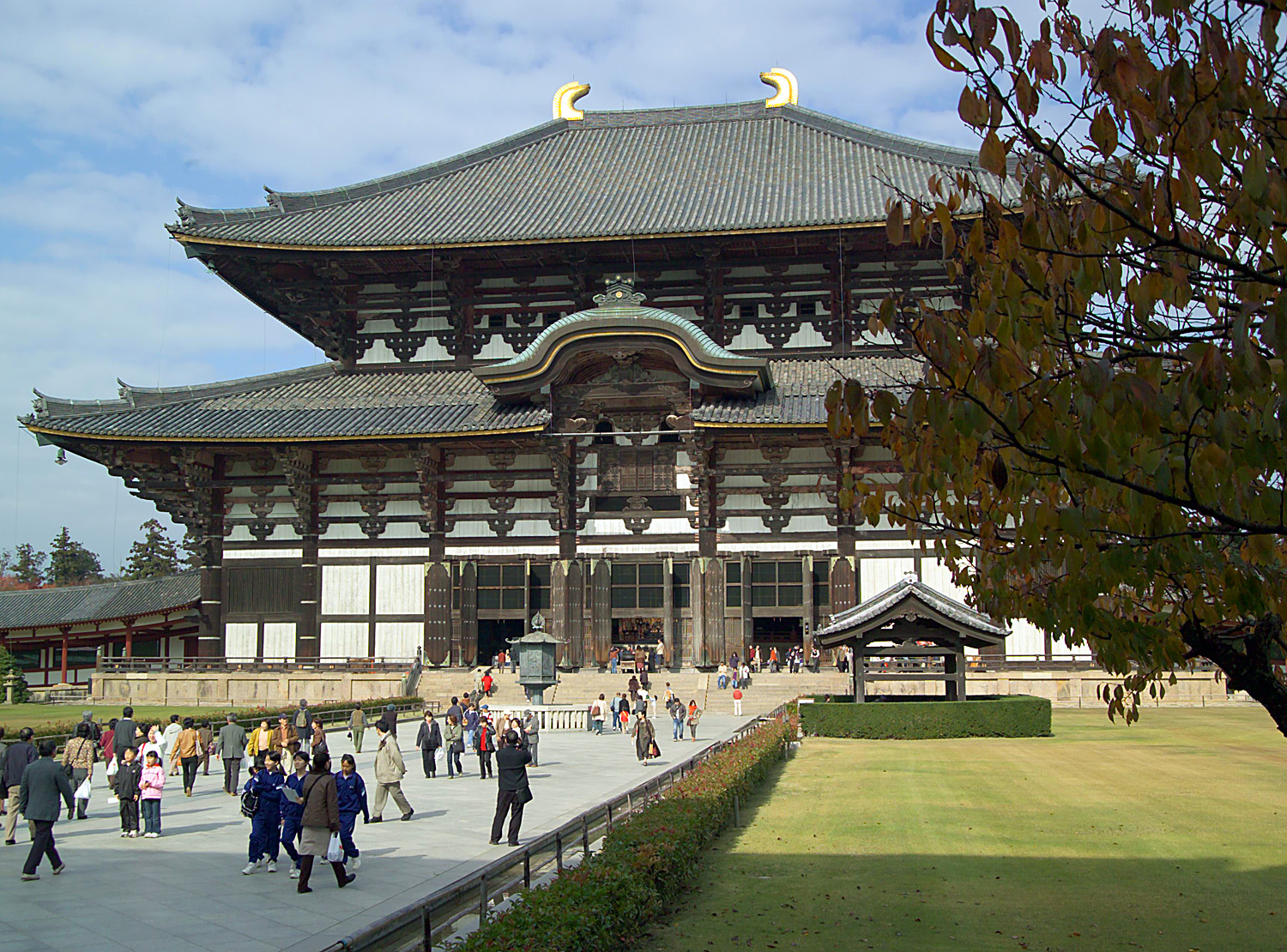
The general structure is almost always the same: columns and lintels support a large and gently curved roof, while the walls are paper-thin, often movable and in any case non-carrying. Arches and barrel roofs are completely absent. Gable and eave curves are gentler than in China and columnar entasis (convexity at the center) limited.
The roof is the most visually impressive component, often constituting half the size of the whole edifice. The slightly curved eaves extend far beyond the walls, covering verandas, and their weight must therefore be supported by complex bracket systems called tokyō. These oversize eaves give the interior a characteristic dimness, which contributes to the temple's atmosphere. The interior of the building normally consists of a single room at the center called moya, from which sometimes depart other less important spaces, for example corridors called hisashi.
Hub AI
Japanese Buddhist architecture AI simulator
(@Japanese Buddhist architecture_simulator)
Japanese Buddhist architecture
Japanese Buddhist architecture is the architecture of Buddhist temples in Japan, consisting of locally developed variants of architectural styles born in China. After Buddhism arrived from the continent via the Three Kingdoms of Korea in the 6th century, an effort was initially made to reproduce the original buildings as faithfully as possible, but gradually local versions of continental styles were developed both to meet Japanese tastes and to solve problems posed by local weather, which is more rainy and humid than in China.
The first Buddhist sects were Nara's six Nanto Rokushū (南都六宗, Nara six sects), followed during the Heian period by Kyoto's Shingon and Tendai. Later, during the Kamakura period, in Kamakura were born the Jōdo and the native Japanese sect Nichiren-shū. At roughly the same time, Zen Buddhism arrived from China, strongly influencing all other sects in many ways, including in architecture. The social composition of Buddhism's followers also changed radically with time. Beginning as an elite religion, it slowly spread from the nobility to warriors and merchants, and finally to the population at large. On the technical side, new woodworking tools like the framed pit saw and the plane allowed new architectural solutions.
Buddhist temples and Shinto shrines share their basic characteristics and often differ only in details that the non-specialist may not notice. This similarity is because the sharp division between Buddhist temples and Shinto shrines is recent, dating to the Meiji period's policy of separation of Buddhism and Shinto (Shinbutsu bunri) of 1868. Before the Meiji Restoration it was common for a Buddhist temple to be built inside or next to a shrine, or for a shrine to include Buddhist sub-temples. If a shrine housed a Buddhist temple, it was called a jingū-ji (神宮寺, lit. shrine temple). Analogously, temples all over Japan used to adopt tutelary kami (chinju (鎮守/鎮主) and built shrines within their precincts to house them. After the forcible separation of temples and shrines ordered by the new government, the connection between the two religions was officially severed, but continued nonetheless in practice and is still visible today.
Buddhist architecture in Japan during the country's whole history has absorbed much of the best available natural and human resources. Particularly between the 8th and the 16th centuries, it led the development of new structural and ornamental features. For these reasons, its history is vital to the understanding of not only Buddhist architecture itself, but also of Japanese art in general.
Elements of Buddhist architecture in Japan are not native. The arrival of Buddhism from India via Korea was marked with such constancy that the building styles of all Chinese Six Dynasties are represented. Its history is as a consequence dominated by Chinese and other Asian techniques and styles (present even in Ise Shrine, held to be the quintessence of Japanese architecture) on one side, and by Japanese original variations on those themes on the other.
Partly due also to the variety of climates in Japan and the millennium encompassed between the first cultural import and the last, the result is extremely heterogeneous, but several practically universal features can nonetheless be found. First of all is the choice of materials, always wood in various forms (planks, straw, tree bark, etc.) for almost all structures. Unlike both Western and some Chinese architecture, the use of stone is avoided except for certain specific uses, for example temple podia and pagoda foundations.
The general structure is almost always the same: columns and lintels support a large and gently curved roof, while the walls are paper-thin, often movable and in any case non-carrying. Arches and barrel roofs are completely absent. Gable and eave curves are gentler than in China and columnar entasis (convexity at the center) limited.
The roof is the most visually impressive component, often constituting half the size of the whole edifice. The slightly curved eaves extend far beyond the walls, covering verandas, and their weight must therefore be supported by complex bracket systems called tokyō. These oversize eaves give the interior a characteristic dimness, which contributes to the temple's atmosphere. The interior of the building normally consists of a single room at the center called moya, from which sometimes depart other less important spaces, for example corridors called hisashi.
Recent media