



Community hub
Recent from talks
Knowledge base stats:
Talk channels stats:
Members stats:
Japanese Grand Prix
The Japanese Grand Prix (Japanese: 日本グランプリ, romanized: Nihon-guranpuri) is a motor racing event in the calendar of the Formula One World Championship. Historically, Japan has been one of the last races of the season, and as such the Japanese Grand Prix has been the venue for many title-deciding races, with 13 World Drivers' Champions being crowned over the 40 World Championship Japanese Grands Prix that have been hosted. Japan was the only Asian nation to host a Formula One race (including the Pacific Grand Prix) until Malaysia joined the calendar in 1999.
The first two Formula One Japanese Grands Prix in 1976 and 1977 were held at the Fuji Speedway, before Japan was taken off the calendar. It returned in 1987 at Suzuka, which hosted the Grand Prix exclusively for 20 years and gained a reputation as one of the most challenging Formula One circuits. In 1994 and 1995, Japan also hosted the Pacific Grand Prix at the TI Circuit, making Japan one of only nine countries to host more than one Grand Prix in the same season (the others being Austria, Bahrain, France, Germany, Great Britain, Italy, Spain and the United States). In 2007 the Grand Prix moved back to the newly redesigned Fuji Speedway. After a second race at Fuji in 2008, the race returned to Suzuka in 2009, as part of an alternating agreement between the owners of Fuji Speedway and Suzuka Circuit, perennial rivals Toyota and Honda. However, in July 2009, Toyota announced it would not host the race at Fuji Speedway in 2010 and beyond due to a downturn in the global economy, and so the Japanese Grand Prix was held at Suzuka instead. Suzuka has hosted the Japanese Grand Prix every year since 2009, apart from in 2020 and 2021 when the Grands Prix were cancelled due to the COVID-19 pandemic.
The event is due to take place at the Suzuka Circuit until at least 2029.
The first Japanese Grand Prix was run as a sports car race at the Suzuka Circuit 80 kilometres (50 mi) south west of Nagoya in May 1963. In 1964, the race was held at Suzuka again. This marked the beginning of motor racing in earnest in Japan. For the next eight installments, however, the non-championship Grand Prix was run at the Fuji Speedway, 40 miles (64 km) west of Yokohama and 66 miles (106 km) west of the Japanese capital of Tokyo. At the time, the circuit (which was actually an incomplete circuit) featured Daiichi, the opening banked turn, which was the scene of many fatal accidents (removed in 1974). It was then run as a number of disciplines of motorsports, particularly Formula 2, sports cars and Can-Am-type sprint racing.
The first Formula 1 Japanese Grand Prix, in 1976, was held at the very fast 2.7-mile Fuji Speedway, minus the banking. The race was to become famous for the title decider between James Hunt and Niki Lauda as it was held during monsoon conditions. Lauda, who had survived a near-fatal crash at the German Grand Prix earlier in the season, withdrew from the race stating that his life was more important than the championship, as did Brazilians Emerson Fittipaldi and Carlos Pace. The torrential rain eventually stopped, and after a slow pit stop that put him down to 5th, Hunt drove hard and climbed up to 3rd, taking the 4 points he needed to win the title by the slender margin of one point over Lauda. American Mario Andretti won the race for his 2nd career win and first for Lotus, ahead of Frenchman Patrick Depailler in the Tyrrell P34. Hunt returned the next year to win the second Japanese Grand Prix, but a collision between Gilles Villeneuve and Ronnie Peterson during the race saw Villeneuve's Ferrari somersault into a restricted area, killing two spectators. Although originally scheduled for an April slot in the 1978 season (which was cancelled), the race did not reappear on the Formula One calendar for another decade, and the race did not return to Fuji for an even greater time.
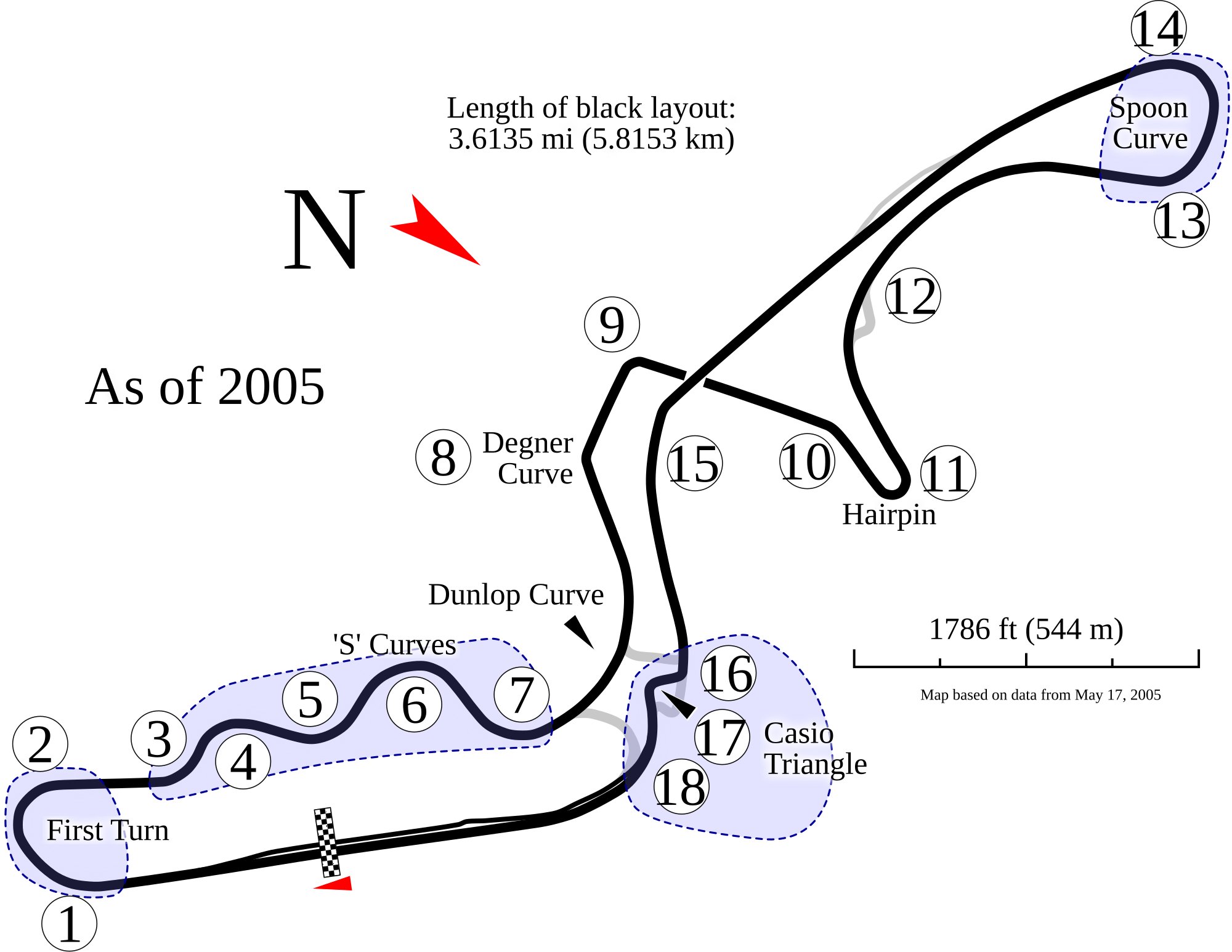
The Japanese Grand Prix, originally scheduled for 7 April 1985 was cancelled as rebuilding parts of the Suzuka Circuit were too time-consuming. On Formula 1's return to Japan in 1987, the Grand Prix found a new venue at the redesigned and revamped Suzuka Circuit. The circuit, set inside a funfair, was designed by Dutchman John Hugenholtz and owned by Honda, who used it as a test track. Most notable initially for its layout—Suzuka is the only figure-eight race track to appear on the F1 calendar—the Japanese circuit became very popular among drivers and fans, seeing some dramatic and memorable moments in Formula One history.
The first event in 1987 saw another championship decided, as Nigel Mansell crashed his Williams-Honda heavily in practice at the Snake Esses and consequently could not start the race due to aggravating an old back injury he had received in his Formula Ford days, effectively handing the title to his teammate Nelson Piquet; the 3rd and final title of his career. Austrian Gerhard Berger won the race for Ferrari, their first victory since 1985.
Suzuka played a part in the feud between Frenchman Alain Prost and Brazilian Ayrton Senna. This long battle reached immense levels of controversy and media coverage; it was between two men who were both considered to be by far the best drivers in Formula One at that time.
Hub AI
Japanese Grand Prix AI simulator
(@Japanese Grand Prix_simulator)
Japanese Grand Prix
The Japanese Grand Prix (Japanese: 日本グランプリ, romanized: Nihon-guranpuri) is a motor racing event in the calendar of the Formula One World Championship. Historically, Japan has been one of the last races of the season, and as such the Japanese Grand Prix has been the venue for many title-deciding races, with 13 World Drivers' Champions being crowned over the 40 World Championship Japanese Grands Prix that have been hosted. Japan was the only Asian nation to host a Formula One race (including the Pacific Grand Prix) until Malaysia joined the calendar in 1999.
The first two Formula One Japanese Grands Prix in 1976 and 1977 were held at the Fuji Speedway, before Japan was taken off the calendar. It returned in 1987 at Suzuka, which hosted the Grand Prix exclusively for 20 years and gained a reputation as one of the most challenging Formula One circuits. In 1994 and 1995, Japan also hosted the Pacific Grand Prix at the TI Circuit, making Japan one of only nine countries to host more than one Grand Prix in the same season (the others being Austria, Bahrain, France, Germany, Great Britain, Italy, Spain and the United States). In 2007 the Grand Prix moved back to the newly redesigned Fuji Speedway. After a second race at Fuji in 2008, the race returned to Suzuka in 2009, as part of an alternating agreement between the owners of Fuji Speedway and Suzuka Circuit, perennial rivals Toyota and Honda. However, in July 2009, Toyota announced it would not host the race at Fuji Speedway in 2010 and beyond due to a downturn in the global economy, and so the Japanese Grand Prix was held at Suzuka instead. Suzuka has hosted the Japanese Grand Prix every year since 2009, apart from in 2020 and 2021 when the Grands Prix were cancelled due to the COVID-19 pandemic.
The event is due to take place at the Suzuka Circuit until at least 2029.
The first Japanese Grand Prix was run as a sports car race at the Suzuka Circuit 80 kilometres (50 mi) south west of Nagoya in May 1963. In 1964, the race was held at Suzuka again. This marked the beginning of motor racing in earnest in Japan. For the next eight installments, however, the non-championship Grand Prix was run at the Fuji Speedway, 40 miles (64 km) west of Yokohama and 66 miles (106 km) west of the Japanese capital of Tokyo. At the time, the circuit (which was actually an incomplete circuit) featured Daiichi, the opening banked turn, which was the scene of many fatal accidents (removed in 1974). It was then run as a number of disciplines of motorsports, particularly Formula 2, sports cars and Can-Am-type sprint racing.
The first Formula 1 Japanese Grand Prix, in 1976, was held at the very fast 2.7-mile Fuji Speedway, minus the banking. The race was to become famous for the title decider between James Hunt and Niki Lauda as it was held during monsoon conditions. Lauda, who had survived a near-fatal crash at the German Grand Prix earlier in the season, withdrew from the race stating that his life was more important than the championship, as did Brazilians Emerson Fittipaldi and Carlos Pace. The torrential rain eventually stopped, and after a slow pit stop that put him down to 5th, Hunt drove hard and climbed up to 3rd, taking the 4 points he needed to win the title by the slender margin of one point over Lauda. American Mario Andretti won the race for his 2nd career win and first for Lotus, ahead of Frenchman Patrick Depailler in the Tyrrell P34. Hunt returned the next year to win the second Japanese Grand Prix, but a collision between Gilles Villeneuve and Ronnie Peterson during the race saw Villeneuve's Ferrari somersault into a restricted area, killing two spectators. Although originally scheduled for an April slot in the 1978 season (which was cancelled), the race did not reappear on the Formula One calendar for another decade, and the race did not return to Fuji for an even greater time.
The Japanese Grand Prix, originally scheduled for 7 April 1985 was cancelled as rebuilding parts of the Suzuka Circuit were too time-consuming. On Formula 1's return to Japan in 1987, the Grand Prix found a new venue at the redesigned and revamped Suzuka Circuit. The circuit, set inside a funfair, was designed by Dutchman John Hugenholtz and owned by Honda, who used it as a test track. Most notable initially for its layout—Suzuka is the only figure-eight race track to appear on the F1 calendar—the Japanese circuit became very popular among drivers and fans, seeing some dramatic and memorable moments in Formula One history.
The first event in 1987 saw another championship decided, as Nigel Mansell crashed his Williams-Honda heavily in practice at the Snake Esses and consequently could not start the race due to aggravating an old back injury he had received in his Formula Ford days, effectively handing the title to his teammate Nelson Piquet; the 3rd and final title of his career. Austrian Gerhard Berger won the race for Ferrari, their first victory since 1985.
Suzuka played a part in the feud between Frenchman Alain Prost and Brazilian Ayrton Senna. This long battle reached immense levels of controversy and media coverage; it was between two men who were both considered to be by far the best drivers in Formula One at that time.