
Recent from talks
Japanese battleship Mutsu
Knowledge base stats:
Talk channels stats:
Members stats:
Japanese battleship Mutsu
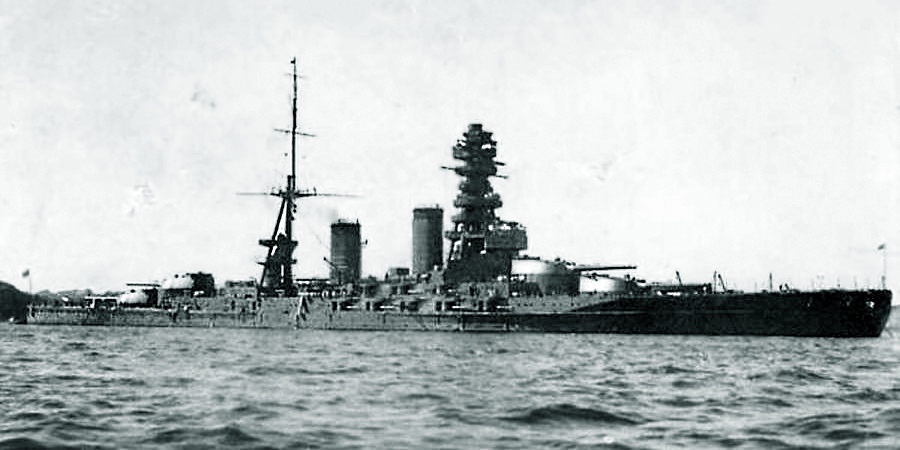
Mutsu (Japanese: 陸奥; named after the ancient Mutsu Province) was the second and last Nagato-class dreadnought battleship built for the Imperial Japanese Navy (IJN) at the end of World War I. In 1923 she carried supplies for the survivors of the Great Kantō earthquake. The ship was modernized in 1934–1936 with improvements to her armour and machinery, and a rebuilt superstructure in the pagoda mast style.
Other than participating in the Battle of Midway and the Battle of the Eastern Solomons in 1942, where she did not see any significant combat, Mutsu spent most of the first year of the Pacific War in training. She returned to Japan in early 1943. That June, one of her aft magazines detonated while she was at anchor, sinking the ship with the loss of 1,121 crew and visitors. The IJN investigation into the cause of her loss concluded that it was the work of a disgruntled crew member. The navy dispersed the survivors in an attempt to conceal the sinking in the interest of morale in Japan. Much of the wreck was scrapped after the war, but some artefacts and relics are on display in Japan, and a small portion of the ship remains where she was sunk.
Mutsu had a length of 201.17 metres (660 ft) between perpendiculars and 215.8 metres (708 ft) overall. She had a beam of 28.96 metres (95 ft) and a draught of 9 metres (29 ft 6 in). The ship displaced 32,720 tonnes (32,200 long tons) at standard load and 39,116 tonnes (38,498 long tons) at full load. Her crew consisted of 1,333 officers and enlisted men as built and 1,368 in 1935. The crew totaled around 1,475 men in 1942.
In 1927, Mutsu's bow was remodeled to reduce the amount of spray produced when steaming into a head sea. This increased her overall length by 1.59 metres (5 ft 3 in) to 217.39 metres (713 ft 3 in). During her 1934–1936 reconstruction, the ship's stern was lengthened by 7.55 metres (24 ft 9 in) to improve her speed, and her forward superstructure was rebuilt into a pagoda mast. She was given torpedo bulges to improve her underwater protection and to compensate for the weight of the additional armour and equipment. These changes increased her overall length to 224.94 m (738 ft), her beam to 34.6 m (113 ft 6 in) and her draught to 9.49 metres (31 ft 2 in). Her displacement increased over 7,000 tonnes (6,900 long tons) to 46,690 tonnes (45,950 long tons) at deep load.
Mutsu was equipped with four Gihon geared steam turbines, each of which drove one propeller shaft. The turbines were designed to produce a total of 80,000 shaft horsepower (60,000 kW), using steam provided by 21 Kampon water-tube boilers; 15 of these were oil-fired, and the remaining half-dozen consumed a mixture of coal and oil. The ship had a stowage capacity of 1,600 t (1,600 long tons) of coal and 3,400 t (3,300 long tons) of fuel oil, giving her a range of 5,500 nmi (10,200 km; 6,300 mi) at a speed of 16 knots (30 km/h; 18 mph). The ship exceeded her designed speed of 26.5 knots (49.1 km/h; 30.5 mph) during her sea trials, reaching 26.7 knots (49.4 km/h; 30.7 mph) at 85,500 shp (63,800 kW).
During a refit in 1924 the fore funnel was rebuilt in a serpentine shape in an unsuccessful effort to prevent smoke interference with the bridge and fire-control systems. That funnel was eliminated during the ship's 1930s reconstruction when all of her existing boilers were replaced by ten lighter and more powerful oil-fired Kampon boilers, which had working pressures of 22 kg/cm2 (2,200 kPa; 310 psi) and temperatures of 300 °C (572 °F). In addition her turbines were replaced by lighter, more modern, units. When Mutsu conducted her post-reconstruction trials, she reached a speed of 24.98 knots (46.26 km/h; 28.75 mph) with 82,300 shp (61,400 kW). Additional fuel oil was stored in the bottoms of the newly added torpedo bulges, which increased her capacity to 5,560 t (5,470 long tons) and thus her range to 8,560 nmi (15,850 km; 9,850 mi) at 16 knots (30 km/h; 18 mph).
Mutsu's eight 45-caliber 41-centimetre (16.1 in) guns were mounted in two pairs of twin-gun, superfiring turrets fore and aft. Numbered one to four from front to rear, the hydraulically powered turrets gave the guns an elevation range of −2 to +35 degrees. The rate of fire for the guns was around two rounds per minute. A special Type 3 Sankaidan incendiary shrapnel shell was developed in the 1930s for anti-aircraft use. The turrets aboard the Nagato-class ships were replaced in the mid-1930s using those stored from the unfinished Tosa-class battleships. While in storage the turrets were modified to increase their range of elevation to −3 degrees to +43 degrees, which increased the guns' maximum range from 30,200 to 37,900 metres (33,000 to 41,400 yd).
The ship's secondary armament of twenty 50-calibre 14-centimetre (5.5 in) guns was mounted in casemates on the upper sides of the hull and in the superstructure. The manually operated guns had a maximum range of 20,500 metres (22,400 yd) and fired at a rate of six to ten rounds per minute. Anti-aircraft defence was provided by four 40-calibre 8-centimetre (3.1 in) 3rd Year Type AA guns in single mounts. These guns had a maximum elevation of +75 degrees, and a rate of fire of 13 to 20 rounds per minute. The ship was also fitted with eight 533-millimetre (21 in) torpedo tubes, four on each broadside, two above water and two submerged.
Hub AI
Japanese battleship Mutsu AI simulator
(@Japanese battleship Mutsu_simulator)
Japanese battleship Mutsu
Mutsu (Japanese: 陸奥; named after the ancient Mutsu Province) was the second and last Nagato-class dreadnought battleship built for the Imperial Japanese Navy (IJN) at the end of World War I. In 1923 she carried supplies for the survivors of the Great Kantō earthquake. The ship was modernized in 1934–1936 with improvements to her armour and machinery, and a rebuilt superstructure in the pagoda mast style.
Other than participating in the Battle of Midway and the Battle of the Eastern Solomons in 1942, where she did not see any significant combat, Mutsu spent most of the first year of the Pacific War in training. She returned to Japan in early 1943. That June, one of her aft magazines detonated while she was at anchor, sinking the ship with the loss of 1,121 crew and visitors. The IJN investigation into the cause of her loss concluded that it was the work of a disgruntled crew member. The navy dispersed the survivors in an attempt to conceal the sinking in the interest of morale in Japan. Much of the wreck was scrapped after the war, but some artefacts and relics are on display in Japan, and a small portion of the ship remains where she was sunk.
Mutsu had a length of 201.17 metres (660 ft) between perpendiculars and 215.8 metres (708 ft) overall. She had a beam of 28.96 metres (95 ft) and a draught of 9 metres (29 ft 6 in). The ship displaced 32,720 tonnes (32,200 long tons) at standard load and 39,116 tonnes (38,498 long tons) at full load. Her crew consisted of 1,333 officers and enlisted men as built and 1,368 in 1935. The crew totaled around 1,475 men in 1942.
In 1927, Mutsu's bow was remodeled to reduce the amount of spray produced when steaming into a head sea. This increased her overall length by 1.59 metres (5 ft 3 in) to 217.39 metres (713 ft 3 in). During her 1934–1936 reconstruction, the ship's stern was lengthened by 7.55 metres (24 ft 9 in) to improve her speed, and her forward superstructure was rebuilt into a pagoda mast. She was given torpedo bulges to improve her underwater protection and to compensate for the weight of the additional armour and equipment. These changes increased her overall length to 224.94 m (738 ft), her beam to 34.6 m (113 ft 6 in) and her draught to 9.49 metres (31 ft 2 in). Her displacement increased over 7,000 tonnes (6,900 long tons) to 46,690 tonnes (45,950 long tons) at deep load.
Mutsu was equipped with four Gihon geared steam turbines, each of which drove one propeller shaft. The turbines were designed to produce a total of 80,000 shaft horsepower (60,000 kW), using steam provided by 21 Kampon water-tube boilers; 15 of these were oil-fired, and the remaining half-dozen consumed a mixture of coal and oil. The ship had a stowage capacity of 1,600 t (1,600 long tons) of coal and 3,400 t (3,300 long tons) of fuel oil, giving her a range of 5,500 nmi (10,200 km; 6,300 mi) at a speed of 16 knots (30 km/h; 18 mph). The ship exceeded her designed speed of 26.5 knots (49.1 km/h; 30.5 mph) during her sea trials, reaching 26.7 knots (49.4 km/h; 30.7 mph) at 85,500 shp (63,800 kW).
During a refit in 1924 the fore funnel was rebuilt in a serpentine shape in an unsuccessful effort to prevent smoke interference with the bridge and fire-control systems. That funnel was eliminated during the ship's 1930s reconstruction when all of her existing boilers were replaced by ten lighter and more powerful oil-fired Kampon boilers, which had working pressures of 22 kg/cm2 (2,200 kPa; 310 psi) and temperatures of 300 °C (572 °F). In addition her turbines were replaced by lighter, more modern, units. When Mutsu conducted her post-reconstruction trials, she reached a speed of 24.98 knots (46.26 km/h; 28.75 mph) with 82,300 shp (61,400 kW). Additional fuel oil was stored in the bottoms of the newly added torpedo bulges, which increased her capacity to 5,560 t (5,470 long tons) and thus her range to 8,560 nmi (15,850 km; 9,850 mi) at 16 knots (30 km/h; 18 mph).
Mutsu's eight 45-caliber 41-centimetre (16.1 in) guns were mounted in two pairs of twin-gun, superfiring turrets fore and aft. Numbered one to four from front to rear, the hydraulically powered turrets gave the guns an elevation range of −2 to +35 degrees. The rate of fire for the guns was around two rounds per minute. A special Type 3 Sankaidan incendiary shrapnel shell was developed in the 1930s for anti-aircraft use. The turrets aboard the Nagato-class ships were replaced in the mid-1930s using those stored from the unfinished Tosa-class battleships. While in storage the turrets were modified to increase their range of elevation to −3 degrees to +43 degrees, which increased the guns' maximum range from 30,200 to 37,900 metres (33,000 to 41,400 yd).
The ship's secondary armament of twenty 50-calibre 14-centimetre (5.5 in) guns was mounted in casemates on the upper sides of the hull and in the superstructure. The manually operated guns had a maximum range of 20,500 metres (22,400 yd) and fired at a rate of six to ten rounds per minute. Anti-aircraft defence was provided by four 40-calibre 8-centimetre (3.1 in) 3rd Year Type AA guns in single mounts. These guns had a maximum elevation of +75 degrees, and a rate of fire of 13 to 20 rounds per minute. The ship was also fitted with eight 533-millimetre (21 in) torpedo tubes, four on each broadside, two above water and two submerged.
Recent media