



Community hub
Recent from talks
Knowledge base stats:
Talk channels stats:
Members stats:
Jellabiya
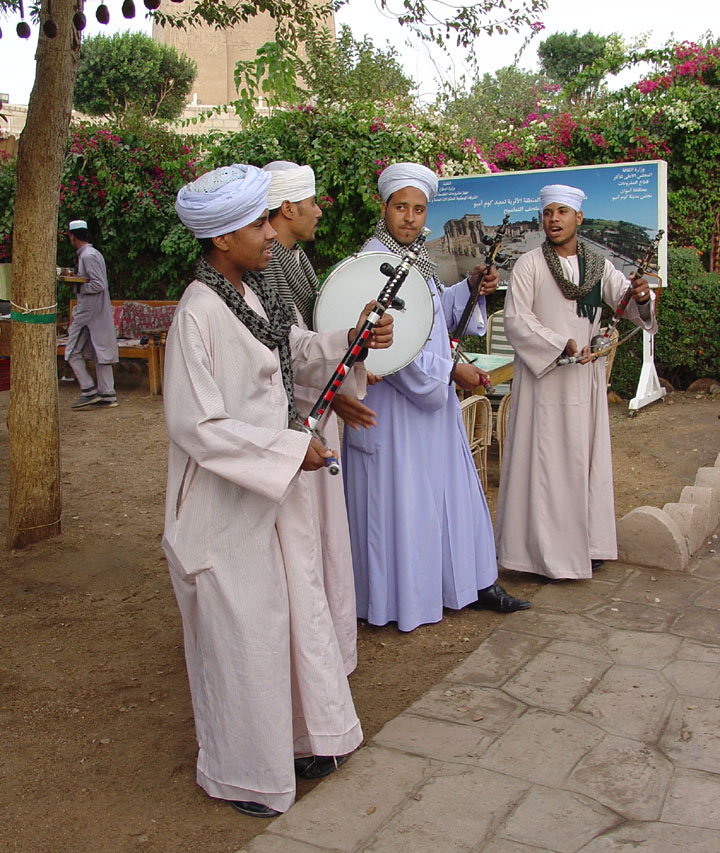
The jellabiya[citation needed], also jalabiya, galabeya or jalamia (Standard Arabic: جَلَّابِيَّة / ALA-LC: jallābīyah, Sudanese Arabic: jilabīyah, and in Egyptian Arabic: Galabiya, Egyptian Arabic: [ɡæ.læ.ˈbej.jæ, ɡæl.læ-]ē-); is a loose-fitting, traditional garment from Egypt. Today, it is the national clothing in Egypt and is also associated with farmers living in Egypt (Greater Cairo, countryside, Luxor, and Aswan). It comes in rich color varieties. The garment is also worn in Eritrea and Ethiopia but has other textures and is usually white. In Saudi Arabia the term jallābiyyah is used for women's traditional loose dresses that resembles a Kaftan.
The earliest forms of Jalabeya can be traced back to Ancient Egypt and Ancient Nubia (modern-day Sudan) where similar long, loose-fitting garments were worn by both men and women. In Ancient Egypt discoveries like Tarkhan dress (c. 3482–3102 BCE) housed at Petrie Museum of Egyptian Archaeology provide early evidence of woven tunic-style clothing. In parallel, archaeological evidence from Sudan also reveals early examples of robe-like attire. Excavations at royal burial sites in Kerma (c. 2500–1500 BCE) and the Meroitic Period (c. 300 BCE–350 CE) and hundreds of textile fragments recovered from royal pyramids in Sudan further demonstrate a complex clothing culture, often using cotton, a material not yet widely used in Egypt during the same period. Depictions of Nubians in Tomb of Huy (c. 1350 BCE), shown wearing tunics with wide sashes that pre-date the 25th Dynasty, further illustrate that loose-fitting robes were a shared feature of Nile Valley cultures, likely evolving independently or concurrently across both regions.
The Jalabeya differs from the Arabic thawb, as it has a wider cut, typically no collar (in some cases, no buttons) and longer, wider sleeves. Versions for farmers have very wide sleeves and sewn-in pockets used to carry tobacco, money, or other small items. Along the Red Sea coast in Egypt, and Sudan and among Beja tribesmen, the Arabic dishdash is preferred due to the jalabeya's relation to farming.
Jalabeya worn in summer are often white. During winter, thicker fabrics that are grey, dark green, olive, blue, tan or striped are used, and colorful scarves are worn around the neck or over the head. The garment is traditionally worn with an ammama (turban).
A full male dress in Sudan usually consists of three pieces, the jibba, the kaftan, and the sederi. The gebba/jibba, is the outermost garment characterized by a long opening over the chest. The urban version used to have this opening continue to the end, which made the jibba effectively a long coat. It has one pocket on one side and, on the other side, just an opening that leads to a pocket in the Kaftan, the gallabiya's undergarment. The kaftan is perfectly aligned with the jibba and worn under it for protection against both heat and cold. It is also made of pure cotton to avoid irritation caused by the wool of the winter jibba. Between the kaftan and the jibba there is a sederi (vest) which has small pockets for money, cigarette packs, and even pistols.
Men's galabeya in Egypt typically have wider hems and sleeves in the country than in the city and a wide neckline with a slit. In the city, there is usually a button placket instead of a simple slit. Dull, solid colors, stripes, and plaid are considered appropriate for men's galabeya, while women's are usually prints and bright colors (or occasionally solid black). In the summer, men's galabeya are made of cotton, while in winter they are made of flannel or wool in darker colors. A heavier galabeya may be worn on top of another and feature couched cord or braid decorations concentrated on the neckline, sometimes with braid buttons.
In Egypt, two men's galabeya with collars exist: the galabeya frangi (foreign) which has a western shirt collar and the galabeya scandarani (Alexandrian) which has a stand collar. They also have breast pockets and collars, buttoned placket front openings, high necklines, and a slightly tighter cut. These are seen as more sophisticated styles of men's galabeya compared to the standard. This clothing has been famous in Arab world with many different nationalities.
Women's galabeya in Egypt are typically varied along regional lines. The two main styles are the galabeya bi wist (with waist) and galabeya bi sufra (yoked and loose). The former is common in Middle Upper Egypt from Beni Suef to Assiut, and the latter is common in the Delta. Deep Upper Egypt has both, distributed along ethnic lines.
Hub AI
Jellabiya AI simulator
(@Jellabiya_simulator)
Jellabiya
The jellabiya[citation needed], also jalabiya, galabeya or jalamia (Standard Arabic: جَلَّابِيَّة / ALA-LC: jallābīyah, Sudanese Arabic: jilabīyah, and in Egyptian Arabic: Galabiya, Egyptian Arabic: [ɡæ.læ.ˈbej.jæ, ɡæl.læ-]ē-); is a loose-fitting, traditional garment from Egypt. Today, it is the national clothing in Egypt and is also associated with farmers living in Egypt (Greater Cairo, countryside, Luxor, and Aswan). It comes in rich color varieties. The garment is also worn in Eritrea and Ethiopia but has other textures and is usually white. In Saudi Arabia the term jallābiyyah is used for women's traditional loose dresses that resembles a Kaftan.
The earliest forms of Jalabeya can be traced back to Ancient Egypt and Ancient Nubia (modern-day Sudan) where similar long, loose-fitting garments were worn by both men and women. In Ancient Egypt discoveries like Tarkhan dress (c. 3482–3102 BCE) housed at Petrie Museum of Egyptian Archaeology provide early evidence of woven tunic-style clothing. In parallel, archaeological evidence from Sudan also reveals early examples of robe-like attire. Excavations at royal burial sites in Kerma (c. 2500–1500 BCE) and the Meroitic Period (c. 300 BCE–350 CE) and hundreds of textile fragments recovered from royal pyramids in Sudan further demonstrate a complex clothing culture, often using cotton, a material not yet widely used in Egypt during the same period. Depictions of Nubians in Tomb of Huy (c. 1350 BCE), shown wearing tunics with wide sashes that pre-date the 25th Dynasty, further illustrate that loose-fitting robes were a shared feature of Nile Valley cultures, likely evolving independently or concurrently across both regions.
The Jalabeya differs from the Arabic thawb, as it has a wider cut, typically no collar (in some cases, no buttons) and longer, wider sleeves. Versions for farmers have very wide sleeves and sewn-in pockets used to carry tobacco, money, or other small items. Along the Red Sea coast in Egypt, and Sudan and among Beja tribesmen, the Arabic dishdash is preferred due to the jalabeya's relation to farming.
Jalabeya worn in summer are often white. During winter, thicker fabrics that are grey, dark green, olive, blue, tan or striped are used, and colorful scarves are worn around the neck or over the head. The garment is traditionally worn with an ammama (turban).
A full male dress in Sudan usually consists of three pieces, the jibba, the kaftan, and the sederi. The gebba/jibba, is the outermost garment characterized by a long opening over the chest. The urban version used to have this opening continue to the end, which made the jibba effectively a long coat. It has one pocket on one side and, on the other side, just an opening that leads to a pocket in the Kaftan, the gallabiya's undergarment. The kaftan is perfectly aligned with the jibba and worn under it for protection against both heat and cold. It is also made of pure cotton to avoid irritation caused by the wool of the winter jibba. Between the kaftan and the jibba there is a sederi (vest) which has small pockets for money, cigarette packs, and even pistols.
Men's galabeya in Egypt typically have wider hems and sleeves in the country than in the city and a wide neckline with a slit. In the city, there is usually a button placket instead of a simple slit. Dull, solid colors, stripes, and plaid are considered appropriate for men's galabeya, while women's are usually prints and bright colors (or occasionally solid black). In the summer, men's galabeya are made of cotton, while in winter they are made of flannel or wool in darker colors. A heavier galabeya may be worn on top of another and feature couched cord or braid decorations concentrated on the neckline, sometimes with braid buttons.
In Egypt, two men's galabeya with collars exist: the galabeya frangi (foreign) which has a western shirt collar and the galabeya scandarani (Alexandrian) which has a stand collar. They also have breast pockets and collars, buttoned placket front openings, high necklines, and a slightly tighter cut. These are seen as more sophisticated styles of men's galabeya compared to the standard. This clothing has been famous in Arab world with many different nationalities.
Women's galabeya in Egypt are typically varied along regional lines. The two main styles are the galabeya bi wist (with waist) and galabeya bi sufra (yoked and loose). The former is common in Middle Upper Egypt from Beni Suef to Assiut, and the latter is common in the Delta. Deep Upper Egypt has both, distributed along ethnic lines.