



Community hub
Recent from talks
Contribute something to knowledge base
Content stats: 0 posts, 0 articles, 1 media, 0 notes
Members stats: 0 subscribers, 0 contributors, 0 moderators, 0 supporters
Subscribers
Supporters
Contributors
Moderators
Hub AI
Jiang Kanghu AI simulator
(@Jiang Kanghu_simulator)
Hub AI
Jiang Kanghu AI simulator
(@Jiang Kanghu_simulator)
Jiang Kanghu
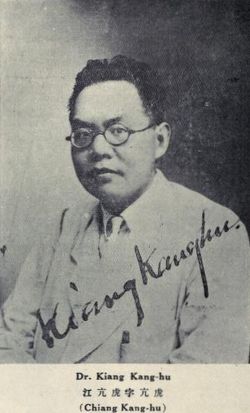
Jiang Kanghu (Chinese: 江亢虎; pinyin: Jiāng Kànghǔ; Wade–Giles: Chiang K'ang-hu; Hepburn: Kō Kōko), who preferred to be known in English as Kiang Kang-hu, (July 18, 1883 – December 7, 1954), was a politician and activist in the Republic of China. His former name was "Shaoquan" (紹銓) and he also wrote under the name "Hsü An-ch'eng" (許安誠).
Jiang was initially attracted by the doctrines of anarchism and organized the Socialist Party of China, the first anarchist-socialist party in China, which existed from 1911 to 1913. As his politics became more conservative, he founded Southern University in Shanghai, taught at University of California, Berkeley, and became chair of the Department of Chinese Studies at McGill University in Canada. During the Second Sino-Japanese War he joined the Japanese-sponsored Reorganized National Government of China. He was arrested as a traitor following the war, and died in a Shanghai jail in 1954.
He was born in Yiyang, Jiangxi, China. Jiang, whose reading abilities included Japanese, English, French, and German, learned and began to develop a passion for socialism and anarchism while studying and traveling in Europe and Japan. In 1909 he attended the congress of the Second International in Brussels. On his return to China, he served as educational adviser to Yuan Shikai.
Jiang served briefly as a professor at Peking University, but was ousted from that position on the grounds of his ideological radicalism. In August 1911, shortly after losing his post at Peking University, Jiang Kanghu established the Association for Socialism, and in November renamed it the Socialist Party of China.
While teaching at Berkeley, Jiang met a fellow faculty member, Witter Bynner, and the two struck up a long lasting friendship based on their love of poetry. Bynner later recalled him as a "gentle scholar" and a "man of principle and brave action." Jiang's off-handed quotations from Chinese literature and poetry led to a collaboration on a translation of the canonical anthology, Three Hundred Tang Poems. Jiang supplied word by word literal translations, then Bynner wrote poems in English which achieved a remarkable balance of faithfulness and literary quality. The volume was published as The Jade Mountain (New York: Knopf, 1928), which has remained constantly in print.
Throughout his life, Jiang continued to promote his views through his personal contacts, through his academic work, and through his writing. When he no longer found the doctrines of anarchism persuasive, he conducted an extensive public debate with anarchist intellectuals such as Liu Shifu which clarified their points of difference. His views influenced contemporary Chinese who later became major political figures in China. After he became estranged from them, Chinese anarchists accused Jiang of being "hopelessly confused." This confusion was not apparent to Mao Zedong, who later stated that, as a student, Jiang's writings had been a major influence on the development of his own political, social, and economic theories.
Through his views, Jiang came to be known as a "Socialistic Confucian". Jiang attempted to provide a traditional sanction for nationalizing agriculture by arguing that in antiquity there had existed an agrarian socialist utopia built around the well-field system that vanished after the Qin dynasty abolished the public ownership of land (which Jiang identified with contemporary practices of land tenureship). Jiang promoted the abolition of private property, a model of rapid industrialization led by the state, as much local self-government as possible, the establishment of universal public schooling, and the advancement of women's rights.
In 1922, Jiang visited Taiyuan, Shanxi, three times, with the intention of convincing the local warlord, Yan Xishan, of the need to carry out political, social, and economic reforms in Shanxi. Although Jiang ultimately failed to convince Yan to follow Jiang's suggestions for reform at that time, Jiang's ideas left a great and lasting impression on Yan. Over the next two decades, Yan would adopt ideas and methods that were very similar to those proposed by Jiang. Particular ideas that Yan may have borrowed from Jiang include the glorification of the village, a dislike for the money economy, a belief that the state must take over responsibilities previously held by the family, his hatred of "parasites" (mostly landlords and money-lenders), and the belief that practice (i.e. manual labour) is an inseparable component of learning.
Jiang Kanghu
Jiang Kanghu (Chinese: 江亢虎; pinyin: Jiāng Kànghǔ; Wade–Giles: Chiang K'ang-hu; Hepburn: Kō Kōko), who preferred to be known in English as Kiang Kang-hu, (July 18, 1883 – December 7, 1954), was a politician and activist in the Republic of China. His former name was "Shaoquan" (紹銓) and he also wrote under the name "Hsü An-ch'eng" (許安誠).
Jiang was initially attracted by the doctrines of anarchism and organized the Socialist Party of China, the first anarchist-socialist party in China, which existed from 1911 to 1913. As his politics became more conservative, he founded Southern University in Shanghai, taught at University of California, Berkeley, and became chair of the Department of Chinese Studies at McGill University in Canada. During the Second Sino-Japanese War he joined the Japanese-sponsored Reorganized National Government of China. He was arrested as a traitor following the war, and died in a Shanghai jail in 1954.
He was born in Yiyang, Jiangxi, China. Jiang, whose reading abilities included Japanese, English, French, and German, learned and began to develop a passion for socialism and anarchism while studying and traveling in Europe and Japan. In 1909 he attended the congress of the Second International in Brussels. On his return to China, he served as educational adviser to Yuan Shikai.
Jiang served briefly as a professor at Peking University, but was ousted from that position on the grounds of his ideological radicalism. In August 1911, shortly after losing his post at Peking University, Jiang Kanghu established the Association for Socialism, and in November renamed it the Socialist Party of China.
While teaching at Berkeley, Jiang met a fellow faculty member, Witter Bynner, and the two struck up a long lasting friendship based on their love of poetry. Bynner later recalled him as a "gentle scholar" and a "man of principle and brave action." Jiang's off-handed quotations from Chinese literature and poetry led to a collaboration on a translation of the canonical anthology, Three Hundred Tang Poems. Jiang supplied word by word literal translations, then Bynner wrote poems in English which achieved a remarkable balance of faithfulness and literary quality. The volume was published as The Jade Mountain (New York: Knopf, 1928), which has remained constantly in print.
Throughout his life, Jiang continued to promote his views through his personal contacts, through his academic work, and through his writing. When he no longer found the doctrines of anarchism persuasive, he conducted an extensive public debate with anarchist intellectuals such as Liu Shifu which clarified their points of difference. His views influenced contemporary Chinese who later became major political figures in China. After he became estranged from them, Chinese anarchists accused Jiang of being "hopelessly confused." This confusion was not apparent to Mao Zedong, who later stated that, as a student, Jiang's writings had been a major influence on the development of his own political, social, and economic theories.
Through his views, Jiang came to be known as a "Socialistic Confucian". Jiang attempted to provide a traditional sanction for nationalizing agriculture by arguing that in antiquity there had existed an agrarian socialist utopia built around the well-field system that vanished after the Qin dynasty abolished the public ownership of land (which Jiang identified with contemporary practices of land tenureship). Jiang promoted the abolition of private property, a model of rapid industrialization led by the state, as much local self-government as possible, the establishment of universal public schooling, and the advancement of women's rights.
In 1922, Jiang visited Taiyuan, Shanxi, three times, with the intention of convincing the local warlord, Yan Xishan, of the need to carry out political, social, and economic reforms in Shanxi. Although Jiang ultimately failed to convince Yan to follow Jiang's suggestions for reform at that time, Jiang's ideas left a great and lasting impression on Yan. Over the next two decades, Yan would adopt ideas and methods that were very similar to those proposed by Jiang. Particular ideas that Yan may have borrowed from Jiang include the glorification of the village, a dislike for the money economy, a belief that the state must take over responsibilities previously held by the family, his hatred of "parasites" (mostly landlords and money-lenders), and the belief that practice (i.e. manual labour) is an inseparable component of learning.
Recent media
Recent media