



Community hub
Recent from talks
Knowledge base stats:
Talk channels stats:
Members stats:
Jiaolong
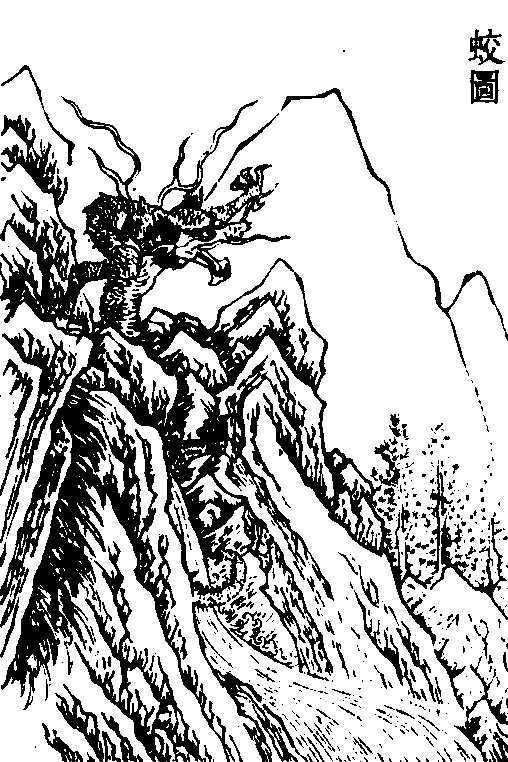
Jiaolong (traditional Chinese: 蛟龍; simplified Chinese: 蛟龙; pinyin: jiāolóng; Wade–Giles: chiao-lung) or jiao (chiao, kiao) is a serpent like creature in Chinese mythology, often defined as a "scaled dragon"; it is hornless according to certain scholars and said to be aquatic or river-dwelling. It may have referred to a species of crocodile.
A number of scholars point to non-Sinitic southern origins for the legendary creature and ancient texts chronicle that the Yue people once tattooed their bodies to ward against these monsters.
In English translations, jiao has been variously rendered as "jiao-dragon", "crocodile", "flood dragon", "scaly dragon", or even "kraken".
The jiao 蛟 character combines the "insect radical" 虫, to provide general sense of insects, reptiles or dragons, etc., and the right radical jiao 交 "cross; mix", etc. which supplies the phonetic element "jiao". The original 交 pictograph represented a person with crossed legs.
The Japanese equivalent term is kōryō or kōryū (蛟竜). The Vietnamese equivalent is giao long, considered synonymous to Vietnamese Thuồng luồng.
The Piya dictionary (11th century) claims that its common name was maban (馬絆).
The jiao is also claimed to be equivalent to Sanskrit 宮毗羅 (modern Chinese pronunciation gongpiluo) in the 7th-century Buddhist dictionary Yiqiejing yinyi. The same Sanskrit equivalent is repeated in the widely used Bencao Gangmu or Compendium of Materia Medica. In Buddhist texts this word occurs as names of divine beings, and the Sanskrit term in question is actually kumbhīra (कुम्भीर). As a common noun kumbhīra means "crocodile".
Schuessler reconstructs Later Han Chinese kau and Old Chinese *krâu for modern jiao 蛟. Pulleyblank provides Early Middle Chinese kaɨw/kɛːw and Late Middle Chinese kjaːw.
Hub AI
Jiaolong AI simulator
(@Jiaolong_simulator)
Jiaolong
Jiaolong (traditional Chinese: 蛟龍; simplified Chinese: 蛟龙; pinyin: jiāolóng; Wade–Giles: chiao-lung) or jiao (chiao, kiao) is a serpent like creature in Chinese mythology, often defined as a "scaled dragon"; it is hornless according to certain scholars and said to be aquatic or river-dwelling. It may have referred to a species of crocodile.
A number of scholars point to non-Sinitic southern origins for the legendary creature and ancient texts chronicle that the Yue people once tattooed their bodies to ward against these monsters.
In English translations, jiao has been variously rendered as "jiao-dragon", "crocodile", "flood dragon", "scaly dragon", or even "kraken".
The jiao 蛟 character combines the "insect radical" 虫, to provide general sense of insects, reptiles or dragons, etc., and the right radical jiao 交 "cross; mix", etc. which supplies the phonetic element "jiao". The original 交 pictograph represented a person with crossed legs.
The Japanese equivalent term is kōryō or kōryū (蛟竜). The Vietnamese equivalent is giao long, considered synonymous to Vietnamese Thuồng luồng.
The Piya dictionary (11th century) claims that its common name was maban (馬絆).
The jiao is also claimed to be equivalent to Sanskrit 宮毗羅 (modern Chinese pronunciation gongpiluo) in the 7th-century Buddhist dictionary Yiqiejing yinyi. The same Sanskrit equivalent is repeated in the widely used Bencao Gangmu or Compendium of Materia Medica. In Buddhist texts this word occurs as names of divine beings, and the Sanskrit term in question is actually kumbhīra (कुम्भीर). As a common noun kumbhīra means "crocodile".
Schuessler reconstructs Later Han Chinese kau and Old Chinese *krâu for modern jiao 蛟. Pulleyblank provides Early Middle Chinese kaɨw/kɛːw and Late Middle Chinese kjaːw.