


Community hub
Recent from talks
Contribute something to knowledge base
Content stats: 0 posts, 0 articles, 1 media, 0 notes
Members stats: 0 subscribers, 0 contributors, 0 moderators, 0 supporters
Subscribers
Supporters
Contributors
Moderators
Hub AI
Joe Albi Stadium AI simulator
(@Joe Albi Stadium_simulator)
Hub AI
Joe Albi Stadium AI simulator
(@Joe Albi Stadium_simulator)
Joe Albi Stadium
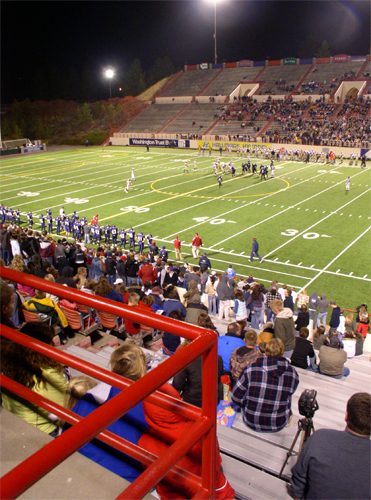
Joe Albi Stadium was an outdoor multi-purpose stadium in Spokane, Washington, United States. It was located in the northwest part of the city, just east of the Spokane River. The stadium was primarily used for high school football, as a secondary home field for the Washington State Cougars, and for minor league soccer.
The venue opened in 1950 on the site of a former U.S. Army hospital, and was originally known as Memorial Stadium. It was renamed in 1962 for local civic leader Joe Albi, who spearheaded efforts to build more sporting facilities in Spokane. After more than seventy years of service, it closed in early 2022 and was demolished; its successor is the new One Spokane Stadium in downtown Spokane, just northeast of the Spokane Arena.
The stadium is located on part of the former site of the U.S. Army's Baxter General Hospital, which operated on the site during World War II between March 1943 and December 12, 1945. Built in less than four months in 1950, it opened as "Spokane Memorial Stadium" on September 15 with high school football. The name was selected through a newspaper contest and adopted by the city council in July. Its original grass field was taken from the lush sod of the parade grounds at historic Fort George Wright, south of the stadium. The lighted venue had a seating capacity of 25,000 but did not have a running track; city track and field continued at Hart Field (47°37′19″N 117°24′16″W / 47.622°N 117.4044°W) in south Spokane. High school football was previously played at wooden Gonzaga Stadium, until it was deemed unsafe after the 1947 season. For the next two seasons, the high schools played at Ferris Field, a minor league ballpark just west of the Playfair horse track.
On Saturday, November 25, 1950, Memorial Stadium was officially presented to the city by attorney Joseph A. Albi, leader of the Athletic Round Table (ART), and dedicated by Governor Arthur Langlie. The ceremonies were prior to the kickoff of the Washington–Washington State football game (now known as the Apple Cup). The rivalry game had been absent from the city for forty years, last played in Spokane in 1910.
The first manager of the stadium was Fred Bohler, the former coach and athletic director at Washington State College in Pullman. In 1954, it was considered as a potential minor league baseball venue; Indians Stadium (now Avista Stadium) opened in 1958.
Memorial Stadium was renamed in the spring of 1962 for Albi (1892–1962), a local sports booster who led the efforts to fund and construct it. A bronze statue of Albi was unveiled in 1997 at the stadium. Seated several rows above the field in the southwest corner bleachers, the 600-pound (270 kg) statue is often adorned in the school colors of competing teams.
In the summer of 1962, the field level was lowered by 11 feet (3.4 m) and 7,000 seats were added. AstroTurf was first installed in 1970, and was replaced with SuperTurf in 1979, and 1984. The playing surface was altered for professional soccer in 1996, essentially undoing the lowering project of 1962. The field level was raised 6+1⁄2 feet (2.0 m) and the width of the new artificial turf was extended to 250 feet (76 m), formerly at 191 feet (58 m), and seating was removed. The field was changed a decade later to infilled FieldTurf in 2006.
The stadium, in its final configuration, had a seating capacity of 28,646, and the playing field runs in the traditional north–south configuration at an elevation of 1,890 feet (575 m) above sea level. Located at the top of the west grandstand; the press box was rebuilt in 1978.
Joe Albi Stadium
Joe Albi Stadium was an outdoor multi-purpose stadium in Spokane, Washington, United States. It was located in the northwest part of the city, just east of the Spokane River. The stadium was primarily used for high school football, as a secondary home field for the Washington State Cougars, and for minor league soccer.
The venue opened in 1950 on the site of a former U.S. Army hospital, and was originally known as Memorial Stadium. It was renamed in 1962 for local civic leader Joe Albi, who spearheaded efforts to build more sporting facilities in Spokane. After more than seventy years of service, it closed in early 2022 and was demolished; its successor is the new One Spokane Stadium in downtown Spokane, just northeast of the Spokane Arena.
The stadium is located on part of the former site of the U.S. Army's Baxter General Hospital, which operated on the site during World War II between March 1943 and December 12, 1945. Built in less than four months in 1950, it opened as "Spokane Memorial Stadium" on September 15 with high school football. The name was selected through a newspaper contest and adopted by the city council in July. Its original grass field was taken from the lush sod of the parade grounds at historic Fort George Wright, south of the stadium. The lighted venue had a seating capacity of 25,000 but did not have a running track; city track and field continued at Hart Field (47°37′19″N 117°24′16″W / 47.622°N 117.4044°W) in south Spokane. High school football was previously played at wooden Gonzaga Stadium, until it was deemed unsafe after the 1947 season. For the next two seasons, the high schools played at Ferris Field, a minor league ballpark just west of the Playfair horse track.
On Saturday, November 25, 1950, Memorial Stadium was officially presented to the city by attorney Joseph A. Albi, leader of the Athletic Round Table (ART), and dedicated by Governor Arthur Langlie. The ceremonies were prior to the kickoff of the Washington–Washington State football game (now known as the Apple Cup). The rivalry game had been absent from the city for forty years, last played in Spokane in 1910.
The first manager of the stadium was Fred Bohler, the former coach and athletic director at Washington State College in Pullman. In 1954, it was considered as a potential minor league baseball venue; Indians Stadium (now Avista Stadium) opened in 1958.
Memorial Stadium was renamed in the spring of 1962 for Albi (1892–1962), a local sports booster who led the efforts to fund and construct it. A bronze statue of Albi was unveiled in 1997 at the stadium. Seated several rows above the field in the southwest corner bleachers, the 600-pound (270 kg) statue is often adorned in the school colors of competing teams.
In the summer of 1962, the field level was lowered by 11 feet (3.4 m) and 7,000 seats were added. AstroTurf was first installed in 1970, and was replaced with SuperTurf in 1979, and 1984. The playing surface was altered for professional soccer in 1996, essentially undoing the lowering project of 1962. The field level was raised 6+1⁄2 feet (2.0 m) and the width of the new artificial turf was extended to 250 feet (76 m), formerly at 191 feet (58 m), and seating was removed. The field was changed a decade later to infilled FieldTurf in 2006.
The stadium, in its final configuration, had a seating capacity of 28,646, and the playing field runs in the traditional north–south configuration at an elevation of 1,890 feet (575 m) above sea level. Located at the top of the west grandstand; the press box was rebuilt in 1978.
Recent media
Recent media