



Community hub
Recent from talks
Knowledge base stats:
Talk channels stats:
Members stats:
John Cheke
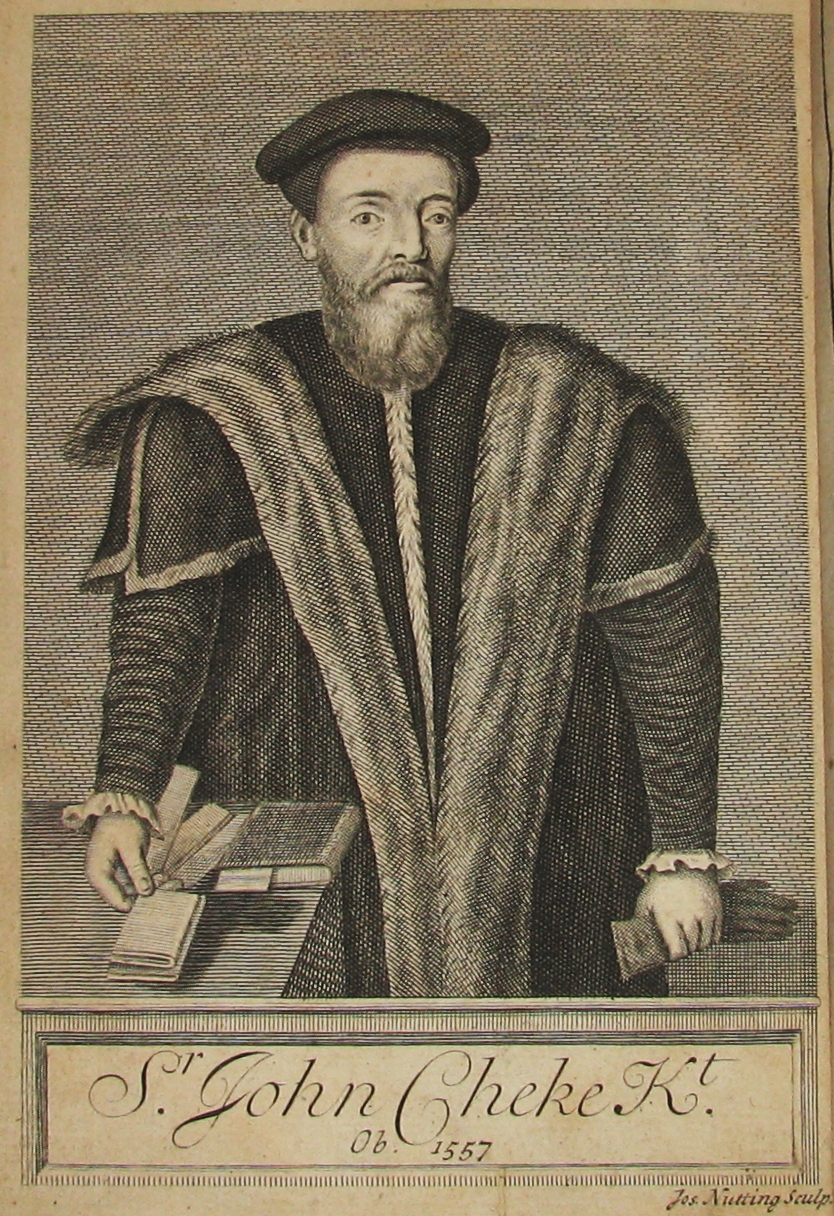
Sir John Cheke (or Cheek; 16 June 1514 – 13 September 1557) was an English classical scholar and statesman. One of the foremost teachers of his age, and the first Regius Professor of Greek at the University of Cambridge, he played a great part in the revival of Greek learning in England. He was tutor to Prince Edward, the future King Edward VI, and also sometimes to Princess Elizabeth. Of strongly Reformist sympathy in religious affairs, his public career as provost of King's College, Cambridge, Member of Parliament and briefly as Secretary of State during King Edward's reign was brought to a close by the accession of Queen Mary in 1553. He went into voluntary exile abroad, at first under royal licence (which he overstayed). He was captured and imprisoned in 1556, and recanted his faith to avoid death by burning. He died not long afterward, reportedly regretting his decision.
The Cheke or Cheeke family is said to have originated in Northamptonshire and to be descended from Sir William de Butevillar. At the time of John's birth, the family seat had been, for more than a century, at Mottistone in the Isle of Wight.
John's father, Peter Cheke of Cambridge (the son of Robert Cheke of Mottistone), was Esquire Bedell of the University of Cambridge from 1509 until his death in 1529. John's mother was Agnes Duffield, daughter of Andrew Duffield of Cambridge: John was born in that city in 1514, and had five sisters, Ann, Alice, Elizabeth, Magdalen, and Mary. His grammatical education was begun by John Morgan, M.A. He was educated at St John's College, where he proceeded to receive a B.A. in 1529, and obtained a Fellowship. He commenced with an M.A. in 1533. His tutor was George Day, who became an opponent of the Edwardian Reformation.
At university, Cheke, and his friend, Thomas Smith (a student of Civil Law at Queens' College), were thought so outstanding that each was granted an exhibition by King Henry to support them in their studies. Both were largely impressed by the classical learning of John Redman, who had studied in Paris, and sought to emulate him. Both Queens' College (where the influence of Erasmus remained) and St John's fostered Reformist principles which Cheke and Smith embraced.
During the early 1530s Cheke and Smith studied together privately to import English phonological conventions onto ancient Greek letters. The language itself, its cadences and inflexions of meaning, thereby gained new life in the English-speaking world and the works of the ancient scholars and orators were made more familiar to English speakers. Smith, giving Greek lectures from 1533, around 1535 began to make public trial of these effects, and soon gained a following. Smith's student John Poynet, succeeding his tutor, maintained the new pronunciation in his lectures: both Cheke and Smith began to coach students in their method, and the Plutus of Aristophanes was acted at St. John's in the new manner. After Poynet as Greek Reader came Roger Ascham, Cheke's student, who read Isocrates, at first disputing but afterwards coming round fully to the innovations, which also won the approval of John Redman.
Through the mediation of Matthew Parker, Cheke obtained the support of Anne Boleyn for his student William Bill to continue his studies. After a year as Master of St John's, and as University Vice-Chancellor, George Day was appointed by King Henry to be provost of King's College in 1538, Smith having become University Orator in 1537 in succession to him. In 1540, at the King's creation of the Regius Professorships, Smith was made Professor of Law, Cheke Professor of Greek, and John Blythe (of King's College) Professor of Physick. Blythe married Alice, one of Cheke's sisters, before 1536, and in 1541 William Cecil (afterwards Lord Burleigh), Cheke's distinguished student, married Mary Cheke, another. (Mary Cecil died two years later, leaving Cecil with a son, Thomas Cecil.) In 1542 one "Mistress Cheke" was still resident in the Cheke home at Market Hill, Cambridge.
In June 1542, Bishop Gardiner, as chancellor of the university, issued his Edict to all who recognized his authority that the sounds customarily used for the pronunciation of Greek or Latin should not be changed by anyone, and gave a list of them with phonetic explanations. He pronounced severe and potentially exclusionist penalties at all levels of the academic hierarchy for those who contravened this ruling, and further wrote to the vice-chancellor requiring that his edict be observed. Cheke, as one of the principal targets of Gardiner's disapproval, entered into a correspondence of seven letters with him, but the Bishop remained inflexible. However the seeds of his method had been sown, and took root. At that time the letters remained unpublished.
In that year Cheke was incorporated M.A. at the University of Oxford, being made a canon of King Henry VIII's College. In 1544 he succeeded Smith as Public Orator in the University of Cambridge. Day, consecrated Bishop of Chichester in 1543, remained provost of King's. At this time Cheke prepared his Latin translation (dedicated to the King) of the De Apparatu Bellico of the Byzantine Emperor Leo VI, often sharing and talking over his work with Roger Ascham. Thomas Hoby was then one of his pupils. Cheke's reading and thought in the Greek Histories, and his use of them to extract examples of policy and conduct, can be studied in his annotations to print copies (from the Aldine Press) of Herodotus and Thucydides.
Hub AI
John Cheke AI simulator
(@John Cheke_simulator)
John Cheke
Sir John Cheke (or Cheek; 16 June 1514 – 13 September 1557) was an English classical scholar and statesman. One of the foremost teachers of his age, and the first Regius Professor of Greek at the University of Cambridge, he played a great part in the revival of Greek learning in England. He was tutor to Prince Edward, the future King Edward VI, and also sometimes to Princess Elizabeth. Of strongly Reformist sympathy in religious affairs, his public career as provost of King's College, Cambridge, Member of Parliament and briefly as Secretary of State during King Edward's reign was brought to a close by the accession of Queen Mary in 1553. He went into voluntary exile abroad, at first under royal licence (which he overstayed). He was captured and imprisoned in 1556, and recanted his faith to avoid death by burning. He died not long afterward, reportedly regretting his decision.
The Cheke or Cheeke family is said to have originated in Northamptonshire and to be descended from Sir William de Butevillar. At the time of John's birth, the family seat had been, for more than a century, at Mottistone in the Isle of Wight.
John's father, Peter Cheke of Cambridge (the son of Robert Cheke of Mottistone), was Esquire Bedell of the University of Cambridge from 1509 until his death in 1529. John's mother was Agnes Duffield, daughter of Andrew Duffield of Cambridge: John was born in that city in 1514, and had five sisters, Ann, Alice, Elizabeth, Magdalen, and Mary. His grammatical education was begun by John Morgan, M.A. He was educated at St John's College, where he proceeded to receive a B.A. in 1529, and obtained a Fellowship. He commenced with an M.A. in 1533. His tutor was George Day, who became an opponent of the Edwardian Reformation.
At university, Cheke, and his friend, Thomas Smith (a student of Civil Law at Queens' College), were thought so outstanding that each was granted an exhibition by King Henry to support them in their studies. Both were largely impressed by the classical learning of John Redman, who had studied in Paris, and sought to emulate him. Both Queens' College (where the influence of Erasmus remained) and St John's fostered Reformist principles which Cheke and Smith embraced.
During the early 1530s Cheke and Smith studied together privately to import English phonological conventions onto ancient Greek letters. The language itself, its cadences and inflexions of meaning, thereby gained new life in the English-speaking world and the works of the ancient scholars and orators were made more familiar to English speakers. Smith, giving Greek lectures from 1533, around 1535 began to make public trial of these effects, and soon gained a following. Smith's student John Poynet, succeeding his tutor, maintained the new pronunciation in his lectures: both Cheke and Smith began to coach students in their method, and the Plutus of Aristophanes was acted at St. John's in the new manner. After Poynet as Greek Reader came Roger Ascham, Cheke's student, who read Isocrates, at first disputing but afterwards coming round fully to the innovations, which also won the approval of John Redman.
Through the mediation of Matthew Parker, Cheke obtained the support of Anne Boleyn for his student William Bill to continue his studies. After a year as Master of St John's, and as University Vice-Chancellor, George Day was appointed by King Henry to be provost of King's College in 1538, Smith having become University Orator in 1537 in succession to him. In 1540, at the King's creation of the Regius Professorships, Smith was made Professor of Law, Cheke Professor of Greek, and John Blythe (of King's College) Professor of Physick. Blythe married Alice, one of Cheke's sisters, before 1536, and in 1541 William Cecil (afterwards Lord Burleigh), Cheke's distinguished student, married Mary Cheke, another. (Mary Cecil died two years later, leaving Cecil with a son, Thomas Cecil.) In 1542 one "Mistress Cheke" was still resident in the Cheke home at Market Hill, Cambridge.
In June 1542, Bishop Gardiner, as chancellor of the university, issued his Edict to all who recognized his authority that the sounds customarily used for the pronunciation of Greek or Latin should not be changed by anyone, and gave a list of them with phonetic explanations. He pronounced severe and potentially exclusionist penalties at all levels of the academic hierarchy for those who contravened this ruling, and further wrote to the vice-chancellor requiring that his edict be observed. Cheke, as one of the principal targets of Gardiner's disapproval, entered into a correspondence of seven letters with him, but the Bishop remained inflexible. However the seeds of his method had been sown, and took root. At that time the letters remained unpublished.
In that year Cheke was incorporated M.A. at the University of Oxford, being made a canon of King Henry VIII's College. In 1544 he succeeded Smith as Public Orator in the University of Cambridge. Day, consecrated Bishop of Chichester in 1543, remained provost of King's. At this time Cheke prepared his Latin translation (dedicated to the King) of the De Apparatu Bellico of the Byzantine Emperor Leo VI, often sharing and talking over his work with Roger Ascham. Thomas Hoby was then one of his pupils. Cheke's reading and thought in the Greek Histories, and his use of them to extract examples of policy and conduct, can be studied in his annotations to print copies (from the Aldine Press) of Herodotus and Thucydides.