


Community hub
Recent from talks
Contribute something to knowledge base
Content stats: 0 posts, 0 articles, 1 media, 0 notes
Members stats: 0 subscribers, 0 contributors, 0 moderators, 0 supporters
Subscribers
Supporters
Contributors
Moderators
Hub AI
John Major (philosopher) AI simulator
(@John Major (philosopher)_simulator)
Hub AI
John Major (philosopher) AI simulator
(@John Major (philosopher)_simulator)
John Major (philosopher)
John Major (or Mair; also known in Latin as Joannes Majoris and Haddingtonus Scotus; 1467–1550) was a Scottish philosopher, theologian, and historian who was much admired in his day and was an acknowledged influence on all the great thinkers of the time. A renowned teacher, his works were much collected and frequently republished across Europe. His "sane conservatism" and his sceptical, logical approach to the study of texts such as Aristotle or the Bible were less prized in the subsequent age of humanism, when a more committed and linguistic/literary approach prevailed.
His influence in logic (especially the analysis of terms), science (impetus and infinitesimals), politics (placing the people over kings), Church (councils over Popes), and international law (establishing the human rights of "savages" conquered by the Spanish) can be traced across the centuries and appear decidedly modern, and it is only in the modern age that he is not routinely dismissed as a scholastic. His Latin style did not help – he thought that "it is of more moment to understand aright, and clearly to lay down the truth of any matter than to use eloquent language". Nevertheless, it is to his writings, including their dedications, that we owe much of our knowledge of the everyday facts of Major's life – for example his "shortness of stature". He was an extremely curious and very observant man, and used his experiences – of earthquakes in Paisley, thunder in Glasgow, storms at sea, eating oatcakes in northern England – to illustrate the more abstract parts of his logical writings.
John Major (or 'Mair') was born about 1467 at Gleghornie, East Lothian near North Berwick where he received his early education. It was at nearby Haddington, East Lothian, Scotland, where he attended grammar school. He was probably taught by the town schoolmaster, who was, according to Major "although a circumspect man in other ways, more severe than was just in beating boys". If it had not been for the influence of his mother, Major says he would have left, but he and his brother stayed on and were successful. According to him, Haddington was "the town which fostered the beginning of my studies, and in whose kindly embrace I was nourished as a novice with the sweetest milk of the art of grammar". He says he stayed in Haddington "to a pretty advanced age" and he remembers the sound of the King James III's bombardment of the nearby castle of Dunbar, which was in 1479. He also remembers the comet which was supposed to have foretold the King's defeat at Sauchieburn which was in 1488.
However, it was in 1490, he reports, that he "first left the paternal hearth". In 1490, probably under the influence of Robert Cockburn, another Haddington man, destined to be an influential bishop (of Ross and later of Dunkeld), he decided to go to Paris to study among the great numbers of Scots there at the time.
It is not known whether he attended university in Scotland as a student – there are no matriculation records of him and he claimed never to have seen the university town of St Andrews, Fife as a young man (though he did complain later of its bad beer). He seems to have decided to prepare for Paris at Cambridge in England. He says that in 1492 he attended "Gods House", which later became Christ's College. He remembers the bells – "on great feast days, I spent half the night listening to them"[citation needed] – but was obviously well-prepared, as he left for Paris after three terms.
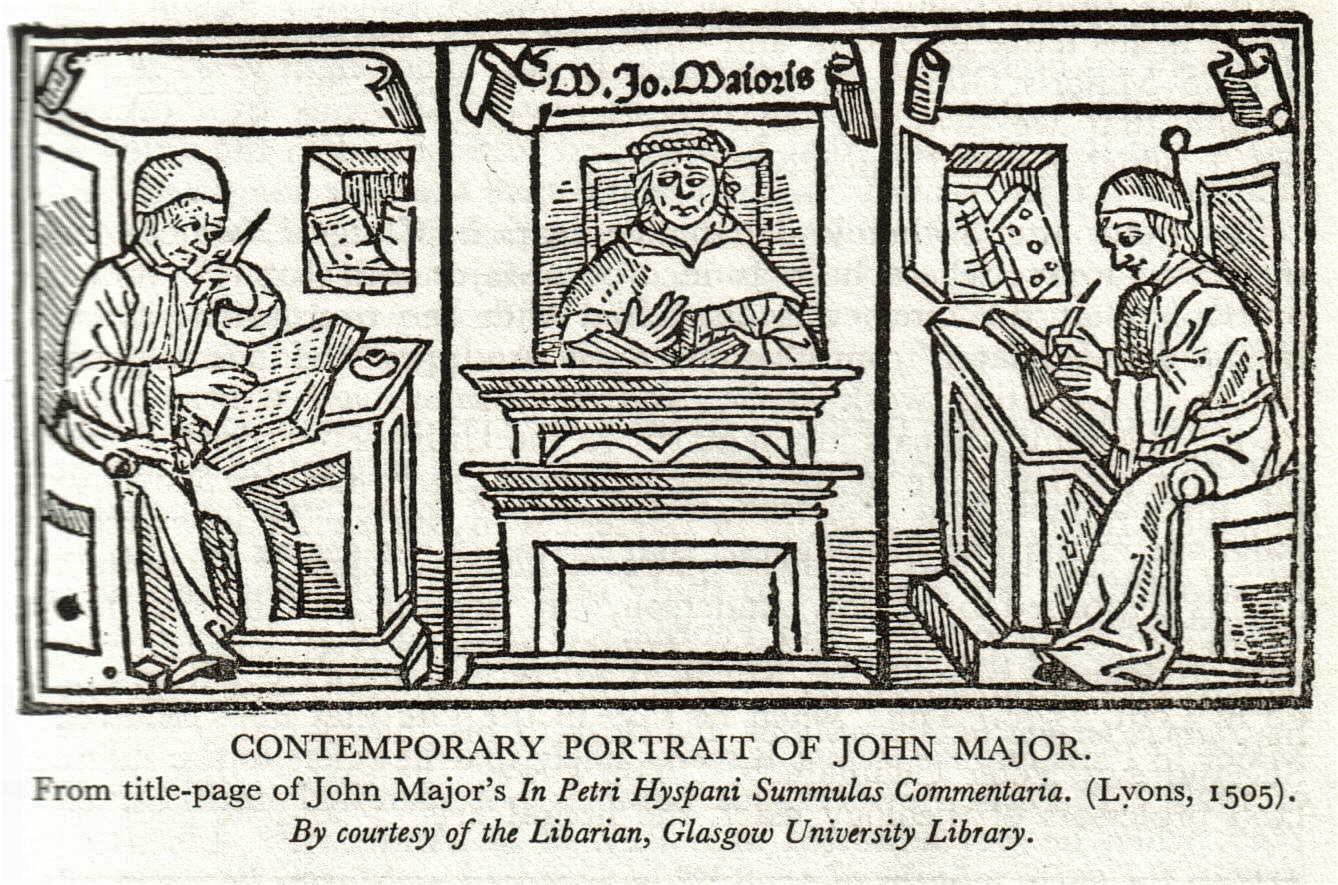
In 1493 he matriculated in the University of Paris, France, then the foremost university in Europe. He studied at the Collège Sainte-Barbe and took his Bachelor of Arts degree there in 1495 followed by his master's degree in 1496. There were many currents of thought in Paris but he was heavily influenced, as were fellow Scots such as Lawrence of Lindores by the nominalist and empiricist approach of John Buridan. (The latter's influence on Copernicus and Galileo can be traced through Major's published works). He became a student master ('regent') in Arts in the Collège de Montaigu in 1496 and began the study of theology under the formidable Jan Standonck. He consorted with scholars of later renown, some from his hometown, Robert Walterston, and his home country (David Cranston of Glasgow, who died in 1512), but mostly they were the luminaries of the age, including Erasmus, whose reforming enthusiasms he shared, Rabelais and Reginald Pole. In the winter of 1497 he had a serious illness, from which he never completely recovered. He had never had dreams before, but ever afterwards he was troubled by dreams, migraine, colic and "excessive sleepiness" (he was always hard to awaken). In 1499, he moved to the College of Navarre. In 1501, he received his degree of Bachelor of Sacred Theology and in 1505 his logical writings were collected and published for the first time. In 1506 he was licensed to teach theology and was awarded the degree of Doctor of Sacred Theology on 11 November that year (coming 3rd in the listings). He taught at the Collège de Montaigu (where he was, temporarily joint Director) and also the prestigious Sorbonne, where he served on many commissions.
In 1510 he discussed the moral and legal questions arising from the Spanish discovery of America. He claimed that the natives had political and property rights that could not be invaded, at least not without compensation. He also uses the new discoveries to argue for the possibility of innovation in all knowledge saying "Has not Amerigo Vespucci discovered lands unknown to Ptolemy, Pliny and other geographers up to the present? Why cannot the same happen in other spheres?" At the same time, he was impatient of humanist criticism of the logical analysis of texts (including the Bible). "...these questions which the humanists think futile, are like a ladder for the intelligence to rise towards the Bible" (which he elsewhere, perhaps unwisely called "the easier parts of theology"). Nevertheless, in 1512, like a good humanist, he learned Greek from Girolamo Aleandro (who re-introduced the study of Greek to Paris) who wrote "Many scholastics are to be found in France who are keen students in different kinds of knowledge and several of these are among my faithful hearers, such as John Mair, Doctor of Philosophy..."
In 1518 he returned to Scotland to become Principal of the University of Glasgow (and also canon of the cathedral, vicar of Dunlop and Treasurer of the Chapel Royal). He returned to Paris several times – by sea one time, getting delayed in Dieppe for three weeks by a storm; and by land another time, having dinner en route through England with his friend, Cardinal Wolsey. He offered Major a post, which he declined, in his new college at the University of Oxford, to be called Cardinal's College, (later Christ Church, Oxford). In 1528, King Francis I of France issued Major with a patent of naturalisation, making him a naturalised subject of France.
John Major (philosopher)
John Major (or Mair; also known in Latin as Joannes Majoris and Haddingtonus Scotus; 1467–1550) was a Scottish philosopher, theologian, and historian who was much admired in his day and was an acknowledged influence on all the great thinkers of the time. A renowned teacher, his works were much collected and frequently republished across Europe. His "sane conservatism" and his sceptical, logical approach to the study of texts such as Aristotle or the Bible were less prized in the subsequent age of humanism, when a more committed and linguistic/literary approach prevailed.
His influence in logic (especially the analysis of terms), science (impetus and infinitesimals), politics (placing the people over kings), Church (councils over Popes), and international law (establishing the human rights of "savages" conquered by the Spanish) can be traced across the centuries and appear decidedly modern, and it is only in the modern age that he is not routinely dismissed as a scholastic. His Latin style did not help – he thought that "it is of more moment to understand aright, and clearly to lay down the truth of any matter than to use eloquent language". Nevertheless, it is to his writings, including their dedications, that we owe much of our knowledge of the everyday facts of Major's life – for example his "shortness of stature". He was an extremely curious and very observant man, and used his experiences – of earthquakes in Paisley, thunder in Glasgow, storms at sea, eating oatcakes in northern England – to illustrate the more abstract parts of his logical writings.
John Major (or 'Mair') was born about 1467 at Gleghornie, East Lothian near North Berwick where he received his early education. It was at nearby Haddington, East Lothian, Scotland, where he attended grammar school. He was probably taught by the town schoolmaster, who was, according to Major "although a circumspect man in other ways, more severe than was just in beating boys". If it had not been for the influence of his mother, Major says he would have left, but he and his brother stayed on and were successful. According to him, Haddington was "the town which fostered the beginning of my studies, and in whose kindly embrace I was nourished as a novice with the sweetest milk of the art of grammar". He says he stayed in Haddington "to a pretty advanced age" and he remembers the sound of the King James III's bombardment of the nearby castle of Dunbar, which was in 1479. He also remembers the comet which was supposed to have foretold the King's defeat at Sauchieburn which was in 1488.
However, it was in 1490, he reports, that he "first left the paternal hearth". In 1490, probably under the influence of Robert Cockburn, another Haddington man, destined to be an influential bishop (of Ross and later of Dunkeld), he decided to go to Paris to study among the great numbers of Scots there at the time.
It is not known whether he attended university in Scotland as a student – there are no matriculation records of him and he claimed never to have seen the university town of St Andrews, Fife as a young man (though he did complain later of its bad beer). He seems to have decided to prepare for Paris at Cambridge in England. He says that in 1492 he attended "Gods House", which later became Christ's College. He remembers the bells – "on great feast days, I spent half the night listening to them"[citation needed] – but was obviously well-prepared, as he left for Paris after three terms.
In 1493 he matriculated in the University of Paris, France, then the foremost university in Europe. He studied at the Collège Sainte-Barbe and took his Bachelor of Arts degree there in 1495 followed by his master's degree in 1496. There were many currents of thought in Paris but he was heavily influenced, as were fellow Scots such as Lawrence of Lindores by the nominalist and empiricist approach of John Buridan. (The latter's influence on Copernicus and Galileo can be traced through Major's published works). He became a student master ('regent') in Arts in the Collège de Montaigu in 1496 and began the study of theology under the formidable Jan Standonck. He consorted with scholars of later renown, some from his hometown, Robert Walterston, and his home country (David Cranston of Glasgow, who died in 1512), but mostly they were the luminaries of the age, including Erasmus, whose reforming enthusiasms he shared, Rabelais and Reginald Pole. In the winter of 1497 he had a serious illness, from which he never completely recovered. He had never had dreams before, but ever afterwards he was troubled by dreams, migraine, colic and "excessive sleepiness" (he was always hard to awaken). In 1499, he moved to the College of Navarre. In 1501, he received his degree of Bachelor of Sacred Theology and in 1505 his logical writings were collected and published for the first time. In 1506 he was licensed to teach theology and was awarded the degree of Doctor of Sacred Theology on 11 November that year (coming 3rd in the listings). He taught at the Collège de Montaigu (where he was, temporarily joint Director) and also the prestigious Sorbonne, where he served on many commissions.
In 1510 he discussed the moral and legal questions arising from the Spanish discovery of America. He claimed that the natives had political and property rights that could not be invaded, at least not without compensation. He also uses the new discoveries to argue for the possibility of innovation in all knowledge saying "Has not Amerigo Vespucci discovered lands unknown to Ptolemy, Pliny and other geographers up to the present? Why cannot the same happen in other spheres?" At the same time, he was impatient of humanist criticism of the logical analysis of texts (including the Bible). "...these questions which the humanists think futile, are like a ladder for the intelligence to rise towards the Bible" (which he elsewhere, perhaps unwisely called "the easier parts of theology"). Nevertheless, in 1512, like a good humanist, he learned Greek from Girolamo Aleandro (who re-introduced the study of Greek to Paris) who wrote "Many scholastics are to be found in France who are keen students in different kinds of knowledge and several of these are among my faithful hearers, such as John Mair, Doctor of Philosophy..."
In 1518 he returned to Scotland to become Principal of the University of Glasgow (and also canon of the cathedral, vicar of Dunlop and Treasurer of the Chapel Royal). He returned to Paris several times – by sea one time, getting delayed in Dieppe for three weeks by a storm; and by land another time, having dinner en route through England with his friend, Cardinal Wolsey. He offered Major a post, which he declined, in his new college at the University of Oxford, to be called Cardinal's College, (later Christ Church, Oxford). In 1528, King Francis I of France issued Major with a patent of naturalisation, making him a naturalised subject of France.
Recent media
Recent media