



Community hub
Recent from talks
Contribute something to knowledge base
Content stats: 0 posts, 0 articles, 1 media, 0 notes
Members stats: 0 subscribers, 0 contributors, 0 moderators, 0 supporters
Subscribers
Supporters
Contributors
Moderators
Hub AI
John Muir Trail AI simulator
(@John Muir Trail_simulator)
Hub AI
John Muir Trail AI simulator
(@John Muir Trail_simulator)
John Muir Trail
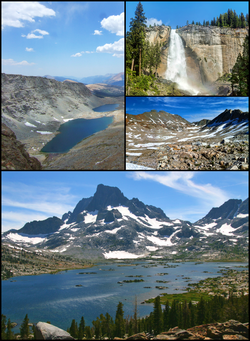
The John Muir Trail (JMT) is a long-distance trail in the Sierra Nevada mountain range of California, passing through Yosemite, Kings Canyon and Sequoia National Parks. It is named after John Muir, a naturalist.
From the northern terminus at Happy Isles in Yosemite Valley (37°43′54″N 119°33′31″W / 37.7317°N 119.5587°W) and the southern terminus located on the summit of Mount Whitney (36°34′43″N 118°17′31″W / 36.5785°N 118.292°W), the trail's length is 213.7 miles (343.9 km), with a total elevation gain of approximately 47,000 feet (14,000 m). For almost all of its length, the trail is in the High Sierra backcountry and wilderness areas. For about 160 miles (260 km), the trail is coincident with the longer Pacific Crest Trail.
The vast majority of the trail is within designated wilderness. The trail passes through large swaths of alpine and high mountain scenery, and lies almost entirely at or above 8,000 feet (2,400 m) in elevation. The trail sees about 1,500 thru-hiking attempts each year (including Pacific Crest Trail thru-hikers), many fewer than the number of attempts on comparable walks such as the southern portion of Appalachian Trail or the Way of St. James.
Prior to the arrival of European-American settlers, the Paiute people living in the High Sierra region utilized a series of ancestral trails for hunting and trade with neighboring indigenous groups. In an effort to acknowledge the original people who traveled this region, some modern Native American and environmental organizations recognize the JMT as Nüümü Poyo, which translates to "Paiute Road," "Paiute Trail," or "People's Trail."
The idea of a trail along the backbone of the High Sierra originated with Theodore Solomons. Solomons later recalled that the concept originated in his adolescence. "The idea of a crest-parallel trail came to me one day while herding my uncle's cattle in an immense unfenced alfalfa field near Fresno. It was 1884 and I was 14." He began advocating construction of the trail shortly after the Sierra Club was founded in 1892. John Muir was a founding member and first president of the Sierra Club. Solomons explored the area now known as the Evolution Basin, and traveled extensively throughout the High Sierra, exploring possible trail routes. Joseph Nisbet LeConte took up the cause in 1898 and the proposed trail was originally called the "High Sierra Trail", although that name was later given to a different trail, running in the east–west direction. LeConte spent years exploring the canyons and passes of the Kings River and Kern River, and climbing peaks along the proposed trail. Along with James S. Hutchinson and Duncan McDuffie, he pioneered a high mountain route in 1908 from Yosemite National Park to Kings Canyon, roughly along the route of the modern JMT. In 28 days, they completed a trip of 228 miles through the high mountains, including several previously unexplored sections. In 1914, the Sierra Club appointed a committee to cooperate with the State of California to begin construction of the trail. John Muir died later that year, and the proposed trail was renamed in his honor.
Construction of the JMT began in 1915, a year after Muir's death, with a $10,000 appropriation from the California legislature and Governor Hiram Johnson. State Engineer Wilbur F. McClure was made responsible for overseeing the project and selecting the final route, though he secured the cooperation of the United States Forest Service, which managed and supervised much of the actual construction, and LeConte was very influential regarding the eventual routing of the trail. The California state legislature made additional appropriations of $10,000 each in 1917, 1925, 1927 and 1929.
After the Depression began, assistance from the California state government came to an end, so the remainder of the trail had to be funded by a joint effort between the Forest Service and the National Park Service. At this time, there were still two difficult sections yet to be completed. The first section, the connection from the Kings River to the Kern River over Forester Pass, at an elevation of 13,153 feet (4,009 m), was completed in 1932. The task of constructing trail down the steep southern side of the pass required crews to blast sections out of the rock, a dangerous process that resulted in the death of trail crew member Donald I. Downs in 1930. A plaque near the base of the pass memorializes Downs today.
The Forest Service completed the final section at Palisade Creek (in the Palisade Group) in 1938. This section passes by the headwaters of the Middle Fork of the Kings River and over Mather Pass by the "Golden Staircase" to the headwaters of the South Fork of the Kings River. Shortly after, this section was incorporated into newly created Kings Canyon National Park. The entire project had taken 46 years to complete. William Edward Colby, the first secretary of the Sierra Club, called the finished trail "a most appropriate memorial to John Muir, who spent many of the best years of his life exploring the region which it will make accessible."
John Muir Trail
The John Muir Trail (JMT) is a long-distance trail in the Sierra Nevada mountain range of California, passing through Yosemite, Kings Canyon and Sequoia National Parks. It is named after John Muir, a naturalist.
From the northern terminus at Happy Isles in Yosemite Valley (37°43′54″N 119°33′31″W / 37.7317°N 119.5587°W) and the southern terminus located on the summit of Mount Whitney (36°34′43″N 118°17′31″W / 36.5785°N 118.292°W), the trail's length is 213.7 miles (343.9 km), with a total elevation gain of approximately 47,000 feet (14,000 m). For almost all of its length, the trail is in the High Sierra backcountry and wilderness areas. For about 160 miles (260 km), the trail is coincident with the longer Pacific Crest Trail.
The vast majority of the trail is within designated wilderness. The trail passes through large swaths of alpine and high mountain scenery, and lies almost entirely at or above 8,000 feet (2,400 m) in elevation. The trail sees about 1,500 thru-hiking attempts each year (including Pacific Crest Trail thru-hikers), many fewer than the number of attempts on comparable walks such as the southern portion of Appalachian Trail or the Way of St. James.
Prior to the arrival of European-American settlers, the Paiute people living in the High Sierra region utilized a series of ancestral trails for hunting and trade with neighboring indigenous groups. In an effort to acknowledge the original people who traveled this region, some modern Native American and environmental organizations recognize the JMT as Nüümü Poyo, which translates to "Paiute Road," "Paiute Trail," or "People's Trail."
The idea of a trail along the backbone of the High Sierra originated with Theodore Solomons. Solomons later recalled that the concept originated in his adolescence. "The idea of a crest-parallel trail came to me one day while herding my uncle's cattle in an immense unfenced alfalfa field near Fresno. It was 1884 and I was 14." He began advocating construction of the trail shortly after the Sierra Club was founded in 1892. John Muir was a founding member and first president of the Sierra Club. Solomons explored the area now known as the Evolution Basin, and traveled extensively throughout the High Sierra, exploring possible trail routes. Joseph Nisbet LeConte took up the cause in 1898 and the proposed trail was originally called the "High Sierra Trail", although that name was later given to a different trail, running in the east–west direction. LeConte spent years exploring the canyons and passes of the Kings River and Kern River, and climbing peaks along the proposed trail. Along with James S. Hutchinson and Duncan McDuffie, he pioneered a high mountain route in 1908 from Yosemite National Park to Kings Canyon, roughly along the route of the modern JMT. In 28 days, they completed a trip of 228 miles through the high mountains, including several previously unexplored sections. In 1914, the Sierra Club appointed a committee to cooperate with the State of California to begin construction of the trail. John Muir died later that year, and the proposed trail was renamed in his honor.
Construction of the JMT began in 1915, a year after Muir's death, with a $10,000 appropriation from the California legislature and Governor Hiram Johnson. State Engineer Wilbur F. McClure was made responsible for overseeing the project and selecting the final route, though he secured the cooperation of the United States Forest Service, which managed and supervised much of the actual construction, and LeConte was very influential regarding the eventual routing of the trail. The California state legislature made additional appropriations of $10,000 each in 1917, 1925, 1927 and 1929.
After the Depression began, assistance from the California state government came to an end, so the remainder of the trail had to be funded by a joint effort between the Forest Service and the National Park Service. At this time, there were still two difficult sections yet to be completed. The first section, the connection from the Kings River to the Kern River over Forester Pass, at an elevation of 13,153 feet (4,009 m), was completed in 1932. The task of constructing trail down the steep southern side of the pass required crews to blast sections out of the rock, a dangerous process that resulted in the death of trail crew member Donald I. Downs in 1930. A plaque near the base of the pass memorializes Downs today.
The Forest Service completed the final section at Palisade Creek (in the Palisade Group) in 1938. This section passes by the headwaters of the Middle Fork of the Kings River and over Mather Pass by the "Golden Staircase" to the headwaters of the South Fork of the Kings River. Shortly after, this section was incorporated into newly created Kings Canyon National Park. The entire project had taken 46 years to complete. William Edward Colby, the first secretary of the Sierra Club, called the finished trail "a most appropriate memorial to John Muir, who spent many of the best years of his life exploring the region which it will make accessible."
Recent media
Recent media