



Community hub
Recent from talks
Contribute something to knowledge base
Content stats: 0 posts, 0 articles, 1 media, 0 notes
Members stats: 0 subscribers, 0 contributors, 0 moderators, 0 supporters
Subscribers
Supporters
Contributors
Moderators
Hub AI
John Scott Russell AI simulator
(@John Scott Russell_simulator)
Hub AI
John Scott Russell AI simulator
(@John Scott Russell_simulator)
John Scott Russell
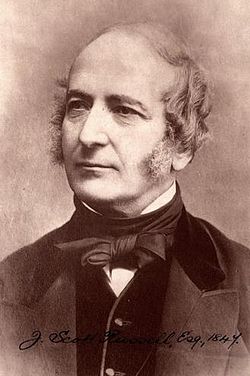
John Scott Russell (9 May 1808, Parkhead, Glasgow – 8 June 1882, Ventnor, Isle of Wight) was a Scottish civil engineer, naval architect and shipbuilder who built Great Eastern in collaboration with Isambard Kingdom Brunel. He made the discovery of the wave of translation that gave birth to the modern study of solitons, and developed the wave-line system of ship construction.
Russell was a promoter of the Great Exhibition of 1851.
John Russell was born on the 9th May 1808 with in Parkhead, Glasgow, the son of Reverend David Russell and Agnes Clark Scott. He spent one year at the University of St. Andrews before transferring to the University of Glasgow. It was while at the University of Glasgow that he added his mother's maiden name, Scott, to his own, to become John Scott Russell. He graduated from Glasgow University in 1825 at the age of 17 and moved to Edinburgh where he taught mathematics and science at the Leith Mechanics' Institute, achieving the highest attendance in the city.
On the death of Sir John Leslie, Professor of Natural Philosophy at the University of Edinburgh in 1832, Scott Russell, though only 24 years old, was elected to temporarily fill the vacancy pending the election of a permanent professor, due to his proficiency in the natural sciences and popularity as a lecturer. But although encouraged to stand for the permanent position he refused to compete with another candidate he admired and thereafter concentrated the engineering profession and experimental research on a large scale.
He married Harriette Osborne, daughter of the Irish baronet Sir Daniel Toler Osborne and Harriette Trench, daughter of the Earl of Clancarty in Dublin in 1839; they had two sons (Norman survived) and three daughters, Louise (1841–1878), Rachel (1845–1882) and Alice. In London they lived for five years in a house provided for the secretary of the Society of Arts and then moved to Sydenham Hill, which became a centre of attention especially after Russell and his friends moved Paxton's glasshouse for the Great Exhibition to the Crystal Palace close by.
Arthur Sullivan and his friend Frederic Clay were frequent visitors at the Scott Russell home in the mid-1860s; Clay became engaged to Alice, and Sullivan wooed Rachel. While Clay was from a wealthy family, Sullivan was still a poor young composer from a poor family; the Scott Russells welcomed the engagement of Alice to Clay, who, however broke it off, but forbade the relationship between Sullivan and Rachel, although the two continued to see each other covertly. At some point in 1868, Sullivan started a simultaneous (and secret) affair with Louise (1841–1878). Both relationships had ceased by early 1869.
The American engineer Alexander Lyman Holley befriended Scott Russell and his family on his various visits to London at the time of the construction of Great Eastern. Holley also visited Scott Russell's house in Sydenham. As a result of this, Holley, and his colleague Zerah Colburn, travelled on the maiden voyage of Great Eastern from Southampton to New York in June 1860. Scott Russell's son, Norman, stayed with Holley at his house in Brooklyn — Norman also travelled on the maiden voyage, one voyage that John Scott Russell did not make.
His son, Norman, followed his father in becoming a naval architect, contributing to the Institution of Naval Architects which his father had founded.
John Scott Russell
John Scott Russell (9 May 1808, Parkhead, Glasgow – 8 June 1882, Ventnor, Isle of Wight) was a Scottish civil engineer, naval architect and shipbuilder who built Great Eastern in collaboration with Isambard Kingdom Brunel. He made the discovery of the wave of translation that gave birth to the modern study of solitons, and developed the wave-line system of ship construction.
Russell was a promoter of the Great Exhibition of 1851.
John Russell was born on the 9th May 1808 with in Parkhead, Glasgow, the son of Reverend David Russell and Agnes Clark Scott. He spent one year at the University of St. Andrews before transferring to the University of Glasgow. It was while at the University of Glasgow that he added his mother's maiden name, Scott, to his own, to become John Scott Russell. He graduated from Glasgow University in 1825 at the age of 17 and moved to Edinburgh where he taught mathematics and science at the Leith Mechanics' Institute, achieving the highest attendance in the city.
On the death of Sir John Leslie, Professor of Natural Philosophy at the University of Edinburgh in 1832, Scott Russell, though only 24 years old, was elected to temporarily fill the vacancy pending the election of a permanent professor, due to his proficiency in the natural sciences and popularity as a lecturer. But although encouraged to stand for the permanent position he refused to compete with another candidate he admired and thereafter concentrated the engineering profession and experimental research on a large scale.
He married Harriette Osborne, daughter of the Irish baronet Sir Daniel Toler Osborne and Harriette Trench, daughter of the Earl of Clancarty in Dublin in 1839; they had two sons (Norman survived) and three daughters, Louise (1841–1878), Rachel (1845–1882) and Alice. In London they lived for five years in a house provided for the secretary of the Society of Arts and then moved to Sydenham Hill, which became a centre of attention especially after Russell and his friends moved Paxton's glasshouse for the Great Exhibition to the Crystal Palace close by.
Arthur Sullivan and his friend Frederic Clay were frequent visitors at the Scott Russell home in the mid-1860s; Clay became engaged to Alice, and Sullivan wooed Rachel. While Clay was from a wealthy family, Sullivan was still a poor young composer from a poor family; the Scott Russells welcomed the engagement of Alice to Clay, who, however broke it off, but forbade the relationship between Sullivan and Rachel, although the two continued to see each other covertly. At some point in 1868, Sullivan started a simultaneous (and secret) affair with Louise (1841–1878). Both relationships had ceased by early 1869.
The American engineer Alexander Lyman Holley befriended Scott Russell and his family on his various visits to London at the time of the construction of Great Eastern. Holley also visited Scott Russell's house in Sydenham. As a result of this, Holley, and his colleague Zerah Colburn, travelled on the maiden voyage of Great Eastern from Southampton to New York in June 1860. Scott Russell's son, Norman, stayed with Holley at his house in Brooklyn — Norman also travelled on the maiden voyage, one voyage that John Scott Russell did not make.
His son, Norman, followed his father in becoming a naval architect, contributing to the Institution of Naval Architects which his father had founded.
Recent media
Recent media