
Recent from talks
SS Great Eastern
Knowledge base stats:
Talk channels stats:
Members stats:
SS Great Eastern
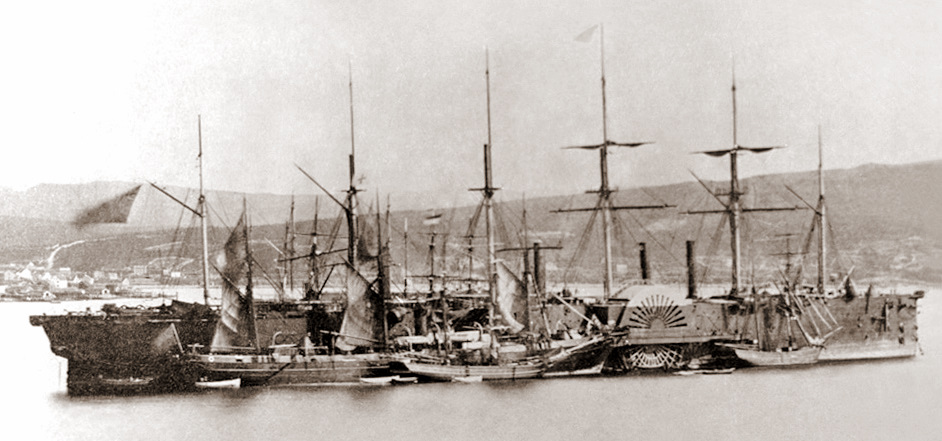
SS Great Eastern was an iron-hulled steamship designed by Isambard Kingdom Brunel, and built by John Scott Russell & Co. at Millwall Iron Works on the River Thames, London, England. Powered by both sidewheels and a screw propeller, she was by far the largest ship ever built at the time of her 1858 launch, and had the capacity to carry 4,000 passengers from England to Australia without refuelling. Her length of 692 feet (211 m) was surpassed only in 1899, by the 705-foot (215 m) 17,274-gross-ton RMS Oceanic, her gross tonnage of 18,915 was surpassed only in 1901, by the 701-foot (214 m) 20,904-gross-ton RMS Celtic and her 4,000-passenger capacity was surpassed only in 1913, by the 4,234-passenger SS Imperator. Her five funnels (later reduced to four) was unusual for the time. She also had the largest set of paddle wheels in existence.
Brunel knew her affectionately as the "Great Babe". He died in 1859 shortly after her maiden voyage, during which she was damaged by an explosion. After repairs, she plied for several years in her intended use as a passenger liner between Britain and North America, her voyages made largely unprofitable by her high initial and operating costs. Within a few years she was repurposed to lay underwater cable, laying the first lasting transatlantic telegraph cable in 1866. Finishing her life as a floating music hall and advertising hoarding (for the department store Lewis's) in Liverpool, she was broken up on Merseyside in 1889.
It is important to emphasize that, unlike other ships, the Great Eastern was not just a simple record-breaking ship of the 19th century: her dimensions dramatically exceeded the previous limits of shipbuilding, making her both the largest ship of her time and an exceptional exception in the history of engineering. She did not simply set a new record, but rather represented a breakthrough in the development of ship design that proved difficult to surpass for a very long time. The colossal nature of her dimensions is also emphasized by the fact that not only at the time of her construction, but also when she was scrapped thirty years later, only smaller ships existed in all three main indicators (length, gross tonnage and passenger capacity). In practice, this meant that no similar ship was built between 1858 and 1889. This is particularly remarkable in the history of shipbuilding, as there are few similar examples – in fact, in this sense, the Great Eastern is almost unique to this day.
After his success in pioneering steam travel to North America with Great Western and Great Britain, Brunel turned his attention to a vessel capable of making longer voyages as far as Australia. With a planned capacity of 15,000 tons of coal, Great Eastern was envisioned as being able to sail halfway around the world without taking on coal, while also carrying so much cargo and passengers that papers described her as a "floating city" and "the Crystal Palace of the sea". Brunel saw the ship as being able to effectively monopolize trade with Asia and Australia, making regular trips between Britain and either Sri Lanka or Australia.
On 25 March 1852, Brunel made a sketch of a steamship in his diary and wrote beneath it: "Say 600 ft x 65 ft x 30 ft" (180 m x 20 m x 9.1 m). These measurements were six times larger by volume than any ship afloat; such a large vessel would benefit from economies of scale and would be both fast and economical, requiring fewer crew than the equivalent tonnage made up of smaller ships. Brunel realised that the ship would need more than one propulsion system; since twin screws were still very much experimental, he settled on a combination of a single screw and paddle wheels, with auxiliary sail power. Although Brunel had pioneered the screw propeller on a large scale with Great Britain, he did not believe that it was possible to build a single propeller and shaft (or, for that matter, a paddleshaft) that could transmit the required power to drive his giant ship at the required speed.
Brunel showed his idea to John Scott Russell, an experienced naval architect and ship builder whom he had first met at the Great Exhibition. Scott Russell examined Brunel's plan and made his own calculations as to the ship's feasibility. He calculated that it would have a displacement of 20,000 tons and would require 8,500 horsepower (6,300 kW) to achieve 14 knots (26 km/h; 16 mph), but believed it was possible. At Scott Russell's suggestion, they approached the directors of the Eastern Steam Navigation Company with the new design plan. The James Watt Company would design the ship's screw, Professor Piazzi Smyth would design its gyroscopic equipment, and Russell himself would build the hull and paddle wheel.
Brunel entered into a partnership with Scott Russell to build Great Eastern. Unknown to Brunel, Russell was in financial difficulties. The two men disagreed on many details. It was Brunel's final great project, and he collapsed from a stroke after being photographed on her deck, and died only ten days later, a mere four days after Great Eastern's first sea trials. About the ship, Brunel said "I have never embarked on any one thing to which I have so entirely devoted myself, and to which I have devoted so much time, thought and labour, on the success of which I have staked so much reputation."
Great Eastern was built by Messrs Scott Russell & Co. of Millwall, Middlesex, England, the keel being laid down on 1 May 1854. She was 211 metres (692 ft 3 in) long, 25 metres (82 ft 0 in) wide, with a draught of 6.1 metres (20 ft 0 in) unloaded and 9.1 metres (29 ft 10 in) fully laden, and displaced 32,000 tons fully loaded. In comparison, SS Persia, launched in 1856, was 119 m (390 ft 5 in) long with a 14 m (45 ft 11 in) beam. She was at first named Leviathan, but her high building and launching costs ruined the Eastern Steam Navigation Company and so she lay unfinished for a year before being sold to the Great Eastern Ship Company and finally renamed Great Eastern.
Hub AI
SS Great Eastern AI simulator
(@SS Great Eastern_simulator)
SS Great Eastern
SS Great Eastern was an iron-hulled steamship designed by Isambard Kingdom Brunel, and built by John Scott Russell & Co. at Millwall Iron Works on the River Thames, London, England. Powered by both sidewheels and a screw propeller, she was by far the largest ship ever built at the time of her 1858 launch, and had the capacity to carry 4,000 passengers from England to Australia without refuelling. Her length of 692 feet (211 m) was surpassed only in 1899, by the 705-foot (215 m) 17,274-gross-ton RMS Oceanic, her gross tonnage of 18,915 was surpassed only in 1901, by the 701-foot (214 m) 20,904-gross-ton RMS Celtic and her 4,000-passenger capacity was surpassed only in 1913, by the 4,234-passenger SS Imperator. Her five funnels (later reduced to four) was unusual for the time. She also had the largest set of paddle wheels in existence.
Brunel knew her affectionately as the "Great Babe". He died in 1859 shortly after her maiden voyage, during which she was damaged by an explosion. After repairs, she plied for several years in her intended use as a passenger liner between Britain and North America, her voyages made largely unprofitable by her high initial and operating costs. Within a few years she was repurposed to lay underwater cable, laying the first lasting transatlantic telegraph cable in 1866. Finishing her life as a floating music hall and advertising hoarding (for the department store Lewis's) in Liverpool, she was broken up on Merseyside in 1889.
It is important to emphasize that, unlike other ships, the Great Eastern was not just a simple record-breaking ship of the 19th century: her dimensions dramatically exceeded the previous limits of shipbuilding, making her both the largest ship of her time and an exceptional exception in the history of engineering. She did not simply set a new record, but rather represented a breakthrough in the development of ship design that proved difficult to surpass for a very long time. The colossal nature of her dimensions is also emphasized by the fact that not only at the time of her construction, but also when she was scrapped thirty years later, only smaller ships existed in all three main indicators (length, gross tonnage and passenger capacity). In practice, this meant that no similar ship was built between 1858 and 1889. This is particularly remarkable in the history of shipbuilding, as there are few similar examples – in fact, in this sense, the Great Eastern is almost unique to this day.
After his success in pioneering steam travel to North America with Great Western and Great Britain, Brunel turned his attention to a vessel capable of making longer voyages as far as Australia. With a planned capacity of 15,000 tons of coal, Great Eastern was envisioned as being able to sail halfway around the world without taking on coal, while also carrying so much cargo and passengers that papers described her as a "floating city" and "the Crystal Palace of the sea". Brunel saw the ship as being able to effectively monopolize trade with Asia and Australia, making regular trips between Britain and either Sri Lanka or Australia.
On 25 March 1852, Brunel made a sketch of a steamship in his diary and wrote beneath it: "Say 600 ft x 65 ft x 30 ft" (180 m x 20 m x 9.1 m). These measurements were six times larger by volume than any ship afloat; such a large vessel would benefit from economies of scale and would be both fast and economical, requiring fewer crew than the equivalent tonnage made up of smaller ships. Brunel realised that the ship would need more than one propulsion system; since twin screws were still very much experimental, he settled on a combination of a single screw and paddle wheels, with auxiliary sail power. Although Brunel had pioneered the screw propeller on a large scale with Great Britain, he did not believe that it was possible to build a single propeller and shaft (or, for that matter, a paddleshaft) that could transmit the required power to drive his giant ship at the required speed.
Brunel showed his idea to John Scott Russell, an experienced naval architect and ship builder whom he had first met at the Great Exhibition. Scott Russell examined Brunel's plan and made his own calculations as to the ship's feasibility. He calculated that it would have a displacement of 20,000 tons and would require 8,500 horsepower (6,300 kW) to achieve 14 knots (26 km/h; 16 mph), but believed it was possible. At Scott Russell's suggestion, they approached the directors of the Eastern Steam Navigation Company with the new design plan. The James Watt Company would design the ship's screw, Professor Piazzi Smyth would design its gyroscopic equipment, and Russell himself would build the hull and paddle wheel.
Brunel entered into a partnership with Scott Russell to build Great Eastern. Unknown to Brunel, Russell was in financial difficulties. The two men disagreed on many details. It was Brunel's final great project, and he collapsed from a stroke after being photographed on her deck, and died only ten days later, a mere four days after Great Eastern's first sea trials. About the ship, Brunel said "I have never embarked on any one thing to which I have so entirely devoted myself, and to which I have devoted so much time, thought and labour, on the success of which I have staked so much reputation."
Great Eastern was built by Messrs Scott Russell & Co. of Millwall, Middlesex, England, the keel being laid down on 1 May 1854. She was 211 metres (692 ft 3 in) long, 25 metres (82 ft 0 in) wide, with a draught of 6.1 metres (20 ft 0 in) unloaded and 9.1 metres (29 ft 10 in) fully laden, and displaced 32,000 tons fully loaded. In comparison, SS Persia, launched in 1856, was 119 m (390 ft 5 in) long with a 14 m (45 ft 11 in) beam. She was at first named Leviathan, but her high building and launching costs ruined the Eastern Steam Navigation Company and so she lay unfinished for a year before being sold to the Great Eastern Ship Company and finally renamed Great Eastern.
Recent media