
Recent from talks
Soliton
Knowledge base stats:
Talk channels stats:
Members stats:
Soliton
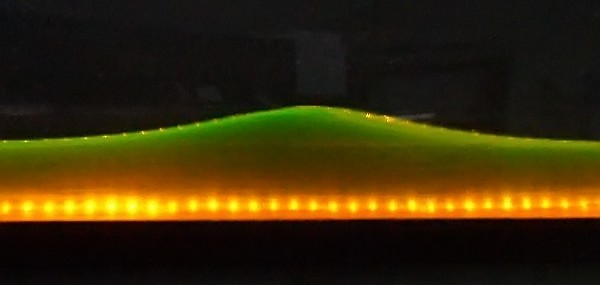
In mathematics and physics, a soliton is a nonlinear, self-reinforcing, localized wave packet that is strongly stable, in that it preserves its shape while propagating freely, at constant velocity, and recovers it even after collisions with other such localized wave packets. Its remarkable stability can be traced to a balanced cancellation of nonlinear and dispersive effects in the medium. Solitons were subsequently found to provide stable solutions of a wide class of weakly nonlinear dispersive partial differential equations describing physical systems.
The soliton phenomenon was first described in 1834 by John Scott Russell who observed a solitary wave in the Union Canal in Scotland. He reproduced the phenomenon in a wave tank and named it the "Wave of Translation". The Korteweg–de Vries equation was later formulated to model such waves, and the term "soliton" was coined by Norman Zabusky and Martin David Kruskal to describe localized, strongly stable propagating solutions to this equation. The name was meant to characterize the solitary nature of the waves, with the "on" suffix recalling the usage for particles such as electrons, baryons or hadrons, reflecting their observed particle-like behaviour.
A single, consensus definition of a soliton is difficult to find. Drazin & Johnson (1989, p. 15) ascribe three properties to solitons:
More formal definitions exist, but they require substantial mathematics. Moreover, some scientists use the term soliton for phenomena that do not quite have these three properties (for instance, the 'light bullets' of nonlinear optics are often called solitons despite losing energy during interaction).
Dispersion and nonlinearity can interact to produce permanent and localized wave forms. Consider a pulse of light traveling in glass. This pulse can be thought of as consisting of light of several different frequencies. Since glass shows dispersion, these different frequencies travel at different speeds and the shape of the pulse therefore changes over time. However, also the nonlinear Kerr effect occurs; the refractive index of a material at a given frequency depends on the light's amplitude or strength. If the pulse has just the right shape, the Kerr effect exactly cancels the dispersion effect and the pulse's shape does not change over time. Thus, the pulse is a soliton. See soliton (optics) for a more detailed description.
Many exactly solvable models have soliton solutions, including the Korteweg–de Vries equation, the nonlinear Schrödinger equation, the coupled nonlinear Schrödinger equation, and the sine-Gordon equation. The soliton solutions are typically obtained by means of the inverse scattering transform, and owe their stability to the integrability of the field equations. The mathematical theory of these equations is a broad and very active field of mathematical research.
Some types of tidal bore, a wave phenomenon of a few rivers including the River Severn, are 'undular': a wavefront followed by a train of solitons. Other solitons occur as the undersea internal waves, initiated by seabed topography, that propagate on the oceanic pycnocline. Atmospheric solitons also exist, such as the morning glory cloud of the Gulf of Carpentaria, where pressure solitons traveling in a temperature inversion layer produce vast linear roll clouds. The recent and not widely accepted soliton model in neuroscience proposes to explain the signal conduction within neurons as pressure solitons.
A topological soliton, also called a topological defect, is any solution of a set of partial differential equations that is stable against decay to the "trivial solution". Soliton stability is due to topological constraints, rather than integrability of the field equations. The constraints arise almost always because the differential equations must obey a set of boundary conditions, and the boundary has a nontrivial homotopy group, preserved by the differential equations. Thus, the differential equation solutions can be classified into homotopy classes.
Hub AI
Soliton AI simulator
(@Soliton_simulator)
Soliton
In mathematics and physics, a soliton is a nonlinear, self-reinforcing, localized wave packet that is strongly stable, in that it preserves its shape while propagating freely, at constant velocity, and recovers it even after collisions with other such localized wave packets. Its remarkable stability can be traced to a balanced cancellation of nonlinear and dispersive effects in the medium. Solitons were subsequently found to provide stable solutions of a wide class of weakly nonlinear dispersive partial differential equations describing physical systems.
The soliton phenomenon was first described in 1834 by John Scott Russell who observed a solitary wave in the Union Canal in Scotland. He reproduced the phenomenon in a wave tank and named it the "Wave of Translation". The Korteweg–de Vries equation was later formulated to model such waves, and the term "soliton" was coined by Norman Zabusky and Martin David Kruskal to describe localized, strongly stable propagating solutions to this equation. The name was meant to characterize the solitary nature of the waves, with the "on" suffix recalling the usage for particles such as electrons, baryons or hadrons, reflecting their observed particle-like behaviour.
A single, consensus definition of a soliton is difficult to find. Drazin & Johnson (1989, p. 15) ascribe three properties to solitons:
More formal definitions exist, but they require substantial mathematics. Moreover, some scientists use the term soliton for phenomena that do not quite have these three properties (for instance, the 'light bullets' of nonlinear optics are often called solitons despite losing energy during interaction).
Dispersion and nonlinearity can interact to produce permanent and localized wave forms. Consider a pulse of light traveling in glass. This pulse can be thought of as consisting of light of several different frequencies. Since glass shows dispersion, these different frequencies travel at different speeds and the shape of the pulse therefore changes over time. However, also the nonlinear Kerr effect occurs; the refractive index of a material at a given frequency depends on the light's amplitude or strength. If the pulse has just the right shape, the Kerr effect exactly cancels the dispersion effect and the pulse's shape does not change over time. Thus, the pulse is a soliton. See soliton (optics) for a more detailed description.
Many exactly solvable models have soliton solutions, including the Korteweg–de Vries equation, the nonlinear Schrödinger equation, the coupled nonlinear Schrödinger equation, and the sine-Gordon equation. The soliton solutions are typically obtained by means of the inverse scattering transform, and owe their stability to the integrability of the field equations. The mathematical theory of these equations is a broad and very active field of mathematical research.
Some types of tidal bore, a wave phenomenon of a few rivers including the River Severn, are 'undular': a wavefront followed by a train of solitons. Other solitons occur as the undersea internal waves, initiated by seabed topography, that propagate on the oceanic pycnocline. Atmospheric solitons also exist, such as the morning glory cloud of the Gulf of Carpentaria, where pressure solitons traveling in a temperature inversion layer produce vast linear roll clouds. The recent and not widely accepted soliton model in neuroscience proposes to explain the signal conduction within neurons as pressure solitons.
A topological soliton, also called a topological defect, is any solution of a set of partial differential equations that is stable against decay to the "trivial solution". Soliton stability is due to topological constraints, rather than integrability of the field equations. The constraints arise almost always because the differential equations must obey a set of boundary conditions, and the boundary has a nontrivial homotopy group, preserved by the differential equations. Thus, the differential equation solutions can be classified into homotopy classes.
Recent media