


Community hub
Recent from talks
Contribute something
Nothing was collected or created yet.
John Smart
View on Wikipedia
John Smart (1 May 1741 – 1 May 1811) was an English painter who specialised in portrait miniatures. He was a contemporary of Richard Cosway, George Engleheart, William Wood and Richard Crosse.
Key Information


Biography
[edit]Smart was born in Norfolk, but not much is known of his early life. It is recorded that in 1755 he was runner up to Richard Cosway in a drawing competition for under-14s held by the Society for the Encouragement of Arts, Manufactures and Commerce. In the same year he began attending the new drawing school of William Shipley in London, along with Cosway and Richard Crosse.
He exhibited at the Society of Artists, in London, from 1762 onwards; and became its president in 1778. He went to India in 1788 and obtained a number of commissions in that country. He settled down in London in 1797, latterly in Fitzroy Street, and died there in 1811.[1]
He was a man of simple habits and a member of the Society of Sandemanians.[2]
Work
[edit]Smart mainly painted watercolour miniatures on ivory, and often clearly signed and dated his work. A number of his preparatory drawings and sketches survive.
His work is entirely different from that of Cosway, quiet and grey in its colouring, with the flesh tints elaborated with much subtlety and modelled in exquisite fashion. He possessed a great knowledge of anatomy, and his portraits are drawn with greater anatomical accuracy and possess more distinction than those of any miniature painter of his time.[2]
The most important collection of Smart's work was given by John W. and Martha Jane Phillips Starr to the Nelson-Atkins Museum of Art. The Starr collection includes a signed and dated miniature for each year of Smart's career, from 1760 to 1811, enabling scholars to view the full progression of Smart's style and technique as well as the changing fashions of the period.
Many of his pencil drawings still exist in the possession of the descendants of a great friend of his only sister. Several of his miniatures are in Australia and belong to a cadet branch of the family.[2]
Smart taught portrait painting to Isabella Beetham,[3] who was one of Britain's finest silhouette artists in the 18th century.[4]
Personal life
[edit]Gallery
[edit]-
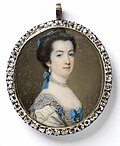 Portrait of Hon. Miss Eliza Booth, dated 1766. Victoria & Albert Museum
 -
 Portrait of Unknown Man, dated 1767. Victoria & Albert Museum
 -
 Portrait of Unknown Woman, dated 1779. Victoria & Albert Museum
 -
 Portrait of Unknown Woman, dated 1780. Victoria & Albert Museum
 -
 Watercolor on ivory portrait miniature of a lady, 1782, 5.1 x 4.1 cm, Cincinnati Art Museum
 -
 Portrait of a Member of the Tayler Family, dated 1787. Frame with bracelet fitting. Victoria & Albert Museum
 -
 Sir Robert Brooke, probably c. 1788


References
[edit]- ^ "Fitzroy Street Pages 44-46 Survey of London: Volume 21, the Parish of St Pancras Part 3: Tottenham Court Road and Neighbourhood. Originally published by London County Council, London, 1949". British History Online. Retrieved 4 August 2020.
- ^ a b c d Williamson 1911.
- ^ Joy Ruskin Hanes. "Shady Ladies: Female Silhouette Artists of the 18th Century". New England Antiques Journal. Palmer, Massachusetts. Archived from the original on 4 July 2009. Retrieved 3 March 2015.
- ^ Ian Chilvers (10 June 2004). The Oxford Dictionary of Art. Oxford University Press. pp. 652–653. ISBN 978-0-19-860476-1.
- This article incorporates text from a publication now in the public domain: Williamson, George Charles (1911). "Smart, John". In Chisholm, Hugh (ed.). Encyclopædia Britannica. Vol. 25 (11th ed.). Cambridge University Press. p. 250.
Further reading
[edit]

- GC Williamson, The History of Portrait Miniatures, vol. ii. (London, 1904).
- Foskett, Daphne (1987). Miniatures: Dictionary and Guide. London: Antique Collectors' Club. ISBN 1-85149-063-9.
