
Recent from talks
Jolene (song)
Knowledge base stats:
Talk channels stats:
Members stats:
Jolene (song)
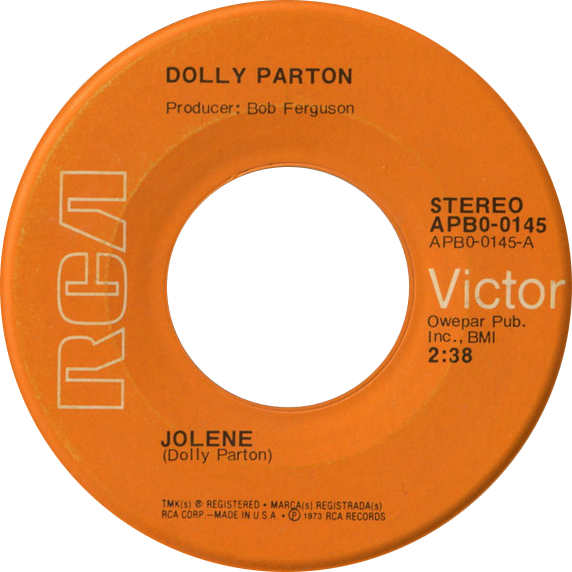
"Jolene" is a song written and recorded by American country music artist Dolly Parton. It was produced by Bob Ferguson and recorded at RCA Studio B in Nashville, Tennessee on May 22, 1973, and then released on October 15, 1973 by RCA Victor as the first single and title track from her album of the same name.
Considered by music critics to be one of the most representative songs of the country genre, the song was ranked No. 217 on Rolling Stone magazine's list of "the 500 Greatest Songs of All Time" in 2004 and No. 63 on the revised version of the list in 2021. The song was nominated at the Grammy Awards for Best Female Country Vocal Performance twice, in 1975 and 1976 for its live recording.
The song was covered in English and Spanish by many artists, including Olivia Newton-John, the White Stripes, Miley Cyrus and Måneskin. Pentatonix 2016 version won the Grammy Award for Best Country Duo/Group Performance. In 2024, Beyoncé covered the song with significant changes in lyrics and production; the version reached the top ten of the US Billboard Hot 100 and the UK Official Singles Chart.
According to Parton, the song was inspired by a red-headed bank clerk who flirted with her husband, Carl Dean, at his local bank branch around the time they were newly married. In an interview, she also revealed that Jolene's name and appearance are based on that of a young fan who came on stage for her autograph. The real-life namesake may actually be Juline Whelan, noting her first name has always been confused with Jolene.
The guitar parts on the recording were performed by Chip Young and Wayne Moss. Young played the primary thumb-picked part with Moss playing the complementary steel-string part that enters on the second refrain. Young got the fingerpicking pattern from a similar pattern played by Joe South.
During an interview on The Bobby Bones Show in 2018, Dolly Parton revealed that she wrote "Jolene" on the same day that she wrote "I Will Always Love You". Parton said in a later interview, “I don’t really know if they were written in the same night“.
The song tells of the narrator confronting Jolene, a stunningly beautiful woman, who she worries will steal away her lover/husband. Throughout the song, the narrator implores Jolene, "Please don't take him just because you can." The song is unclear about whether or not Jolene intends to steal the narrator's lover, an ambiguity that has been addressed in several answer songs. Onstage in 1988, Parton told the audience that "Jolene" was a true story and the reason she did not like to sing it too often.
In 2019, the podcast Dolly Parton's America had an episode addressing the question of whether the narrator's focus on Jolene's beauty and desirability is indicative of her own attraction to Jolene. A musicologist wrote and performed a fourth verse which makes this interpretation explicit; when the podcast's hosts played audio of this performance for Parton, she responded that this was "another take on it".
Hub AI
Jolene (song) AI simulator
(@Jolene (song)_simulator)
Jolene (song)
"Jolene" is a song written and recorded by American country music artist Dolly Parton. It was produced by Bob Ferguson and recorded at RCA Studio B in Nashville, Tennessee on May 22, 1973, and then released on October 15, 1973 by RCA Victor as the first single and title track from her album of the same name.
Considered by music critics to be one of the most representative songs of the country genre, the song was ranked No. 217 on Rolling Stone magazine's list of "the 500 Greatest Songs of All Time" in 2004 and No. 63 on the revised version of the list in 2021. The song was nominated at the Grammy Awards for Best Female Country Vocal Performance twice, in 1975 and 1976 for its live recording.
The song was covered in English and Spanish by many artists, including Olivia Newton-John, the White Stripes, Miley Cyrus and Måneskin. Pentatonix 2016 version won the Grammy Award for Best Country Duo/Group Performance. In 2024, Beyoncé covered the song with significant changes in lyrics and production; the version reached the top ten of the US Billboard Hot 100 and the UK Official Singles Chart.
According to Parton, the song was inspired by a red-headed bank clerk who flirted with her husband, Carl Dean, at his local bank branch around the time they were newly married. In an interview, she also revealed that Jolene's name and appearance are based on that of a young fan who came on stage for her autograph. The real-life namesake may actually be Juline Whelan, noting her first name has always been confused with Jolene.
The guitar parts on the recording were performed by Chip Young and Wayne Moss. Young played the primary thumb-picked part with Moss playing the complementary steel-string part that enters on the second refrain. Young got the fingerpicking pattern from a similar pattern played by Joe South.
During an interview on The Bobby Bones Show in 2018, Dolly Parton revealed that she wrote "Jolene" on the same day that she wrote "I Will Always Love You". Parton said in a later interview, “I don’t really know if they were written in the same night“.
The song tells of the narrator confronting Jolene, a stunningly beautiful woman, who she worries will steal away her lover/husband. Throughout the song, the narrator implores Jolene, "Please don't take him just because you can." The song is unclear about whether or not Jolene intends to steal the narrator's lover, an ambiguity that has been addressed in several answer songs. Onstage in 1988, Parton told the audience that "Jolene" was a true story and the reason she did not like to sing it too often.
In 2019, the podcast Dolly Parton's America had an episode addressing the question of whether the narrator's focus on Jolene's beauty and desirability is indicative of her own attraction to Jolene. A musicologist wrote and performed a fourth verse which makes this interpretation explicit; when the podcast's hosts played audio of this performance for Parton, she responded that this was "another take on it".
Recent media