
Recent from talks
RCA Studio B
Knowledge base stats:
Talk channels stats:
Members stats:
RCA Studio B
RCA Studio B was a music recording studio in Nashville, Tennessee, established in 1957 by Steve Sholes and Chet Atkins for RCA Victor. Originally known simply as the RCA Victor Studio, in 1965 the studio was designated as Studio B after RCA Victor built the newer, larger Studio A in an adjacent building.
Located centrally in what would become Nashville's Music Row, the RCA Victor Studios were an essential factor to the development of the musical production style and sound engineering technique known as the Nashville Sound. In the two decades the studio was in operation, RCA Studio B produced 60 percent of the Billboard magazine's Country chart hits.
The studio closed in 1977. Since 1992 the studio has been under the ownership of the Country Music Hall of Fame, which offers scheduled tours of the facilities.
After years of using portable equipment to record projects in various recording facilities around Nashville, Steve Sholes and Chet Atkins established RCA Victor's first Nashville recording facility within the Methodist Television Radio & Film Commission building at 1525 McGavock Street in 1954. It was at this studio in January, 1956, that Sholes and Atkins produced a session with Elvis Presley during which he recorded Heartbreak Hotel, the song that would become Presley's first gold record and the biggest-selling single of 1956. The building on McGavock Street that housed this recording studio was demolished in 2006 for a parking lot.
With Atkins and Sholes establishing RCA Victor's Nashville operations, the company sought to build a recording studio. The company's chief engineer and recording manager Bill Milttenburg drew building plans on a dinner napkin and Dan Maddox, a local businessman, offered to construct the building as an investment. Four months later, in November 1957, the pastel cinderblock building located at 1611 Hawkins Street (later re-named Roy Acuff Place) was completed at a cost of $37,515, and Maddox leased it to RCA for the next twenty years.
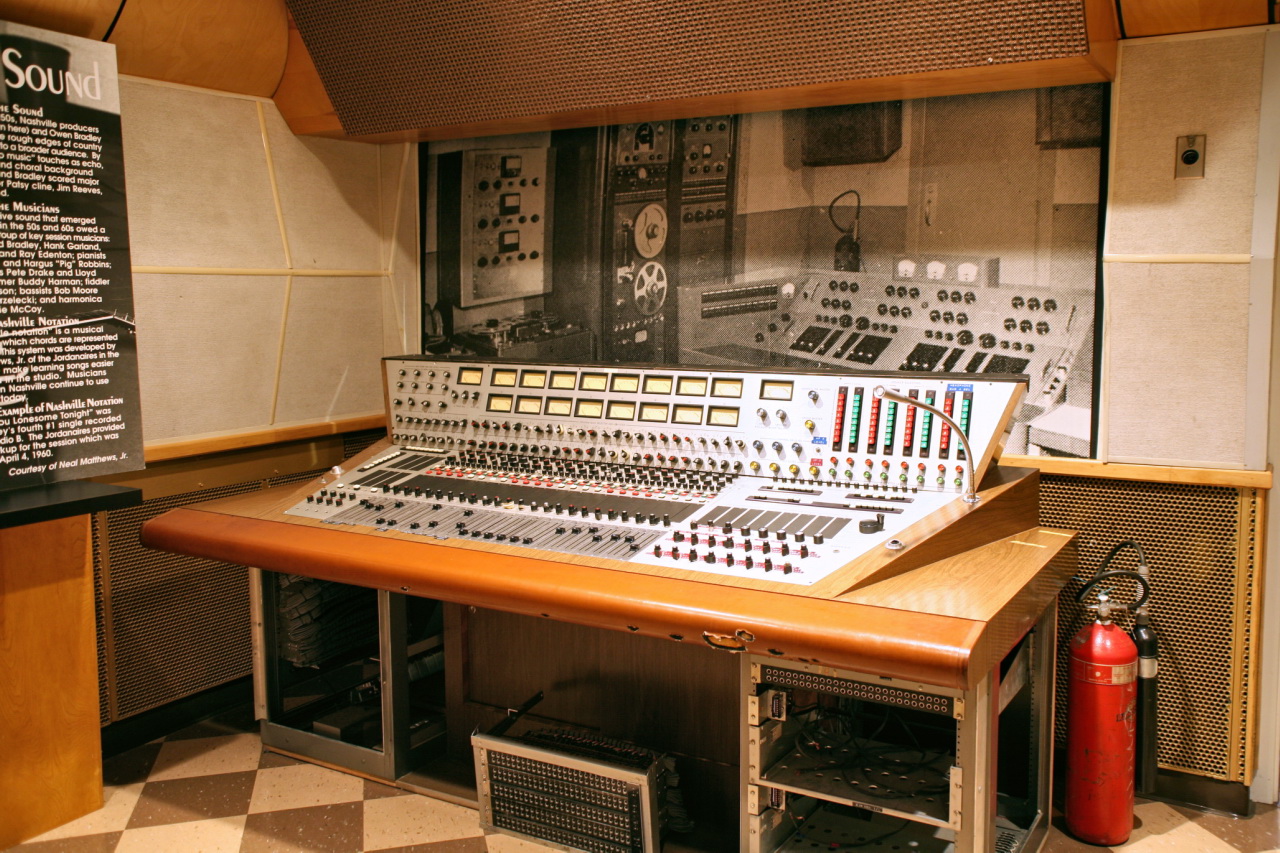
Business offices resided in the single-story front of the building, with studio facilities in the rear. The studio measured 40.5 by 26.25 feet (12.34 by 8.00 m), with a 13 feet (4.0 m) high ceiling. A grand piano, acquired from NBC's Tonight Starring Steve Allen, sat in the corner. The small control room was only 12 feet (3.7 m) deep, and housed an RCA radio station tube console with 12 microphone inputs and four outputs, which fed an Ampex 2-track deck. An echo chamber occupied the second story.
In March, 1959, Bill Porter replaced Bob Ferris, RCA Studio B's first chief engineer, and by June had mixed a number one hit: "The Three Bells" by the Browns. Porter considered the studio's acoustics problematic, with resonant room modes creating an uneven frequency response. To lessen the problem, he took some $60 from the studio's petty cash and bought fiberglass acoustic ceiling panels which he cut into triangles and hung from the ceiling at varying heights; these were dubbed "Porter Pyramids". Porter also marked "X"es on the floor where he discovered, by careful experimentation, the resonant modes to be minimal. Porter positioned lead vocalists, background vocalists, and acoustic guitarists at microphones placed directly over his marks. After these improvements, Don Gibson recorded his album Girls, Guitars and Gibson in the studio. Porter later told an interviewer: "Everybody said, 'God, what a different sound!'"
Porter also preferred the luminous echo of the studio's EMT 140 plate reverb rather than its echo chamber, keeping the plates chilled in the air conditioned room to brighten their sound.
Hub AI
RCA Studio B AI simulator
(@RCA Studio B_simulator)
RCA Studio B
RCA Studio B was a music recording studio in Nashville, Tennessee, established in 1957 by Steve Sholes and Chet Atkins for RCA Victor. Originally known simply as the RCA Victor Studio, in 1965 the studio was designated as Studio B after RCA Victor built the newer, larger Studio A in an adjacent building.
Located centrally in what would become Nashville's Music Row, the RCA Victor Studios were an essential factor to the development of the musical production style and sound engineering technique known as the Nashville Sound. In the two decades the studio was in operation, RCA Studio B produced 60 percent of the Billboard magazine's Country chart hits.
The studio closed in 1977. Since 1992 the studio has been under the ownership of the Country Music Hall of Fame, which offers scheduled tours of the facilities.
After years of using portable equipment to record projects in various recording facilities around Nashville, Steve Sholes and Chet Atkins established RCA Victor's first Nashville recording facility within the Methodist Television Radio & Film Commission building at 1525 McGavock Street in 1954. It was at this studio in January, 1956, that Sholes and Atkins produced a session with Elvis Presley during which he recorded Heartbreak Hotel, the song that would become Presley's first gold record and the biggest-selling single of 1956. The building on McGavock Street that housed this recording studio was demolished in 2006 for a parking lot.
With Atkins and Sholes establishing RCA Victor's Nashville operations, the company sought to build a recording studio. The company's chief engineer and recording manager Bill Milttenburg drew building plans on a dinner napkin and Dan Maddox, a local businessman, offered to construct the building as an investment. Four months later, in November 1957, the pastel cinderblock building located at 1611 Hawkins Street (later re-named Roy Acuff Place) was completed at a cost of $37,515, and Maddox leased it to RCA for the next twenty years.
Business offices resided in the single-story front of the building, with studio facilities in the rear. The studio measured 40.5 by 26.25 feet (12.34 by 8.00 m), with a 13 feet (4.0 m) high ceiling. A grand piano, acquired from NBC's Tonight Starring Steve Allen, sat in the corner. The small control room was only 12 feet (3.7 m) deep, and housed an RCA radio station tube console with 12 microphone inputs and four outputs, which fed an Ampex 2-track deck. An echo chamber occupied the second story.
In March, 1959, Bill Porter replaced Bob Ferris, RCA Studio B's first chief engineer, and by June had mixed a number one hit: "The Three Bells" by the Browns. Porter considered the studio's acoustics problematic, with resonant room modes creating an uneven frequency response. To lessen the problem, he took some $60 from the studio's petty cash and bought fiberglass acoustic ceiling panels which he cut into triangles and hung from the ceiling at varying heights; these were dubbed "Porter Pyramids". Porter also marked "X"es on the floor where he discovered, by careful experimentation, the resonant modes to be minimal. Porter positioned lead vocalists, background vocalists, and acoustic guitarists at microphones placed directly over his marks. After these improvements, Don Gibson recorded his album Girls, Guitars and Gibson in the studio. Porter later told an interviewer: "Everybody said, 'God, what a different sound!'"
Porter also preferred the luminous echo of the studio's EMT 140 plate reverb rather than its echo chamber, keeping the plates chilled in the air conditioned room to brighten their sound.
Recent media