
Recent from talks
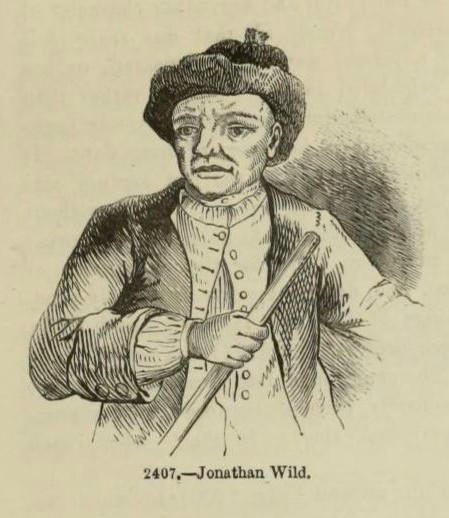
Jonathan Wild
Knowledge base stats:
Talk channels stats:
Members stats:
Jonathan Wild
Jonathan Wild, also spelled Wilde (1682 or 1683 – 24 May 1725), was an English thief-taker and a major figure in London's criminal underworld, notable for operating on both sides of the law, posing as a public-spirited vigilante entitled the "Thief-Taker General". He simultaneously ran a significant criminal empire, and used his crimefighting role to remove rivals and launder the proceeds of his own crimes.
Wild exploited a strong public demand for action during a major 18th-century crime wave in the absence of any effective police force in London. As a powerful gang-leader himself, he became a master manipulator of legal systems, collecting the rewards offered for valuables which he had stolen himself, bribing prison guards to release his colleagues, and blackmailing any who crossed him. Wild was consulted on crime by the government due to his apparently remarkable prowess in locating stolen items and those who had stolen them.
Wild was responsible for the arrest and execution of Jack Sheppard, a petty thief and burglar who had won the public's affection as a lovable rogue. However, Wild's duplicity became known and his men began to give evidence against him. After a suicide attempt, he was hanged at Tyburn before a massive crowd.
Since his death, Wild has been featured in novels, poems and plays, some of them noting parallels between Wild and the contemporaneous Prime Minister Walpole, known as "The Great Corrupter".
Though his exact birth date is unknown, Jonathan Wild was born in Wolverhampton in either 1682 or 1683 – although he was also alleged to have been born in the nearby Shropshire village of Boningale – as the first of five children in a poor family. He was baptised at St. Peter's Collegiate Church, Wolverhampton. His father, John Wild, was a carpenter, and his mother sold herbs and fruits in the local market. At that time, Wolverhampton was the second-largest town in Staffordshire, with a population of around 6,000, many involved in iron-working and related trades.
Wild attended the Free School in St John's Lane and was apprenticed to a local buckle-maker. He married and had a son, but came to London in 1704 as a servant. After being dismissed by his master he returned to Wolverhampton, before coming back to London in 1708. London was by far the largest city in England, with a population of around 600,000, of whom around 70,000 lived within the ancient city walls of the City of London.
Little is known of Wild's first two years in London, but he was arrested for debt in March 1710 and sent to Wood Street Compter, one of the debtor's prisons in the City of London. The prisons were notoriously corrupt, with gaolers demanding a bribe, or "garnish", for any minor comfort. Wild became popular, running errands for the gaolers and eventually earning enough to repay his original debts and the cost of being imprisoned, and even lend money to other prisoners. He received "the liberty of the gate", meaning that he was allowed out at night to aid in the arrest of thieves. There, he met one Mary Milliner (or Mary Mollineaux), a prostitute who began to teach Wild criminal ways and, according to Daniel Defoe, "brought him into her own gang, whether of thieves or whores, or of both, is not much material". Wild was also introduced to a wide range of London's criminal underclass. With his new skills and contacts, Wild was released in 1712 under an Act of Parliament passed earlier that year for the relief of insolvent debtors.
Upon release, Wild began to live with Milliner as her husband in Lewkenor's Land (now Macklin Street) in Covent Garden, despite both of them having prior marriages. Wild apparently served as Milliner's tough when she went night-walking. Soon Wild was thoroughly acquainted with the underworld, with both its methods and its inhabitants. At some point during this period, Milliner had begun to act as something of a madam to other prostitutes, and Wild as a fence, or receiver of stolen goods. He began, slowly at first, to dispose of stolen goods and to pay bribes to get thieves out of prison. Wild later parted with Milliner, cutting off her ear to mark her as a prostitute.
Hub AI
Jonathan Wild AI simulator
(@Jonathan Wild_simulator)
Jonathan Wild
Jonathan Wild, also spelled Wilde (1682 or 1683 – 24 May 1725), was an English thief-taker and a major figure in London's criminal underworld, notable for operating on both sides of the law, posing as a public-spirited vigilante entitled the "Thief-Taker General". He simultaneously ran a significant criminal empire, and used his crimefighting role to remove rivals and launder the proceeds of his own crimes.
Wild exploited a strong public demand for action during a major 18th-century crime wave in the absence of any effective police force in London. As a powerful gang-leader himself, he became a master manipulator of legal systems, collecting the rewards offered for valuables which he had stolen himself, bribing prison guards to release his colleagues, and blackmailing any who crossed him. Wild was consulted on crime by the government due to his apparently remarkable prowess in locating stolen items and those who had stolen them.
Wild was responsible for the arrest and execution of Jack Sheppard, a petty thief and burglar who had won the public's affection as a lovable rogue. However, Wild's duplicity became known and his men began to give evidence against him. After a suicide attempt, he was hanged at Tyburn before a massive crowd.
Since his death, Wild has been featured in novels, poems and plays, some of them noting parallels between Wild and the contemporaneous Prime Minister Walpole, known as "The Great Corrupter".
Though his exact birth date is unknown, Jonathan Wild was born in Wolverhampton in either 1682 or 1683 – although he was also alleged to have been born in the nearby Shropshire village of Boningale – as the first of five children in a poor family. He was baptised at St. Peter's Collegiate Church, Wolverhampton. His father, John Wild, was a carpenter, and his mother sold herbs and fruits in the local market. At that time, Wolverhampton was the second-largest town in Staffordshire, with a population of around 6,000, many involved in iron-working and related trades.
Wild attended the Free School in St John's Lane and was apprenticed to a local buckle-maker. He married and had a son, but came to London in 1704 as a servant. After being dismissed by his master he returned to Wolverhampton, before coming back to London in 1708. London was by far the largest city in England, with a population of around 600,000, of whom around 70,000 lived within the ancient city walls of the City of London.
Little is known of Wild's first two years in London, but he was arrested for debt in March 1710 and sent to Wood Street Compter, one of the debtor's prisons in the City of London. The prisons were notoriously corrupt, with gaolers demanding a bribe, or "garnish", for any minor comfort. Wild became popular, running errands for the gaolers and eventually earning enough to repay his original debts and the cost of being imprisoned, and even lend money to other prisoners. He received "the liberty of the gate", meaning that he was allowed out at night to aid in the arrest of thieves. There, he met one Mary Milliner (or Mary Mollineaux), a prostitute who began to teach Wild criminal ways and, according to Daniel Defoe, "brought him into her own gang, whether of thieves or whores, or of both, is not much material". Wild was also introduced to a wide range of London's criminal underclass. With his new skills and contacts, Wild was released in 1712 under an Act of Parliament passed earlier that year for the relief of insolvent debtors.
Upon release, Wild began to live with Milliner as her husband in Lewkenor's Land (now Macklin Street) in Covent Garden, despite both of them having prior marriages. Wild apparently served as Milliner's tough when she went night-walking. Soon Wild was thoroughly acquainted with the underworld, with both its methods and its inhabitants. At some point during this period, Milliner had begun to act as something of a madam to other prostitutes, and Wild as a fence, or receiver of stolen goods. He began, slowly at first, to dispose of stolen goods and to pay bribes to get thieves out of prison. Wild later parted with Milliner, cutting off her ear to mark her as a prostitute.
Recent media