Recent from talks
Nothing was collected or created yet.
Jack Sheppard
View on Wikipedia
John Sheppard (4 March 1702 – 16 November 1724), nicknamed "Honest Jack", "Gentleman Jack" or "Jack the Lad" (the origin of the British phrase), was an English criminal who became notorious in early 18th-century London.
Key Information
Born into a poor family, he was apprenticed as a carpenter, but began committing theft and burglary in 1723 with little more than a year of his training to complete. He was arrested and imprisoned five times in 1724, but escaped four times from prison, making him notorious, though popular with the poorer classes. Ultimately, he was caught, convicted, and hanged at Tyburn, ending his brief criminal career after less than two years. The inability of the notorious "Thief-Taker General" Jonathan Wild to control Sheppard, and injuries suffered by Wild at the hands of Sheppard's colleague Joseph "Blueskin" Blake, resulted in Wild's demise as a criminal boss.
Sheppard was as renowned for his attempts to escape from prison as he was for his crimes. An autobiographical "Narrative", thought to have been ghostwritten by Daniel Defoe, was sold at his execution,[1] quickly followed by popular plays. The character of Macheath in John Gay's The Beggar's Opera (1728) was based on Sheppard, keeping him well known for more than 100 years. He returned to the public consciousness around 1840, when William Harrison Ainsworth wrote a novel entitled Jack Sheppard, with illustrations by George Cruikshank. The popularity of his tale, and the fear that others would be drawn to emulate his behaviour, caused the authorities to refuse to license any plays in London with "Jack Sheppard" in the title for forty years.
Early life
[edit]Sheppard was born in White's Row, in London's Spitalfields.[2][3] He was baptised on 5 March, the day after he was born, at St Dunstan's, Stepney, suggesting a fear of infant mortality by his parents, perhaps because the newborn was weak or sickly.[2] His parents named him after an older brother, John, who had died before Sheppard's birth.[2] In life, he was better known as "Gentleman Jack" or "Jack the Lad". He had a second brother, Thomas, and a younger sister, Mary. Their father, a carpenter, died while Sheppard was young, and his sister died two years later.[2]

Unable to support her family without her husband's income, Sheppard's mother sent him to Mr Garrett's School, a workhouse near St Helen's Bishopsgate, when he was six years old.[2] Sheppard was sent out as a parish apprentice to a cane-chair maker, taking a settlement of 20 shillings, but his new master soon died. He was sent out to a second cane-chair maker, but Sheppard was treated badly.[4] Finally, when Sheppard was 10 years old, he went to work as a shop-boy for William Kneebone, a wool draper with a shop on the Strand.[5] Sheppard's mother had been working for Kneebone since her husband's death. Kneebone taught Sheppard to read and write and apprenticed him to a carpenter, Owen Wood, in Wych Street, off Drury Lane in Covent Garden. Sheppard signed his seven-year indenture on 2 April 1717.[5]
By 1722, Sheppard was showing great promise as a carpenter. Aged 20, he was a small man, only 5 ft 4 in (1.63 m) and lightly built, but deceptively strong. He had a pale face with large, dark eyes, a wide mouth and a quick smile. Despite a slight stutter, his wit made him popular in the taverns of Drury Lane.[6] He served five unblemished years of his apprenticeship but then began to become involved with crime.
Joseph Hayne, a button-moulder who owned a shop nearby, also managed a tavern named the Black Lion off Drury Lane, which he encouraged the local apprentices to frequent.[7] The Black Lion was visited by criminals such as Joseph "Blueskin" Blake, Sheppard's future partner in crime, and self-proclaimed "Thief-Taker General" Jonathan Wild, secretly the boss of a criminal gang which operated across London and later Sheppard's implacable enemy.
According to Sheppard's autobiography, he had been an innocent until going to Hayne's tavern, but there began a preference for strong drink and the affections of Elizabeth Lyon, a prostitute also known as Edgworth Bess (or Edgeworth Bess) from her place of birth at Edgeworth in Middlesex. In his History, Defoe records that Bess was "a main lodestone in attracting of him up to this Eminence of Guilt".[8] Such, Sheppard claimed, was the source of his later ruin.[9] Peter Linebaugh offers a more politicised version: that Sheppard's sudden transformation was a liberation from the dull drudgery of indentured labour and that he progressed from pious servitude to self-confident rebellion and Levelling.[10]
Criminal career
[edit]Sheppard began habitually drinking and whoring. Inevitably, his carpentry suffered, and he became disobedient to his master. With Lyon's encouragement, Sheppard began criminal activity in order to augment his legitimate wages. His first recorded theft was in Spring 1723, when he engaged in petty shoplifting, stealing two silver spoons while on an errand for his master to the Rummer Tavern in Charing Cross.[7] Sheppard's misdeeds were undetected, and he progressed to larger crimes, often stealing goods from the houses where he was working. Finally, he quit the employ of his master on 2 August 1723, with less than two years of his apprenticeship left,[11] although he continued to work as a journeyman carpenter.[12] He was not suspected of the crimes, and progressed to burglary, in company with criminals in Jonathan Wild's gang.
He relocated to Fulham, living as husband and wife with Lyon at Parsons Green, before relocating to Piccadilly.[11] When Lyon was arrested and imprisoned at St Giles's Roundhouse, the beadle, a Mr Brown, refused to let Sheppard visit, so he broke in and took her away.[13]
Arrested and escaped twice
[edit]Sheppard was first arrested after a burglary he committed with his brother, Tom, and his mistress, Lyon, in Clare Market on 5 February 1724. Tom, also a carpenter, had already been convicted once for stealing tools from his master the previous autumn and burned in the hand. Tom was arrested again on 24 April 1724. Afraid that he would be hanged this time, Tom informed on Jack, and a warrant was issued for Jack's arrest.[14]
Jonathan Wild was aware of Sheppard's thefts, as Sheppard had fenced some stolen goods through one of Wild's men, William Field.[11] Wild asked another of his men, James Sykes (known as "Hell and Fury") to challenge Sheppard to a game of skittles at Redgate's public house near Seven Dials.[15] Sykes betrayed Sheppard to a Mr Price, a constable from the parish of St Giles, to gather the usual £40 reward for giving information resulting in the conviction of a felon. The magistrate, Justice Parry, had Sheppard imprisoned overnight on the top floor of St Giles's Roundhouse pending further questioning, but Sheppard escaped within three hours by breaking through the timber ceiling and lowering himself to the ground with a rope fashioned from bedclothes.[16] Still wearing irons, Sheppard coolly joined the crowd that had been attracted by the sounds of his breaking out. He distracted their attention by pointing to the shadows on the roof and shouting that he could see the escapee, and then swiftly departed.[16]

On 19 May 1724, Sheppard was arrested for a second time, caught in the act of picking a pocket in Leicester Fields (near present-day Leicester Square). He was detained overnight in St Ann's Roundhouse in Soho and visited there the next day by Lyon; she was recognised as his wife and locked in a cell with him. They appeared before Justice Walters, who sent them to the New Prison in Clerkenwell, but they escaped from their cell, known as the Newgate Ward, within a matter of days. By 25 May, Whitsun Monday, Sheppard and Lyon had filed through their manacles; they removed a bar from the window and used their knotted bed-clothes to descend to ground level. Finding themselves in the yard of the neighbouring Bridewell, they clambered over the 22-foot-high (6.7 m) prison gate to freedom. This feat was widely publicised, not least because Sheppard was only a small man, and Lyon was a large, buxom woman.[17][18]
Third arrest, trial, and third escape
[edit]Sheppard's thieving abilities were admired by Jonathan Wild. Wild demanded that Sheppard surrender his stolen goods for Wild to fence, and so take the greater profits, but Sheppard refused. He began to work with Joseph "Blueskin" Blake, and they burgled Sheppard's former master, William Kneebone, on Sunday 12 July 1724. Wild could not permit Sheppard to continue outside his control and began to seek Sheppard's arrest.[19] Unfortunately for Sheppard, his fence, William Field, was one of Wild's men. After Sheppard had a brief foray with Blueskin as highwaymen on the Hampstead Road on Sunday 19 July and Monday 20 July, Field informed on Sheppard to Wild. Wild believed Lyon would know Sheppard's whereabouts, so he plied her with drinks at a brandy shop near Temple Bar until she betrayed him. Sheppard was arrested a third time at Blueskin's mother's brandy shop in Rosemary Lane, east of the Tower of London (later renamed Royal Mint Street), on 23 July by Wild's henchman, Quilt Arnold.[20]
Sheppard was imprisoned in Newgate Prison pending his trial at the next Assize of oyer and terminer. He was prosecuted on three charges of theft at the Old Bailey, but was acquitted on the first two due to lack of evidence. Kneebone, Wild and Field gave evidence against him on the third charge, the burglary of Kneebone's house. He was convicted on 12 August, the case "being plainly prov'd", and sentenced to death.[21] On Monday 31 August, the very day when the death warrant arrived from the court in Windsor setting Friday 4 September as the date for his execution, Sheppard escaped. Having loosened an iron bar in a window used when talking to visitors, he was visited by Lyon and Poll Maggott, who distracted the guards while he removed the bar (security was lax compared to that of later years; the guard-to-prisoner ratio at Newgate in 1724 was 1:90, and wives could stay overnight).[22] His slight build enabled him to climb through the resulting gap in the grille, and he was smuggled out of Newgate in women's clothing that his visitors had brought him.[23] He took a coach to Blackfriars Stairs, a boat up the River Thames to the horse ferry in Westminster, near the warehouse where he hid his stolen goods, and completed his escape.[8]
Fourth arrest and final escape
[edit]
By this time, Sheppard was a hero to a segment of the population, being a cockney, non-violent, handsome and seemingly able to escape punishment for his crimes at will. He spent a few days out of London, visiting a friend's family in Chipping Warden in Northamptonshire, but was soon back in town.[24] He evaded capture by Wild and his men but was arrested again on 9 September by a posse from Newgate as he hid on Finchley Common,[25] and returned to the condemned cell at Newgate. His fame had increased with each escape, and he was visited in prison by various people. His plans to escape during September were thwarted twice when the guards found files and other tools in his cell, and he was transferred to a strong-room in Newgate known as the "Castle", put in leg irons, and chained to two metal staples in the floor to prevent further escape attempts.[26] After demonstrating to his gaolers that these measures were insufficient, by showing them how he could use a small nail to unlock the horse padlock at will, he was bound more tightly and handcuffed. In his History, Defoe reports that Sheppard made light of his predicament, joking that "I am the Sheppard, and all the Gaolers in the Town are my Flock, and I cannot stir into the Country, but they are all at my Heels Baughing after me".[8]
Meanwhile, "Blueskin" Blake was arrested by Wild and his men on Friday 9 October, and Tom, Jack's brother, was transported for robbery on Saturday 10 October 1724.[27] New court sessions began on Wednesday 14 October, and Blueskin was tried on Thursday 15 October, with Field and Wild again giving evidence. Their accounts were not consistent with the evidence that they gave at Sheppard's trial, but Blueskin was convicted anyway. Enraged, Blueskin attacked Wild in the courtroom, slashing his throat with a pocket-knife and causing an uproar.[28] Wild was lucky to survive, and his control of his criminal gang was weakened while he recuperated.
Taking advantage of the disturbance, which spread to Newgate Prison next door and continued into the night, Sheppard escaped for the fourth time. He unlocked his handcuffs and removed the chains. Still encumbered by his leg irons, he attempted to climb up the chimney, but his path was blocked by an iron bar set into the brickwork. He removed the bar and used it to break through the ceiling into the "Red Room" above the "Castle", a room which had last been used some seven years before to confine aristocratic Jacobite prisoners after the Battle of Preston. Still wearing his leg irons as night began, he then broke through six barred doors into the prison chapel, then to the roof of Newgate, 60 feet (18 m) above the ground. He went back down to his cell to get a blanket, then back to the roof of the prison, and used the blanket to reach the roof of an adjacent house, owned by William Bird, a turner. He broke into Bird's house, and went down the stairs and out into the street at around midnight without disturbing the occupants. Escaping through the streets to the north and west, Sheppard hid in a cowshed in "Tottenham" (near modern Tottenham Court Road). Spotted by the barn's owner, Sheppard told him that he had escaped from Bridewell Prison, having been imprisoned there for failing to provide for a (nonexistent) bastard son. His leg irons remained in place for several days until he persuaded a passing shoemaker to accept the considerable sum of 20 shillings to bring a blacksmith's tools and help him remove them, telling him the same tale.[29] His manacles and leg irons were later recovered in the rooms of Kate Cook, one of Sheppard's mistresses. This escape astonished everyone. Daniel Defoe, working as a journalist, wrote an account for John Applebee, The History of the Remarkable Life of John Sheppard. In his History, Defoe reports the belief in Newgate that the Devil came in person to assist Sheppard's escape.[8]
Final capture
[edit]
Sheppard's final period of liberty lasted just two weeks. He disguised himself as a beggar and returned to the city. He broke into the Rawlins brothers' pawnbroker's shop in Drury Lane on the night of 29 October 1724, taking a black silk suit, a silver sword, rings, watches, a wig, and other items.[31][32] He dressed himself as a dandy gentleman and used the proceeds to spend a day and the ensuing evening on the tiles with two mistresses. He was arrested a final time in the early morning on 1 November, drunk, "in a handsome Suit of Black, with a Diamond Ring and a carnelian ring on his Finger, and a fine Light Tye Peruke".[33]
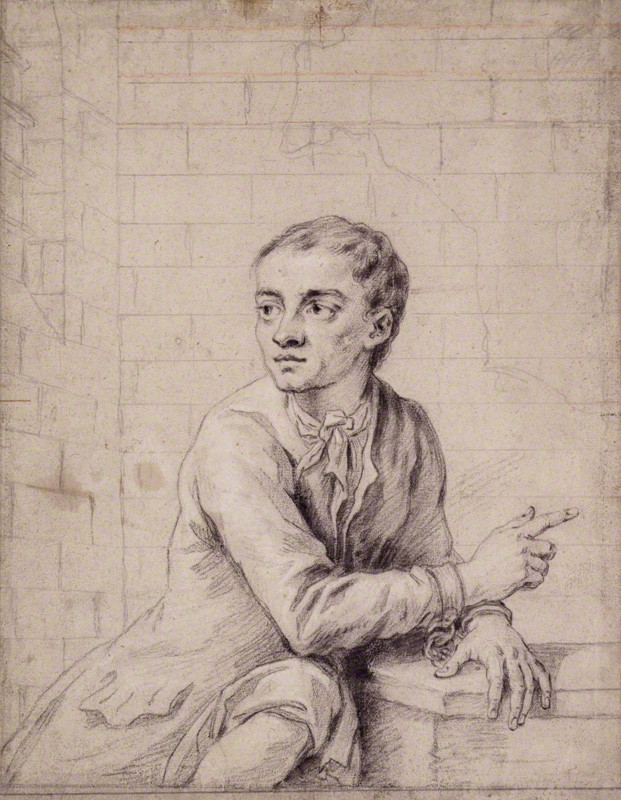
This time, Sheppard was placed in the Middle Stone Room, in the centre of Newgate next to the "Castle", where he could be observed at all times. He was also loaded with 300 pounds of iron weights. He was so celebrated that the gaolers charged high society visitors four shillings to see him, and the King's painter James Thornhill painted his portrait.[34] Several prominent people sent a petition to King George I, begging for his sentence of death to be commuted to transportation. "The Concourse of People of tolerable Fashion to see him was exceeding Great, he was always Chearful and Pleasant to a Degree, as turning almost everything as was said onto a Jest and Banter."[8] To a Reverend Wagstaffe who visited him, he said, according to Defoe, "One file's worth all the Bibles in the World".[8]
Sheppard came before Mr Justice Powis in the Court of King's Bench at Westminster Hall on 10 November. He was offered the chance to have his sentence reduced by informing on his associates, but he scorned the offer, and the death sentence was confirmed.[35] The next day, Blueskin was hanged, and Sheppard was moved to the condemned cell.
Execution
[edit]The next Monday, 16 November, Sheppard was taken to the gallows at Tyburn to be hanged. He planned one more escape, but his pen-knife, intended to cut the ropes binding him on the way to the gallows, was found by a prison warder shortly before he left Newgate for the last time.[36]
A joyous procession passed through the streets of London, with Sheppard's cart drawn along Holborn and Oxford Street accompanied by a mounted City Marshal and liveried Javelin Men. The occasion was as much as anything a celebration of Sheppard's life, attended by crowds of as many as 200,000 people (one third of London's population). The procession halted at the City of Oxford tavern on Oxford Street, where Sheppard drank a pint of sack.[37] A carnival atmosphere pervaded Tyburn, where his "official" autobiography, published by Applebee and probably ghostwritten by Defoe, was on sale. Sheppard handed "a paper to someone as he mounted the scaffold",[38] perhaps as a symbolic endorsement of the account in the "Narrative". His slight build had aided his previous prison escapes, but it caused him a slow death by strangulation from the hangman's noose. After hanging for the prescribed 15 minutes, his body was cut down. The crowd pressed forward to stop his body from being removed, fearing dissection; their actions inadvertently prevented Sheppard's friends from implementing a plan to take his body to a doctor in an attempt to revive him. His badly mauled remains were recovered later and buried in the churchyard of St Martin-in-the-Fields that evening.[39]
Legacy
[edit]
There was a spectacular public reaction to Sheppard's deeds, which were cited favourably as an example in newspapers. Pamphlets, broadsheets, and ballads were all devoted to his amazing experiences, real and fictional,[40] and his story was adapted for the stage almost immediately. Harlequin Sheppard, a pantomime by one John Thurmond (subtitled "A night scene in grotesque characters"), opened at the Theatre Royal, Drury Lane, on Saturday 28 November, only two weeks after Sheppard's hanging.[39][41] In a famous contemporary sermon, a London preacher drew on Sheppard's popular escapes as a way of holding his congregation's attention:
Let me exhort ye, then, to open the locks of your hearts with the nail of repentance! Burst asunder the fetters of your beloved lusts! – mount the chimney of hope! – take from thence the bar of good resolution! – break through the stone wall of despair![42]
The account of his life remained well-known through the Newgate Calendar, and a three-act farce was published but never produced, but, mixed with songs, it became The Quaker's Opera, later performed at Bartholomew Fair.[43] An imagined dialogue between Jack Sheppard and Julius Caesar was published in the British Journal on 4 December 1724, in which Sheppard favourably compares his virtues and exploits to those of Caesar.[44]
Perhaps the most prominent play based on Sheppard's life is John Gay's The Beggar's Opera (1728). Sheppard was the inspiration for the character Captain Macheath; his nemesis, Peachum, is based on Jonathan Wild.[45] The play was spectacularly popular, restoring the fortune that Gay had lost in the South Sea Bubble, and was produced regularly for more than 100 years. An unperformed but published play The Prison-Breaker was turned into The Quaker's Opera (in imitation of The Beggar's Opera) and performed at Bartholomew Fair in 1725 and 1728. Two centuries later The Beggar's Opera was the basis for The Threepenny Opera of Bertolt Brecht and Kurt Weill (1928).
Sheppard's tale may have been an inspiration for William Hogarth's 1747 series of 12 engravings, Industry and Idleness, which shows the parallel habituation of an apprentice, Tom Idle, to crime, resulting in his being hung, beside the fortunes of his fellow apprentice, Francis Goodchild, who marries his master's daughter and takes over his business, becoming wealthy as a result, eventually emulating Dick Whittington to become Lord Mayor of London.[46]

Sheppard's tale was revived during the first half of the 19th century. A melodrama, Jack Sheppard, The Housebreaker, or London in 1724, by W. T. Moncrieff was published in 1825. More successful was William Harrison Ainsworth's third novel, entitled Jack Sheppard, which was published originally in Bentley's Miscellany from January 1839 with illustrations by George Cruikshank, overlapping with the final episodes of Charles Dickens' Oliver Twist.[47] An archetypal Newgate novel, it generally remains close to the facts of Sheppard's life, but portrays him as a daring hero. Like Hogarth's prints, the novel pairs the increasing involvement of the "idle" apprentice with crime with the fortunes of a typical melodramatic character, Thames Darrell, a foundling of aristocratic birth who defeats his evil uncle to recover his fortune. Cruikshank's images perfectly complemented Ainsworth's tale—William Thackeray wrote that "... Mr Cruickshank really created the tale, and that Mr Ainsworth, as it were, only put words to it."[48] The novel quickly became very popular: it was published in book form later that year, before the serialised version was completed, and even outsold early editions of Oliver Twist.[49] Ainsworth's novel was adapted into a successful play by John Buckstone in October 1839 at the Adelphi Theatre featuring (strangely enough) Mary Anne Keeley; indeed, it seems likely that Cruikshank's illustrations were deliberately created in a form that were informed by, and would be easy to repeat as, tableaux on stage. It has been described as the "exemplary climax" of "the pictorial novel dramatized pictorially".[50]
The story generated a type of cultural mania, embellished by pamphlets, prints, cartoons, plays and souvenirs, not repeated until George du Maurier's novel Trilby in 1895. By early 1840, a cant song from Buckstone's play "Nix My Dolly, Pals, Fake Away" was reported to be "deafening us in the streets".[51] Public alarm at the possibility that young people would emulate Sheppard's behaviour caused the Lord Chamberlain to ban, at least in London, the licensing of any plays with "Jack Sheppard" in the title for forty years. The fear may not have been entirely unfounded: Courvousier, the valet of Lord William Russell, said in one of his several confessions that the book had inspired him to murder his master.[52] Frank and Jesse James wrote letters to the Kansas City Star signed "Jack Sheppard".[53] Nevertheless, burlesques of the story were written after the ban was ended, including a popular Gaiety Theatre, London, piece called Little Jack Sheppard (1886) by Henry Pottinger Stephens and William Yardley, which featured Nellie Farren as Jack.[54]
The Sheppard story has been revived three times as movies the 20th century: The Hairbreadth Escape of Jack Sheppard (1900), Jack Sheppard (1923), and Where's Jack? (1969), a British historical drama directed by James Clavell with Tommy Steele in the title role.[54] Jake Arnott features him in his 2017 novel The Fatal Tree.[55]
In 1971 British popular music group Chicory Tip paid tribute to Sheppard in "Don't Hang Jack", the B-side to "I Love Onions".[56] The song, apparently sung from the viewpoint of a witness in the courtroom, describes Jack's daring exploits as a thief, and futilely begs the judge to spare Sheppard because he was loved by the women of the town, and idolised by the lads who "made him their king".[57]
In Jordy Rosenberg's 2018 novel Confessions of the Fox, the Sheppard story was recontextualised as a queer narrative:[58] a 21st-century academic discovers a manuscript containing Sheppard's "confessions", which tell the story of his childhood and his love affair with Edgeworth Bess, and reveals that he was a transgender man.
The reasons for the lasting legacy of Sheppard's exploits in the popular imagination have been addressed by Peter Linebaugh, who suggests that Sheppard's legend was based on the prospect of excarceration, of escape from what Michel Foucault in Folie et déraison termed the grand renfermement (Great Confinement), in which "unreasonable" members of the population were locked away and institutionalised.[59] Linebaugh further says that the laws applied to Sheppard and similar working class criminals were a means of disciplining a potentially rebellious multitude into accepting increasingly harsh property laws. Another nineteenth-century opinion of the Jack Sheppard phenomenon was offered by Charles Mackay in Memoirs of Extraordinary Popular Delusions and the Madness of Crowds:
Whether it be that the multitude, feeling the pangs of poverty, sympathise with the daring and ingenious depredators who take away the rich man's superfluity, or whether it be the interest that mankind in general feel for the records of perilous adventure, it is certain that the populace of all countries look with admiration upon great and successful thieves.[60]
Notes
[edit]- ^ Compiled for Applebee's Original Weekly Journal, probably by Daniel Defoe, and endorsed by Sheppard at his hanging in November 1724.
- ^ a b c d e Moore, p.31.
- ^ Lynch, para.2.
- ^ Moore, p.38.
- ^ a b Moore, p.33.
- ^ Moore, p.96.
- ^ a b Moore, p.98.
- ^ a b c d e f Defoe, History.
- ^ Defoe's History reports that he called Edgworth Bess "the sole author of all his misfortunes" and said he "cared not what became of her".
- ^ Linebaugh, Ch.1. "The Common Discourse of the Whole Nation: Jack Sheppard and the Art of Escape", in The London Hanged, pp.7–42. On the comparison with the Levellers, see p.164.
- ^ a b c Moore, p.99.
- ^ Lynch, para.7.
- ^ Lynch, para.8.
- ^ Lynch, para.11.
- ^ Moore, p.100.
- ^ a b Moore, p.104.
- ^ Moore, p.105.
- ^ Defoe's History reports that she was "more corpulent than himself".
- ^ Moore, p.110.
- ^ Moore, p.111.
- ^ Trial summary on three charges of theft, 12 August 1724, where his name is incorrectly recorded as Joseph Sheppard. Retrieved 5 February 2007. Archived 27 September 2007 at the Wayback Machine
- ^ Linebaugh, p.29.
- ^ Moore, p.206.
- ^ Moore, p.207.
- ^ Moore, p.208.
- ^ Norton, The Daily Journal for Thursday 17 September 1724.
- ^ Moore, p.158.
- ^ Moore, p.159.
- ^ Moore, p.162.
- ^ The closeness of the resemblance is praised in a poem published in the British Journal on 28 November 1724, which recites that "Thornhill, 'tis thine to gild with fame // Th' obscure, and raise the humble Name; // To make the form elude the Grave, // and Sheppard from oblivion save ... Appelles, Alexander drew, // Caesar is to Aurellius due, // Cromwell in Lilly's works doth shine, // and Sheppard, Thornhill, lives in thine."
- ^ Moore, p.164.
- ^ Lynch, para.46.
- ^ The London Journal, 7 November 1724. Mullan, p.186.
- ^ The original has not survived, but this sketch attributed to Thornhill, and this mezzotint engraving by George White based on it, are possessed by the National Portrait Gallery. The Daily Journal records that the sketch was taken on Friday 13 September, by "an eminent painter". Retrieved 5 February 2007.
- ^ Moore, p.168.
- ^ Moore, p.219.
- ^ Moore, p.222.
- ^ The Weekly Journal (Read's Journal), October 1724. Mullan, p.187.
- ^ a b Moore, p.225.
- ^ Fiction was readily mixed with fact. Applebee's Journal had a letter from one "Betty Blueskin", supposed niece of Moll Flanders, telling of her life of crime and her passion for Jack Sheppard. Mullan, p. 187.
- ^ Norton, The Weekly Journal or Saturday's-Post for Saturday 5 December 1724. See also William Hogarth's print satirising the production: A Just View of the British Stage.
- ^ Oh, that ye were all like Jack Sheppard! ... Let me exhort ye then to open the locks of your hearts with the nail of repentance! Burst asunder the fetters of your beloved lusts, mount the chimney of hope ..." etc. Quoted by Mackay, p. 638, from Annals of Newgate, 1754.
- ^ The Bloody Register, p. 324.
- ^ The Bloody Register, pp. 325–330.
- ^ Moore, p. 227.
- ^ Moore, p. 231.
- ^ Ainsworth, Jack Sheppard at Project Gutenberg. See also an analysis at The Literary Encyclopedia. Retrieved 5 February 2007.
- ^ Buckley, p. 432, from Meisel, pp. 247–8.
- ^ Buckley, p. 426.
- ^ Buckley, p. 438, quoting Meisel, p. 265.
- ^ Reported in Buckley, p. 427.
- ^ Moore, p. 229.
- ^ Linebaugh, p. 7.
- ^ a b Sugden
- ^ Menmuir, Wyl (26 March 2017). "The Fatal Tree by Jake Arnott review – a double helping of love and loss". The Observer. Retrieved 8 September 2018.
- ^ I Love Onions
- ^ "Chicory Tip discography". Archived from the original on 24 October 2015. Retrieved 20 September 2017.
- ^ Confessions of the Fox Archived 20 July 2018 at the Wayback Machine, Kirkus Reviews.
- ^ Linebaugh describes excarceration as "the growing propensity, skill and success of London working people in escaping from the newly created institutions that were designed to discipline people by closing them in." The London Hanged, pp. 7–42.
- ^ Mackay, p. 632.
References
[edit]- Anon. The Bloody Register vol. II London, 1764.
- Buckley, Matthew. "Sensations of Celebrity: Jack Sheppard and the Mass Audience", Victorian Studies, Volume 44, Number 3, Spring 2002, pp. 423–463
- Defoe, Daniel. The History of the Remarkable Life of John Sheppard. London: 1724. Retrieved 5 February 2007.
- Howson, Gerald. Thief-Taker General: Jonathan Wild and the Emergence of Crime and Corruption as a Way of Life in Eighteenth-Century England. New Brunswick, NJ and Oxford, UK: 1970. ISBN 0-88738-032-8
- Linebaugh, Peter. The London Hanged: Crime and Civil Society in the Eighteenth Century. Verso, 2003, ISBN 1-85984-638-6
- Lynch, Jack (editor). Jack Sheppard, from The Complete Newgate Calendar. Retrieved 5 February 2007.
- Mackay, Charles. Memoirs of Extraordinary Popular Delusions and the Madness of Crowds. Wordsworth Editions, (1841) 1999 edition. ISBN 1-890151-40-8.
- Moore, Lucy. The Thieves' Opera. Viking, 1997, ISBN 0-670-87215-6
- Mullan, John, and Christopher Reid. Eighteenth-Century Popular Culture: A Selection. Oxford University Press, 2000. ISBN 0-19-871134-4.
- Norton, Rictor. Early Eighteenth-Century Newspaper Reports: A Sourcebook, "Jack Sheppard, Jail-Breaker". Retrieved 5 February 2007.
- Sugden, Philip. "John Sheppard" in Matthew, H.C.G. and Brian Harrison, eds. The Oxford Dictionary of National Biography. vol. 50, 261–263. London: OUP, 2004.
Further reading
[edit]- Proceedings from the Old Bailey. Ordinary's Account of 4 September 1724. Reference (docket) t17240812-52.
- Anon (often attributed to Defoe). A Narrative of All the Robberies, Escapes, Etc. of John Sheppard. 1724.
- Bleackley, Horace, Trial of Jack Sheppard. Wm Gaunt & Sons, (1933) 1996 edition. ISBN 1-56169-117-8.
- G.E. Authentick Memoirs of the Life and Surprising Adventures of John Sheppard by Way of Familiar Letters from a Gentleman in Town. 1724.
- Gatrell, V.A. The Hanging Tree: Execution and the English People 1770–1868. Oxford University Press, 1996. ISBN 0-19-285332-5.
- Hibbert, Christopher. The Road to Tyburn: The story of Jack Sheppard and the Eighteenth-Century London Underworld. New York: The World Publishing Company, 1957. (2001 Penguin reprint: ISBN 0-14-139023-9)
- Linnane, Fergus. The Encyclopedia of London Crime. Sutton Publishing, 2003. ISBN 0-7509-3302-X.
- Meisel, Martin. (1983) Realizations: Narrative, Pictorial and Theatrical Arts in Nineteenth-Century England. Princeton.
- Rawlings, Philip. Drunks, Whores, and Idle Apprentices: Criminal Biographies of the Eighteenth Century. Routledge (UK), 1992. ISBN 0-415-05056-1.
- Rogers, Pat. Daniel Defoe: The Critical Heritage. Routledge (UK), 1995. ISBN 0-415-13423-4.
External links
[edit]- Jack Sheppard, from the Newgate Calendar, including contemporary sermon. Retrieved 5 February 2007.
- Project Gutenberg etext of William Harrison Ainsworth's novel.
- The Thief-Taker Hangings: How Daniel Defoe, Jonathan Wild, and Jack Sheppard Captivated London and Created the Celebrity Criminal by Aaron Skirboll
Jack Sheppard
View on GrokipediaJohn Sheppard (1702 – 16 November 1724), commonly known as Jack Sheppard, was an English housebreaker and thief active in London during the early 1720s, whose notoriety stemmed primarily from four successful escapes from custody, including two from Newgate Prison.[1][2][3]
Born in Spitalfields to a carpenter father who died young, Sheppard received basic education before apprenticing as a carpenter in 1717; however, by 1722, associations with criminals at the Black Lion alehouse, including Elizabeth Lyon (known as Edgeworth Bess), drew him into petty theft and burglary.[3][1] His crimes involved breaking into homes and shops to steal items such as silverware, clothing, and small sums of money, including a conviction for robbing pawnbroker William Kneebone.[1][2]
Sheppard's escapes began in 1723 from St Giles's roundhouse, followed by New Prison in Clerkenwell using knotted sheets to scale a wall, and culminated in feats from Newgate: on 30 August 1724, he filed through a spike in irons to flee with aid from accomplices, and on 15 October, he dismantled locks and bars in the condemned hold using rudimentary tools before recapture.[1][2][3] Tried and sentenced to death at the Old Bailey in August 1724, he was executed by hanging at Tyburn on 16 November, his repeated evasions having fueled public fascination despite the mundane scale of his offenses.[1][2]
Early Life and Background
Family Origins and Childhood Poverty
John Sheppard, commonly known as Jack, was born on 4 March 1702 in the impoverished district of Spitalfields, east London, to Thomas Sheppard, a carpenter by trade, and his wife. The family lived in White's Row, a notorious slum area plagued by poverty and crime, where working-class households like theirs struggled amid urban decay and limited economic opportunities.[4][5] Sheppard was named after an older brother who had died in infancy, reflecting the high infant mortality rates common in such environments.[6] Thomas Sheppard's death occurred when Jack was still a young child, around 1703, leaving his widow unable to adequately support the household of several children through her own labors. With no substantial inheritance or social safety net beyond rudimentary parish aid, the family descended into deeper destitution, forcing reliance on institutional relief systems. Jack's mother entered domestic service to survive, while he and his siblings were placed under the oversight of local parish authorities, highlighting the precarious existence of fatherless working-class families in early 18th-century London.[2][7] Deprived of stable paternal guidance, young Sheppard received only minimal formal education, acquiring basic reading and writing skills likely through sporadic parish schooling or workhouse instruction rather than consistent tutelage. His early years unfolded amid Spitalfields' harsh realities—overcrowded tenements, widespread vagrancy, and proximity to markets teeming with transient laborers—fostering an intimate acquaintance with material want from age five onward, as the family navigated intermittent charity and the grind of low-wage survival. This backdrop of chronic instability and absent familial structure underscored the empirical constraints of his origins, though personal choices later defined his path.[2][8]Apprenticeship and Initial Deviations
In 1717, at the age of fifteen, John Sheppard was apprenticed as a carpenter to Owen Wood in Wych Street near Drury Lane, following his late father's trade amid family poverty in Spitalfields.[7][3] He served a standard term of about seven years, during which he acquired proficiency in woodworking, including the use of chisels, saws, and locks, skills rooted in precise manual dexterity that initially supported legitimate construction work.[9][10] By 1722, after five years, Sheppard had become an accomplished journeyman, capable of independent tasks but with less than two years remaining in his indenture.[2] Sheppard's discipline eroded through exposure to local vices; he began frequenting alehouses like the Black Lion in Drury Lane, where gambling and drinking supplanted work ethic, drawing him into associations with petty criminals and prostitutes around age eighteen or nineteen.[1][7] In 1722, he entered a common-law relationship with Elizabeth Lyon, alias Edgeworth Bess, a habitual receiver of stolen goods who, according to contemporary accounts, actively enticed him toward illicit opportunities over continued apprenticeship.[2][1] This partnership marked a causal pivot, as Bess provided both companionship and a market for pilfered items, undermining Sheppard's prior steadiness in Wood's shop.[11] Initial deviations manifested as opportunistic thefts during carpentry jobs; while employed on sites, Sheppard stole small valuables such as tankards, spoons, and fabric scraps from clients' homes, undetected at first and fencing them through Bess to fund alehouse indulgences.[1][12] These acts, commencing around 1721–1722, reflected a preference for low-risk gains—exploiting trusted access—over the drudgery of full apprenticeship completion, setting a pattern of recidivism despite no prior convictions.[2] One early instance involved purloining fustian cloth from a trunk, prompting his master's suspicion but not immediate prosecution, allowing temporary continuance as a journeyman.[1] Such petty opportunism, enabled by his trade mobility, prioritized immediate gratification amid economic pressures, foreshadowing escalation without external coercion evident in records.[3]Criminal Offenses and Modus Operandi
Early Thefts and Burglaries
Sheppard's criminal activities commenced in early 1723 with petty shoplifting, including the theft of two silver spoons from the Rummer Tavern in Charing Cross while running an errand for his carpentry master.[13] Continuing in his apprenticeship, he exploited access to employers' residences, pilfering items such as tankards and spoons from houses where he worked, which he then sold to fences.[1] By mid-1723, Sheppard escalated to more organized housebreaking, beginning with the theft of a yard of fustian cloth from Mr. Bains, a piece-maker in White Horse Yard near Drury Lane.[7] In July of that year, he broke into Bains's home at midnight by removing the bars from a cellar window, stealing goods and money valued at £22.[1] Shortly thereafter, in August 1723, Sheppard, accompanied by his brother Thomas and mistress Elizabeth Lyon (known as Edgworth Bess), forced entry into Mrs. Cook's linen-draper's shop in Clare Market—adjacent to Drury Lane—and absconded with assorted goods worth £55, inflicting direct economic loss on the proprietor through the removal of marketable inventory.[1] Further burglaries followed in the Drury Lane vicinity, including the robbery of Mr. Phillips's house, where unspecified items were taken during a break-in.[1] Sheppard also targeted a gentleman's residence in Mayfair, a Westminster district area, stealing money, plate, gold rings, and four suits of clothes while ostensibly employed there as a carpenter; these high-value portable goods represented significant financial detriment to the victim, equivalent to months of skilled labor wages in the era.[1] His methods relied on rudimentary tools to pry open windows and bars rather than sophisticated locks, preying on vulnerabilities in urban homes and shops of tradesmen and middling sorts, thereby compounding the pervasive property insecurity in 1720s London, where such intrusions eroded household security and economic stability for victims reliant on accumulated goods.[1]Gang Involvement and Victim Impacts
Sheppard allied with Joseph Blake, known as "Blueskin," a seasoned thief, and Elizabeth Lyon, alias Edgeworth Bess, his mistress who often received and fenced stolen goods, forming part of loose networks among London's petty criminals frequenting taverns like the Black Lion in Drury Lane.[7][10] These associations, typical of the era's disorganized underworld rather than structured gangs, enabled coordinated burglaries and housebreakings, with Sheppard providing carpentry skills to force entries while accomplices handled lookout or disposal.[14] Key operations included the April 1724 burglary of woollendraper William Kneebone's Fleet Street shop, where Sheppard and Blueskin stole lace, cambric, and other fabrics valued at over £24, leading to their arrest on information from thief-taker Jonathan Wild.[14] Earlier, in July 1723, Sheppard alone took a yard of fustian from piece-maker Charles Bains's Wych Street residence, escalating to larger hauls like seventy yards of silk and forty yards of fustian in similar tradesmen's homes.[7][15] Such thefts targeted mash houses, linen drapers, and workshops, exploiting Sheppard's employment access for insider thefts of tools, utensils, and inventory. Victims, predominantly middling tradespeople and laborers, faced direct economic harm: Kneebone, for instance, lost irreplaceable stock essential to his trade, risking insolvency in an era without insurance, as trial accounts detailed the precision of entries that stripped livelihoods without restitution.[1] Bains and similar proprietors suffered comparable depletions of fabrics critical for garment production, compounding poverty risks amid 1720s London's high unemployment and weak property protections. These self-interested depredations, far from redistributive "Robin Hood" exploits, inflicted amplified damage through group coordination—enabling bolder entries and faster fencing—while underscoring Sheppard's personal agency in initiating and executing the crimes.[7][1]Arrests, Escapes, and Technical Exploits
First Two Arrests and Escapes
Jack Sheppard's first arrest occurred in early 1724 following a burglary committed with accomplices including his brother Thomas and mistress Elizabeth Lyon (known as Edgworth Bess), leading to his detention in St Giles Roundhouse.[1] There, leveraging his carpentry training, he broke through the ceiling at night and descended using knotted bedclothes while still manacled, effecting an escape without external aid.[16][1] His second arrest came swiftly on 19 May 1724, after a failed pickpocketing attempt in Leicester Fields with Bess, resulting in commitment to Clerkenwell's New Prison (also called Bridewell).[16][1] On 25 May, Sheppard filed off his iron fetters using smuggled tools provided by acquaintances, then with Bess's assistance, he enlarged a hole in the cell wall, removed bars from the window, and lowered himself 25 feet via a rope fashioned from a blanket and sheet tied to an iron bar.[1][16] He subsequently scaled a 22-foot outer wall using protruding locks and bolts as handholds, his slight build—approximately 5 feet 4 inches tall—enabling passage through tight spaces where larger men could not.[1][2] These breakouts highlighted Sheppard's resourcefulness with improvised tools and structural weaknesses, rooted in his four years as a carpenter's apprentice, though they preceded his more infamous Newgate exploits.[1]Third Imprisonment, Trial, and Dramatic Breakout
Following his recapture on 9 September 1724 in Finchley after the August escape, Sheppard was confined to Newgate Prison's Castle chamber, the facility's most secure strong-room reserved for notorious escapees.[16] There, unlike the less fortified roundhouses and common wards of his prior detentions—which relied on basic padlocks and minimal oversight—he was restrained with handcuffs, a heavy pair of leg irons weighing approximately 13 pounds, and a chain bolted to a floor staple, measures intended to prevent repetition of his earlier feats.[1] The underlying conviction stemmed from his trial on 12 August 1724 at the Old Bailey, where Sheppard, under the name Joseph Sheppard, faced three indictments for theft and housebreaking.[17] He was acquitted on the first two—burglaries at William Philips's house on 14 February and Mary Cook's on 9 February, due to insufficient evidence linking him directly—but found guilty on the third: the 12 June burglary of his former master William Kneebone's haberdashery, from which he stole 118 yards of woollen cloth valued at £33 10 shillings.[17] Testimony from Kneebone, thief-taker Jonathan Wild, and others established Sheppard's prior access as an apprentice and his confession under examination; the jury delivered a guilty verdict, resulting in a death sentence by hanging.[17] On the night of 14-15 October 1724, as Old Bailey sessions commenced, Sheppard executed his most elaborate breakout from the Castle, exploiting the chamber's architecture in ways that highlighted its vulnerabilities despite enhanced fortifications.[1] Starting around 4 p.m., he used a loose nail found in the room to pick the handcuff padlock and unbolt the floor chain, then twisted apart an iron link in the leg irons to gain mobility.[1] He next wrenched free a thick iron bar from the chimney breast—requiring leverage against the masonry to bend and extract it—creating a breach to adjacent spaces; from there, he battered through a wooden door and several internal locks using the bar as a lever and battering ram.[1] Ascending via a knotted blanket secured to a chapel spike, he reached the prison leads, traversed the rooftops under cover of darkness, and executed multiple drops totaling over 20 feet: first to the chapel roof, then to an adjoining shed, and finally to street level, emerging unscathed around 1 a.m. on 15 October.[1] This feat contrasted sharply with his simpler prior evasions, demanding sustained physical force against reinforced ironwork and multi-story navigation without external aid.[1]Fourth Capture, Temporary Freedom, and Recidivism
Following his escape from Newgate Prison on October 15, 1724, Sheppard enjoyed approximately two weeks of liberty, during which he reverted to criminal activities rather than fleeing London to avoid detection.[1] [2] He broke into a pawnbroker's shop owned by the Rawlins brothers in Drury Lane, stealing goods while threatening the occupants, an act that added fresh burglary charges to his docket upon recapture.[1] This recidivism underscored a pattern of impulsive opportunism, contrasting sharply with the calculated ingenuity displayed in his prior escapes, as sustained evasion would have required abstaining from familiar haunts and high-risk ventures.[7] Sheppard's temporary freedom devolved into a drinking spree, exacerbating his vulnerability. On October 31, 1724, he consumed three quarterns of brandy and additional liquors with his mother at her alehouse, The Shears in Smithfield, becoming severely intoxicated.[1] Despite attempting a rudimentary disguise—a torn coat, cap, stockings, and head handkerchief to pose as a beggar—he was recognized by multiple acquaintances in public, who spread word of his presence through informal networks among London's underclass and authorities.[1] Alcohol impaired his judgment and mobility, rendering him unable to resist arrest when constables apprehended him that same evening in London.[1] [2] This final capture highlighted the causal role of self-sabotaging behaviors in Sheppard's downfall: while his technical prowess enabled repeated breakouts, chronic indulgence in drink and failure to sever ties with known associates negated any potential for prolonged freedom, leading directly to enhanced security measures upon his return to Newgate.[1] [7]Final Trial, Execution, and Immediate Consequences
Condemnation and Sentencing
Following his recapture on October 9, 1724, Sheppard was returned to Newgate Prison without a new trial, as he remained under the death sentence imposed for the burglary of William Kneebone's house in May of that year.[17] The conviction stemmed from the Old Bailey proceedings of August 12, 1724, where prosecutors presented testimony from Kneebone himself, who identified Sheppard as one of the intruders, along with corroboration from Jonathan Wild and other associates who had turned king's evidence.[17] Recovered stolen goods, including lace valued at over £20, further substantiated the break-in, which involved forcing entry through a back window after hours.[1] Sheppard pleaded not guilty and mounted a defense centered on claims that he had been coerced into the crime by more dominant associates like Joseph "Blueskin" Blake and his own brother Thomas, portraying himself as a reluctant participant led astray by stronger influences rather than a primary actor.[1] However, the jury rejected this, finding the prosecution's direct evidence—multiple eyewitness accounts and physical proof—irrefutable under the legal standards for burglary, which mandated capital punishment for entering a dwelling at night with intent to steal.[17] The judge pronounced the death sentence immediately after the verdict on August 12, 1724, aligning with the Bloody Code's stringent penalties for property crimes amid rising urban theft rates.[17] Post-recapture, the Newgate Ordinary, Paul Lorrain, interviewed Sheppard multiple times to elicit a full confession in hopes of qualifying him for royal pardon, a common though rare practice requiring demonstrated remorse.[1] Sheppard admitted to over 30 burglaries but offered no contrition for his repeated escapes, which authorities cited as evidence of his ongoing threat to justice and public order, leading to the rejection of any clemency petition.[1] Execution proceeded under the prior warrant, underscoring the era's emphasis on deterrence over rehabilitation for recidivists.[2]Public Execution at Tyburn
On November 16, 1724, Jack Sheppard, aged 22, was hanged at Tyburn Tree in Middlesex, England, following his conviction for burglary.[1] The execution procession from Newgate Prison drew an estimated crowd of 200,000 spectators lining the route, one of the largest assemblies for a public hanging in early 18th-century London, with throngs milling around the prison for days prior and women and children positioned to raise alarms against interference.[18] Sheppard, weakened by repeated imprisonments, displayed composure during the journey, confessing only to two prior robberies for which he had been acquitted but expressing no broader repentance; instead, he harbored hopes that friends might revive him after the hanging by placing his body in a warm bed and bleeding him, and he had concealed a penknife in an attempt to cut his bonds en route, though it was discovered.[1] The hanging employed the era's standard short-drop method from a horse-drawn cart, which typically caused death by strangulation and asphyxiation rather than instantaneous cervical fracture due to insufficient drop length, leading to prolonged convulsions as the body was deprived of oxygen and the carotid arteries compressed.[19] Sheppard's slight build exacerbated this, requiring most of the prescribed observation period—around 15 minutes—for twitching to cease after the cart was driven away, leaving him suspended and pitied by onlookers who noted the difficulty of his death.[18] In the immediate aftermath, a soldier cut down the body prematurely, sparking a riot among the crowd, who mistook the intent as preparation for dissection by anatomists and fought fiercely for possession, tossing it overhead in chaos that prompted the reading of the Riot Act and intervention by footguards with arrests.[18] Sheppard's friends eventually secured the corpse, transporting it to a public house in Long Acre before a mourning coach conveyed it through the dispersing riotous throng for burial in the churchyard of St Martin-in-the-Fields that evening.[1][18]Legacy and Cultural Reception
Rise as Folk Antihero in Ballads and Literature
Following his execution on November 16, 1724, Jack Sheppard's exploits were swiftly immortalized in broadsheets and ballads that celebrated his daring prison breaks as acts of ingenious defiance against the era's penal system.[9] These popular prints depicted Sheppard outwitting guards and dismantling locks, framing his escapes from facilities like Newgate as triumphs over institutional incompetence rather than mere criminality.[3] A play based on his life premiered less than two weeks after his hanging, further embedding the narrative of Sheppard as a clever underdog evading elite-controlled justice.[20] Daniel Defoe contributed to this early glorification through A Narrative of All the Robberies, Escapes, &c. of John Sheppard, published in 1724, which detailed his breakouts with vivid accounts emphasizing their audacity and technical prowess.[21] The text portrayed Sheppard's repeated evasions from Newgate's "castle" as remarkable feats, attributing success to his resourcefulness amid what it implied were flawed custodial arrangements.[2] Such writings resonated with working-class audiences, casting Sheppard as a symbol of resistance to oppressive authority structures.[3] In the 19th century, William Harrison Ainsworth's novel Jack Sheppard, serialized in Bentley's Miscellany from 1839 to 1840 and illustrated by George Cruikshank, amplified the legend by interweaving fictional elements like romantic entanglements and moral contrasts with Sheppard's historical escapes.[22] The book presented Sheppard as a charismatic figure led astray by corrupt influences, with his jailbreaks serving as climactic victories over villainous overseers, thereby enhancing his status as a folk antihero.[23] This romanticized depiction appealed to readers by positioning Sheppard against a rigged system, perpetuating ballads and prints that lionized his ingenuity over his thefts.[3]Modern Critiques of Romanticization and Societal Implications
In historical scholarship, Sheppard's portrayal as a dashing rebel against corrupt authority has been scrutinized for overlooking the tangible harms inflicted on ordinary victims, including tradespeople and householders whose livelihoods depended on the security of their premises. For instance, on July 12, 1724, Sheppard and accomplice Joseph "Blueskin" Blake burgled the house of wool draper William Kneebone—Sheppard's former master—stealing lace, linen, and other goods valued at £24 13s, a sum equivalent to several months' wages for a laborer, directly undermining the economic stability of a middle-class artisan rather than targeting distant elites.[17] Such acts, documented in contemporary court records, extended beyond symbolic protest to opportunistic thefts that exacerbated insecurity in London's underbelly communities, where victims like Kneebone faced not only material loss but also vulnerability to further predation in an era of rudimentary policing.[2] The mechanics of Sheppard's escapes, often mythologized as solitary triumphs of ingenuity, relied substantially on external assistance and basic tools rather than extraordinary prowess, tempering claims of him as an unassailable folk icon. Court and eyewitness accounts reveal that during his August 1724 breakout from Newgate, accomplices Elizabeth Lyon (Edgeworth Bess) and Mary Milliner (Moll Maggot) distracted guards while smuggling a file to sever iron spikes; similarly, his October escape involved slipping handcuffs aided by a smuggled nail for picking locks and a blanket rope for descending walls, feats enabled by his carpentry background but contingent on contraband and timing.[2] Modern analyses, drawing on these primary sources, argue that exaggerating such events into superhuman narratives distorts causal realism, attributing success to luck, preparation, and network support over innate heroism, while ignoring repeated recaptures that underscore the limits of his exploits.[24] Critiques of this romanticization, prominent since Victorian-era condemnations of works like William Harrison Ainsworth's 1839–1840 novel Jack Sheppard—which prompted play bans for fear of inciting youth crime—extend into contemporary scholarship emphasizing rule-of-law erosion. By framing recidivists as antiheroes, these depictions cultivate sentiments that prioritize systemic grievances like poverty over personal agency, despite Sheppard's documented choice to forsake a stable carpentry apprenticeship for vice dens and theft rings after 1717.[2] Such narratives risk normalizing defiance of authority without reckoning with empirical fallout, including heightened urban burglary rates in early 18th-century London, where figures like Sheppard contributed to a cycle of victimization that burdened communities reliant on mutual trust and property rights.[24] This glamorization parallels broader cultural tendencies to sympathize with outlaws at the expense of accountability, underscoring the need for evidence-based views that affirm individual responsibility amid socioeconomic pressures.References
- https://en.wikisource.org/wiki/Dictionary_of_National_Biography%2C_1885-1900/Sheppard%2C_John_%281702-1724%29
