



Community hub
Recent from talks
Contribute something to knowledge base
Content stats: 0 posts, 0 articles, 1 media, 0 notes
Members stats: 0 subscribers, 0 contributors, 0 moderators, 0 supporters
Subscribers
Supporters
Contributors
Moderators
Hub AI
Joseph Wedderburn AI simulator
(@Joseph Wedderburn_simulator)
Hub AI
Joseph Wedderburn AI simulator
(@Joseph Wedderburn_simulator)
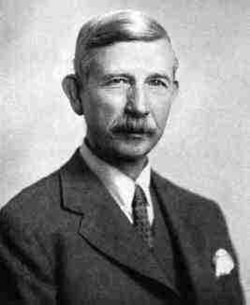
Joseph Wedderburn
Joseph Henry Maclagan Wedderburn FRSE FRS (2 February 1882 – 9 October 1948) was a Scottish mathematician, who taught at Princeton University for most of his career. A significant algebraist, he proved that a finite division algebra is a field (Wedderburn's little theorem), and part of the Artin–Wedderburn theorem on simple algebras. He also worked on group theory and matrix algebra.
His younger brother was the lawyer Ernest Wedderburn.
Joseph Wedderburn was the tenth of fourteen children of Alexander Wedderburn of Pearsie, a physician, and Anne Ogilvie. He was educated at Forfar Academy then in 1895 his parents sent Joseph and his younger brother Ernest to live in Edinburgh with their paternal uncle, J. R. Maclagan Wedderburn, allowing them to attend George Watson's College. This house was at 3 Glencairn Crescent in the West End of the city.
In 1898 Joseph entered the University of Edinburgh. In 1903, he published his first three papers, worked as an assistant in the Physical Laboratory of the University, obtained an MA degree with first class honours in mathematics, and was elected a Fellow of the Royal Society of Edinburgh, upon the proposal of George Chrystal, James Gordon MacGregor, Cargill Gilston Knott and William Peddie. Aged 21 on election he remains one of the youngest Fellows ever.
He then studied briefly at the University of Leipzig and the University of Berlin, where he met the algebraists Frobenius and Schur. A Carnegie Scholarship allowed him to spend the 1904–1905 academic year at the University of Chicago where he worked with Oswald Veblen, E. H. Moore, and most importantly, Leonard Dickson, who was to become the most important American algebraist of his day.
Returning to Scotland in 1905, Wedderburn worked for four years at the University of Edinburgh as an assistant to George Chrystal, who supervised his D.Sc, awarded in 1908 for a thesis titled On Hypercomplex Numbers. He gained a PhD in algebra from the University of Edinburgh in 1908. From 1906 to 1908, Wedderburn edited the Proceedings of the Edinburgh Mathematical Society. In 1909, he returned to the United States to become a Preceptor in Mathematics at Princeton University; his colleagues included Luther P. Eisenhart, Oswald Veblen, Gilbert Ames Bliss, and George Birkhoff.
Upon the outbreak of the First World War, Wedderburn enlisted in the British Army as a private. He was the first person at Princeton to volunteer for that war, and had the longest war service of anyone on the staff. He served with the Seaforth Highlanders in France, as Lieutenant (1914), then as Captain in the 10th (Reserve) Battalion (1915–18). While a Captain in the Fourth Field Survey Battalion of the Royal Engineers in France, he devised sound-ranging equipment to locate enemy artillery.
He returned to Princeton after the war, becoming Associate Professor in 1921 and editing the Annals of Mathematics until 1928. While at Princeton, he supervised only three PhDs, one of them being Nathan Jacobson. In his later years, Wedderburn became an increasingly solitary figure and may even have suffered from depression. His isolation after his 1945 early retirement was such that his death from a heart attack was not noticed for several days. His Nachlass was destroyed, as per his instructions.
Joseph Wedderburn
Joseph Henry Maclagan Wedderburn FRSE FRS (2 February 1882 – 9 October 1948) was a Scottish mathematician, who taught at Princeton University for most of his career. A significant algebraist, he proved that a finite division algebra is a field (Wedderburn's little theorem), and part of the Artin–Wedderburn theorem on simple algebras. He also worked on group theory and matrix algebra.
His younger brother was the lawyer Ernest Wedderburn.
Joseph Wedderburn was the tenth of fourteen children of Alexander Wedderburn of Pearsie, a physician, and Anne Ogilvie. He was educated at Forfar Academy then in 1895 his parents sent Joseph and his younger brother Ernest to live in Edinburgh with their paternal uncle, J. R. Maclagan Wedderburn, allowing them to attend George Watson's College. This house was at 3 Glencairn Crescent in the West End of the city.
In 1898 Joseph entered the University of Edinburgh. In 1903, he published his first three papers, worked as an assistant in the Physical Laboratory of the University, obtained an MA degree with first class honours in mathematics, and was elected a Fellow of the Royal Society of Edinburgh, upon the proposal of George Chrystal, James Gordon MacGregor, Cargill Gilston Knott and William Peddie. Aged 21 on election he remains one of the youngest Fellows ever.
He then studied briefly at the University of Leipzig and the University of Berlin, where he met the algebraists Frobenius and Schur. A Carnegie Scholarship allowed him to spend the 1904–1905 academic year at the University of Chicago where he worked with Oswald Veblen, E. H. Moore, and most importantly, Leonard Dickson, who was to become the most important American algebraist of his day.
Returning to Scotland in 1905, Wedderburn worked for four years at the University of Edinburgh as an assistant to George Chrystal, who supervised his D.Sc, awarded in 1908 for a thesis titled On Hypercomplex Numbers. He gained a PhD in algebra from the University of Edinburgh in 1908. From 1906 to 1908, Wedderburn edited the Proceedings of the Edinburgh Mathematical Society. In 1909, he returned to the United States to become a Preceptor in Mathematics at Princeton University; his colleagues included Luther P. Eisenhart, Oswald Veblen, Gilbert Ames Bliss, and George Birkhoff.
Upon the outbreak of the First World War, Wedderburn enlisted in the British Army as a private. He was the first person at Princeton to volunteer for that war, and had the longest war service of anyone on the staff. He served with the Seaforth Highlanders in France, as Lieutenant (1914), then as Captain in the 10th (Reserve) Battalion (1915–18). While a Captain in the Fourth Field Survey Battalion of the Royal Engineers in France, he devised sound-ranging equipment to locate enemy artillery.
He returned to Princeton after the war, becoming Associate Professor in 1921 and editing the Annals of Mathematics until 1928. While at Princeton, he supervised only three PhDs, one of them being Nathan Jacobson. In his later years, Wedderburn became an increasingly solitary figure and may even have suffered from depression. His isolation after his 1945 early retirement was such that his death from a heart attack was not noticed for several days. His Nachlass was destroyed, as per his instructions.
Recent media
Recent media