Hubbry Logo
Matrix ringMatrix ringMain
Open search
Matrix ring
Community hub
Matrix ring
logo
7 pages, 0 posts
0 subscribers
Be the first to start a discussion here.
Matrix ring
Matrix ring
from Wikipedia

In abstract algebra, a matrix ring is a set of matrices with entries in a ring R that form a ring under matrix addition and matrix multiplication.[1] The set of all n × n matrices with entries in R is a matrix ring denoted Mn(R)[2][3][4][5] (alternative notations: Matn(R)[3] and Rn×n[6]). Some sets of infinite matrices form infinite matrix rings. A subring of a matrix ring is again a matrix ring. Over a rng, one can form matrix rngs.

When R is a commutative ring, the matrix ring Mn(R) is an associative algebra over R, and may be called a matrix algebra. In this setting, if M is a matrix and r is in R, then the matrix rM is the matrix M with each of its entries multiplied by r.

Examples

[edit]
  • The set of all n × n square matrices over R, denoted Mn(R). This is sometimes called the "full ring of n-by-n matrices".
  • The set of all upper triangular matrices over R.
  • The set of all lower triangular matrices over R.
  • The set of all diagonal matrices over R. This subalgebra of Mn(R) is isomorphic to the direct product of n copies of R.
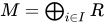
  • For any index set I, the ring of endomorphisms of the right R-module is isomorphic to the ring [citation needed] of column finite matrices whose entries are indexed by I × I and whose columns each contain only finitely many nonzero entries. The ring of endomorphisms of M considered as a left R-module is isomorphic to the ring of row finite matrices.
  • If R is a Banach algebra, then the condition of row or column finiteness in the previous point can be relaxed. With the norm in place, absolutely convergent series can be used instead of finite sums. For example, the matrices whose column sums are absolutely convergent sequences form a ring.[dubiousdiscuss] Analogously of course, the matrices whose row sums are absolutely convergent series also form a ring.[dubiousdiscuss] This idea can be used to represent operators on Hilbert spaces, for example.
  • The intersection of the row-finite and column-finite matrix rings forms a ring .
  • If R is commutative, then Mn(R) has a structure of a *-algebra over R, where the involution * on Mn(R) is matrix transposition.
  • If A is a C*-algebra, then Mn(A) is another C*-algebra. If A is non-unital, then Mn(A) is also non-unital. By the Gelfand–Naimark theorem, there exists a Hilbert space H and an isometric *-isomorphism from A to a norm-closed subalgebra of the algebra B(H) of continuous operators; this identifies Mn(A) with a subalgebra of B(Hn). For simplicity, if we further suppose that H is separable and A B(H) is a unital C*-algebra, we can break up A into a matrix ring over a smaller C*-algebra. One can do so by fixing a projection p and hence its orthogonal projection 1 − p; one can identify A with , where matrix multiplication works as intended because of the orthogonality of the projections. In order to identify A with a matrix ring over a C*-algebra, we require that p and 1 − p have the same "rank"; more precisely, we need that p and 1 − p are Murray–von Neumann equivalent, i.e., there exists a partial isometry u such that p = uu* and 1 − p = u*u. One can easily generalize this to matrices of larger sizes.
  • Complex matrix algebras Mn(C) are, up to isomorphism, the only finite-dimensional simple associative algebras over the field C of complex numbers. Prior to the invention of matrix algebras, Hamilton in 1853 introduced a ring, whose elements he called biquaternions[7] and modern authors would call tensors in CR H, that was later shown to be isomorphic to M2(C). One basis of M2(C) consists of the four matrix units (matrices with one 1 and all other entries 0); another basis is given by the identity matrix and the three Pauli matrices.
  • A matrix ring over a field is a Frobenius algebra, with Frobenius form given by the trace of the product: σ(A, B) = tr(AB).
Structure

[edit]
  • The matrix ring Mn(R) can be identified with the ring of endomorphisms of the free right R-module of rank n; that is, Mn(R) ≅ EndR(Rn). Matrix multiplication corresponds to composition of endomorphisms.
  • The ring Mn(D) over a division ring D is an Artinian simple ring, a special type of semisimple ring. The rings and are not simple and not Artinian if the set I is infinite, but they are still full linear rings.
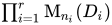
  • The Artin–Wedderburn theorem states that every semisimple ring is isomorphic to a finite direct product , for some nonnegative integer r, positive integers ni, and division rings Di.
  • When we view Mn(C) as the ring of linear endomorphisms of Cn, those matrices which vanish on a given subspace V form a left ideal. Conversely, for a given left ideal I of Mn(C) the intersection of null spaces of all matrices in I gives a subspace of Cn. Under this construction, the left ideals of Mn(C) are in bijection with the subspaces of Cn.
  • There is a bijection between the two-sided ideals of Mn(R) and the two-sided ideals of R. Namely, for each ideal I of R, the set of all n × n matrices with entries in I is an ideal of Mn(R), and each ideal of Mn(R) arises in this way. This implies that Mn(R) is simple if and only if R is simple. For n ≥ 2, not every left ideal or right ideal of Mn(R) arises by the previous construction from a left ideal or a right ideal in R. For example, the set of matrices whose columns with indices 2 through n are all zero forms a left ideal in Mn(R).
  • The previous ideal correspondence actually arises from the fact that the rings R and Mn(R) are Morita equivalent. Roughly speaking, this means that the category of left R-modules and the category of left Mn(R)-modules are very similar. Because of this, there is a natural bijective correspondence between the isomorphism classes of left R-modules and left Mn(R)-modules, and between the isomorphism classes of left ideals of R and left ideals of Mn(R). Identical statements hold for right modules and right ideals. Through Morita equivalence, Mn(R) inherits any Morita-invariant properties of R, such as being simple, Artinian, Noetherian, prime.

Properties

[edit]
  • If S is a subring of R, then Mn(S) is a subring of Mn(R). For example, Mn(Z) is a subring of Mn(Q).
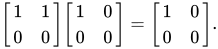
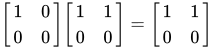
  • The matrix ring Mn(R) is commutative if and only if n = 0, R = 0, or R is commutative and n = 1. In fact, this is true also for the subring of upper triangular matrices. Here is an example showing two upper triangular 2 × 2 matrices that do not commute, assuming 1 ≠ 0 in R:
    and
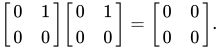
  • For n ≥ 2, the matrix ring Mn(R) over a nonzero ring has zero divisors and nilpotent elements; the same holds for the ring of upper triangular matrices. An example in 2 × 2 matrices would be
  • The center of Mn(R) consists of the scalar multiples of the identity matrix, In, in which the scalar belongs to the center of R.
  • The unit group of Mn(R), consisting of the invertible matrices under multiplication, is denoted GLn(R).
  • If F is a field, then for any two matrices A and B in Mn(F), the equality AB = In implies BA = In. This is not true for every ring R though. A ring R whose matrix rings all have the mentioned property is known as a stably finite ring (Lam 1999, p. 5).
Matrix semiring

[edit]

In fact, R needs to be only a semiring for Mn(R) to be defined. In this case, Mn(R) is a semiring, called the matrix semiring. Similarly, if R is a commutative semiring, then Mn(R) is a matrix semialgebra.

For example, if R is the Boolean semiring (the two-element Boolean algebra R = {0, 1} with 1 + 1 = 1),[8] then Mn(R) is the semiring of binary relations on an n-element set with union as addition, composition of relations as multiplication, the empty relation (zero matrix) as the zero, and the identity relation (identity matrix) as the unity.[9]

See also

[edit]

Citations

[edit]
  1. ^ Lam (1999), Theorem 3.1
  2. ^ Lam (2001).
  3. ^ a b Lang (2005), V.§3
  4. ^ Serre (2006), p. 3
  5. ^ Serre (1979), p. 158
  6. ^ Artin (2018), Example 3.3.6(a)
  7. ^ Lecture VII of Sir William Rowan Hamilton (1853) Lectures on Quaternions, Hodges and Smith
  8. ^ Droste & Kuich (2009), p. 7
  9. ^ Droste & Kuich (2009), p. 8

References

[edit]
Revisions and contributorsEdit on WikipediaRead on Wikipedia
from Grokipedia
In , a matrix ring, denoted Mn(R)M_n(R), is the set of all n×nn \times n square matrices with entries from a given ring RR, forming a ring under the standard operations of and multiplication. This structure generalizes the familiar ring of real or complex matrices to arbitrary rings RR, where nn is a positive , and the operations satisfy the ring axioms: addition forms an , multiplication is associative and distributive over addition. If RR has a multiplicative identity, then Mn(R)M_n(R) also possesses one, namely the identity matrix with 1's on the diagonal and 0's elsewhere, and the units of Mn(R)M_n(R) are precisely the invertible matrices, forming the general linear group GLn(R)GL_n(R). For n2n \geq 2 and nontrivial RR, Mn(R)M_n(R) is typically non-commutative—even when RR is commutative—and contains zero divisors, distinguishing it from simpler ring structures like polynomial rings. Key properties include the transpose operation, which preserves addition and reverses the order of multiplication ((A+B)t=At+Bt(A + B)^t = A^t + B^t and (AB)t=BtAt(AB)^t = B^t A^t), and the fact that, when RR is commutative, a matrix is invertible if and only if its determinant is a unit in RR. Matrix rings play a central role in , serving as fundamental examples for studying non-commutative rings, modules, and equivalences such as between rings. They arise in applications to linear algebra over rings, of algebras, and constructions like group rings or polynomial rings extended to matrices, providing tools to analyze more complex algebraic structures.

Definition and Fundamentals

Definition

In ring theory, a ring RR is an abelian group under addition equipped with a multiplication operation that is associative and distributive over addition. The matrix ring Mn(R)M_n(R), for a positive integer nn and ring RR, consists of all n×nn \times n matrices with entries in RR, forming a ring under componentwise matrix addition and the standard matrix multiplication. This structure inherits associativity and distributivity from RR, with the additive identity being the zero matrix and the multiplicative identity the n×nn \times n identity matrix, provided RR has a unit. If RR lacks a unit, Mn(R)M_n(R) still forms a ring under these operations but without a multiplicative identity. When RR is unital, as an RR-module, Mn(R)M_n(R) is free of rank n2n^2, with basis consisting of the standard matrix units EijE_{ij} (matrices with 1 in the (i,j)(i,j)-entry and zeros elsewhere). Equivalently, when RR is unital, Mn(R)M_n(R) is isomorphic to the endomorphism ring EndR(Rn)\mathrm{End}_R(R^n) of the free right RR-module of rank nn. For n=1n=1, M1(R)M_1(R) is the set of 1×11 \times 1 matrices, which is canonically isomorphic to RR itself as rings.

Basic Operations

The matrix ring Mn(R)M_n(R), where RR is a ring and n1n \geq 1, is endowed with addition and multiplication operations that satisfy the ring axioms, making it a ring in its own right. Matrix addition is defined componentwise: for two matrices A=(aij)A = (a_{ij}) and B=(bij)B = (b_{ij}) in Mn(R)M_n(R), the sum A+BA + B has entries (A+B)ij=aij+bij(A + B)_{ij} = a_{ij} + b_{ij}, where addition occurs in RR. This operation renders (Mn(R),+)(M_n(R), +) an , with the —all entries equal to the of RR—serving as the , and the of AA given by A=(aij)-A = (-a_{ij}). Moreover, as addition is componentwise across n2n^2 entries, the additive group (Mn(R),+)(M_n(R), +) is isomorphic to the of n2n^2 copies of the additive group of RR, denoted Rn2R^{n^2}. Matrix is defined via row-column : for A=(aij)A = (a_{ij}), B=(bij)B = (b_{ij}) in Mn([R](/page/R))M_n([R](/page/R)), the product ABAB has entries (AB)ij=k=1naikbkj,(AB)_{ij} = \sum_{k=1}^n a_{ik} b_{kj}, where the sum and products are taken in [R](/page/R)[R](/page/R). This operation is associative, inheriting the property from the associativity of and in [R](/page/R)[R](/page/R). The multiplicative identity is the InI_n, which has 1 (the multiplicative identity of [R](/page/R)[R](/page/R), if it exists) on the and 0 elsewhere, satisfying AIn=InA=AA I_n = I_n A = A for all AA in Mn([R](/page/R))M_n([R](/page/R)). These operations satisfy distributivity: for any A,B,CA, B, C in Mn(R)M_n(R), A(B+C)=AB+AC,(B+C)A=BA+CA,A(B + C) = AB + AC, \quad (B + C)A = BA + CA, with the sums and products computed as defined above. Additionally, the operations on Mn(R)M_n(R) are compatible with those of RR, in that they are constructed directly from the and in RR, ensuring closure and adherence to the ring whenever RR satisfies its own axioms.

Examples and Constructions

Matrices over Fields

The ring Mn(F)M_n(F), where FF is a field and nn is a positive , consists of all n×nn \times n matrices with entries from FF, equipped with the standard operations of and multiplication. This forms an associative ring with unity, the InI_n, and is non-commutative for n2n \geq 2. When F=RF = \mathbb{R} or F=CF = \mathbb{C}, Mn(F)M_n(F) plays a central role in linear algebra, representing linear transformations on finite-dimensional vector spaces over these fields. A concrete example is M2(R)M_2(\mathbb{R}), the ring of 2×22 \times 2 real matrices. Elements include matrices such as the (0000)\begin{pmatrix} 0 & 0 \\ 0 & 0 \end{pmatrix}, scalar matrices like (a00a)\begin{pmatrix} a & 0 \\ 0 & a \end{pmatrix} for aRa \in \mathbb{R}, and more general forms like (1234)\begin{pmatrix} 1 & 2 \\ 3 & 4 \end{pmatrix}. Rotation matrices, which represent counterclockwise rotations by an angle θ\theta in the plane, are particular elements of M2(R)M_2(\mathbb{R}), given by (cosθsinθsinθcosθ).\begin{pmatrix} \cos \theta & -\sin \theta \\ \sin \theta & \cos \theta \end{pmatrix}. These matrices are orthogonal and preserve the Euclidean norm, illustrating how M2(R)M_2(\mathbb{R}) encodes geometric transformations. In the context of vector spaces, if VV is an nn-dimensional vector space over the field FF, the endomorphism ring EndF(V)\operatorname{End}_F(V), consisting of all FF-linear maps from VV to itself under composition, is isomorphic as a ring to Mn(F)M_n(F). This isomorphism arises by choosing a basis for VV, where each linear map corresponds uniquely to its matrix representation with respect to that basis, and composition corresponds to matrix multiplication. The units of Mn(F)M_n(F)—the invertible elements under matrix multiplication—are precisely the full-rank matrices, which form the general linear group GLn(F)\operatorname{GL}_n(F), the group of all n×nn \times n invertible matrices over FF. This group is fundamental in the study of linear representations and symmetries.

Matrices over Commutative Rings

Matrix rings over the , denoted Mn(Z)M_n(\mathbb{Z}), consist of all n×nn \times n matrices with entries, forming a non-commutative ring under standard and multiplication. The units in this ring are precisely the unimodular matrices, those with ±1\pm 1, which are invertible over Z\mathbb{Z} via matrices. For example, the SLn(Z)\mathrm{SL}_n(\mathbb{Z}) comprises the unimodular matrices with 1, playing a key role in and geometry. When the base ring is a quotient of the integers, such as Z/nZ\mathbb{Z}/n\mathbb{Z}, the resulting matrix ring Mn(Z/nZ)M_n(\mathbb{Z}/n\mathbb{Z}) is finite and supports operations. This structure links to applications in and , where computations modulo nn preserve ring properties but introduce finite constraints. For instance, over Z/pZ\mathbb{Z}/p\mathbb{Z} for prime pp, it reduces to the case over fields, but composite nn yields rings with more complex ideal structures. Commutative rings with zero divisors give rise to zero divisors in their matrix rings; specifically, if RR has nonzero elements a,ba, b such that ab=0ab = 0, then matrices like diag(a,0,,0)\operatorname{diag}(a, 0, \dots, 0) and diag(0,b,,0)\operatorname{diag}(0, b, \dots, 0) multiply to zero while both being nonzero. In Mn(Z/4Z)M_n(\mathbb{Z}/4\mathbb{Z}), where 2 is a zero divisor since 22=0mod42 \cdot 2 = 0 \mod 4, nilpotent matrices exemplify this: the matrix (0200)\begin{pmatrix} 0 & 2 \\ 0 & 0 \end{pmatrix} satisfies A2=0A^2 = 0, rendering it a zero divisor. Over Z\mathbb{Z}, two integer matrices are equivalent if one can be obtained from the other by multiplying on the left and right by unimodular matrices, and every such pair admits a —a with nonnegative entries d1d2drd_1 \mid d_2 \mid \dots \mid d_r where rr is the rank. This form, unique up to associates, facilitates the study of solutions to linear systems and lattice theory.

Algebraic Structure

Isomorphisms and Representations

Matrix rings exhibit several important isomorphisms that reveal their structural properties. A fundamental result is the isomorphism between iterated matrix rings and larger matrix rings over the same base ring. Specifically, for positive integers mm and nn, and any ring RR with identity, the ring Mm(Mn(R))M_m(M_n(R)) of m×mm \times m matrices whose entries are n×nn \times n matrices over RR is isomorphic to the ring Mmn(R)M_{mn}(R) of (mn)×(mn)(mn) \times (mn) matrices over RR. This isomorphism can be explicitly described by reshaping the block matrices: an element of Mm(Mn(R))M_m(M_n(R)) is mapped to a larger matrix where each block entry (Aij)(A_{ij}), with AijMn(R)A_{ij} \in M_n(R), is expanded into the corresponding n×nn \times n block in the mn×mnmn \times mn matrix. This preserves addition and multiplication, as matrix operations on blocks correspond to the overall matrix operations in the larger ring. Another key isomorphism relates matrix rings to endomorphism rings, underpinning Morita equivalence. For any ring RR with identity, the ring Mn(R)M_n(R) is isomorphic to the ring EndR(Rn)\mathrm{End}_R(R^n) of RR-linear endomorphisms of the free right RR-module RnR^n. This isomorphism sends a matrix A=(aij)Mn(R)A = (a_{ij}) \in M_n(R) to the endomorphism that maps the standard basis vector eke_k (the kk-th column of the identity matrix) to j=1najkej\sum_{j=1}^n a_{jk} e_j, extended linearly. As rings, this identification shows that Mn(R)M_n(R) and RR are Morita equivalent, meaning their categories of right modules are equivalent via the bimodule RnR^n. This equivalence preserves module-theoretic properties, such as projectivity and injectivity, and implies that matrix rings share many categorical features with the base ring despite differing as rings. In , matrix rings over fields provide a simple setting for studying modules. Let FF be a field; then the ring Mn(F)M_n(F) is a semisimple Artinian , and its simple left modules are all isomorphic to the natural module FnF^n, consisting of column vectors acted upon by left . This module is irreducible because any nonzero subspace is invariant under all matrices only if it is the full space, due to the of matrix actions spanning all linear transformations. Up to , there is a unique simple left Mn(F)M_n(F)-module, and every left module decomposes as a of copies of FnF^n. This structure reflects the fact that Mn(F)M_n(F) is isomorphic to the full matrix over the division ring FF, highlighting its role as the basic building block in semisimple . The Artin–Wedderburn theorem extends these ideas to central simple algebras over fields, providing a classification via matrix rings over division algebras. For a field kk, a central simple kk-algebra AA (finite-dimensional, simple, with center kk) is isomorphic to Mr(D)M_r(D), where DD is a central division kk-algebra and r1r \geq 1 is an integer. This decomposition follows from the Artin-Wedderburn theorem applied to the semisimple case, combined with the centrality condition ensuring the center of DD is exactly kk. The integer rr is uniquely determined as the square root of the dimension of the unique simple module over AA, and two such algebras are Brauer equivalent if they yield the same DD up to isomorphism. This theorem underpins the Brauer group of kk, which classifies central simple algebras up to in the matrix direction.

Center and Commutator Subring

The center of the matrix ring Mn(R)M_n(R), denoted Z(Mn(R))Z(M_n(R)), is the set of all elements that commute with every matrix in Mn(R)M_n(R). This center consists precisely of the scalar matrices of the form λIn\lambda I_n, where λ\lambda belongs to the center Z(R)Z(R) of the base ring RR. Thus, Z(Mn(R))={λInλZ(R)}Z(M_n(R)) = \{ \lambda I_n \mid \lambda \in Z(R) \}. When RR is commutative, its center Z(R)Z(R) coincides with RR itself, so Z(Mn(R))Z(M_n(R)) is isomorphic to RR via the embedding that sends each λR\lambda \in R to the scalar matrix λIn\lambda I_n. This isomorphism preserves the ring structure, as scalar matrices multiply componentwise according to elements of RR. A concrete example arises when R=FR = F is a field. In this case, Z(Mn(F))=FInZ(M_n(F)) = F \cdot I_n, the set of scalar multiples of the identity matrix by elements of FF. This reflects the simplicity of the center over fields, where only multiples of the identity commute universally with all matrices. The commutator subring of Mn(R)M_n(R), denoted [Mn(R),Mn(R)][M_n(R), M_n(R)], is the smallest subring containing all commutators of the form [A,B]=ABBA[A, B] = AB - BA for A,BMn(R)A, B \in M_n(R). These commutators capture the non-commutativity inherent in matrix multiplication for n2n \geq 2, as [A,B]=0[A, B] = 0 for all A,BA, B would imply Mn(R)M_n(R) is commutative, which occurs only if n=1n=1 and RR is commutative. The structure of this subring reveals how deviations from commutativity generate significant portions of Mn(R)M_n(R); for instance, over a field FF, the additive group generated by commutators consists of all trace-zero matrices.

Key Properties

Non-commutativity and Units

Unlike in commutative rings, in the ring Mn(R)M_n(R) for n>1n > 1 is non-commutative, meaning that for general matrices A,BMn(R)A, B \in M_n(R), ABBAAB \neq BA. This property holds even when RR is commutative, as the operation involves row-column interactions that do not preserve order. A prominent example arises in M2(C)M_2(\mathbb{C}) with the , defined as σx=(0110),σy=(0ii0),σz=(1001),\sigma_x = \begin{pmatrix} 0 & 1 \\ 1 & 0 \end{pmatrix}, \quad \sigma_y = \begin{pmatrix} 0 & -i \\ i & 0 \end{pmatrix}, \quad \sigma_z = \begin{pmatrix} 1 & 0 \\ 0 & -1 \end{pmatrix}, where σxσy=iσz\sigma_x \sigma_y = i \sigma_z but σyσx=iσz\sigma_y \sigma_x = -i \sigma_z, illustrating the failure of commutativity. The units in the matrix ring Mn(R)M_n(R), where RR is a ring with identity, form the general linear group GLn(R)GL_n(R), consisting of all invertible matrices AMn(R)A \in M_n(R) such that there exists BMn(R)B \in M_n(R) with AB=BA=InAB = BA = I_n, the n×nn \times n identity matrix. These units preserve the ring structure under multiplication and constitute a group under this operation. When RR is a field FF, GLn(F)GL_n(F) comprises precisely the matrices with non-zero determinant, as a square matrix over a field is invertible if and only if det(A)0\det(A) \neq 0. Associated with GLn(R)GL_n(R), the special linear group SLn(R)SL_n(R) is the kernel of the determinant homomorphism det:GLn(R)R×\det: GL_n(R) \to R^\times, where R×R^\times denotes the multiplicative group of units in RR, provided the determinant is defined (e.g., when RR is commutative). Thus, SLn(R)={AGLn(R)det(A)=1}SL_n(R) = \{ A \in GL_n(R) \mid \det(A) = 1 \}, forming a normal subgroup of index R×|R^\times| when finite. This structure highlights the interplay between the multiplicative group of the base ring and the matrix units.

Ideals and Modules

In matrix rings Mn(R)M_n(R) over a ring RR, the two-sided ideals are in one-to-one correspondence with the two-sided ideals of RR. Specifically, for each two-sided ideal II of RR, the set of all n×nn \times n matrices with entries in II, denoted Mn(I)M_n(I), forms a two-sided ideal of Mn(R)M_n(R), and every two-sided ideal of Mn(R)M_n(R) arises in this manner. Consequently, Mn(R)M_n(R) is a simple ring if and only if RR is simple. The Wedderburn-Artin characterizes semisimple s, stating that any semisimple left is isomorphic to a finite of matrix rings Mni(Di)M_{n_i}(D_i) over division rings DiD_i, where the nin_i and DiD_i (up to ) are uniquely determined. In particular, a simple left is isomorphic to Mn(D)M_n(D) for some division ring DD and positive integer nn. This highlights how matrix rings over division rings capture the building blocks of semisimple s. The category of left Mn(R)M_n(R)-modules is equivalent to the category of left RR-modules, via Morita equivalence between Mn(R)M_n(R) and RR. This equivalence is induced by the bimodule RnR^n, where RnR^n serves as a progenerator over RR and the endomorphism ring of RnR^n as a right RR-module is isomorphic to Mn(R)M_n(R), establishing a functorial correspondence between modules. Thus, every left Mn(R)M_n(R)-module corresponds to a left RR-module, and vice versa, preserving properties such as projectivity and injectivity. When RR is left Artinian, so is Mn(R)M_n(R), and it possesses minimal left ideals. These minimal left ideals are principal, generated by idempotents, and Mn(R)M_n(R) admits a as a module over itself, with simple factors isomorphic to minimal left modules over the division rings appearing in its Wedderburn-Artin decomposition. This ensures that descending chains of left ideals stabilize, reflecting the Artinian nature.

Generalizations and Extensions

Matrix Semirings

A matrix semiring, denoted Mn(S)M_n(S), consists of all n×nn \times n matrices with entries from a SS, equipped with componentwise addition and the standard adapted to the operations of SS. The additive identity is the with all entries equal to the 0S0_S of SS, while the multiplicative identity is the with diagonal entries 1S1_S (the multiplicative identity of SS) and off-diagonal entries 0S0_S. The operations are defined as follows: for matrices A=(aij)A = (a_{ij}) and B=(bij)B = (b_{ij}) in Mn(S)M_n(S), the sum AB=(aijSbij)A \oplus B = (a_{ij} \oplus_S b_{ij}), where S\oplus_S is the in SS, performed componentwise. The product AB=C=(cij)A \otimes B = C = (c_{ij}), where cij=k=1n(aikSbkj)c_{ij} = \bigoplus_{k=1}^n (a_{ik} \otimes_S b_{kj}), with S\otimes_S and S\oplus_S denoting and in SS, respectively. The 0S0_S of SS acts as an absorbing element in multiplication, satisfying 0SSx=xS0S=0S0_S \otimes_S x = x \otimes_S 0_S = 0_S for all xSx \in S, which extends to the absorbing under . A prominent example is the matrix semiring over the tropical (max-plus) semiring R{}\mathbb{R} \cup \{-\infty\}, where addition is max\max (with identity -\infty) and multiplication is (with identity 0). Non-negative tropical matrices thus have entries in R0{}\mathbb{R}_{\geq 0} \cup \{-\infty\}, and their powers compute quantities like longest paths in . In applications, matrix semirings arise in through path algebras, where the of a weighted over a encodes path weights via matrix powers; for instance, in the max-plus semiring Mn(R{})M_n(\mathbb{R} \cup \{-\infty\}), powers yield maximum-weight paths, useful in optimization problems like scheduling. Unlike matrix rings over rings, matrix semirings lack additive inverses, preventing and often resulting in idempotent addition (e.g., max(a,a)=a\max(a, a) = a) that supports non-negative computations without cancellation.

Matrices over Non-associative Structures

Matrices over non-associative structures extend the concept of matrix rings beyond associative algebras, where the underlying multiplication lacks the , leading to novel algebraic behaviors and applications in areas like and exceptional groups. In such settings, may not satisfy (AB)C = A(BC), complicating standard ring properties like the existence of units or ideals. These generalizations arise naturally in non-associative algebras, such as Lie algebras, Jordan algebras, and division algebras like , where matrices serve as representations or models for derivations and symmetric forms. For algebras, matrices appear prominently in the , which maps elements of the g\mathfrak{g} to endomorphisms of g\mathfrak{g} via derivations. Specifically, for AgA \in \mathfrak{g}, the map ad(A):gg\mathrm{ad}(A): \mathfrak{g} \to \mathfrak{g} is defined by ad(A)(B)=[A,B]\mathrm{ad}(A)(B) = [A, B], where [,][ \cdot, \cdot ] is the , representing AA as a matrix in a chosen basis of g\mathfrak{g}. This embeds the into the space of matrices over the base field, typically R\mathbb{R} or C\mathbb{C}, with the non-associative nature reflected in the bracket's bilinearity and antisymmetry rather than full . The is crucial for studying the structure of g\mathfrak{g}, as its image consists of derivations preserving the Lie structure. In , matrices over associative structures are equipped with a symmetrized product to capture non-associative aspects, particularly for modeling quadratic forms and observables. The prototypical example is the algebra of n×nn \times n Hermitian matrices over R,C\mathbb{R}, \mathbb{C}, quaternions, or (for n=3n=3) , denoted Hn(K)H_n(\mathbb{K}), where the Jordan product is defined as AB=12(AB+BA)A \circ B = \frac{1}{2}(AB + BA), with ABAB the standard matrix product over the base algebra K\mathbb{K}. This product is commutative and satisfies the Jordan identity (A2B)A=A2(BA)(A^2 \circ B) \circ A = A^2 \circ (B \circ A), forming a special Jordan algebra isomorphic to the full matrix algebra under symmetrization. For the exceptional case H3(O)H_3(\mathbb{O}), the 27-dimensional Albert algebra emerges, which is not derivable from an and plays a role in exceptional Lie groups like F4F_4. Matrices over , denoted Mn(O)M_n(\mathbb{O}), directly inherit the non-associativity of the algebra O\mathbb{O}, an 8-dimensional alternative over R\mathbb{R}. Here, entries are , and follows the usual but fails associativity due to the base algebra's associator [eα,eβ,eγ]=(eαeβ)eγeα(eβeγ)0[e_\alpha, e_\beta, e_\gamma] = (e_\alpha e_\beta) e_\gamma - e_\alpha (e_\beta e_\gamma) \neq 0 for basis elements. Hermitian 3×33 \times 3 matrices form the exceptional , while higher-dimensional cases like n4n \geq 4 yield algebras that are neither associative nor fully , with dimensions such as 4n23n4n^2 - 3n for Hermitian forms. These structures underpin exceptional algebras, such as E8E_8 via 3×33 \times 3 anti-Hermitian traceless matrices over . The primary challenge in these non-associative matrix settings is the of associativity failure to higher-order products and operations, which disrupts standard theorems like the or invertibility criteria. For instance, in octonion matrices, the lack of associativity prevents straightforward definitions of adjoints or traces in quantum contexts, limiting interpretations and requiring alternative properties like alternativity to bound subspace growth. In and cases, while derivations or identities mitigate some issues, computing powers or exponentials becomes ambiguous without specified parenthesization, complicating applications in physics and .

References

Add your contribution
Related Hubs
User Avatar
No comments yet.