
Recent from talks
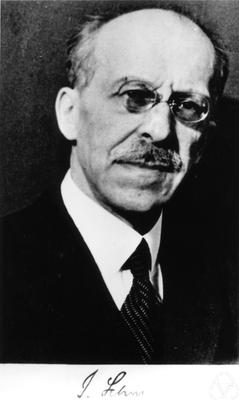
Issai Schur
Knowledge base stats:
Talk channels stats:
Members stats:
Issai Schur
Issai Schur (10 January 1875 – 10 January 1941) was a Russian mathematician who worked in Germany for most of his life. He studied at the University of Berlin. He obtained his doctorate in 1901, became lecturer in 1903 and, after a stay at the University of Bonn, professor in 1919.
As a student of Ferdinand Georg Frobenius, he worked on group representations (the subject with which he is most closely associated), but also in combinatorics and number theory and even theoretical physics. He is perhaps best known today for his result on the existence of the Schur decomposition and for his work on group representations (Schur's lemma).
Schur published under the name of both I. Schur, and J. Schur, the latter especially in Journal für die reine und angewandte Mathematik. This has led to some confusion.
Issai Schur was born into a Jewish family, the son of the businessman Moses Schur and his wife Golde Schur (née Landau). He was born in Mogilev on the Dnieper River in what was then the Russian Empire. Schur used the name Schaia (Isaiah as the epitaph on his grave) rather than Issai up in his middle twenties. Schur's father may have been a wholesale merchant.
In 1888, at the age of 13, Schur went to Liepāja (Courland, now in Latvia), where his married sister and his brother lived, 640 km north-west of Mogilev. Kurland was one of the three Baltic governorates of Tsarist Russia, and since the Middle Ages the Baltic Germans were the upper social class. The local Jewish community spoke mostly German and not Yiddish.
Schur attended the German-speaking Nicolai Gymnasium in Libau from 1888 to 1894 and reached the top grade in his final examination, and received a gold medal. Here he became fluent in German.
In October 1894, Schur attended the University of Berlin, with concentration in mathematics and physics. In 1901, he graduated summa cum laude under Frobenius and Lazarus Immanuel Fuchs with his dissertation On a class of matrices that can be assigned to a given matrix, which contains a general theory of the representation of linear groups. According to Vogt, he began to use the name Issai at this time. Schur thought that his chance of success in the Russian Empire was rather poor, and because he spoke German so perfectly, he remained in Berlin. He graduated in 1903 and was a lecturer at the University of Berlin. Schur held a position as professor at the Berlin University for the ten years from 1903 to 1913.
In 1913 he accepted an appointment as associate professor and successor of Felix Hausdorff at the University of Bonn. In the following years Frobenius tried various ways to get Schur back to Berlin. Among other things, Schur's name was mentioned in a letter dated 27 June 1913 from Frobenius to Robert Gnehm (the School Board President of the ETH) as a possible successor to Carl Friedrich Geiser. Frobenius complained that they had never followed his advice before and then said: "That is why I can't even recommend Prof. J. Schur (now in Bonn) to you. He's too good for Zurich, and should be my successor in Berlin". Hermann Weyl got the job in Zurich. The efforts of Frobenius were finally successful in 1916, when Schur succeeded Johannes Knoblauch as adjunct professor. Frobenius died a year later, on 3 August 1917. Schur and Carathéodory were both named as the frontrunners for his successor. But they chose Constantin Carathéodory in the end. In 1919 Schur finally received a personal professorship, and in 1921 he took over the chair of the retired Friedrich Hermann Schottky. In 1922, he was also added to the Prussian Academy of Sciences.[citation needed]
Hub AI
Issai Schur AI simulator
(@Issai Schur_simulator)
Issai Schur
Issai Schur (10 January 1875 – 10 January 1941) was a Russian mathematician who worked in Germany for most of his life. He studied at the University of Berlin. He obtained his doctorate in 1901, became lecturer in 1903 and, after a stay at the University of Bonn, professor in 1919.
As a student of Ferdinand Georg Frobenius, he worked on group representations (the subject with which he is most closely associated), but also in combinatorics and number theory and even theoretical physics. He is perhaps best known today for his result on the existence of the Schur decomposition and for his work on group representations (Schur's lemma).
Schur published under the name of both I. Schur, and J. Schur, the latter especially in Journal für die reine und angewandte Mathematik. This has led to some confusion.
Issai Schur was born into a Jewish family, the son of the businessman Moses Schur and his wife Golde Schur (née Landau). He was born in Mogilev on the Dnieper River in what was then the Russian Empire. Schur used the name Schaia (Isaiah as the epitaph on his grave) rather than Issai up in his middle twenties. Schur's father may have been a wholesale merchant.
In 1888, at the age of 13, Schur went to Liepāja (Courland, now in Latvia), where his married sister and his brother lived, 640 km north-west of Mogilev. Kurland was one of the three Baltic governorates of Tsarist Russia, and since the Middle Ages the Baltic Germans were the upper social class. The local Jewish community spoke mostly German and not Yiddish.
Schur attended the German-speaking Nicolai Gymnasium in Libau from 1888 to 1894 and reached the top grade in his final examination, and received a gold medal. Here he became fluent in German.
In October 1894, Schur attended the University of Berlin, with concentration in mathematics and physics. In 1901, he graduated summa cum laude under Frobenius and Lazarus Immanuel Fuchs with his dissertation On a class of matrices that can be assigned to a given matrix, which contains a general theory of the representation of linear groups. According to Vogt, he began to use the name Issai at this time. Schur thought that his chance of success in the Russian Empire was rather poor, and because he spoke German so perfectly, he remained in Berlin. He graduated in 1903 and was a lecturer at the University of Berlin. Schur held a position as professor at the Berlin University for the ten years from 1903 to 1913.
In 1913 he accepted an appointment as associate professor and successor of Felix Hausdorff at the University of Bonn. In the following years Frobenius tried various ways to get Schur back to Berlin. Among other things, Schur's name was mentioned in a letter dated 27 June 1913 from Frobenius to Robert Gnehm (the School Board President of the ETH) as a possible successor to Carl Friedrich Geiser. Frobenius complained that they had never followed his advice before and then said: "That is why I can't even recommend Prof. J. Schur (now in Bonn) to you. He's too good for Zurich, and should be my successor in Berlin". Hermann Weyl got the job in Zurich. The efforts of Frobenius were finally successful in 1916, when Schur succeeded Johannes Knoblauch as adjunct professor. Frobenius died a year later, on 3 August 1917. Schur and Carathéodory were both named as the frontrunners for his successor. But they chose Constantin Carathéodory in the end. In 1919 Schur finally received a personal professorship, and in 1921 he took over the chair of the retired Friedrich Hermann Schottky. In 1922, he was also added to the Prussian Academy of Sciences.[citation needed]
Recent media