Hubbry Logo
Joy buzzerJoy buzzerMain
Open search
Joy buzzer
Community hub
Joy buzzer
logo
8 pages, 0 posts
0 subscribers
Be the first to start a discussion here.
Joy buzzer
Joy buzzer
from Wikipedia
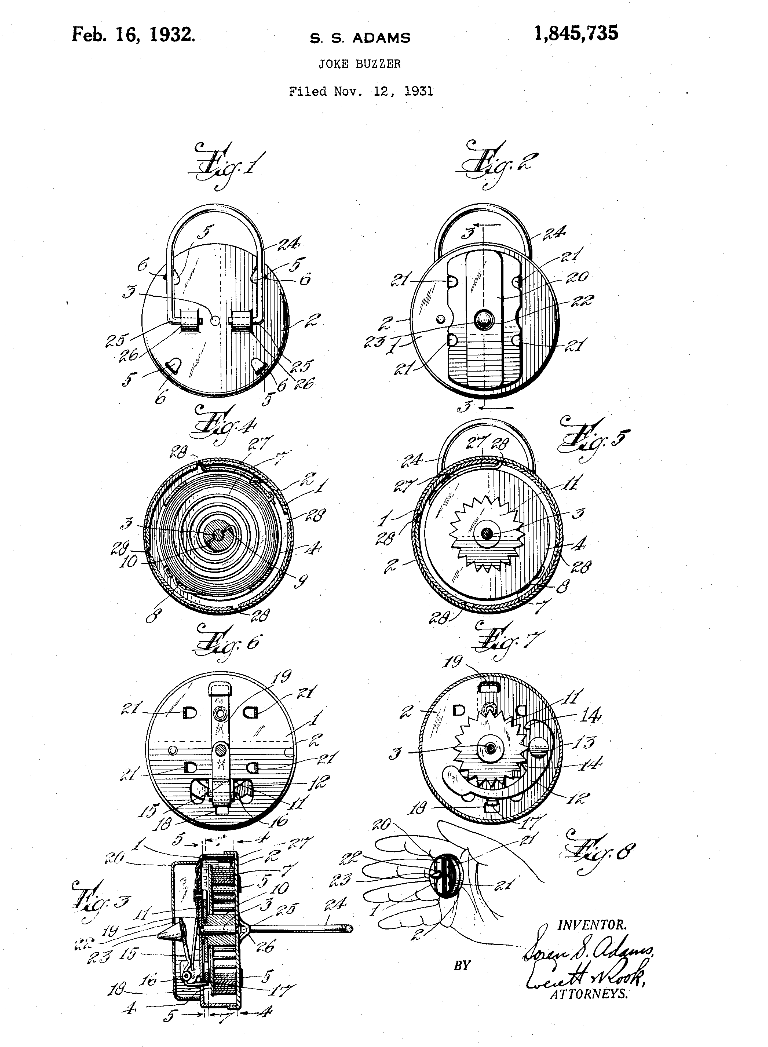
Patent drawing, from Soren Adams's 1932 US patent application.

A joy buzzer (also called a hand buzzer) is a practical joke device that consists of a coiled mainspring inside a disc worn in the palm of the hand. When the wearer shakes hands with another person, a button on the disc releases the spring, which rapidly unwinds creating a vibration that mimics an electric shock to the unsuspecting victim.[1]

History

[edit]

The joy buzzer was invented in 1928 or 1931 by Soren Sorensen "Sam" Adams of the S.S. Adams Co.[1][2] It was modeled after The Zapper, a product that was similar to the joy buzzer, but did not have a very effective buzz and contained a button with a blunt point that would hurt the recipient's hand.[citation needed]

Adams brought a large prototype of his newly designed buzzer to Dresden, Germany, where a machinist created the tools that would make the parts for a new palm-sized Joy Buzzer. In 1932, the item received U.S. patent 1,845,735 from the U.S. Patent Office. The instant success of the new item allowed Adams to move to a new building and increase the size of his company. Adams continued to send royalty payments to the tool and die maker until 1934 when the payments were returned.[citation needed]

In 1987, Sam Adamses' son, Joseph "Bud" Adams, redesigned the mechanism for greater durability and a louder buzz, marketing it as the Super Joy Buzzer.[citation needed]

Electric shock

[edit]

A common misconception, largely due to false advertising by the makers of the device, is that the joy buzzer delivers an electric shock, when in fact it only causes a vibration simulating a shock.

[edit]

Some device variations were later created to actually shock the person being pranked rather than simulate the shock with vibrations. These devices include the shocking pen, which generates a mild electric shock when a victim clicks the button on top, or shocking gum, which also delivers a mild electric shock when a victim touches or pulls upon what appears to be the last stick of gum from a box.

See also

[edit]

References

[edit]
Revisions and contributorsEdit on WikipediaRead on Wikipedia
from Grokipedia
A joy buzzer, also known as a hand buzzer, is a classic designed for use during handshakes, consisting of a small, concealable metal disc worn in the palm that produces a buzzing and mild tingling sensation upon activation. The mechanism involves a coiled spiral spring housed within a casing formed by two rotatable sections; when wound by twisting the sections relative to each other, the spring powers a toothed and oscillating that creates the buzzing effect as it unwinds rapidly under pressure from a releasing . Invented in 1928 by Danish-American novelty manufacturer Soren Sorensen "Sam" Adams, the device was an immediate success, with over three million units sold during the through his S.S. Adams Company, which specialized in harmless pranks like sneezing powder and dribble glasses. Adams refined an earlier prototype called the "Zapper" into the joy buzzer, securing U.S. No. 1,845,735 for the "joke buzzer" in 1932, which detailed its concealable design featuring a looped for secure placement in the hand. Despite its mechanical nature—relying solely on spring tension without electricity or batteries—the joy buzzer has become a of lighthearted , often depicted in cartoons and films as a tool for comedic handshakes, though sometimes exaggerated as delivering an electric shock.

Description

Physical Design

The joy buzzer is a compact, flat disc-shaped device, typically measuring 1.5 to 3 inches in and less than 1 inch thick, engineered to fit unobtrusively within the palm of the hand. This size allows for easy concealment, enabling its use in social interactions like handshakes without drawing attention. The outer casing consists of two telescoping cup-shaped sections joined by a central or stud, forming a durable that houses the internal mechanisms. Early versions were primarily constructed from metal for robustness, while modern iterations often employ lightweight plastic, such as ABS, to improve comfort and reduce weight during prolonged wear. Central to the design is the internal coiled , a spiral component that stores for , paired with a releasing or embedded in the center of the casing for user control. An optional looped wire strap or finger ring attachment secures the device to the hand, preventing slippage during use. These elements combine to create a discreet, palm-concealed tool that simulates a vibrating sensation upon engagement.

Operation

To use the joy buzzer in a , the operator first inserts their through the small loop attached to the device, positioning the flat disc snugly against the palm of the hand for secure placement. This setup allows the device to remain concealed within a closed or relaxed hand, with only the small protruding button or releasing member subtly exposed on the outer side of the palm. During a social interaction, such as a , the operator extends their hand to initiate a , ensuring the recipient's grip applies directly to the exposed button. This pressure activates the device, delivering an unexpected vibration that startles the recipient and elicits a surprised reaction. Effective concealment relies on natural hand positioning and casual timing to avoid detection, maximizing the element of surprise in everyday encounters like meeting friends or colleagues.

History

Invention and Patent

The joy buzzer was invented by Soren Sorensen "Sam" Adams, a Danish immigrant who founded the S.S. Adams Company in 1906 as a novelty goods manufacturer. Adams, born in 1879, developed the initial prototype of the device in 1928 while seeking to create more effective prank items following his earlier successes with products like exploding cigars and sneezing powder. The invention was modeled after an earlier vibration-based novelty called The Zapper, which produced a weaker buzz through a button-activated mechanism but lacked the concealed, handshake-friendly design Adams envisioned. To refine the prototype, Adams traveled to , , in the late , where he collaborated with a local to test the design and produce the precision tooling needed for its small, intricate components. This European development phase addressed challenges in miniaturizing the device for concealability in the palm of the hand, ensuring it could deliver a startling buzz without visible movement. Initial testing in confirmed the viability of the mechanism before production shifted back to the , allowing Adams to scale at his facilities. On February 16, 1932, Adams secured U.S. No. 1,845,735 for his "Joke ," filed on November 12, 1931, which provided legal protection for the core invention. The patent specifically described a coiled spring system housed in a two-part rotatable casing, where winding the spring via the casing's sections stores energy, and a pressure-sensitive release allows the spring to unwind, driving a toothed wheel that oscillates a buzzer arm to create the characteristic vibration and sound. This patent marked a key milestone, enabling the S.S. Adams Company to exclusively produce and market the joy buzzer amid growing demand during the early era. The device's commercial triumph later fueled significant expansion for the company.

Production and Evolution

The S.S. Adams Company, founded by Soren Sorensen "Sam" Adams in 1906, served as the primary manufacturer of the Joy Buzzer, leveraging the device's popularity to expand its portfolio of novelty items and establish itself as a leading producer of pranks and magic tricks in the 20th century. Originally invented by Sam Adams in 1928, the Joy Buzzer propelled the company's growth, contributing to the development of over 650 joke shop products, including sneezing powder, dribble glasses, and exploding cigars. This expansion was facilitated by relocating production facilities from Asbury Park to Neptune, New Jersey, in 1932, where the company employed over 80 workers at its peak. Production of the Joy Buzzer began in earnest in the early following its patent, with the company mass-marketing it as a harmless prank device during the . Despite economic challenges, S.S. Adams sold over 3 million units between 1930 and 1941, distributing them through catalogs, novelty stores, and hobby shops to a wide audience, including celebrities like and . The device's simple mechanical design allowed for efficient manufacturing in the company's factory, solidifying its role as a staple in the prank industry and supporting broader business diversification into magic tricks and gag gifts. In the , Joseph "Bud" Adams, son of the founder, led a significant redesign of the Joy Buzzer, enhancing its mechanism for greater durability and a louder buzz, and rebranding it as the Super Joy Buzzer to compete with cheaper foreign imports. This update helped sustain the product's market presence amid changing manufacturing landscapes. The S.S. Adams Company continued producing the Joy Buzzer into the until its acquisition by Magic Makers, Inc., in , after which the new owner reintroduced classic items like the Super Joy Buzzer with updated packaging while maintaining the core design. Today, the device remains available through magic retailers and online outlets, with minor production adjustments to ensure ongoing safety and quality standards, keeping it a enduring novelty in the prank market.

Mechanism and Effects

Mechanical Function

The joy buzzer operates through a purely mechanical system centered on a spiral that stores when wound. This metal spring, housed within a disc-shaped casing composed of two rotatable cup-shaped sections, has one end fixed to a spring carrier on one section and the other end attached to the spindle of a toothed journaled on a central shaft. When the device is prepared for use, the relative rotation of the casing sections winds the spring, tensioning it and building stored elastic that is ready for release. Activation occurs when pressure is applied to a releasing member—a lever pivoted on the casing's exterior—that disengages a catch mechanism, specifically freeing a buzzer lever previously held in engagement with the toothed . This allows the spring to unwind rapidly, converting the stored into that drives the toothed to rotate at high speed. The rotating wheel's teeth interact with the now-oscillating buzzer lever, which is pivotally mounted on the casing and features engaging prongs, causing the lever to vibrate rhythmically against the wheel. This oscillation generates rotational vibrations that are transmitted directly through the metal casing to the user's hand, mimicking a buzzing sensation without any electrical components. After , the spring must be rewound manually by rotating the casing sections relative to each other, often aided by a looped wire on one section for grip. A mechanism, consisting of a spring-loaded pawl engaging notches on the casing, prevents unintended unwinding during storage or winding. While the emphasizes through simple , the spring and engaging components experience over repeated cycles, limiting long-term reliability without . This mechanical vibration produces the characteristic buzz felt during use.

Sensory Experience

The primary sensory effect of the joy buzzer is an intense, rapid transmitted through the hand during a , perceived as a buzzing or rattling sensation that mimics the tingle of an electric shock without delivering any actual current. This vibration typically lasts for a brief period as the internal mechanism activates, providing a sudden and startling tactile feedback concentrated in the palm and fingers. Victims commonly experience a to the unexpected buzz, accompanied by mild discomfort or surprise that elicits or exclamations, though the device is designed to cause no lasting harm. The prankster, wearing the device, receives subtle vibrational feedback through their own hand, allowing them to gauge the activation without overpowering their own sensation. As a purely mechanical novelty, the joy buzzer poses low risk of due to its non-electric nature. A common misconception portrays it as delivering a genuine electric shock, but the sensation arises solely from mechanical .

Variations

Mechanical Variants

Mechanical variants of the joy buzzer maintain the core spring-driven mechanism while introducing enhancements for durability, intensity, and practicality. In the mid-1980s, Joseph "Bud" Adams, son of the original inventor Soren Sorensen Adams, redesigned the device with a stronger coiled to produce greater and a louder buzzing sound, marketing it as the Super Joy Buzzer for improved performance during use. This iteration addressed wear issues in earlier models by reinforcing the internal components without altering the non-electric operation. Size variations allow for different concealment and effect levels, with standard models typically measuring about 1.5 inches in to fit comfortably in the palm. Smaller versions, around 1 inch, cater to users seeking subtler placement on smaller fingers or for children, while slightly larger designs amplify the vibrational impact for more dramatic pranks. Material adaptations have evolved from the original metal casings, often made of tin for a premium feel and longevity, to modern constructions using durable ABS for cost-effectiveness and lighter weight. These variants preserve the mechanical function but offer reduced manufacturing costs and easier .

Electric Prank Devices

Electric prank devices differ from the mechanical joy buzzer by incorporating actual low-voltage electrical components to deliver a mild shock, rather than relying on for the surprise effect. These items typically use small batteries combined with high-voltage circuits, such as transformers, to generate a high-voltage but low-current that produces a tingling or startling sensation upon contact. A common example is the shocking pen, which appears as an ordinary writing instrument but administers an electric jolt when the button is pressed. The device stores energy in a capacitor charged by the battery, discharging it through the user's skin to create the shock; voltages typically range from 500 to 800 volts, though the current remains very low to ensure harmlessness under normal use. Another related item is shocking gum, where pulling what seems to be a stick of gum from the pack activates a similar circuit, delivering the shock via contacts in the lid or pull mechanism. These differ fundamentally from the joy buzzer's spring-based operation, as the electric versions emphasize a sharp, sensory "zap" over prolonged buzzing. Variants of the hand buzzer itself that incorporate electricity are rare and often confused with the original mechanical design, leading to a common misconception that all hand buzzers deliver true shocks. In these battery-powered models, electrodes in the palm disc connect during a to release the charge, mimicking the joy buzzer's form but using electrical discharge for the effect. Such devices have appeared in novelty markets, particularly as imported gadgets, but remain less prevalent than non-electric pranks due to production complexities and safety regulations. Safety profiles of these electric pranks highlight greater potential discomfort compared to the joy buzzer's , as the shocks can cause involuntary muscle contractions or brief , though they are designed to avoid serious . Currents below 1 milliamp typically produce only a tingle, while 5 to 10 milliamps may feel painful but are brief enough to prevent harm in healthy individuals; however, risks increase for those with cardiac implants or sensitive skin, prompting bans in some regions. This contrasts with the joy buzzer's purely mechanical, non-invasive surprise, fueling myths that the traditional device involves .

Cultural Significance

Use in Pranks

The joy buzzer is commonly employed in practical jokes involving handshakes during social gatherings such as parties, casual meetings, or even sales interactions, where the wearer activates the device to deliver an unexpected vibrating sensation to the unsuspecting recipient's palm. This surprise element creates immediate humor through the victim's startled reaction, making it a staple for light-hearted mischief among acquaintances. Historically, the joy buzzer gained prominence in 20th-century American novelty culture as a popular gag gift, frequently advertised and sold through mail-order catalogs like those from the starting in the . These catalogs, which expanded to hundreds of pages by the late , marketed the device alongside other items such as sneezing powder and dribble glasses, positioning it as an accessible tool for fooling friends at a low cost, often around 10 to 25 cents. By the mid-20th century, it appeared in advertisements, further embedding it in youth-oriented prank traditions. In , the joy buzzer leverages the element of surprise to induce light-hearted , fostering in group settings among friends or during performance routines, where the prankster's concealed device levels the interaction through shared . This dynamic often appeals particularly to boys and young men, with interest typically diminishing around as social priorities shift. The brief, vibrating buzz experienced by the victim enhances the comedic timing without causing . Regarding and norms, the joy buzzer is generally regarded as a harmless form of within informal contexts, though its acceptability depends on the relationship between prankster and target to prevent unintended offense or discomfort. While it carries a subtle sadistic undertone in disrupting expectations, its widespread use in catalogs and media underscores a cultural tolerance for such benign in playful environments.

Media and Pop Culture References

The joy buzzer has been a recurring motif in comic books, particularly as a weaponized prank device in the hands of villains. In the 1952 DC Comics story "The Joker's Utility Belt" from Batman #73, written by David Vern Reed with art by and Charles Paris, the Joker introduces his joy buzzer as part of his utility belt, using it to distract a policeman and escape. This depiction established the device as a signature element of the Joker's arsenal, blending humor with deadly intent in later stories, where it evolves into a high-voltage tool—starting at 200 volts in The Joker #2 (1975) and up to 50,000 volts for stunning or assassinating foes. In television and film, the joy buzzer appears both as a harmless gag and a sinister tool. In the Arrowverse's Batwoman (Season 3, 2021–2022), the device is central to the backstory of villain Marquis Jet, who as a child was shocked in the head by the Joker's joy buzzer during a school bus hijacking, causing brain damage that alters his personality; the buzzer, crafted by Kiki Roulette, is later reactivated as a weapon. Conversely, in the animated series Super Friends (Earth-1956 segment, 1973), the joy buzzer is portrayed as a benign prank toy carried by Uncle Dudley in his briefcase of magic tricks alongside items like a rubber chicken, used to mimic an electric shock for comedic effect during handshakes. The 1988 film Who Framed Roger Rabbit features novelty salesman Marvin Acme wielding a stylized hand buzzer as his "biggest seller," emphasizing its role in classic Toontown humor. Cartoons frequently exaggerate the joy buzzer for villainous gags, often mythologizing it as an electric shocker rather than its real-world mechanism of vibration from an unwinding coiled spring. In the 1936 short , Mortimer Mouse zaps with a joy buzzer hidden in his hand during a , playing on and surprise for laughs. Similarly, in the 1948 , employs a 200-volt joy buzzer on a butler's hand to gain entry to a mansion, only to later shock himself in a botched robbery attempt, highlighting the trope's harmless-to-hazardous escalation in animated comedy. This fictional electric portrayal contrasts with the device's actual non-electric vibration, a common stylistic choice in villain gags across series like and . Historical toy catalogs and advertisements further embedded the joy buzzer in pop culture, with Johnson Smith & Co.'s catalogs from the 1930s onward promoting it as a must-have novelty for pranks, alongside items like dribble glasses, evoking nostalgia for early 20th-century gag traditions. As a symbol of classic pranks, the joy buzzer influences modern media reflections on humor history. A 2014 New Yorker article on the Johnson Smith catalog describes it as a cornerstone of mid-century gag culture, inspiring generations of comedic tropes that blend innocence with mischief. Its enduring legacy appears in trope compilations and retrospectives, underscoring its transition from novelty item to cultural icon of deceptive fun in entertainment.

References

Add your contribution
Related Hubs
User Avatar
No comments yet.