



Community hub
Recent from talks
Contribute something to knowledge base
Content stats: 0 posts, 0 articles, 1 media, 0 notes
Members stats: 0 subscribers, 0 contributors, 0 moderators, 0 supporters
Subscribers
Supporters
Contributors
Moderators
Hub AI
Judaean Desert AI simulator
(@Judaean Desert_simulator)
Hub AI
Judaean Desert AI simulator
(@Judaean Desert_simulator)
Judaean Desert
The Judaean Desert or Judean Desert (Hebrew: מִדְבַּר יְהוּדָה, romanized: Midbar Yehuda, Arabic: برية الخليل, romanized: Bariyat al-Khalil[clarification needed]) is a desert in the West Bank and Israel that stretches east of the ridge of the Judaean Mountains and in their rain shadow, so east of Jerusalem, and descends to the Dead Sea.
The Judaean Desert has historically functioned as a place of refuge for rebels and displaced populations. According to the Hebrew Bible, David took shelter there while fleeing from King Saul. The Hasmonean rulers of Judaea, and their successor, Herod the Great, built several monumental fortresses in the region, including Herodium, Hyrcania, and Masada. In the period of the Jewish–Roman Wars, the desert became a key theater of conflict, with Roman forces besieging major strongholds. Caves in the area, such as the Cave of Letters and the Cave of Horrors, later served as hiding places for Jewish refugees, preserving personal documents, religious texts, skeletons, weapons, clothing, and household items—thanks to the region's arid climate. The desert also attracted religious sects, including the classical-era Jewish ascetics of Qumran (likely Essenes) and Byzantine-era Christian monks who practiced spiritual isolation in local lavras.
Under the name El-Bariyah, it has been nominated to the Tentative List of World Heritage Sites in the West Bank and Israel, particularly for its monastic ruins.
The term Hebrew: מִדְבַּר יְהוּדָה, lit. 'Desert of Judaea' originates in the Hebrew Bible, and it is mentioned in Judges and Psalms.
It is sometimes known as יְשִׁימוֹן Yeshimon, meaning desert or wildland, or yet Wilderness of Judah or Wilderness of Judaea, among others.
Similarly, the Arabic name برية الخليل, Bariyat El-Khalil (sometimes stylized 'El-Bariyah') means Wilderness of Hebron.
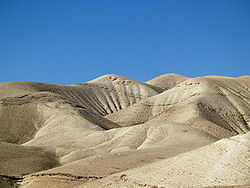
The Judaean Desert lies east of Jerusalem and descends to the Dead Sea. The Judaean Desert stretches from the northeastern Negev to the east of Beit El, and is marked by natural terraces with escarpments. It ends in a steep escarpment dropping to the Dead Sea and the Jordan Valley. The Judaean Desert is characterized by the topography of a plateau that ends in the east in a cliff. It is crossed by numerous wadis flowing from west to east and has many ravines, most of them deep, from 366 metres (1,201 ft) in the west to 183 metres (600 ft) in the east. The Judaean Desert is an area with a special morphological structure along the east of the Judaean Mountains.
A study by the Hebrew University of Jerusalem of an underground water reservoir beneath the Judaean Desert known as the Judaea Group Aquifer, found that the aquifer begins in the Judaean Mountains and flows in a northeasterly direction towards the Dead Sea with outflows at the Tsukim, Kane, Samar and Ein-Gedi springs. The rain-fed aquifer contains an average yearly volume of some 100 million m3 (3.5 billion cu ft) of water.
Judaean Desert
The Judaean Desert or Judean Desert (Hebrew: מִדְבַּר יְהוּדָה, romanized: Midbar Yehuda, Arabic: برية الخليل, romanized: Bariyat al-Khalil[clarification needed]) is a desert in the West Bank and Israel that stretches east of the ridge of the Judaean Mountains and in their rain shadow, so east of Jerusalem, and descends to the Dead Sea.
The Judaean Desert has historically functioned as a place of refuge for rebels and displaced populations. According to the Hebrew Bible, David took shelter there while fleeing from King Saul. The Hasmonean rulers of Judaea, and their successor, Herod the Great, built several monumental fortresses in the region, including Herodium, Hyrcania, and Masada. In the period of the Jewish–Roman Wars, the desert became a key theater of conflict, with Roman forces besieging major strongholds. Caves in the area, such as the Cave of Letters and the Cave of Horrors, later served as hiding places for Jewish refugees, preserving personal documents, religious texts, skeletons, weapons, clothing, and household items—thanks to the region's arid climate. The desert also attracted religious sects, including the classical-era Jewish ascetics of Qumran (likely Essenes) and Byzantine-era Christian monks who practiced spiritual isolation in local lavras.
Under the name El-Bariyah, it has been nominated to the Tentative List of World Heritage Sites in the West Bank and Israel, particularly for its monastic ruins.
The term Hebrew: מִדְבַּר יְהוּדָה, lit. 'Desert of Judaea' originates in the Hebrew Bible, and it is mentioned in Judges and Psalms.
It is sometimes known as יְשִׁימוֹן Yeshimon, meaning desert or wildland, or yet Wilderness of Judah or Wilderness of Judaea, among others.
Similarly, the Arabic name برية الخليل, Bariyat El-Khalil (sometimes stylized 'El-Bariyah') means Wilderness of Hebron.
The Judaean Desert lies east of Jerusalem and descends to the Dead Sea. The Judaean Desert stretches from the northeastern Negev to the east of Beit El, and is marked by natural terraces with escarpments. It ends in a steep escarpment dropping to the Dead Sea and the Jordan Valley. The Judaean Desert is characterized by the topography of a plateau that ends in the east in a cliff. It is crossed by numerous wadis flowing from west to east and has many ravines, most of them deep, from 366 metres (1,201 ft) in the west to 183 metres (600 ft) in the east. The Judaean Desert is an area with a special morphological structure along the east of the Judaean Mountains.
A study by the Hebrew University of Jerusalem of an underground water reservoir beneath the Judaean Desert known as the Judaea Group Aquifer, found that the aquifer begins in the Judaean Mountains and flows in a northeasterly direction towards the Dead Sea with outflows at the Tsukim, Kane, Samar and Ein-Gedi springs. The rain-fed aquifer contains an average yearly volume of some 100 million m3 (3.5 billion cu ft) of water.
Recent media
Recent media