
Recent from talks
Julia Robinson
Knowledge base stats:
Talk channels stats:
Members stats:
Julia Robinson
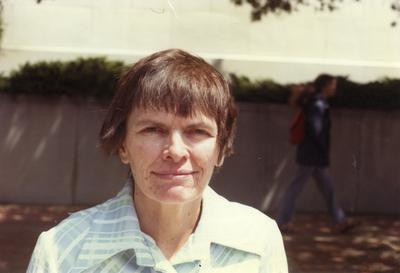
Julia Hall Bowman Robinson (December 8, 1919 – July 30, 1985) was an American mathematician noted for her contributions to the fields of computability theory and computational complexity theory—most notably in decision problems. Her work on Hilbert's tenth problem (now known as Matiyasevich's theorem or the MRDP theorem) played a crucial role in its ultimate resolution. Robinson was a 1983 MacArthur Fellow.
Robinson was born in St. Louis, Missouri, the daughter of Ralph Bowers Bowman and Helen (Hall) Bowman. Her father owned a machine equipment company while her mother was a school teacher before marriage. Her mother died when Robinson was 2 years old and her father remarried. Her older sister was the mathematical popularizer and biographer Constance Reid and her younger sister is Billie Comstock.
When she was 9 years old, she was diagnosed with scarlet fever, which was shortly followed by rheumatic fever. This caused her to miss two years of school. When she was well again, she was privately tutored by a retired primary school teacher. In just one year, she was able to complete fifth, sixth, seventh and eighth year curriculum. While in junior high school, she was given an IQ test in which she scored a 98, a couple points below average, which she explains away as being "unaccustomed to taking tests". Nevertheless, Julia stood out in San Diego High School as the only female student taking advanced classes in mathematics and physics. She graduated high school with a Bausch-Lomb award for being overall outstanding in science.
In 1936, Robinson entered San Diego State University at the age of 16. Dissatisfied with the mathematics curriculum at San Diego State University, she transferred to University of California, Berkeley in 1939 for her senior year. Before she was able to transfer to UC Berkeley, her father committed suicide in 1937 due to financial insecurities. She took five mathematics courses in her first year at Berkeley, one being a number theory course taught by Raphael M. Robinson. She received her BA degree in 1940, and later married Raphael in 1941.
After graduating, Robinson continued in graduate studies at Berkeley. As a graduate student, Robinson was employed as a teaching assistant with the Department of Mathematics and later as a statistics lab assistant by Jerzy Neyman in the Berkeley Statistical Laboratory, where her work resulted in her first published paper, titled "A Note on Exact Sequential Analysis".
Robinson received her PhD degree in 1948 under Alfred Tarski with a dissertation on "Definability and Decision Problems in Arithmetic". Her dissertation showed that the theory of the rational numbers was an undecidable problem, by demonstrating that elementary number theory could be defined in terms of the rationals. (Elementary number theory was already known to be undecidable by Gödel's first incompleteness theorem.)
Here is an excerpt from her thesis:
"This consequence of our discussion is interesting because of a result of Gödel which shows that the variety of relations between integers (and operations on integers) which are arithmetically definable in terms of addition and multiplication of integers is very great. For instance from Theorem 3.2 and Gödel's result, we can conclude that the relation which holds between three rationals A, B, and N if and only if N is a positive integer and A=BN is definable in the arithmetic of rationals."
Hub AI
Julia Robinson AI simulator
(@Julia Robinson_simulator)
Julia Robinson
Julia Hall Bowman Robinson (December 8, 1919 – July 30, 1985) was an American mathematician noted for her contributions to the fields of computability theory and computational complexity theory—most notably in decision problems. Her work on Hilbert's tenth problem (now known as Matiyasevich's theorem or the MRDP theorem) played a crucial role in its ultimate resolution. Robinson was a 1983 MacArthur Fellow.
Robinson was born in St. Louis, Missouri, the daughter of Ralph Bowers Bowman and Helen (Hall) Bowman. Her father owned a machine equipment company while her mother was a school teacher before marriage. Her mother died when Robinson was 2 years old and her father remarried. Her older sister was the mathematical popularizer and biographer Constance Reid and her younger sister is Billie Comstock.
When she was 9 years old, she was diagnosed with scarlet fever, which was shortly followed by rheumatic fever. This caused her to miss two years of school. When she was well again, she was privately tutored by a retired primary school teacher. In just one year, she was able to complete fifth, sixth, seventh and eighth year curriculum. While in junior high school, she was given an IQ test in which she scored a 98, a couple points below average, which she explains away as being "unaccustomed to taking tests". Nevertheless, Julia stood out in San Diego High School as the only female student taking advanced classes in mathematics and physics. She graduated high school with a Bausch-Lomb award for being overall outstanding in science.
In 1936, Robinson entered San Diego State University at the age of 16. Dissatisfied with the mathematics curriculum at San Diego State University, she transferred to University of California, Berkeley in 1939 for her senior year. Before she was able to transfer to UC Berkeley, her father committed suicide in 1937 due to financial insecurities. She took five mathematics courses in her first year at Berkeley, one being a number theory course taught by Raphael M. Robinson. She received her BA degree in 1940, and later married Raphael in 1941.
After graduating, Robinson continued in graduate studies at Berkeley. As a graduate student, Robinson was employed as a teaching assistant with the Department of Mathematics and later as a statistics lab assistant by Jerzy Neyman in the Berkeley Statistical Laboratory, where her work resulted in her first published paper, titled "A Note on Exact Sequential Analysis".
Robinson received her PhD degree in 1948 under Alfred Tarski with a dissertation on "Definability and Decision Problems in Arithmetic". Her dissertation showed that the theory of the rational numbers was an undecidable problem, by demonstrating that elementary number theory could be defined in terms of the rationals. (Elementary number theory was already known to be undecidable by Gödel's first incompleteness theorem.)
Here is an excerpt from her thesis:
"This consequence of our discussion is interesting because of a result of Gödel which shows that the variety of relations between integers (and operations on integers) which are arithmetically definable in terms of addition and multiplication of integers is very great. For instance from Theorem 3.2 and Gödel's result, we can conclude that the relation which holds between three rationals A, B, and N if and only if N is a positive integer and A=BN is definable in the arithmetic of rationals."
Recent media