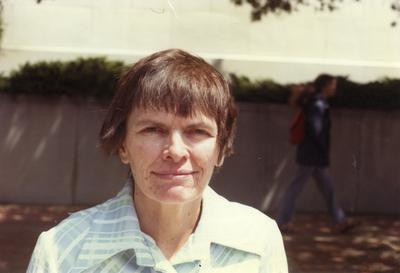
Julia Robinson
Julia Robinson
Main page
2127019

Julia Robinson

logo
Community Hub0 subscribers
Read side by side
from Wikipedia

Julia Hall Bowman Robinson (December 8, 1919 – July 30, 1985) was an American mathematician noted for her contributions to the fields of computability theory and computational complexity theory—most notably in decision problems. Her work on Hilbert's tenth problem (now known as Matiyasevich's theorem or the MRDP theorem) played a crucial role in its ultimate resolution. Robinson was a 1983 MacArthur Fellow.

Key Information

Early years

[edit]

Robinson was born in St. Louis, Missouri, the daughter of Ralph Bowers Bowman and Helen (Hall) Bowman.[1]: 4  Her father owned a machine equipment company while her mother was a school teacher before marriage.[1]: 4  Her mother died when Robinson was 2 years old and her father remarried.[1]: 4  Her older sister was the mathematical popularizer and biographer Constance Reid and her younger sister is Billie Comstock.[1]: 22 

When she was 9 years old, she was diagnosed with scarlet fever, which was shortly followed by rheumatic fever.[2]: 4  This caused her to miss two years of school. When she was well again, she was privately tutored by a retired primary school teacher. In just one year, she was able to complete fifth, sixth, seventh and eighth year curriculum.[1]: 4  While in junior high school, she was given an IQ test in which she scored a 98, a couple points below average, which she explains away as being "unaccustomed to taking tests".[2] Nevertheless, Julia stood out in San Diego High School as the only female student taking advanced classes in mathematics and physics.[1]: 4  She graduated high school with a Bausch-Lomb award for being overall outstanding in science.[3]

In 1936, Robinson entered San Diego State University at the age of 16.[1]: 4  Dissatisfied with the mathematics curriculum at San Diego State University, she transferred to University of California, Berkeley in 1939 for her senior year. Before she was able to transfer to UC Berkeley, her father committed suicide in 1937 due to financial insecurities.[1]: 5  She took five mathematics courses in her first year at Berkeley,[4] one being a number theory course taught by Raphael M. Robinson. She received her BA degree in 1940,[1]: 5  and later married Raphael in 1941.[1]: 5 

Mathematical contributions

[edit]

After graduating, Robinson continued in graduate studies at Berkeley. As a graduate student, Robinson was employed as a teaching assistant with the Department of Mathematics and later as a statistics lab assistant by Jerzy Neyman in the Berkeley Statistical Laboratory, where her work resulted in her first published paper, titled "A Note on Exact Sequential Analysis".[1]: 5 

Robinson received her PhD degree in 1948 under Alfred Tarski with a dissertation on "Definability and Decision Problems in Arithmetic".[3]: 14  Her dissertation showed that the theory of the rational numbers was an undecidable problem, by demonstrating that elementary number theory could be defined in terms of the rationals. (Elementary number theory was already known to be undecidable by Gödel's first incompleteness theorem.)[5]

Here is an excerpt from her thesis:

"This consequence of our discussion is interesting because of a result of Gödel which shows that the variety of relations between integers (and operations on integers) which are arithmetically definable in terms of addition and multiplication of integers is very great. For instance from Theorem 3.2 and Gödel's result, we can conclude that the relation which holds between three rationals A, B, and N if and only if N is a positive integer and A=BN is definable in the arithmetic of rationals."[6]

Hilbert's tenth problem

[edit]

Hilbert's tenth problem asks for an algorithm to determine whether a Diophantine equation has any solutions in integers. Robinson began exploring methods for this problem in 1948 while at the RAND Corporation. Her work regarding Diophantine representation for exponentiation and her method of using Pell's equation led to the J.R. hypothesis (named after Robinson) in 1950. Proving this hypothesis would be central in the eventual solution. Her research publications would lead to collaborations with Martin Davis, Hilary Putnam, and Yuri Matiyasevich.[7]

In 1950, Robinson first met Martin Davis, then an instructor at the University of Illinois at Urbana-Champaign, who was trying to show that all sets with listability property were Diophantine in contrast to Robinson's attempt to show that a few special sets—including prime numbers and the powers of 2—were Diophantine. Robinson and Davis started collaborating in 1959 and were later joined by Hilary Putnam, they then showed that the solutions to a "Goldilocks" equation was key to Hilbert's tenth problem.[8]

In 1970, the problem was resolved in the negative; that is, they showed that no such algorithm can exist. Through the 1970s, Robinson continued working with Matiyasevich on one of their solution's corollaries, which she once stated that

there is a constant N such that, given a Diophantine equation with any number of parameters and in any number of unknowns, one can effectively transform this equation into another with the same parameters but in only N unknowns such that both equations are solvable or unsolvable for the same values of the parameters.[3]

At the time the solution was first published, the authors established N = 200. Robinson and Matiyasevich's joint work would produce further reduction to 9 unknowns.[3]

Game theory

[edit]

During the late 1940s, Robinson spent a year or so at the RAND Corporation in Santa Monica researching game theory. Her 1949 technical report, "On the Hamiltonian game (a traveling salesman problem),"[9] is the first publication to use the phrase "travelling salesman problem".[10] Shortly thereafter she published a paper called "An Iterative Method of Solving a Game" in 1951.[1]: 7  In her paper, she proved that the fictitious play dynamics converges to the mixed strategy Nash equilibrium in two-player zero-sum games. This was posed by George W. Brown as a prize problem at RAND Corporation.[5]: 59 

Professorship at UC Berkeley

[edit]

Robinson was not allowed to teach in the Mathematics Department at Berkeley after marrying Raphael M. Robinson in 1941, as there was a rule that prevented family members from working together in the same department.[1] Robinson then instead stayed in the statistics department despite wanting to teach calculus. Although Raphael retired in 1973, it was not until 1976 she was offered a full-time professorship position at Berkeley after the department heard of her nomination to the National Academy of Sciences.[11]

Honors

[edit]

After Yuri Matiyasevich solved Hilbert's tenth problem by means of the J.R. hypothesis and the Fibonacci number sequence, Saunders Mac Lane nominated Robinson for the National Academy of Sciences.[12] Alfred Tarski and Jerzy Neyman also flew out to Washington, D.C. to further explain to the National Academy of Sciences why her work is so important and how it tremendously contributed to mathematics.[11] In 1975, she was the first female mathematician to be elected to the National Academy of Sciences.[1]

Robinson was chosen as the first female president of the American Mathematical Society (for the term of 1983–1984) but was unable to complete her term as she was suffering from leukemia.[13] It took time for her to accept the nomination, as stated in her autobiography:

"In 1982 I was nominated for the presidency of the American Mathematical Society. I realized that I had been chosen because I was a woman and because I had the seal of approval, as it were, of the National Academy. After discussion with Raphael, who thought I should decline and save my energy for mathematics, and other members of my family, who differed with him, I decided that as a woman and a mathematician I had no alternative but to accept. I have always tried to do everything I could to encourage talented women to become research mathematicians. I found my service as president of the Society taxing but very, very satisfying."[3]

In 1982, Robinson gave the Noether Lecture of the Association for Women in Mathematics; her lecture was called Functional Equations in Arithmetic.[14] Around this time she also was given the MacArthur Fellowship prize of $60,000. In 1985, she also became a member of the American Academy of Arts and Sciences.

Political work

[edit]

In the 1950s Robinson was active in local Democratic party activities. She was Alan Cranston's campaign manager in Contra Costa County when he ran for his first political office, state controller.[5][11]

"I don't remember exactly what happened, but the end result was that Julia involved herself during those years in the nitty-gritty of Democratic Party politics—she registered voters, stuffed envelopes, rang door- bells in neighborhoods where people expected to be paid for their vote. She even served as Alan Cranston's campaign manager for Contra Costa County when he successfully ran for state controller—his first political office."

— Constance Reid [11]

Robinson was also a volunteer for Adlai Stevenson's presidential campaigns.[8]

Death and legacy

[edit]

In 1984, Robinson was diagnosed with leukemia, and she died in Oakland, California, on July 30, 1985.[1][5]

"One of Julia's last requests was that there be no funeral service and that those wishing to make a gift in her memory contribute to the Alfred Tarski Fund, which she had been instrumental in setting up in honor of her late teacher, friend, and colleague. Modest to the end, she let her character and achievements speak for themselves."

One of her sisters, Constance Reid, won the Mathematical Association of America's George Pólya Award in 1987 for writing the article "The Autobiography of Julia Robinson".[15][1]: 22 

The Julia Robinson Mathematics Festival, sponsored by the American Institute of Mathematics from 2013 to the present and by the Mathematical Sciences Research Institute from 2007 to 2013, was named in her honor.

George Csicsery produced and directed a one-hour documentary about Robinson titled Julia Robinson and Hilbert's Tenth Problem, that premiered at the Joint Mathematics Meeting in San Diego on January 7, 2008.[16] Notices of the American Mathematical Society printed a film review[17] and an interview with the director.[18] The College Mathematics Journal also published a film review.[19]

Notes

[edit]

References

[edit]
[edit]
Revisions and contributorsEdit on WikipediaRead on Wikipedia
from Grokipedia
Julia Bowman Robinson (July 8, 1919 – July 30, 1985) was an American mathematician whose pioneering work in the theory of Diophantine equations advanced the understanding of computability limits in mathematics, most notably through her contributions to resolving Hilbert's tenth problem by establishing key results on the undecidability of determining integer solutions to polynomial equations with integer coefficients.[1][2] Her 1948 doctoral thesis under Alfred Tarski at the University of California, Berkeley, examined metamathematical problems in the theory of fields, setting the foundation for her later research on decision problems.[3] Despite chronic health challenges stemming from a childhood bout of scarlet fever that led to aplastic anemia and required frequent hospitalizations, Robinson persisted in her academic career, eventually becoming a full professor at Berkeley in 1976.[4] Robinson's theorem of 1950 provided early insights into the non-arithmetical nature of certain sets definable over the rationals, while her 1960s papers demonstrated that Hilbert's tenth problem reduces to finding a Diophantine set with specific properties, paving the way for Yuri Matiyasevich's 1970 completion of the proof of undecidability in collaboration with earlier efforts by Martin Davis and Hilary Putnam.[1] She was the first woman mathematician elected to the National Academy of Sciences in 1975 and received the MacArthur Fellowship in 1983 for her original contributions to logic and number theory.[3] Elected president of the American Mathematical Society for the 1983–1984 term, she was the first woman to hold this position, though illness prevented her from completing it fully.[5] Her legacy endures as a model of resilience and intellectual rigor in mathematics, influencing subsequent work in logic and computability.[4]

Early life

Family background and childhood

Julia Bowman was born on December 8, 1919, in St. Louis, Missouri, to Ralph Bowers Bowman, who owned a machine tool and equipment company, and Helen Hall Bowman, a primary school teacher before her marriage.[6][7] She had an older sister, Constance, two years her senior, and a younger sister, Billie, born after the family relocated to California.[6][7] Her mother's death from illness when Julia was two years old prompted the family to move to the Arizona desert, where they lived with relatives before settling in the Point Loma area of San Diego, California, when Julia was five, partly to facilitate her schooling.[6][7][8] Raised primarily by her father and his second wife, also a schoolteacher, Julia experienced a stable but marked by early independence due to family circumstances and subsequent illnesses, including scarlet fever at age nine and rheumatic fever at age ten, which required extended bed rest and tutoring.[6][7][8] These periods of recovery fostered self-reliance, during which she developed an interest in mathematics through tutoring sessions, particularly finding fascination in concepts like the square root of two.[7] Julia attended San Diego High School starting in 1933, graduating in 1936 with honors in mathematics and science, earning the Bausch & Lomb Science Award for her proficiency.[6][7] She persisted in advanced math classes despite many female peers dropping out, influenced by reading E.T. Bell's Men of Mathematics, which highlighted historical figures and problems in the field, though her path followed a conventional academic progression rather than early exceptionalism.[6][7] Her sister Constance later documented these formative years in biographical accounts.[8]

Education

Robinson enrolled in San Diego State College in 1936 at the age of 16, pursuing a mathematics degree with the initial goal of teaching at the high school level.[6] The institution emphasized teacher preparation, and her early coursework focused on foundational topics without notable research advancements.[7] In 1939, she transferred to the University of California, Berkeley, for her senior year, completing a Bachelor of Arts in mathematics in 1940.[9] [10] At Berkeley, Robinson encountered advanced mathematics through graduate-level courses, including number theory under Raphael Robinson, which shaped her interests in arithmetic and logic.[3] She continued directly into doctoral studies there, supervised by logician Alfred Tarski, whose work on model theory and decidability influenced her research direction.[11] [12] Her PhD, awarded in 1948, addressed definability within arithmetic structures, with the thesis titled "Definability and Decision Problems in Arithmetic," demonstrating arithmetical definitions of integers using addition and multiplication.[13] [14] The extended timeline from 1940 reflected wartime disruptions to academic progress, though she fulfilled the program's stringent requirements in symbolic logic and foundational mathematics.[3]

Personal life

Marriage and family

Julia Robinson married Raphael M. Robinson, a fellow mathematician and professor of number theory at the University of California, Berkeley, on December 22, 1941.[6] The two had met earlier that year when Julia enrolled as a student in Raphael's number theory course, where their shared interest in mathematics fostered a close relationship; they often took walks together during which he introduced her to advanced topics beyond the curriculum.[6][15] The Robinsons had no children, channeling their energies into reciprocal professional encouragement amid the constraints of academic policies that initially barred Julia from departmental teaching due to her marriage.[16] Their union exemplified a partnership grounded in intellectual synergy, with Raphael exerting a profound influence on her mathematical pursuits, including steering her toward rigorous problem-solving in areas like Diophantine equations.[15] This mutual reinforcement sustained both careers at Berkeley, where they collaborated informally on foundational ideas in arithmetic and logic, though Julia's independent breakthroughs in computability theory remained her hallmark.[16] The marriage endured as a stable companionship until Julia's death on July 30, 1985, with Raphael surviving her and later honoring her legacy through endowments supporting mathematical research.[16][6]

Health challenges

In 1928, at age nine, Julia Robinson contracted scarlet fever, followed by rheumatic fever with several relapses that necessitated a year of bed rest and tutoring, resulting in over two years lost from formal schooling and permanent scar tissue damage to her mitral heart valve.[3] This valvular damage went undiagnosed until the early 1940s, when a episode of viral pneumonia prompted medical evaluation revealing extensive scarring and a prognosis limiting her expected lifespan to around age 40.[3] The condition's progression, typical of untreated rheumatic heart disease in an era with limited diagnostic tools beyond clinical exams and basic imaging, constrained her physical capacity and contributed to a miscarriage following an early pregnancy attempt in the 1940s.[3][7] Despite these limitations, Robinson maintained mathematical output, including doctoral work completed in 1948 and publications in the 1950s addressing decision problems in logic, though the heart issues, alongside Berkeley's nepotism policies prohibiting spousal hires, delayed her full professorship until 1975.[6][3] In 1961, she underwent experimental open-heart surgery to remove the mitral valve scar tissue, a procedure that resolved her chronic fatigue and shortness of breath, allowing resumption of activities such as bicycling within a month and correlating with increased professional engagement post-recovery.[3] Robinson's health deteriorated terminally in 1984 with a leukemia diagnosis discovered during an American Mathematical Society meeting in Eugene, Oregon.[3] Chemotherapy induced a remission by spring 1985, but relapse ensued, causing her death on July 30, 1985, at age 65—substantially exceeding the 1940s heart prognosis amid advancing treatments like surgical interventions unavailable earlier.[3][7]

Mathematical research

Decision problems and early work

Following her PhD in 1948 under Alfred Tarski at the University of California, Berkeley, Julia Robinson shifted focus to undecidability questions in arithmetic, drawing on Kurt Gödel's incompleteness theorems and Alan Turing's work on computability limits.[3] Her dissertation demonstrated that the set of integers Z\mathbb{Z} (and hence the naturals N\mathbb{N}) is first-order definable in the theory of rational numbers Th(Q,+,)\mathrm{Th}(\mathbb{Q}, +, \cdot), thereby establishing the undecidability of Th(Q,+,)\mathrm{Th}(\mathbb{Q}, +, \cdot) by encoding undecidable arithmetic statements within it.[3] Published in 1949 as "Definability and decision problems in arithmetic" in the Journal of Symbolic Logic (volume 14, pages 98–114), this work employed innovative techniques such as ternary quadratic forms to handle rational denominators and eliminate prime factors, for instance, defining oddness of bb via the existential condition (x1x2x3)(7b2+2=x12+x22+x32)(\exists x_1 \exists x_2 \exists x_3)(7b^2 + 2 = x_1^2 + x_2^2 + x_3^2) over Q\mathbb{Q}.[17] [3] These results underscored fundamental barriers to algorithmic decision procedures in arithmetic hierarchies, bridging logical definability with algebraic structures through existential quantifiers.[3] Robinson's approach highlighted technical challenges in reducing recursive predicates to arithmetic relations, such as managing denominator primes without invoking advanced number-theoretic assumptions.[3] In 1961, Robinson collaborated with Martin Davis and Hilary Putnam to address decision problems for equations involving exponentials, proving that every recursively enumerable set admits an exponential Diophantine representation—existential formulas over naturals using polynomials and terms like aba^b.[3] Published as "The decision problem for exponential Diophantine equations" in Annals of Mathematics (second series, volume 74, pages 425–436), their result overcame prior hurdles by bypassing the unproven hypothesis of infinitely many primes in certain progressions, thus empirically linking computability theory's recursive enumerability to number theory's Diophantine constraints via bounded exponential growth.[18] [3] This representation theorem revealed that introducing exponentials does not yield decidability for such equation solvability, advancing the empirical integration of logical undecidability with Diophantine solvability.[3]

Hilbert's tenth problem

In 1900, David Hilbert posed the tenth problem on his list of 23 challenges to mathematics, asking whether there exists a general algorithm to determine, for any given polynomial equation with integer coefficients (a Diophantine equation), whether it admits integer solutions. Julia Robinson's research from the early 1950s onward provided critical reductions demonstrating that the problem's unsolvability hinges on the Diophantine representability of recursively enumerable sets. In her 1952 paper "Existential definability in arithmetic," she proved a sufficient condition under which exponential Diophantine equations—those incorporating exponential terms—could be transformed into purely polynomial Diophantine equations, thereby linking the problem to the expressive power of existential quantifiers over polynomials.[19] This work established that if certain arithmetic functions admit Diophantine definitions with bounded witnesses, then no decision algorithm for Diophantine solvability exists, as it would contradict known undecidability results from computability theory like the halting problem. Building on this, Robinson collaborated with Martin Davis and Hilary Putnam in 1961 to prove that every recursively enumerable set admits an exponential Diophantine representation, meaning any such set can be defined by the existence of integer solutions to equations involving polynomials and exponentials. Their result showed that Hilbert's tenth problem reduces to eliminating exponentials entirely from these representations; if successful, it would embed arbitrary Turing machine computations into Diophantine equations, rendering solvability algorithmically impossible due to the undecidability of the halting problem. This causal chain—encoding computation via exponential growth, then seeking polynomial approximations—highlighted the problem's dependence on rapid integer growth functions, with Robinson's techniques using properties of Pell equations to approximate exponentials through high-degree polynomials while controlling solution bounds. By the late 1960s, Robinson advanced toward a full Diophantine simulation in her 1969 paper "Diophantine decision problems," constructing representations that reduced the need for exponentials to a single instance, effectively nearing a proof of unsolvability by demonstrating how polynomials alone could simulate nearly all required growth via iterative solutions to auxiliary equations.[3] This left only a minor gap in unbounded exponential encoding, which Yuri Matiyasevich bridged in 1970 by proving Fibonacci numbers are Diophantine, allowing polynomial equations to generate the necessary super-exponential growth for complete Turing completeness. The combined MRDP theorem (Matiyasevich-Robinson-Davis-Putnam) thus established the negative answer to Hilbert's problem, with Robinson's reductions providing the foundational machinery that made the proof feasible; however, the result underscores inherent limits in automating Diophantine proofs, as no uniform algorithm can exist despite partial successes in restricted cases.[19]

Game theory

Julia Robinson contributed to game theory through her analysis of algorithmic solutions for finite two-person zero-sum games. During her time at the RAND Corporation in 1949–1950, she addressed a problem posed by George W. Brown concerning the convergence of an iterative procedure for computing game values.[3] In her 1951 paper "An Iterative Method of Solving a Game," published in the Annals of Mathematics, Robinson proved that this method—now recognized as fictitious play—converges to the game's minimax value and optimal mixed strategies for any finite payoff matrix.[20] The approach involves players sequentially selecting best responses to the empirical frequency of their opponent's prior choices, yielding sequences of play distributions that approach the equilibrium prescribed by John von Neumann's 1928 minimax theorem. This result provided a constructive, iterative algorithm for solving such games, extending the theoretical existence of equilibria to a practical computational framework, though without bounds on the rate of convergence.[21] Robinson's proof demonstrated that the limiting value of the game under fictitious play equals the true minimax value, resolving the affirmative for Brown's query, which had been offered as a $200 prize problem at RAND—though she was ineligible as an employee.[9] Her work highlighted the feasibility of approximating solutions in finite strategic settings but also underscored inherent computational challenges, as the method's efficiency depends on the matrix size and does not guarantee polynomial-time performance.[22] While primarily focused on matrix games, Robinson's emphasis on iterative convergence intersected with her broader interests in computability, informing later inquiries into the decidability of strategic outcomes in more complex systems. However, her game-theoretic contributions remained distinct from undecidability results in arithmetic, centering instead on verifiable convergence in bounded, zero-sum environments.

Academic career

Positions at UC Berkeley

Julia Robinson joined the University of California, Berkeley, Mathematics Department as a teaching assistant following her M.A. in 1941, assisting in statistics under Jerzy Neyman.[6] After completing her Ph.D. in 1948, university anti-nepotism rules prohibited her employment in the department due to her marriage to Raphael Robinson, a faculty member, limiting her to occasional lecturing roles over the subsequent decades.[23] These positions involved sporadic teaching in areas such as algebra and logic, amid a period of departmental growth that increased administrative demands on faculty, though her involvement remained part-time.[12] In 1976, Berkeley appointed Robinson full professor, bypassing intermediate ranks in recognition of her research achievements, including her recent election to the National Academy of Sciences; this made her the first woman to achieve a tenured professorship in the department.[24] [25] The appointment included a reduced load of one course per year, reflecting the competitive tenure standards of mid-20th-century academia, where promotions hinged on publication quality rather than teaching volume or institutional favoritism—criteria her record satisfied despite prior constraints.[7] No primary evidence suggests deviations from merit-based evaluation in her case, consistent with the era's emphasis on verifiable scholarly output in a highly selective environment.[3]

Leadership roles

Julia Robinson served as the first woman president of the American Mathematical Society (AMS), elected in 1981 for a term beginning in February 1982 and extending through January 1984.[5] Her leadership coincided with the society's expansion amid increasing professionalization of mathematics, where she emphasized upholding empirical standards of excellence in research and membership criteria.[5] Although leukemia curtailed her active involvement toward the end of her tenure, her election—grounded in her foundational contributions to computability theory—signaled a merit-driven advancement in a field historically resistant to non-traditional entrants, countering institutional tendencies toward ideological quotas in selections.[3] At UC Berkeley, Robinson contributed to departmental administration post-1976 as a full professor, including service on faculty search committees that influenced hiring decisions by prioritizing verifiable expertise over demographic considerations.[26] These roles enabled policy influences favoring rigorous evaluation, as evidenced by the department's sustained output of high-impact research during her era.[24]

Honors and recognition

Major awards and elections

Robinson was elected to the National Academy of Sciences in 1976 for her foundational results in computability theory, particularly her work establishing undecidability bounds for Diophantine equations.[16] This recognition followed her 1950 paper proving that certain exponential Diophantine sets are not recursive, a key step toward resolving Hilbert's tenth problem.[6] In 1982, she was selected as the inaugural Noether Lecturer by the Association for Women in Mathematics, presenting on functional equations in arithmetic that underscored her contributions to the negative solution of Hilbert's tenth problem through degree-of-freedom arguments.[11] The John D. and Catherine T. MacArthur Foundation awarded her a fellowship in February 1983, providing $60,000 annually for five years in acknowledgment of her elegant proofs linking number-theoretic undecidability to logical limitations, including her 1960s advancements on Hilbert's problem via rational approximations.[27] She was elected president of the American Mathematical Society for the term 1983–1984, reflecting peer validation of her influence on decision problem research and leadership in mathematical logic.[5]

Activism and political involvement

Loyalty oath controversy

In the late 1940s, amid escalating Cold War tensions and revelations of Soviet espionage within the United States—such as the 1948-1950 Alger Hiss trial, which confirmed through perjury conviction his ties to communist networks, and the 1950 arrest of Julius and Ethel Rosenberg for passing atomic secrets to the USSR—the University of California Board of Regents imposed an expanded loyalty oath on all employees. Originally a standard pledge to the California Constitution, the 1949 amendment required declarants to affirm they were not members of the Communist Party and did not advocate overthrowing the government by force. Enforcement in spring 1950 prompted refusals from over 200 faculty and staff at Berkeley, citing threats to academic freedom and due process; the Regents dismissed 157 non-signers on June 23, 1950, though subsequent litigation reinstated some after the California Supreme Court upheld the oath's validity in 1952 while invalidating certain punitive aspects.[28][29] These refusals reflected broader faculty concerns over ideological conformity, but the oath targeted verifiable infiltration risks, including FBI-documented communist cells on California campuses and declassified Venona intercepts revealing Soviet recruitment of American academics and scientists during the 1930s-1940s. Julia Robinson, a part-time mathematics lecturer at Berkeley since 1947, actively opposed the requirement as an undue constraint on intellectual autonomy, committing significant effort to the resistance alongside her support for Adlai Stevenson's 1952 presidential campaign.[30][31] Robinson participated in faculty protests extending into 1952-1953, including organized opposition that echoed earlier non-cooperation tactics, though she avoided dismissal by ultimately signing under reservation, preserving her position while critiquing the measure's potential to chill dissent without proportionally addressing espionage imperatives.[30] This stance aligned with academic purists emphasizing unfettered inquiry, yet empirical evidence of Soviet penetration—such as the Steve Nelson spy ring's ties to West Coast radicals—suggested opponents may have underweighted national security trade-offs in favoring institutional self-governance.

Other engagements

Julia Robinson participated actively in Democratic Party politics during the 1950s, serving as county manager for Alan Cranston's successful 1958 campaign for California State Treasurer.[7] She invested substantial time in related efforts over the following years, including registering voters, distributing campaign materials, and supporting local organizing.[12] These activities aligned with broader Democratic priorities, though empirical assessments indicate no attributable policy shifts from her specific contributions, as electoral outcomes depended on multifaceted factors beyond individual volunteer roles.[7] In professional circles, Robinson championed academic freedom during episodes of politicized division. In the 1980 Ershov affair—a controversy over a petition criticizing Soviet logician Yuri Ershov and prompting calls for boycotting associated events—she implored a colleague against resigning from a planning committee, arguing that "our differences are minor compared" to the value of sustained engagement.[32] This position prioritized scientific exchange over ideological exclusion, yet causal analysis reveals limited efficacy: while it helped maintain some collaborations, it did not avert escalating Cold War-era restrictions on international math interactions, where geopolitical deterrence dynamics constrained activist influence.[32]

Death and legacy

Final years and death

In the early 1980s, Robinson maintained her focus on computability theory, delivering the American Mathematical Society's Colloquium Lectures in 1980 on Hilbert's Tenth Problem, decision problems for rings and fields, and related undecidability results.[6] She also presented the Noether Lecture for the Association for Women in Mathematics in 1982, titled "Functional Equations in Arithmetic," extending her prior work on Diophantine equations.[3] These activities reflected sustained productivity amid lingering effects from childhood rheumatic fever, which had compromised her heart function.[6] Elected in 1983 as the first woman president of the American Mathematical Society, Robinson assumed the role in 1984.[5] That August, while presiding over the AMS summer meeting in Eugene, Oregon, she learned of her leukemia diagnosis.[12] Chemotherapy followed, yielding a temporary remission in early 1985, during which she attempted to resume duties, but the disease's progression halted her professional engagements, empirically tying her health decline to the end of active mathematical output.[3][15] Robinson died on July 30, 1985, in Oakland, California, at age 65, from leukemia.[15][16][33]

Mathematical and broader impact

Robinson's contributions to computability theory profoundly influenced the understanding of algorithmic limitations in number theory, particularly through her work on Hilbert's tenth problem, which asks whether there exists an algorithm to determine if a given Diophantine equation has integer solutions. In a series of papers from the 1950s onward, she established that the problem reduces to the existence of a Diophantine set satisfying specific computability properties, providing a critical bridge between recursive enumerability and Diophantine representability.[34][1] Her 1950 publication demonstrated the recursive enumerability of the set of solvable Diophantine equations, while later reductions in 1967 and 1969 narrowed the gap to the full undecidability proof completed by Yuri Matiyasevich in 1970, forming the MRDP theorem (Matiyasevich-Robinson-Davis-Putnam).[35][6] These results not only resolved a core question from David Hilbert's 1900 list but also spurred advancements in the study of Diophantine approximation and the boundaries of provability in arithmetic, with ongoing research building on her predicates to explore variants like Hilbert's tenth over rationals or reals.[34] Earlier, her 1951 paper in the Annals of Mathematics introduced an iterative method proving convergence for solving certain zero-sum games, impacting game theory and optimization techniques.[6] Beyond pure mathematics, Robinson's career as the first woman tenured in the UC Berkeley mathematics department (1965) and the first female president of the American Mathematical Society (1983–1984) modeled resilience and excellence, encouraging female participation in a field historically dominated by men.[5] Her 1976 election as the first woman in the mathematics section of the National Academy of Sciences further symbolized institutional progress, though her influence stemmed more from substantive achievements than advocacy.[5] The Julia Robinson Mathematics Festival, founded posthumously, perpetuates her legacy by promoting problem-solving among underrepresented students, fostering broader access to advanced mathematics.[36]

References

User Avatar
No comments yet.