


Community hub
Recent from talks
Contribute something to knowledge base
Content stats: 0 posts, 0 articles, 1 media, 0 notes
Members stats: 0 subscribers, 0 contributors, 0 moderators, 0 supporters
Subscribers
Supporters
Contributors
Moderators
Hub AI
Juniperus occidentalis AI simulator
(@Juniperus occidentalis_simulator)
Hub AI
Juniperus occidentalis AI simulator
(@Juniperus occidentalis_simulator)
Juniperus occidentalis
Juniperus occidentalis, known as the western juniper, is a shrub or tree native to the Western United States, growing in mountains at altitudes of 800–3,000 meters (2,600–9,800 ft) and rarely down to 100 m (330 ft). It is listed as Least Concern on the IUCN Red List because it is a widespread species with an increasing population.
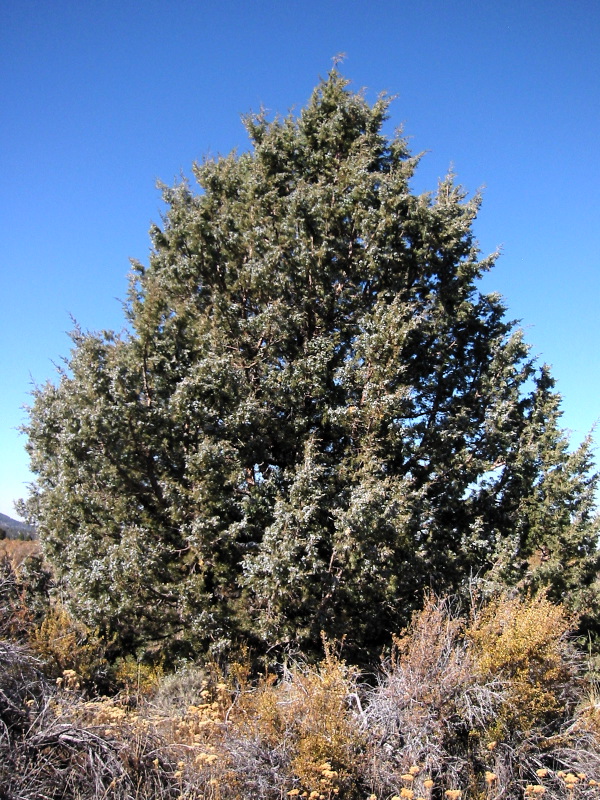
Juniperus occidentalis is a shrub or small tree 4–15 meters (13–49 ft) tall. Exceptionally tall specimens can be found in the John Day area of Oregon in excess of 26–28 m (85–92 ft) tall.
The shoots are of moderate thickness among junipers, at 1–1.6 millimeters (1⁄32–1⁄16 in) diameter. The juvenile leaves (on young seedlings only) are needle-like and 5–10 mm (3⁄16–13⁄32 in) long. Arranged in opposite decussate pairs or whorls of three, the adult leaves are scale-like, 1–2 mm long (5 mm on lead shoots) and 1–1.5 mm broad. The cones are berry-like, 5–10 mm in diameter, blue-brown with a whitish waxy bloom, and mature in about 18 months. The male cones are 2–4 mm long and shed their pollen in early spring. The plants are about half monoecious (with both sexes on the same plant) and half dioecious (producing cones of only one sex).
The cones contain 1–3 seeds, the majority of which germinate in springtime. In Oregon, where most of the species resides, seeds germinate in April and the foliage emerges in June. Seed dispersal is conducted by water runoff, gravity, and animals.
Further to the south, Juniperus grandis (the Sierra juniper) is sometimes treated as a variety of J. occidentalis (as J. occidentalis var. australis). J. grandis is 12–26 m (39–85 ft) tall with a trunk up to 3 m (10 ft) in diameter. The cones are 5–9 mm (3⁄16–11⁄32 in) wide. Most plants are dioecious, but about 5–10% are monoecious. The two plants are also chemically distinct. J. grandis can be found in California and westernmost Nevada, south of 40° 30' N latitude in the Sierra Nevada and San Bernardino Mountains. The oldest and largest specimen of J. grandis is 26 m (85 ft) tall and 3.88 m (12 ft 9 in) wide, perhaps 3,000 years old, and located in California's Stanislaus National Forest.
Common names in English for this species include "western juniper", "sierra juniper", "western red cedar", and "yellow cedar". In the United States it is also occasionally called "pencil wood", likely for a common use. In the Klamath language this tree is called q'eeLo.
J. occidentalis can be found in the Western United States—specifically southeast Washington, eastern and central Oregon, southwest Idaho, northeastern California and extreme northwest Nevada, north of 40° 30' N latitude, east of the Cascade Range.
It usually occurs on dry, rocky sites where there is less competition from larger species like ponderosa pine and coast Douglas-fir. Annual precipitation can be as low as 20 centimetres (7+7⁄8 in). In very exposed positions at high altitude, it can assume a krummholz habit, growing low to the ground even when mature with a wide trunk. Hybrids with J. osteosperma are occasionally found.
Juniperus occidentalis
Juniperus occidentalis, known as the western juniper, is a shrub or tree native to the Western United States, growing in mountains at altitudes of 800–3,000 meters (2,600–9,800 ft) and rarely down to 100 m (330 ft). It is listed as Least Concern on the IUCN Red List because it is a widespread species with an increasing population.
Juniperus occidentalis is a shrub or small tree 4–15 meters (13–49 ft) tall. Exceptionally tall specimens can be found in the John Day area of Oregon in excess of 26–28 m (85–92 ft) tall.
The shoots are of moderate thickness among junipers, at 1–1.6 millimeters (1⁄32–1⁄16 in) diameter. The juvenile leaves (on young seedlings only) are needle-like and 5–10 mm (3⁄16–13⁄32 in) long. Arranged in opposite decussate pairs or whorls of three, the adult leaves are scale-like, 1–2 mm long (5 mm on lead shoots) and 1–1.5 mm broad. The cones are berry-like, 5–10 mm in diameter, blue-brown with a whitish waxy bloom, and mature in about 18 months. The male cones are 2–4 mm long and shed their pollen in early spring. The plants are about half monoecious (with both sexes on the same plant) and half dioecious (producing cones of only one sex).
The cones contain 1–3 seeds, the majority of which germinate in springtime. In Oregon, where most of the species resides, seeds germinate in April and the foliage emerges in June. Seed dispersal is conducted by water runoff, gravity, and animals.
Further to the south, Juniperus grandis (the Sierra juniper) is sometimes treated as a variety of J. occidentalis (as J. occidentalis var. australis). J. grandis is 12–26 m (39–85 ft) tall with a trunk up to 3 m (10 ft) in diameter. The cones are 5–9 mm (3⁄16–11⁄32 in) wide. Most plants are dioecious, but about 5–10% are monoecious. The two plants are also chemically distinct. J. grandis can be found in California and westernmost Nevada, south of 40° 30' N latitude in the Sierra Nevada and San Bernardino Mountains. The oldest and largest specimen of J. grandis is 26 m (85 ft) tall and 3.88 m (12 ft 9 in) wide, perhaps 3,000 years old, and located in California's Stanislaus National Forest.
Common names in English for this species include "western juniper", "sierra juniper", "western red cedar", and "yellow cedar". In the United States it is also occasionally called "pencil wood", likely for a common use. In the Klamath language this tree is called q'eeLo.
J. occidentalis can be found in the Western United States—specifically southeast Washington, eastern and central Oregon, southwest Idaho, northeastern California and extreme northwest Nevada, north of 40° 30' N latitude, east of the Cascade Range.
It usually occurs on dry, rocky sites where there is less competition from larger species like ponderosa pine and coast Douglas-fir. Annual precipitation can be as low as 20 centimetres (7+7⁄8 in). In very exposed positions at high altitude, it can assume a krummholz habit, growing low to the ground even when mature with a wide trunk. Hybrids with J. osteosperma are occasionally found.
Recent media
Recent media