



Community hub
Recent from talks
Knowledge base stats:
Talk channels stats:
Members stats:
Junk (ship)
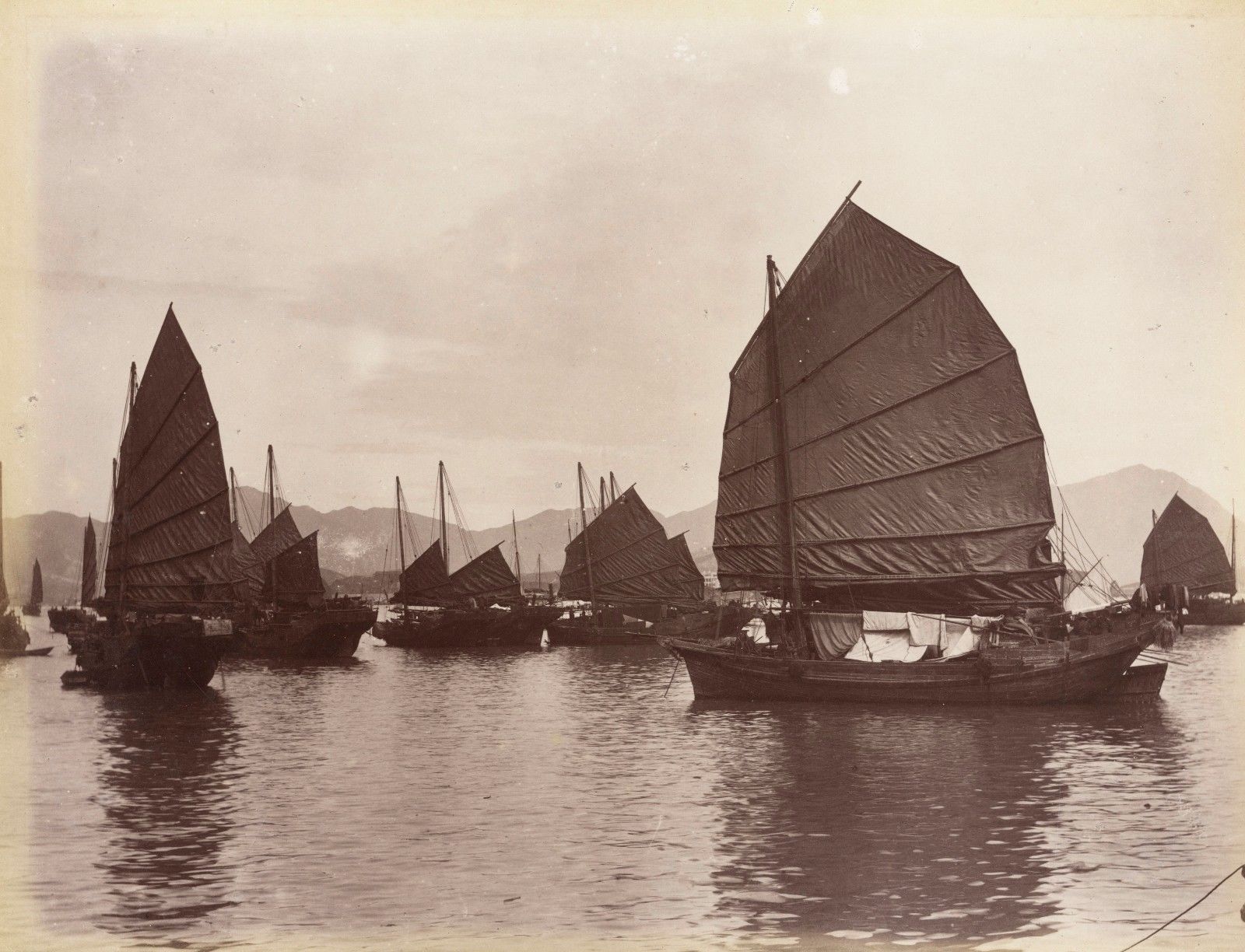
A junk (Chinese: 䑸; pinyin: zōng) is a type of Chinese sailing ship characterized by a central rudder, an overhanging flat transom, watertight bulkheads, and a flat-bottomed design. They are also characteristically built using iron nails and clamps. The term applies to many types of small coastal or river ships, usually serving as cargo ships, pleasure boats, or houseboats, but also going up in size up to large ocean-going vessels. There can be significant regional variations in the type of rig and the layout of the vessel.
Chinese junks were originally only fluvial and had square sails, but by the Song dynasty (c. 960 to 1279), they adopted ocean-going technologies acquired from Southeast Asian k'un-lun po trade ships. Tanja sails and fully battened junk rigs were introduced to Chinese junks by the 12th century CE.
Similar designs to the Chinese junk were also adopted by other East Asian countries, most notably Japan, where junks were used as merchant ships to trade goods with China and Southeast Asia.
The English word "junk" comes from Portuguese junco from Malay jong. The word originally referred to the Javanese djong, very large trading ships that the Portuguese first encountered in Southeast Asia. It later also included the smaller flat-bottomed Chinese chuán, even though the two were markedly different vessels. After the disappearance of the djong in the 17th century, the meaning of "junk" (and other similar words in European languages) came to refer exclusively to the Chinese ship.
The Chinese chuán and the Southeast Asian djong are frequently confused with each other and share some characteristics, including large cargo capacities, multiple (two to three) superimposed layers of hull planks, and multiple masts and sails. However the two are readily distinguishable from each other by two major differences. The first is that Southeast Asian (Austronesian) ships are built exclusively with lugs, dowels, and fiber lashings (lashed lug), in contrast to Chinese ships which are always built with iron nails and clamps. The second is that Chinese ships since the first century AD are all built with a central rudder. In contrast, Southeast Asian ships use double lateral rudders.
The development of the sea-going Chinese chuán (the "junk" in modern usage) in the Song dynasty (c. 960 to 1279) is believed to have been influenced by regular contacts with sea-going Southeast Asian ships (the k'un-lun po of Chinese records) in trading ports in southern China from the 1st millennium CE onward, particularly in terms of the rigging, multiple sails, and the multiple hull sheaths. However, the chuán also incorporates distinctly Chinese innovations from their indigenous river and coastal vessels (namely watertight compartments and the central rudders). "Hybrid" ships (referred to as the "South China Sea tradition") integrating technologies from both the chuán and the djong also started to appear by the 15th century.
Iconographic remains show that Chinese ships before the 12th century used square sails. A ship carving from a stone Buddhist stele shows a ship with square sail from the Liu Sung dynasty or the Liang dynasty (c. 5th or 6th century). Dunhuang cave temple no. 45 (from the 8th or 9th century) features large sailboats and sampans with inflated square sails. A wide ship with a single sail is depicted in the Xi'an mirror (after the 9th or 12th century). Eastern lug sail, which used battens and is commonly known as "junk rig", was likely not Chinese in origin: The oldest depiction of a battened junk sail comes from the Bayon temple at Angkor Thom, Cambodia. From its characteristics and location, it is likely that the ship depicted in Bayon was a Southeast Asian ship. The Chinese themselves may have adopted them around the 12th century CE.
The full-length battens of the junk sail keep the sail flatter than ideal in all wind conditions. Consequently, their ability to sail close to the wind is poorer than other fore-and-aft rigs.
Hub AI
Junk (ship) AI simulator
(@Junk (ship)_simulator)
Junk (ship)
A junk (Chinese: 䑸; pinyin: zōng) is a type of Chinese sailing ship characterized by a central rudder, an overhanging flat transom, watertight bulkheads, and a flat-bottomed design. They are also characteristically built using iron nails and clamps. The term applies to many types of small coastal or river ships, usually serving as cargo ships, pleasure boats, or houseboats, but also going up in size up to large ocean-going vessels. There can be significant regional variations in the type of rig and the layout of the vessel.
Chinese junks were originally only fluvial and had square sails, but by the Song dynasty (c. 960 to 1279), they adopted ocean-going technologies acquired from Southeast Asian k'un-lun po trade ships. Tanja sails and fully battened junk rigs were introduced to Chinese junks by the 12th century CE.
Similar designs to the Chinese junk were also adopted by other East Asian countries, most notably Japan, where junks were used as merchant ships to trade goods with China and Southeast Asia.
The English word "junk" comes from Portuguese junco from Malay jong. The word originally referred to the Javanese djong, very large trading ships that the Portuguese first encountered in Southeast Asia. It later also included the smaller flat-bottomed Chinese chuán, even though the two were markedly different vessels. After the disappearance of the djong in the 17th century, the meaning of "junk" (and other similar words in European languages) came to refer exclusively to the Chinese ship.
The Chinese chuán and the Southeast Asian djong are frequently confused with each other and share some characteristics, including large cargo capacities, multiple (two to three) superimposed layers of hull planks, and multiple masts and sails. However the two are readily distinguishable from each other by two major differences. The first is that Southeast Asian (Austronesian) ships are built exclusively with lugs, dowels, and fiber lashings (lashed lug), in contrast to Chinese ships which are always built with iron nails and clamps. The second is that Chinese ships since the first century AD are all built with a central rudder. In contrast, Southeast Asian ships use double lateral rudders.
The development of the sea-going Chinese chuán (the "junk" in modern usage) in the Song dynasty (c. 960 to 1279) is believed to have been influenced by regular contacts with sea-going Southeast Asian ships (the k'un-lun po of Chinese records) in trading ports in southern China from the 1st millennium CE onward, particularly in terms of the rigging, multiple sails, and the multiple hull sheaths. However, the chuán also incorporates distinctly Chinese innovations from their indigenous river and coastal vessels (namely watertight compartments and the central rudders). "Hybrid" ships (referred to as the "South China Sea tradition") integrating technologies from both the chuán and the djong also started to appear by the 15th century.
Iconographic remains show that Chinese ships before the 12th century used square sails. A ship carving from a stone Buddhist stele shows a ship with square sail from the Liu Sung dynasty or the Liang dynasty (c. 5th or 6th century). Dunhuang cave temple no. 45 (from the 8th or 9th century) features large sailboats and sampans with inflated square sails. A wide ship with a single sail is depicted in the Xi'an mirror (after the 9th or 12th century). Eastern lug sail, which used battens and is commonly known as "junk rig", was likely not Chinese in origin: The oldest depiction of a battened junk sail comes from the Bayon temple at Angkor Thom, Cambodia. From its characteristics and location, it is likely that the ship depicted in Bayon was a Southeast Asian ship. The Chinese themselves may have adopted them around the 12th century CE.
The full-length battens of the junk sail keep the sail flatter than ideal in all wind conditions. Consequently, their ability to sail close to the wind is poorer than other fore-and-aft rigs.