Hubbry Logo
Transom (nautical)Transom (nautical)Main
Open search
Transom (nautical)
Community hub
Transom (nautical)
logo
8 pages, 0 posts
0 subscribers
Be the first to start a discussion here.
Transom (nautical)
Transom (nautical)
from Wikipedia
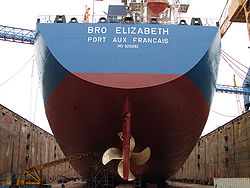
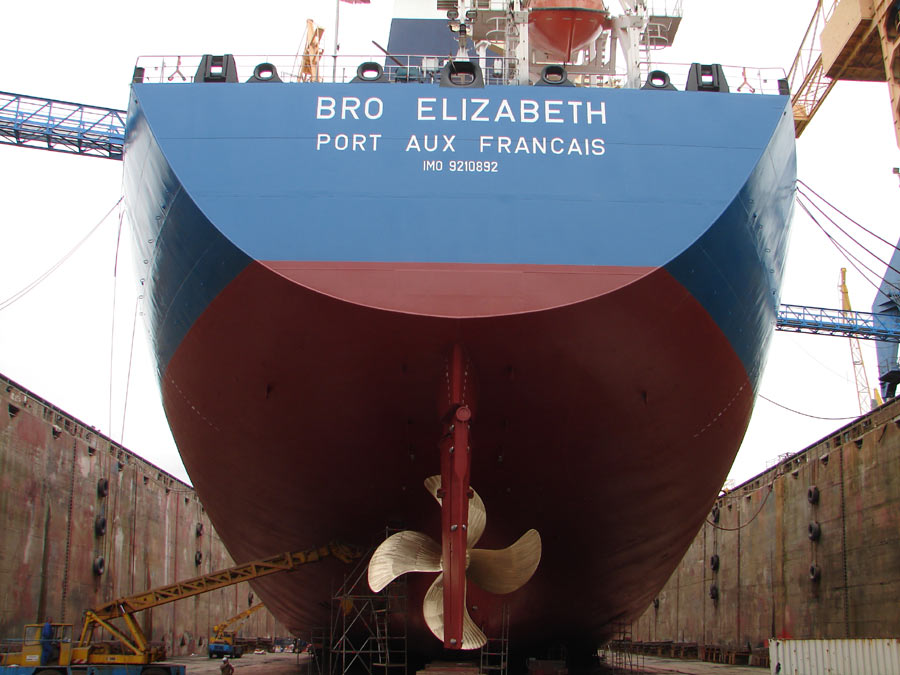
Vertical transom and stern of a modern cargo ship

A transom is the aft transverse surface of the hull of some boats and ships forming its stern. Adding both strength and width to the stern, a transom may be flat or curved, and vertical, raked aft (known as an overhung or "counter" stern), or raked forward (and "reversed",[1] also known as retroussé).[2] In small boats and yachts, a flat termination of the stern is typically above the waterline, but large commercial vessels often exhibit vertical transoms that dip slightly beneath the water.[3]

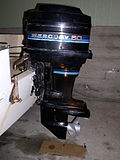
On smaller boats such as dinghies, transoms may be used to support a rudder, outboard motor, or other accessory. On some yachts the transom may include a hinged swim platform, and a lazarette for deck items and leisure toys.[4]

Etymology

[edit]

The term was used as far back as Middle English in the 1300s, having come from Latin transversus (transverse) via Old French traversain (set crosswise).[2][5]

History

[edit]

Design

[edit]
Traditional timber construction with horizontal transom members in pale yellow-green (6) and turquoise (7)
[edit]

References

[edit]
Revisions and contributorsEdit on WikipediaRead on Wikipedia
from Grokipedia
In nautical architecture, a transom is the flat or slightly curved transverse surface at the of a or ship, serving as a structural reinforcement that connects the hull sides and adds strength, width, and stability to the rear section. This component, typically positioned above the on smaller vessels, anchors outboard motors or other systems, disperses , and prevents hull flexing through integrated stringers and bulkheads. Derived from the Latin term for "cross-wise," the word transom originally referred to architectural crosspieces before being adapted to maritime use, reflecting its role as a beam-like element closing off the stern. Transoms have evolved significantly in design to meet varying performance needs, with common types including the full or flat transom, which provides a broad, stable platform ideal for mounting accessories and larger outboards; the notched transom, featuring a cut-out to optimize depth and water flow; and the reverse or sloped transom, which angles aft to improve , reduce drag, and facilitate features like swim platforms on modern recreational boats. Constructed from durable materials such as reinforced , aluminum, or marine-grade to resist and , transoms are critical for overall vessel integrity, acting as a barrier against waves while supporting additional fixtures like ladders, drains, and . Their importance extends to safety and maintenance, as undetected issues like cracks, rot, or from stress or manufacturing defects can compromise and , necessitating regular inspections and sealing of penetrations to ensure longevity. In sailboats and high-performance craft, specialized variants like cutaway transoms further enhance hydrodynamics by minimizing resistance and improving maneuverability.

Overview

Definition

In nautical terminology, a transom refers to the aft transverse surface of a or ship's hull that forms the , typically flat or slightly curved to provide structural reinforcement and increase beam width at the rear. This surface closes off the hull's after end, distinguishing it from other stern configurations such as the counter stern, which features an overhanging curved profile above the . Key characteristics of the transom include its position relative to the : in small boats and recreational vessels, it generally sits above the waterline for accessibility and to avoid drag, while in larger commercial ships, it may extend to or dip below the waterline to enhance hydrodynamic efficiency and deck space. Constructed from durable materials like reinforced , aluminum, or , the transom varies in shape—often rectangular or rounded—but remains a vertical or near-vertical reinforcement that integrates seamlessly with the hull sides. The transom serves essential functions, acting as a primary mounting point for rudders, propellers, outboard motors, and accessories such as ladders or swim platforms, while contributing to overall hull stability by distributing forces and preventing flexing at the . It also helps seal the hull against water ingress and supports the vessel's system by absorbing engine thrust. Evolving from early transverse reinforcements in boatbuilding, the transom has become a fundamental element in modern hull design.

Role in Hull Integrity

The transom serves as a critical at the of a or ship, enhancing overall hull integrity by resisting torsional forces that arise from uneven loading, wave impacts, or stresses. In outboard-powered vessels, the transom experiences significant torsion loads due to the motor's weight and , necessitating reinforced construction such as additional laminations and integration with longitudinal stringers to form a structure that distributes these forces across the hull. This reinforcement not only prevents deformation but also maintains the hull's rigidity, ensuring the vessel can withstand dynamic stresses without compromising seaworthiness. Additionally, the transom's broad, flat design contributes to reserve at the , which counteracts the tendency for the aft section to squat under heavy loads or during , thereby preserving trim and stability. Hydrodynamically, the transom influences water flow at the , where its shape determines and drag characteristics. A vertical transom, extending flat to the , promotes clean separation of the flow with sharp edges, minimizing and reducing resistance in high-speed planing hulls by allowing the to "clear" the water, which eliminates backwash and eddies that would otherwise increase drag. In contrast, a raked transom, which slopes backward, enhances to improve stability in following seas and at moderate speeds, though it may introduce slightly higher drag compared to vertical designs due to less optimal flow alignment; this trade-off favors form stability and speed maintenance in vessels over pure hydrodynamic . These variations allow naval architects to tailor the transom for needs, such as prioritizing speed in powerboats or balance in yachts. The transom integrates seamlessly with the hull's primary components to form a watertight barrier and unified structure. It connects directly to the via a heavy center or , providing longitudinal strength, while vertical stiffeners and deep floors link it to transverse , ensuring even load distribution and preventing flexing. or is fastened along the transom's edges, often with overlapping seams sealed for watertightness, creating a continuous that protects against ingress while transmitting hydrodynamic and structural loads forward to the and . This integration simplifies construction compared to curved , as the flat transom requires fewer cant , yet it maintains the hull's overall integrity under operational stresses.

Origins

Etymology

The term "transom" derives from forms such as "traunsom" or "transyn," attested from the mid-14th century, referring to a crossbeam or spanning an opening. It was likely borrowed from "traversain" (a crosswise piece or beam), which stems ultimately from Latin "transversus," meaning "crosswise," "transverse," or "lying across." This etymological root emphasizes the structural notion of something placed horizontally across a space, a that originated in architectural contexts before extending to other technical fields. In nautical usage, "transom" emerged as specialized in by the 15th and 16th centuries to denote the transverse or flat surface at the of a vessel, providing strength and width to the hull's aft section. Early attestations of this sense appear in English records related to naval construction, reflecting the term's adaptation from general to maritime applications during the late medieval and early modern periods. While the nautical "transom" shares its crosswise etymology with non-maritime uses—such as the architectural transom denoting a over a or dividing a —the applications diverge significantly, with the former focused on hull integrity and the latter on building fixtures. This linguistic evolution highlights how the core idea of transverse support transferred from land-based structures to seafaring designs in medieval shipbuilding.

Early Historical Development

The earliest precursors to the transom appeared in ancient shipbuilding as transverse stern boards that provided stability and structural reinforcement. In Egyptian vessels from around 2000 BCE, such as Nile river boats, large row-boats featured flat sterns to enhance balance during navigation, serving as proto-transoms for hull integrity. Roman ships from the 1st century CE incorporated similar transverse elements at the stern to support sweep rudders and maintain form in double-ended designs. During the medieval period, transoms evolved significantly in European clinker-built ships. In the Viking era (8th–11th centuries), ships like longships retained curved sterns for beaching and maneuverability, but lacked true transoms; however, the shift to straight sternposts laid groundwork for later developments. By the , carracks introduced broader sterns with transom configurations, allowing for expanded cargo holds and the mounting of , which transformed for trade and warfare. Key milestones in transom development occurred during the Age of Sail (17th–18th centuries), when integrated transoms into the ship's frame for enhanced strength. The (launched 1765), a British ship-of-the-line, exemplifies this with its 12 horizontal transom beams extending from the to the sternpost, providing rigidity for its 104 guns. In the , designs shifted toward flatter transoms to accommodate ironclad construction and mounting, improving hydrodynamic efficiency in early steam-powered vessels. These advancements were primarily driven by the demands of during the Age of Sail, where transoms enabled secure platforms and bolstered hull strength against fire. The term "transom" itself roots in "transverse," reflecting its role as a crosswise stern reinforcement.

Design and Construction

Types and Variations

Transoms in nautical design are categorized by their geometric shapes and structural configurations, which influence hydrodynamic performance and overall hull form. The flat transom, also known as a plumb or vertical transom, features a broad, surface at the , maximizing beam width at the aft end for structural simplicity and ease of mounting propulsion systems or accessories. Curved transoms incorporate a rounded profile that tapers smoothly from the hull, promoting a more gradual water exit to minimize and wake formation. This configuration enhances flow uniformity around the , reducing drag in certain conditions compared to sharper edges. Raked transoms introduce angular variations to the basic form, altering the 's inclination relative to the hull's centerline. Aft-raked transoms, often termed overhung or counter sterns, angle backward to create an overhang, which can streamline water flow for reduced resistance and increased speed potential. Forward-raked transoms, known as reverse designs, angle inward or forward, featuring a reversed sheer line that aids in wave and stability by distributing hydrodynamic forces more evenly. Such raking can enhance hull integrity by improving load distribution under dynamic conditions. Notched transoms feature a cut-out section at the lower portion of the , commonly used in powerboats with outboard motors to optimize depth, reduce draft, and minimize water spray while allowing the engine to sit higher for better . Cutaway transoms have a V-shaped portion removed from the , typically found on sailboats to decrease drag, improve maneuverability, and enhance hydrodynamic efficiency by reducing wetted surface area. Other configurations distinguish between true transom sterns and alternatives like the canoe stern, which lacks a distinct transom altogether, instead tapering to a pointed double-ended form for seamless hydrodynamic continuity and lower drag profiles. True transom sterns, whether plumb or angled, provide a defined vertical or that contrasts with the canoe's streamlined absence of a flat aft surface, allowing for varied effects on and stern wave interaction.

Materials and Building Methods

In traditional wooden boat construction, transoms were typically framed using durable hardwoods such as white oak for its strength and resistance to rot, while was favored for its workability and aesthetic appeal in visible areas like the transom face. Planking adjacent to the transom often employed lighter woods like western red cedar, selected for its lightweight nature and natural oils that aid in water resistance. To waterproof these wooden elements, builders applied pitch or , heated and poured into seams to create a flexible, impermeable barrier against ingress. Modern transom construction has shifted toward synthetic composites for enhanced durability and reduced maintenance. Fiberglass-reinforced plastics, often molded in a single piece using polyester or epoxy resins layered over a core, provide corrosion resistance and structural integrity without the need for extensive framing. In metal-hulled vessels, transoms are commonly fabricated from aluminum or steel plates, welded directly to the hull for seamless integration and high impact tolerance. Foam-core sandwich constructions, utilizing closed-cell foams like Airex or Coosa composites encapsulated between fiberglass skins, offer a lightweight yet rigid alternative that minimizes flex and weight while maximizing strength-to-weight ratios. Building methods for transoms emphasize precise assembly to ensure load distribution. In wooden hulls, carvel planking—where edge-to-edge planks are fastened over transverse frames—forms the transom's base, allowing for a smooth, watertight surface when caulked. For curved designs, laminating techniques involve gluing thin strips of wood or veneer around a bent form under pressure, creating compound curves without cracking. Reinforcement integrates the transom with longitudinal stringers and transverse bulkheads, bonded via adhesives or fasteners to transfer stresses from the to the hull's structure. Key engineering processes guide transom fabrication for safety and performance. calculations determine material thickness and frame spacing based on vessel dimensions, using formulas like the scantling number Sn=LOA×Beam×Depth28.32S_n = \frac{LOA \times Beam \times Depth}{28.32} (in meters) to scale components proportionally to overall size and expected loads. Sealing at hull-transom joints employs adhesives such as 5200, applied as a compound and secured with mechanical fasteners, to prevent leaks by accommodating minor flex while maintaining a waterproof bond. These methods ensure the transom's shape variations, such as flat versus curved profiles, can influence material selection for optimal moldability.

Modern Applications

In Recreational and Small Boats

In recreational and small boats, the transom primarily serves as the attachment point for outboard motors, which are common in vessels like dinghies, , and runabouts. Reinforced backing plates, typically made of durable aluminum or composite materials, are installed within or behind the transom to distribute the motor's weight and vibrational stresses, preventing cracking or flexing during operation. Splash wells—recessed enclosures around the motor mounting area—further protect the engine from spray and debris, allowing the to plane efficiently without water ingress. These features are standard in designs adhering to industry standards, ensuring safe motor heights of 15 to 25 inches (corresponding to short, long, and extra-long shafts) depending on hull type. To mitigate trailering stresses, transom savers are widely employed, particularly on lightweight recreational boats where the outboard's weight can exceed the hull's aft buoyancy. These adjustable devices, such as spring-loaded bars or wedge supports, extend from the motor to the trailer frame, absorbing road shocks and transferring loads away from the transom; manufacturers like Tracker and Ranger recommend them to extend transom longevity. Hinged swim platforms, often integrated into the transom on yachts and larger runabouts, fold down via stainless steel arms and hydraulic or manual mechanisms, providing safe water access while capped with teak or fiberglass for durability. Lazarette compartments within the transom structure offer watertight storage for lines, fenders, and safety gear, accessible via sealed hatches. Non-skid surfacing, applied via textured gelcoat or adhesive pads, enhances traction on these platforms, reducing slip risks during boarding or swimming. Contemporary design trends emphasize wide, flat transoms in powerboats to bolster lateral stability at planing speeds above 15 knots, enabling smoother handling in turns and better for towing watersports equipment. Lightweight composites, including cores reinforced with , have become prevalent for transom construction, offering up to 50% weight savings over traditional while maintaining rigidity for planing hulls that lift onto the water's surface. This approach supports efficient fuel use and higher top speeds in vessels like bass boats and center consoles. Such transoms enhance capacity by providing a broad, base for skiers or tubers, with beam widths often exceeding 8 feet for improved balance under load. However, if not hydrodynamically shaped—such as with improper deadrise angles—they can increase drag from vortex formation at the , potentially reducing efficiency in semi-planing conditions.

In Commercial and Large Vessels

In commercial and large vessels, the transom forms a critical component of the frame, which is typically cast, forged, or fabricated from heavy plates and sections to provide robust support for shafts and rudders. This reinforcement is essential in ships, where the frame extends aft to accommodate large propellers and multi-rudder configurations, ensuring structural integrity under high torsional loads from systems. Submerged transom designs are commonly employed in tankers and bulk carriers to optimize hydrodynamic flow at design draughts, reducing drag by minimizing the wetted surface at the while maintaining stability for heavy loads. These configurations allow for better water flow around the hull, particularly in full-block vessels where the transom remains below the even at rest, contributing to overall efficiency in slow-speed operations. Regulatory compliance is paramount, with classification societies such as the (ABS) and mandating specific requirements for stern frames and transoms to withstand extreme loads in heavy seas, including slamming and whipping effects. ABS Rules for Building and Classing Steel Vessels (Part 3, Hull Construction and Equipment) outline minimum thicknesses, welding standards, and fatigue assessments for these elements, ensuring vessels meet international safety criteria under the International Convention for the Safety of Life at Sea (SOLAS). In some designs that incorporate both transoms and bulbous bows to enhance ; for instance, in pure car and truck carriers, this combination can reduce at operational speeds, as demonstrated in studies. Modern innovations focus on hydrodynamic optimization, with faired-edge transoms designed to minimize and resistance, particularly in vessels operating near the . These features, often informed by computational simulations, reduce viscous drag by promoting smoother at the . In high-speed ferries, transom paired with semi-planing hulls enable efficient lift generation at speeds exceeding 20 knots, allowing for shallower draughts and improved passenger throughput without excessive power demands. Key challenges include corrosion resistance in saltwater environments, addressed through impressed current systems that apply controlled electrical currents to the hull plating, including the transom, to prevent galvanic degradation of components. For damage from collisions, repair techniques typically involve drydocking for assessment, followed by cutting out deformed sections of the stern frame, in replacement plates, and non-destructive testing to verify , in accordance with International Association of Classification Societies (IACS) guidelines. These repairs prioritize restoring original scantlings to avoid compromising propulsion alignment or hull girder strength. Contemporary transom designs in large vessels have evolved from earlier flat configurations to incorporate these advanced adaptations for enhanced durability and performance.

References

Add your contribution
Related Hubs
User Avatar
No comments yet.