Main page

Community Hub0 subscribers
Community Hub
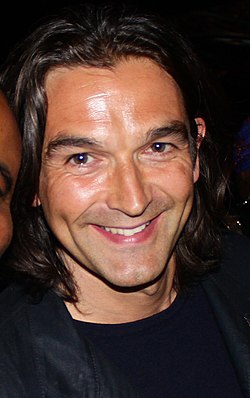
Justin Chadwick
View on Wikipediafrom Wikipedia
Error loading Wikipedia content
Justin Chadwick
View on Grokipediafrom Grokipedia
Early life and beginnings
Upbringing and family influences
Justin Chadwick was born on 6 December 1968 in Salford, Lancashire, England.[2] He was raised in Manchester and later Bolton, areas characterized by their working-class industrial heritage in northern England.[7] His mother worked as an art teacher, which exposed him to creative pursuits from an early age.[7] Chadwick attended Ladybridge Primary School, Edgworth Primary School, and Turton High School in the Bolton area, residing in Edgworth until 1987.[8] A pivotal family and educational influence came through his English teacher, Mrs. Hanson, at Turton High School, who encouraged him at age 11 to join Bolton Little Theatre.[8] There, under the guidance of theatre director Tom Campbell, he portrayed Billy Casper in a production of Kes, fostering his early passion for storytelling and performance.[8] This theatrical involvement, building on his mother's artistic background, shaped his trajectory toward acting and eventual directing, as youth theatre expanded his horizons beyond his local environment.[7]Initial acting pursuits
Chadwick initiated his acting endeavors at age eleven by joining Bolton Little Theatre, where he portrayed the lead role of Billy Casper in a stage adaptation of Kes (based on Barry Hines' novel A Kestrel for a Knave).[7][8] This early involvement in local youth theater fostered his interest in performance, drawing from working-class narratives resonant with his Manchester-area upbringing.[9] By age fourteen, he advanced to Manchester Youth Theatre, securing the role of Jan in the world premiere of The Silver Sword at Oldham Coliseum Theatre.[7] These theatrical experiences, including participation in the National Student Drama Festival during college, provided foundational training amid limited formal opportunities for young actors in the region.[10] Chadwick formalized his pursuits through higher education, earning a First Class Honours degree in Performing Arts Drama from the University of Leicester around the late 1980s.[10][11] While studying, he sustained acting gigs to finance personal short films, marking an early overlap with directing interests; his professional screen debut followed in 1991 with an uncredited role in Hanif Kureishi's London Kills Me.[2][9]Professional transition
Acting career highlights
Chadwick began his professional acting career in theatre at the age of 11, joining Bolton Little Theatre where he portrayed Billy Casper in a production of Kes.[10] He subsequently joined Manchester Youth Theatre and played the role of Jan in the world premiere of Arnold Wesker's The Kitchen.[10] His screen debut came in 1991 with the lead role of Clint Eastwood, a young Londoner attempting to escape the city's drug underworld, in Hanif Kureishi's London Kills Me.[12] The film, which also starred Steven Mackintosh and featured supporting performances by Fiona Shaw and Brad Dourif, marked Chadwick's entry into feature films amid mixed critical reception for its exploration of urban fringe life.[13] Additional film credits include a role in The Loss of Sexual Innocence.[2] On television, Chadwick appeared in guest roles during the early 1990s, including as Derek in the Heartbeat episode "Old, New, Borrowed, Blue" (1992), as well as in episodes of Dangerfield and Dalziel and Pascoe.[3] These appearances in British crime and period dramas represented his primary small-screen work before transitioning to directing in the mid-1990s.[14]Entry into directing
Chadwick, born on December 1, 1968, in Manchester, England, initially pursued acting to gain industry experience and fund his early short films, while having directed theater during college.[9] He transitioned to directing professionally at age 25 with his debut feature-length project, the 1993 television movie Family Style, which he also acted in and which starred Ewan McGregor.[10][15][2] Following this, Chadwick ceased acting upon securing steady directing work and helmed episodes of British television series, including EastEnders, Byker Grove, The Bill, Spooks, and Red Cap, building technical proficiency in serialized drama.[9][16] These early credits, spanning the mid-1990s to early 2000s, emphasized his shift toward narrative-driven television production over performance roles.[11]Television directing
Early television credits
Chadwick's directorial debut came with the 1993 television short film Family Style, a 30-minute drama starring Ewan McGregor as a young man grappling with his brother's death, which won the Lloyds Bank Film Challenge.[17][14] In 1996, he directed and performed in Shakespeare Shorts, a series adapting the playwright's works.[2] He followed with episodes of the BBC children's drama Byker Grove in 1998, focusing on teen storylines in a Newcastle community center.[7][14] In 1999, Chadwick directed episodes of the ITV police procedural The Bill, handling procedural crime narratives.[6][11] Early 2000s credits included episodes of the BBC soap EastEnders, the espionage thriller Spooks (2002), and the legal drama Helen West (2002).[14][16] He also helmed episodes of military drama Red Cap (2004) and crime prevention series Murder Prevention (2004), both for Channel 5, building experience in suspenseful, character-driven television formats.[16][14] These assignments, often involving 1-2 episodes per series, honed his skills in fast-paced British TV production schedules.[11]Breakthrough projects and acclaim
Chadwick's breakthrough in television directing came with the 2005 BBC miniseries Bleak House, an adaptation of Charles Dickens' novel, for which he helmed nine of the fifteen episodes. The series, starring Gillian Anderson and Denis Lawson, innovated Dickens adaptations through its fast-paced, fragmented narrative and modern visual style, earning widespread praise for revitalizing the classic story. Bleak House won the BAFTA Television Award for Best Drama Serial in 2006, with Chadwick receiving a nomination for Best Director-Fiction Direction at the same ceremony.[18] The project garnered Chadwick an Emmy nomination for Outstanding Directing for a Miniseries, Movie or a Dramatic Special in 2006, as well as a Royal Television Society Breakthrough Award - Behind the Screen.[19][4] It also secured the Banff Rockie Award for Best Mini-Series, highlighting the production's international impact.[18] These accolades marked a pivotal elevation in Chadwick's career, transitioning him from episodic television to high-profile prestige dramas and establishing his reputation for handling complex literary adaptations with technical precision.[6]Feature films
Debut and period dramas
Chadwick's feature film debut was The Other Boleyn Girl (2008), a historical drama adapted from Philippa Gregory's 2001 novel of the same name and scripted by Peter Morgan.[20] The film depicts the rivalry between sisters Anne (Natalie Portman) and Mary Boleyn (Scarlett Johansson) for the affections of King Henry VIII (Eric Bana) amid Tudor court intrigue, emphasizing themes of ambition, betrayal, and power dynamics in 16th-century England.[21] Produced with a budget of $35 million, it earned $26.8 million domestically and $78.2 million worldwide upon its wide U.S. release on February 29, 2008.[22] [20] Critics noted the film's visual opulence in recreating period settings but faulted its melodramatic tone and deviations from historical records, such as exaggerated sibling rivalry and simplified political motivations, rendering it more akin to a romantic soap opera than rigorous history.[21] Chadwick, transitioning from television, prioritized atmospheric tension and performances over strict fidelity, drawing on his experience with costume-heavy BBC adaptations like Bleak House (2005).[1] Chadwick revisited period drama with Tulip Fever (2017), directed from a screenplay by Deborah Moggach and Tom Stoppard, based on Moggach's 1999 novel.[23] Set during the 1637 Dutch Tulip Mania economic bubble in Amsterdam, the film follows a young wife (Alicia Vikander) and her artist lover (Dane DeHaan) scheming to escape her marriage by speculating on tulip bulbs, amid a cast including Christoph Waltz and Holliday Grainger.[24] Filming occurred in 2014 but faced a three-year delay due to distributor concerns over test screenings and reshoots, leading to a limited U.S. release on September 1, 2017.[25] Despite lavish production design evoking 17th-century Dutch aesthetics, Tulip Fever underperformed commercially and critically, with reviewers highlighting narrative incoherence, rushed plotting, and failure to meaningfully engage the historical bubble's economic lessons beyond backdrop.[24] Its box office totals remained modest, reflecting challenges in marketing a delayed, ensemble-driven costume piece. These early features established Chadwick's affinity for visually rich historical narratives, though both underscored tensions between entertainment and historical precision in the genre.[25]Biographical and historical films
Chadwick directed The Other Boleyn Girl (2008), a historical drama adapted from Philippa Gregory's novel that dramatizes the rivalry between sisters Mary Boleyn (Scarlett Johansson) and Anne Boleyn (Natalie Portman) for the affections of King Henry VIII (Eric Bana) amid Tudor court intrigue.[21] The film emphasizes themes of ambition, betrayal, and power, though it takes fictional liberties with historical events for narrative effect.[26] In The First Grader (2010), Chadwick helmed a biographical drama recounting the real-life story of Kimani Maruge, an 84-year-old Kenyan Mau Mau freedom fighter who, in 2003, enrolled in primary school after the government introduced free universal education, competing with much younger students for limited spots.[27] Featuring Oliver Litondo as Maruge and Naomie Harris as his teacher, the film underscores resilience and the pursuit of literacy in post-colonial Kenya, drawing from Maruge's documented experiences.[28] Chadwick's Mandela: Long Walk to Freedom (2013) is a biographical epic spanning Nelson Mandela's life from rural childhood through anti-apartheid activism, 27 years of imprisonment, and election as South Africa's first post-apartheid president in 1994.[29] Idris Elba portrays Mandela, with Naomie Harris as Winnie Mandela, in an adaptation of Mandela's autobiography that prioritizes fidelity to key events while compressing decades into a conventional biopic structure.[30] The film premiered at the Toronto International Film Festival on September 8, 2013, and received praise for Elba's performance amid critiques of its straightforward pacing.[29] Tulip Fever (2017), set during the 1637 Dutch Tulip Mania economic bubble, follows a young artist (Dane DeHaan) who falls in love with his employer's wife (Alicia Vikander), entangling them in schemes involving tulip speculation and deception.[25] Adapted from Deborah Moggach's novel and scripted by Tom Stoppard, the historical romance highlights 17th-century Amsterdam's social and financial excesses but faced delays in release due to reshoots.[25]Critical reception
Achievements and nominations
Chadwick received a nomination for the Primetime Emmy Award for Outstanding Directing for a Miniseries, Movie or a Dramatic Special in 2006 for his work on the BBC adaptation Bleak House.[19] He was also nominated for the BAFTA Television Award for Best Director in 2006 for the same project.[19] Additionally, he earned a nomination from the Royal Television Society for directing Bleak House. For his feature film The First Grader (2010), Chadwick won the Emden Film Award at the Emden International Film Festival in 2011.[31] The film itself garnered 18 awards and 12 nominations across various festivals, highlighting its critical recognition for Chadwick's direction of the biographical drama.[31] In 2014, Chadwick received the Cinema for Peace Honorary Award for directing Mandela: Long Walk to Freedom (2013).[32] For Tulip Fever (2017), he was nominated for the Audience Award at the Fünf Seen Film Festival.[33] More recently, in 2022, he received a nomination for the Golden Frog Award in the TV Series Competition at Camerimage for directing the episode "Keep Your Knife Bright" of Becoming Elizabeth.[34]| Year | Award | Category | Project | Result |
|---|---|---|---|---|
| 2006 | Primetime Emmy Award | Outstanding Directing for a Miniseries, Movie or Dramatic Special | Bleak House | Nomination[19] |
| 2006 | BAFTA Television Award | Best Director | Bleak House | Nomination[19] |
| 2011 | Emden International Film Festival | Emden Film Award | The First Grader | Win[31] |
| 2014 | Cinema for Peace Awards | Honorary Award | Mandela: Long Walk to Freedom | Win[32] |
| 2017 | Fünf Seen Film Festival | Audience Award | Tulip Fever | Nomination[33] |
| 2022 | Camerimage | Golden Frog (TV Series) | Becoming Elizabeth ("Keep Your Knife Bright") | Nomination[34] |