Hubbry Logo
KaprunKaprunMain
Open search
Kaprun
Community hub
Kaprun
logo
8 pages, 0 posts
0 subscribers
Be the first to start a discussion here.
Kaprun
Kaprun
from Wikipedia
Not found
Revisions and contributorsEdit on WikipediaRead on Wikipedia
from Grokipedia
Kaprun is a municipality in the District of the Austrian state of , encompassing an area of 100.5 square kilometers at an elevation of 786 meters in the Kaprun Valley on the periphery of the Hohe Tauern National Park. With a resident population of 3,130, it serves as a key hub in the Zell am See-Kaprun region, renowned for its alpine landscapes and outdoor recreation opportunities. The locality features prehistoric settlements dating to the and medieval structures such as the 12th-century Kaprun Castle, which functioned as a fortress and noble residence overlooking the valley. Kaprun's centers on year-round , particularly on the mountain, where lifts ascend to 3,000 meters, supported by 62.5 kilometers of pistes and reliable snow conditions from to May. Additionally, the Kaprun hydroelectric complex, among Europe's largest, generates peak electricity covering about 10% of Austria's demand through water power from high-alpine reservoirs, though its dams were initially built during using forced labor before symbolizing post-war national reconstruction. The municipality achieved tragic prominence in 2000 when a fire in the Gletscherbahn Kaprun 2 tunnel claimed 155 lives, primarily skiers en route to the , due to an overheated hydraulic component igniting in the unventilated ascent path.

Geography

Location and Terrain

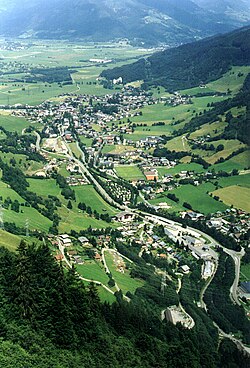
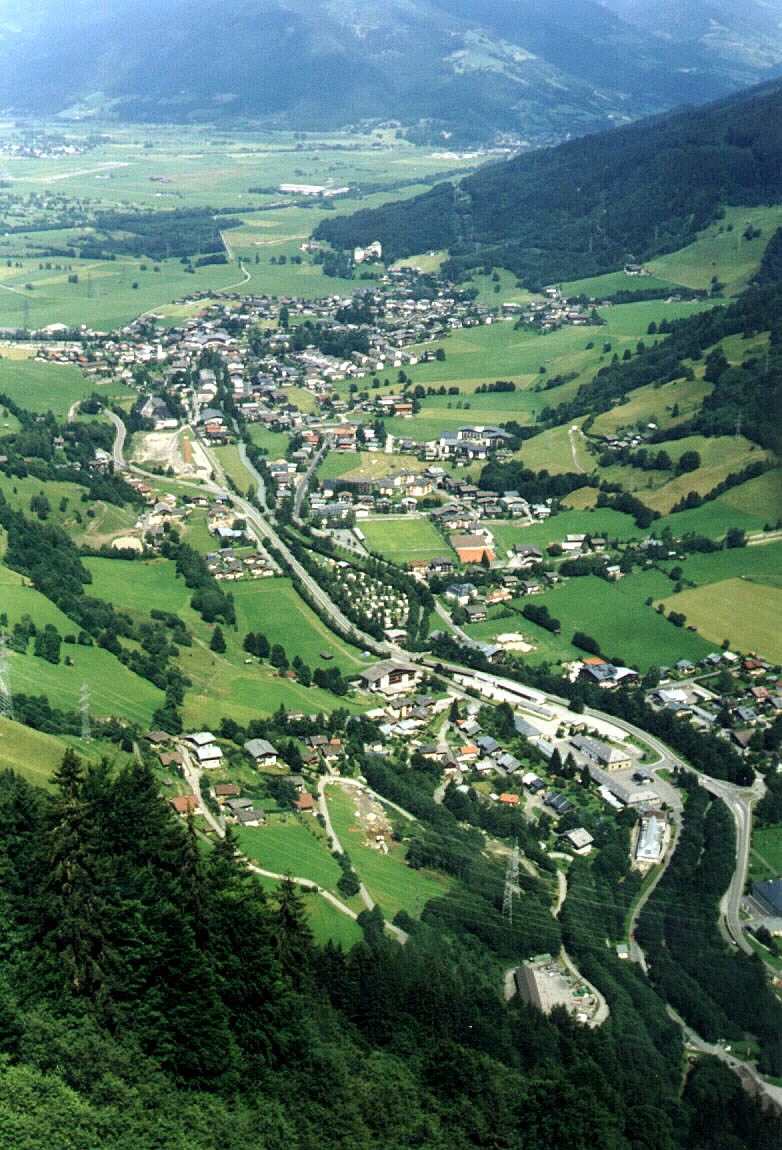
Kaprun is a in the Zell am See District of , , within the Pinzgau region of the . It occupies an area of 100.41 square kilometers and lies at coordinates 47°16′ N, 12°46′ E. The main village center sits at an elevation of 786 meters above , nestled in a valley flanked by steep mountain slopes. The terrain is predominantly alpine, characterized by a transition from forested lower valleys to rugged high-altitude plateaus and glacial zones. Kaprun borders the Hohe Tauern , with its northern flanks rising toward peaks like the Großes Wiesbachhorn at 3,564 meters and the massif, which features year-round glaciation. This diverse topography includes gentle, tree-lined slopes near the village suitable for beginner and , escalating to steep, glaciated terrain above 2,000 meters that supports advanced and extensive networks. The surrounding landscape also encompasses alpine meadows, moraines, and reservoirs integrated into the natural contours, shaping a harsh yet accessible mountainous environment.

Climate and Environmental Features


Kaprun exhibits a continental alpine climate, marked by pronounced seasonal variations, with cold, snowy winters and mild summers conducive to glacier preservation at higher elevations. Average annual temperatures hover around 4.5°C, with July means reaching approximately 10–12°C and January lows often below -5°C, supporting extensive snow cover from October through May.
Precipitation is abundant, averaging 1,696–1,755 mm annually, primarily as snowfall in the mountainous terrain, which totals over 181 rainy or snowy days per year and sustains the Kitzsteinhorn glacier's year-round skiing capabilities.
Environmentally, the area encompasses the Hohe Tauern National Park, hosting exceptional biodiversity including 3,500 plant species and 15,000 animal species amid glacial valleys and peaks exceeding 3,000 m. The Kitzsteinhorn glacier, a prominent feature, is experiencing retreat with thickness reductions exceeding 1 m per year, alongside rising permafrost and air temperatures documented since 2010 at the on-site Open-Air Laboratory, which has also noted a tenfold increase in rockfall incidents linked to thawing conditions.

History

Early Settlement and Pre-Modern Era

The earliest evidence of human activity in the Kaprun area dates to the post-Ice Age period around 10,000 BC, with initial settlements in the broader Pinzgau region. During the , approximately 2000 BC, a significant settlement emerged on the Bürgkogel hill, centered on and processing due to local deposits; this site was abandoned around 1500 BC. In the , during the first millennium BC, a second fortified settlement occupied the same location, featuring ring-shaped earthworks and evidence of trade with Venetia around 700 BC, as well as Roman and Celtic coins from 96–80 BC. Roman influence reached the area by 15 BC, leading to the abandonment of the Bürgkogel settlement, though a nearby station existed near Fischhorn until about 300 AD. A hilltop settlement reoccupied Bürgkogel from around 300 AD to the , ending with the Bavarian conquest. The Kaprun gorge attracted settlers approximately 4,000 years ago for its resources and defensive hilltop position, with continued use through Celtic, late antique, and medieval periods, including Celtic earthworks and medieval fortifications. Kaprun was first documented in 931 AD as "Chataprunnin," derived from Celtic terms meaning "," in a deed recording a trade involving Odalbert of , within the under Bavarian rule established in the late and incorporated into the Frankish kingdom by 788 AD. In the early Middle Ages, a was constructed on Bürgkogel around the by the Counts of Falkenstein but abandoned by the early . The prominent Kaprun Castle was built in the early at the entrance to the Valley, initially held by the Falkenstein family and later divided among the Lords of Felben and Walchen in the 13th century. In 1480, the of purchased the castle for 11,000 ducats, establishing it as a seat of the Pfleggericht administrative court. During the 1526 peasant uprising, rebels occupied and partially destroyed the castle, which was subsequently rebuilt by 1574; administrative functions shifted to in 1606 following the execution of local official Caspar Vogl.

20th-Century Industrialization and Hydroelectric Development

The hydroelectric development in Kaprun transformed the locality from a predominantly agricultural village into a hub of industrial-scale engineering and energy production during the mid-20th century. Initial plans for a major Hohe Tauern power plant, incorporating dams in the Kaprun valley, were formulated in the late 1920s by the German firm AEG and the Salzburg state authorities, though substantive progress awaited political changes. Construction commenced in 1938 under the Nazi administration as the "Tauernkraftwerk" initiative, aimed at harnessing alpine water resources for electricity generation across annexed Austria. The project relied heavily on forced labor, including concentration camp prisoners, reflecting the regime's exploitative mobilization of resources amid wartime priorities. War disruptions halted major advances, but temporary facilities produced the first electricity on November 17, 1944. Following Austria's liberation, the site fell under U.S. before transfer to Austrian control in July 1946, marking a pivot to national reconstruction efforts. With financial support from the , work resumed intensively; the core infrastructure, including the Mooserboden and Wasserfallboden reservoirs and associated power stations, reached operational status by the early , culminating in the full Kaprun power group commissioning on September 23, 1955, after a 17-year span. This pumped-storage system, Austria's largest at the time with an initial capacity exceeding 300 MW, supplied critical energy for postwar industrial revival, while construction employed thousands, injecting economic activity into the region. The Kaprun project epitomized Austria's mid-century technological optimism, overcoming alpine engineering challenges like tunneling through granite and managing high-altitude reservoirs to store and generate power from glacial melt. By prioritizing over dependency, it aligned with broader European shifts toward renewable sources, though early phases bore the ethical scars of coerced labor under prior regimes—a contrast often downplayed in official postwar narratives emphasizing heroic national endeavor. The facilities' output facilitated electrification in and beyond, underpinning manufacturing growth and reducing reliance on imported fuels, though local industrialization remained ancillary to power generation rather than spawning diverse factories.

Rise of Tourism and Ski Infrastructure

Following the completion of hydroelectric projects in the mid-20th century, Kaprun transitioned from an industrial focus to tourism, particularly winter sports, leveraging its proximity to the Kitzsteinhorn glacier. This shift accelerated after World War II, driven by visions of year-round skiing to capitalize on the glacier's reliable snow cover. Glacier skiing originated in Kaprun during in 1915, when Austrian soldiers trained on the . However, commercial development began in earnest in the 1960s under engineer Wilhelm Fazokas, who pioneered infrastructure for accessible glacial skiing. The first cable car, operated by Gletscherbahnen Kaprun, opened on December 12, 1965, transporting guests to the Alpincenter at approximately 2,450 meters, initially establishing summer skiing operations. Subsequent expansions included the Gipfelbahn summit lift in 1966 and the first drag lift on a flowing in 1968, enabling broader access and technical innovations in lift systems. These developments transformed into an all-season destination with snow assurance from to , attracting mass amid Austria's postwar economic boom. By the 1970s, further infrastructure like the 1974 funicular enhanced capacity, solidifying Kaprun's role as a premier ski hub.

The 2000 Funicular Disaster

On November 11, 2000, a erupted in the ascending of the Gletscherbahn Kaprun 2 funicular railway, a tunnel-based system transporting skiers to the glacier above Kaprun, . The incident occurred at approximately 9:00 a.m. , shortly after the —carrying 161 passengers and one attendant—departed the valley station under cold weather conditions with temperatures around -10°C (14°F). Smoke rapidly filled the 3.7 km (2.3 mi) single-track tunnel, which lacked intermediate escape routes or ventilation sufficient for such an event, trapping most occupants. Twelve survivors from the ascending escaped by walking downhill against the smoke toward the valley station, while two passengers in the descending and three personnel at the mountain station also perished. The fire originated from a faulty electric in the train's control cabinet, which overheated and ignited a small leak of highly flammable fluid. This initial ignition melted surrounding plastic pipes, releasing an additional 160 liters of hydraulic oil that accelerated the blaze, causing the brakes to lock and preventing further movement. The tunnel's design exacerbated the : inward-opening hindered evacuation, and the steep 30% gradient made downhill escape physically demanding amid toxic fumes. Most of the 155 fatalities—predominantly from and rather than burns—occurred among skiers and snowboarders aged 7 to 70, including 31 children; victims hailed from multiple nationalities, such as 92 , over 30 (including members of the German Ski Association and freestyle champion Sandra ), 10 Japanese, and 8 Americans from U.S. military families stationed nearby. Emergency response involved helicopters evacuating bodies to a morgue in , with completed via DNA analysis within 19 days despite severe charring. An investigation highlighted systemic shortcomings, including inadequate fire suppression, non-fire-resistant materials, and operational protocols that directed passengers upward toward the fire source. In , an Austrian court acquitted all 16 defendants—including engineers and operators—charged with , citing insufficient of individual culpability despite acknowledged design flaws; relatives decried the ruling as a . The disaster, Austria's deadliest post-World War II incident, prompted stricter European regulations, including enhanced fireproofing and evacuation systems, though the Kaprun glacier railway partially resumed operations after modifications.

Post-2000 Recovery and Modern Developments

Following the on November 11, 2000, which killed 155 people in a aboard the ascending Gletscherbahn Kaprun 2 , the tunnel was permanently sealed to prevent further risks, and glacier access shifted to aerial cable car systems with enhanced safety protocols. Gletscherbahnen Kaprun AG prioritized quality management, operational safety, and environmental sustainability in response, partnering with the Hohe Tauern National Park and the Salzburg Institute for Ecology on conservation initiatives. The company obtained ISO 9001 certification for quality and safety in 2003, followed by ISO 14001 for environmental management in 2007. Subsequent infrastructure upgrades sustained skiing operations and expanded visitor capacity. In 2011, the Gipfelwelt 3000 observation platform opened at 3,000 meters, providing year-round panoramic views and educational exhibits on , drawing tourists beyond . The 2015 and 2016 seasons saw the introduction of the Gletscherjet 3 and Gletscherjet 4 chairlifts, improving transit times across the and reorganizing central ski terrain for better flow and accessibility. These enhancements maintained Kaprun's appeal as one of Europe's premier year-round resorts, with summer on preserved snowfields at elevations up to 3,029 meters. Modern expansions have integrated adjacent areas, bolstering economic resilience through . In December 2017, Gletscherbahnen Kaprun merged with Maiskogelbetriebs AG, enabling the €81.5 million investment in connectivity projects. The MK Maiskogelbahn, a 10-person with 123 cabins capable of transporting 2,800 per hour, and the Kaprun valley station—with facilities for 2,000 pairs—opened in December 2018, serving families and beginners from the 1,137-meter Stanger mid-station. The 3K K-onnection tri-cable , completed in December 2019, linked Maiskogel directly to over 4 kilometers and 2,000 meters of elevation gain in nine minutes, forming the Eastern Alps' longest continuous 12-kilometer lift axis and extending summer operations. These developments have reinforced Kaprun's role in the regional , supporting over 2.5 million annual overnight stays in the broader Zell am See-Kaprun area through diversified winter and summer attractions.

Infrastructure

Hydroelectric Reservoirs and Power Plants

The Kaprun hydroelectric system, managed by , features high-altitude reservoirs and pumped-storage power plants in the Kaprun Valley of the , harnessing for and storage. The setup includes the upper Mooserboden reservoir at 2,036 meters and the lower Wasserfallboden reservoir at 1,672 meters, connected via tunnels and pipelines to facilitate water transfer for peak-load power. This infrastructure supplies about 10% of Austria's peak electricity demand through renewable , with annual output exceeding 1 TWh across the plant group. The Wasserfallboden reservoir, impounded by the Limberg Dam (a 210-meter-high arch-gravity structure completed in 1951), holds a usable capacity of 81.2 million cubic meters prior to recent upgrades. In 2025, the dam crest was raised by 8 meters, increasing the reservoir's volume by 12.7 million cubic meters to 93.9 million cubic meters total, enabling an additional 30 GWh of storage equivalent to the annual consumption of 6,000 households. The Mooserboden reservoir, formed by two parallel dams (each 107 meters high, built 1950–1955), provides upstream storage with a surface area of 0.56 square kilometers and supports water diversion from surrounding Alpine catchments. These reservoirs operate in tandem for pumped-storage cycles, pumping water uphill during low-demand periods using excess grid power and releasing it for turbine generation during peaks. Key power facilities include the Kaprun Hauptstufe plant at the base of the valley, equipped with two 65 MW Pelton turbines commissioned between 1940 and 1953, yielding 549 GWh annually from run-of-river and storage flows. The Oberstufe pumped-storage plant, operational since 1956 with 260 MW capacity, reverses flow between reservoirs for flexibility. The newest addition, Limberg III, an underground 480 MW reversible pumped-storage facility (with four 120 MW pump-turbines), entered service in September 2025 between Mooserboden and Wasserfallboden, boosting the group's total turbine output to 1,382 MW and pump capacity by 75% to support grid stability amid rising renewables integration. of the core system spanned 1938–1960s, evolving from early Nazi-era plans into Austria's flagship asset despite initial reliance on forced labor during wartime buildup.

Gletscherbahnen Kaprun: Cable Cars and Funicular Systems

The Gletscherbahnen Kaprun AG, established on August 1, 1963, by Tauernkraftwerke AG, the municipality of Kaprun, and the state of , developed an integrated network of cable cars and a to provide year-round access to the glacier for and . The initial infrastructure included a cable car opened on December 11, 1965, reaching the Alpincenter at 2,450 meters elevation, followed by the Gipfelbahn on November 26, 1966, which extended to the glacier summit and remains Austria's highest such system. In 1974, the Gletscherbahn Kaprun 2 (GBK2) commenced operations as a weather-independent railway connecting the valley station to the Alpincenter, spanning approximately 3,900 meters with over 3,300 meters enclosed in a . This double-track , featuring two counterbalanced cars propelled by a haul , facilitated efficient of up to 150 passengers per car but was permanently decommissioned following a catastrophic on , 2000. Post-incident investigations highlighted design vulnerabilities, including inadequate fire suppression and egress in the , leading to its replacement by surface-level systems to enhance safety and reliability. Contemporary access relies on a series of lifts and aerial tramways, culminating in the 3K K-onnection inaugurated in 2019, which forms the longest continuous cable car route in the at 12 kilometers, bridging 2,261 vertical meters from Kaprun's town center (786 meters elevation) to the Gipfelwelt 3000 summit station (3,029 meters). This chain comprises six sequential sections: the MK Maiskogelbahn detachable , the 3K Maiskogel-Langwied lift, high-speed detachable s (replacing the route), and further connections to the . The centerpiece, the 3K K-onnection tricable (32-passenger cabins), covers 4,310 meters with a capacity exceeding 2,000 persons per hour, enabling seamless transit through four climate zones while minimizing environmental impact via energy-efficient drive systems. The Gipfelbahn, an with two 80-passenger cabins suspended from a single reversible cable, traverses 1,120 meters horizontally and 630 meters vertically from the Alpincenter to the summit, supported by Pylon 7—extended to 113.6 meters in 1981, once the world's tallest cable car support structure. These systems collectively transport over one million passengers annually, with operational capacities scaled for peak winter demand, and incorporate ISO 9001 and 14001 certifications for quality and environmental management since 2003. Maintenance emphasizes corrosion-resistant materials and advanced monitoring to withstand alpine conditions, ensuring uptime rates above 95% during seasons.

Economy and Tourism

Winter Sports and Glacier Skiing

The ski area in Kaprun centers on skiing at elevations up to 3,029 meters on the , offering snow-reliable conditions from early autumn to late spring. As Austria's first ski resort, it provides diverse terrain for and , with the ensuring natural snow coverage even outside peak winter months. The 2025/26 season is scheduled from October 11 to May 25, enabling an extended period of activity. The resort encompasses 62.5 kilometers of marked pistes, broken down into 30.5 km easy, 23 km intermediate, and 9 km difficult, plus 8.9 km of routes, accessible via 24 lifts covering a vertical drop from 768 to 3,029 meters. sections feature high-alpine runs with consistent snow quality, while lower Maiskogel areas add family-friendly slopes. Snow parks, including a superpipe, cater to freestyle enthusiasts, and designated freeride routes support off-piste exploration under guided conditions. Ski touring routes expand options for backcountry enthusiasts, leveraging the glacier's terrain for ascents and descents. The area's infrastructure, including modern gondolas, facilitates efficient access to upper elevations, minimizing wait times and maximizing time. These features position Kaprun as a premier destination for advanced alongside beginner and intermediate progression.

Summer Activities and Year-Round Appeal

Kaprun's summer offerings center on outdoor pursuits in the Hohe Tauern National Park, featuring over 400 kilometers of marked trails suitable for all levels, from family-friendly paths to challenging alpine routes with panoramic views of glaciers and valleys. Guided tours enhance accessibility, covering topics like local and . draws enthusiasts with more than 30 designated tours, including e-bike paths, freeride trails, and cross-country routes like the Tauern Bike Tour, which traverses varied terrain near the village. Water-based recreation occurs primarily on nearby Lake Zell, where activities include at designated beaches, stand-up paddleboarding, , and , capitalizing on the lake's 24-kilometer shoreline and summer water temperatures reaching 23°C. Adventure options extend to in gorges such as Sigmund-Thun-Klamm and from mountain summits. The bolsters year-round tourism by permitting summer access via cable cars to elevations above 3,000 meters, where visitors engage in snow hikes, guided treks, and exhibits at Gipfelwelt 3000 on alpine and climate. This perennial snow cover contrasts with valley warmth, enabling hybrid experiences like morning followed by afternoon lake dips, while facilities such as offer thermal pools and wellness treatments available throughout the year. The region's infrastructure, including the Zell am See-Kaprun Card for complimentary cable car rides and , sustains appeal across seasons by facilitating seamless transitions between activities.

Economic Impacts and Challenges

The economy of Kaprun is predominantly driven by , particularly on the Kitzsteinhorn glacier, supplemented by hydroelectric power generation from the Kaprun power plant complex. The Gletscherbahnen Kaprun cable car and systems attract over 500,000 visitors annually, generating substantial revenue through lift tickets, accommodations, and related services, while employing a significant portion of the local workforce in and . Hydroelectric operations, managed by , contribute to regional stability by covering approximately 10% of Austria's peak electricity demand with renewable , providing consistent export income and supporting post-World War II industrialization that symbolized economic reconstruction. A major challenge arose from the November 11, 2000, funicular fire disaster, which resulted in direct financial damages estimated at 320 million schillings (equivalent to about 23.3 million euros) from infrastructure loss, operational shutdowns, and immediate recovery efforts, alongside prolonged legal claims exceeding $1 billion from survivors and families. The incident temporarily disrupted inflows and imposed restitution payments totaling around $21 million by 2008, straining local finances and necessitating safety upgrades that increased operational costs. Ongoing challenges include economic dependence on seasonal tourism, with winter activities accounting for the majority of overnight stays despite efforts to promote summer hiking and glacier experiences, leading to revenue volatility. Climate change exacerbates this through glacier retreat, with Austrian glacier ski areas experiencing a 48.3% decline in summer operating days from 2002 to 2019, potentially reducing Kaprun's appeal and requiring costly adaptations like expanded snowmaking or infrastructure investments amid rising environmental regulations. VERBUND's planned billion-euro modernization of the Kaprun plants by the 2030s aims to double output but highlights vulnerabilities to hydrological shifts from warming temperatures.

References

Add your contribution
Related Hubs
User Avatar
No comments yet.