
Recent from talks
Karakoram Highway
Knowledge base stats:
Talk channels stats:
Members stats:
Karakoram Highway
35°36′N 74°39′E / 35.600°N 74.650°E
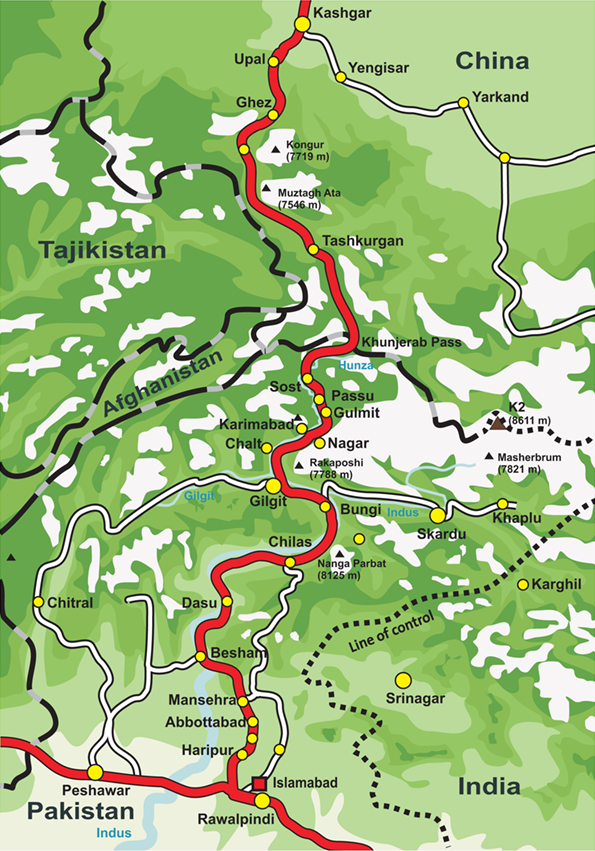
The Karakoram Highway (Urdu: شاہراہ قراقرم, Śāhirāh-i Qarāquram), also known as the KKH, National Highway 35 (Urdu: قومی شاہراہ ۳۵), N-35, and the China–Pakistan Friendship Highway, is a 1,300 km (810 mi) national highway which extends from Hasan Abdal in the Punjab province of Pakistan to the Khunjerab Pass in Gilgit-Baltistan, where it crosses into China and becomes China National Highway 314.
The highway connects the Pakistani provinces of Punjab and Khyber Pakhtunkhwa plus Gilgit-Baltistan with China's Xinjiang Uyghur Autonomous Region. The highway is a popular tourist attraction and is one of the highest paved roads in the world, passing through the Karakoram mountain range, at 36°51′00″N 75°25′40″E / 36.85000°N 75.42778°E at maximum elevation of 4,714 m (15,466 ft) near Khunjerab Pass. Due to its high elevation and the difficult conditions under which it was constructed, it is often referred to as the Eighth Wonder of the World. The highway is also a part of the Asian Highway AH4.
The Karakoram Highway (KKH), also known as the Friendship Highway in China, was jointly constructed by the governments of China and Pakistan. It was started in 1962, completed in 1979 and opened to the public in 1986. Pakistan initially favored routing through Mintaka Pass. In 1966, China, citing the fact that Mintaka would be more susceptible to air strikes, recommended the steeper Khunjerab Pass instead. About 810 Pakistanis and about 200 Chinese workers died, mostly in landslides and falls, while building the highway. Over 140 Chinese workers who died during the construction are buried in the Chinese cemetery in Gilgit. The route of the KKH traces one of the many paths of the ancient Silk Road.
On the Pakistani side, the road was constructed by FWO (Frontier Works Organisation), employing the Pakistan Army Corps of Engineers. The Engineer-in-Chief's Branch of the Pakistani Army completed a project documenting the history of the highway. The book History of Karakoram Highway was written by Brigadier (Retired) Muhammad Mumtaz Khalid in two volumes. In the first volume, the author discusses the land and the people, the pre-historic communication system in the Northern Areas, the need for an all-weather road link with Gilgit, and the construction of Indus Valley Road. The second volume records events leading to the conversion of the Indus Valley Road to the Karakoram Highway, the difficulties in its construction, and the role of the Pakistan Army Corps of Engineers and their Chinese counterparts in its construction.
The highway, connecting the Gilgit–Baltistan region to the ancient Silk Road, runs approximately 1,300 km (810 mi) from Kashgar, a city in the Xinjiang region of China, to Abbottabad, of Pakistan. An extension of the highway southwest from Abbottabad, in the form of the N-35 highway, meets the Grand Trunk Road, N-5, at Hasan Abdal, Pakistan.[citation needed]
The highway cuts through the collision zone between the Eurasian Plate and Indian Plate, where China, Tajikistan, Afghanistan, and Pakistan come within 250 km (160 mi) of each other. Owing largely to the extremely sensitive state of the Kashmir conflict between India and Pakistan, the Karakoram Highway has strategic and military importance to these nations, but particularly Pakistan and China.[citation needed]
On 30 June 2006, a memorandum of understanding was signed between the Pakistani National Highway Authority (NHA) and China's State-owned Assets Supervision and Administration Commission (SASAC) to rebuild and upgrade the Karakoram Highway. According to SASAC, the width will be expanded from 10 to 30 m (33 to 98 ft), and its transport capacity will be increased three times its current capacity. In addition, the upgraded road will be designed to particularly accommodate heavy-laden vehicles and extreme weather conditions.[citation needed]
Hub AI
Karakoram Highway AI simulator
(@Karakoram Highway_simulator)
Karakoram Highway
35°36′N 74°39′E / 35.600°N 74.650°E
The Karakoram Highway (Urdu: شاہراہ قراقرم, Śāhirāh-i Qarāquram), also known as the KKH, National Highway 35 (Urdu: قومی شاہراہ ۳۵), N-35, and the China–Pakistan Friendship Highway, is a 1,300 km (810 mi) national highway which extends from Hasan Abdal in the Punjab province of Pakistan to the Khunjerab Pass in Gilgit-Baltistan, where it crosses into China and becomes China National Highway 314.
The highway connects the Pakistani provinces of Punjab and Khyber Pakhtunkhwa plus Gilgit-Baltistan with China's Xinjiang Uyghur Autonomous Region. The highway is a popular tourist attraction and is one of the highest paved roads in the world, passing through the Karakoram mountain range, at 36°51′00″N 75°25′40″E / 36.85000°N 75.42778°E at maximum elevation of 4,714 m (15,466 ft) near Khunjerab Pass. Due to its high elevation and the difficult conditions under which it was constructed, it is often referred to as the Eighth Wonder of the World. The highway is also a part of the Asian Highway AH4.
The Karakoram Highway (KKH), also known as the Friendship Highway in China, was jointly constructed by the governments of China and Pakistan. It was started in 1962, completed in 1979 and opened to the public in 1986. Pakistan initially favored routing through Mintaka Pass. In 1966, China, citing the fact that Mintaka would be more susceptible to air strikes, recommended the steeper Khunjerab Pass instead. About 810 Pakistanis and about 200 Chinese workers died, mostly in landslides and falls, while building the highway. Over 140 Chinese workers who died during the construction are buried in the Chinese cemetery in Gilgit. The route of the KKH traces one of the many paths of the ancient Silk Road.
On the Pakistani side, the road was constructed by FWO (Frontier Works Organisation), employing the Pakistan Army Corps of Engineers. The Engineer-in-Chief's Branch of the Pakistani Army completed a project documenting the history of the highway. The book History of Karakoram Highway was written by Brigadier (Retired) Muhammad Mumtaz Khalid in two volumes. In the first volume, the author discusses the land and the people, the pre-historic communication system in the Northern Areas, the need for an all-weather road link with Gilgit, and the construction of Indus Valley Road. The second volume records events leading to the conversion of the Indus Valley Road to the Karakoram Highway, the difficulties in its construction, and the role of the Pakistan Army Corps of Engineers and their Chinese counterparts in its construction.
The highway, connecting the Gilgit–Baltistan region to the ancient Silk Road, runs approximately 1,300 km (810 mi) from Kashgar, a city in the Xinjiang region of China, to Abbottabad, of Pakistan. An extension of the highway southwest from Abbottabad, in the form of the N-35 highway, meets the Grand Trunk Road, N-5, at Hasan Abdal, Pakistan.[citation needed]
The highway cuts through the collision zone between the Eurasian Plate and Indian Plate, where China, Tajikistan, Afghanistan, and Pakistan come within 250 km (160 mi) of each other. Owing largely to the extremely sensitive state of the Kashmir conflict between India and Pakistan, the Karakoram Highway has strategic and military importance to these nations, but particularly Pakistan and China.[citation needed]
On 30 June 2006, a memorandum of understanding was signed between the Pakistani National Highway Authority (NHA) and China's State-owned Assets Supervision and Administration Commission (SASAC) to rebuild and upgrade the Karakoram Highway. According to SASAC, the width will be expanded from 10 to 30 m (33 to 98 ft), and its transport capacity will be increased three times its current capacity. In addition, the upgraded road will be designed to particularly accommodate heavy-laden vehicles and extreme weather conditions.[citation needed]
Recent media