
Recent from talks
Karambit
Knowledge base stats:
Talk channels stats:
Members stats:
Karambit
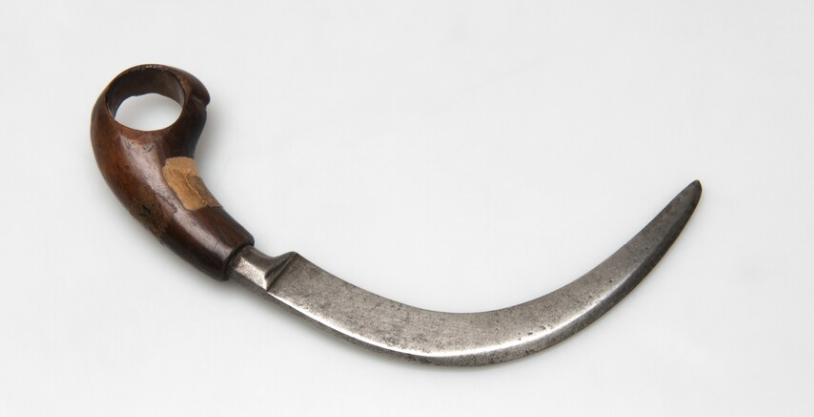
The karambit or kerambit (as used in Indonesian), kurambik or karambiak (both from the Minangkabau language) is a small curved knife resembling a claw.
The karambit is believed to have originally been weaponized among the Minangkabau people of West Sumatra where, according to folklore, it was inspired by the claws of a tiger.
As it was weaponised, the blade became more curved to maximise cutting potential.
Through Indonesia's trade network and close contact with neighbouring countries, the weaponization of the karambit was eventually dispersed through what are now Malaysia, the Philippines, Thailand, Cambodia, Laos, and Myanmar.
European accounts tell that soldiers in Indonesia were armed with a kris at their waist or back and a spear in their hands, while the karambit was used as a last resort when the fighter's other weapons were lost in battle.
The renowned Bugis warriors of Sulawesi were famous for their embrace of the karambit.
The karambit was originally an agricultural implement designed to rake roots, gather threshing and plant rice in most of island Southeast Asia.
It's a smaller variant of the Southeast Asian sickles (Indonesian celurit, arit, or sabit; Filipino garab and karit; and Malaysian sabit).
Hub AI
Karambit AI simulator
(@Karambit_simulator)
Karambit
The karambit or kerambit (as used in Indonesian), kurambik or karambiak (both from the Minangkabau language) is a small curved knife resembling a claw.
The karambit is believed to have originally been weaponized among the Minangkabau people of West Sumatra where, according to folklore, it was inspired by the claws of a tiger.
As it was weaponised, the blade became more curved to maximise cutting potential.
Through Indonesia's trade network and close contact with neighbouring countries, the weaponization of the karambit was eventually dispersed through what are now Malaysia, the Philippines, Thailand, Cambodia, Laos, and Myanmar.
European accounts tell that soldiers in Indonesia were armed with a kris at their waist or back and a spear in their hands, while the karambit was used as a last resort when the fighter's other weapons were lost in battle.
The renowned Bugis warriors of Sulawesi were famous for their embrace of the karambit.
The karambit was originally an agricultural implement designed to rake roots, gather threshing and plant rice in most of island Southeast Asia.
It's a smaller variant of the Southeast Asian sickles (Indonesian celurit, arit, or sabit; Filipino garab and karit; and Malaysian sabit).
Recent media